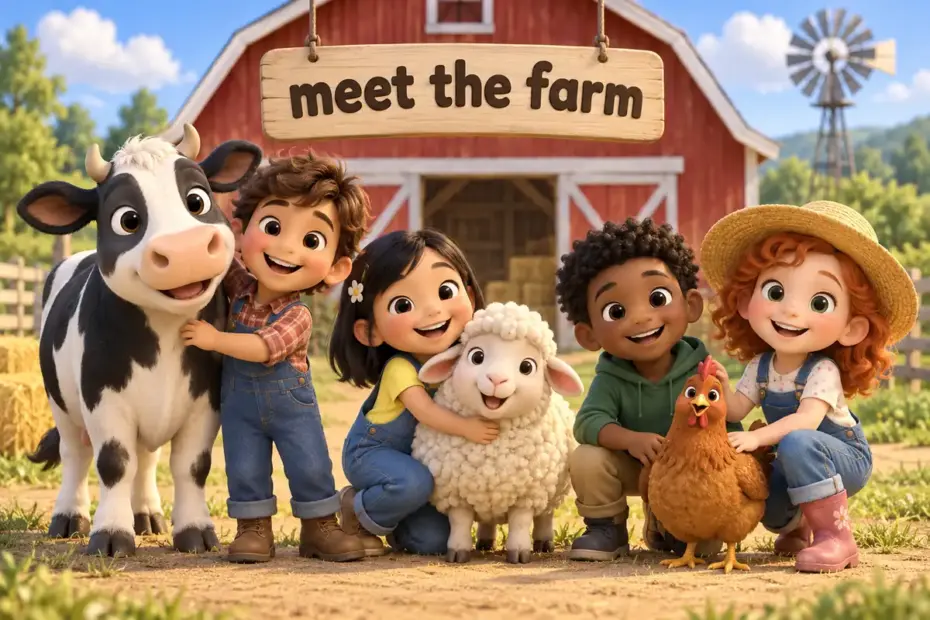
Farm animals names with pictures cover the mammals and birds kept for food, work or wool, from the cow and the horse to the hen and the duck. Each entry becomes far more useful when it also gives the male, female and young forms, so a bull, a cow and a calf all appear together.
farm animals names with pictures at a glance
- Farm animals are domesticated animals raised for food, work, wool or breeding.
- The main groups are cattle, horses, pigs, sheep, goats, poultry and working animals.
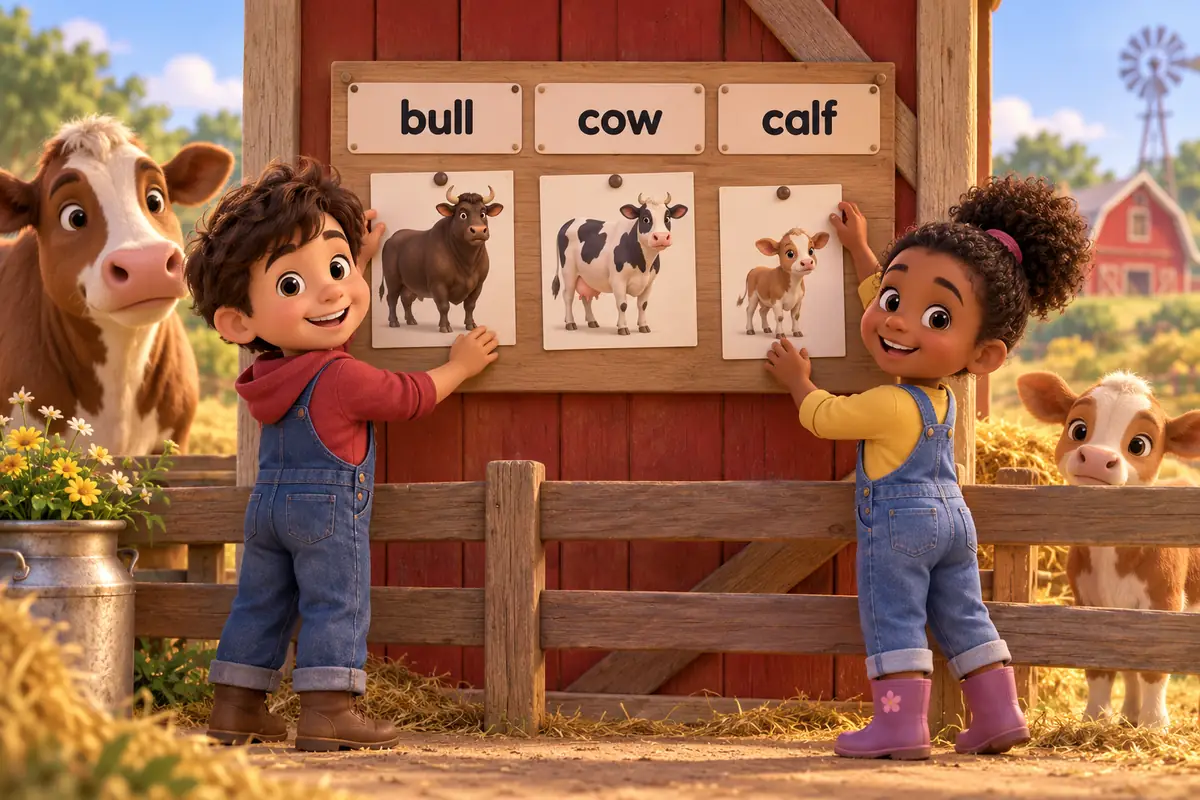
- Many farm animals have separate male, female and young names, such as bull, cow and calf.
- Poultry covers the birds kept for eggs and meat, including hens, ducks, geese and turkeys.
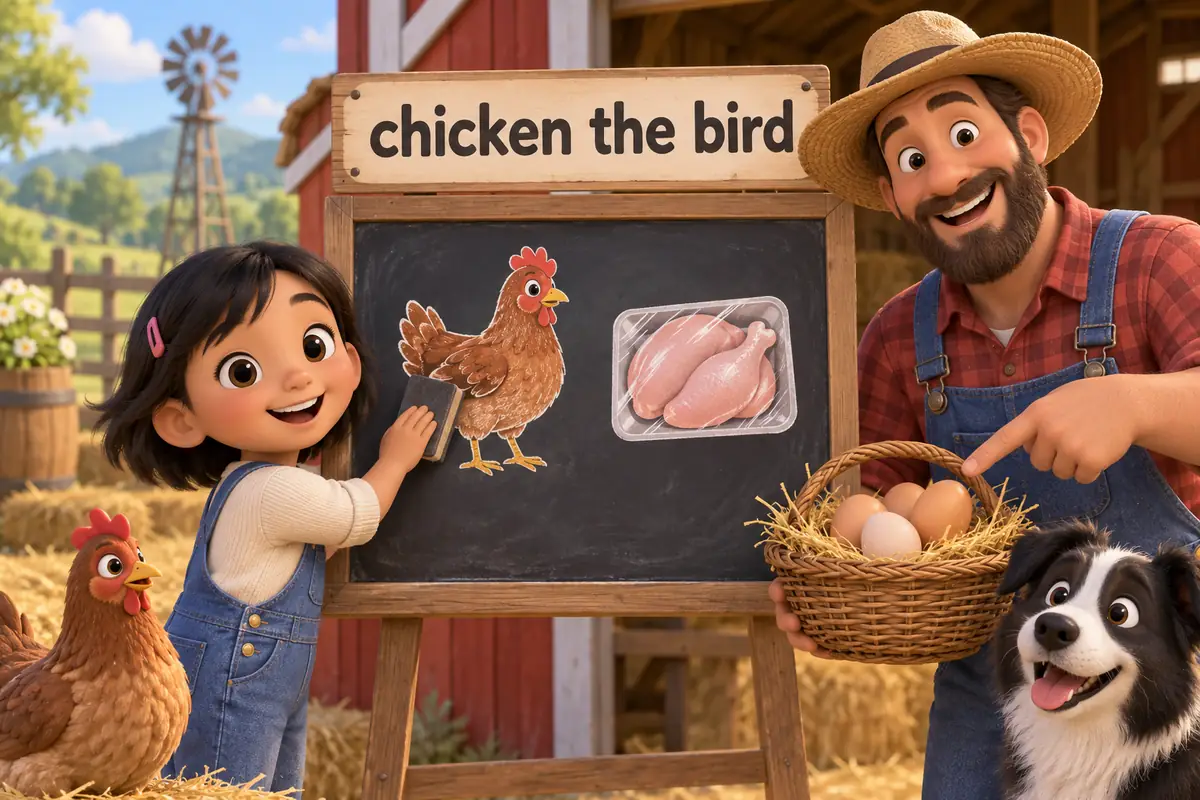
- The commonest mistake is using one word, such as chicken, for the bird and its meat alike.
What are farm animals?
Farm animals are domesticated animals raised on a farm for food, work, wool or breeding. The group is defined by use rather than by species, so a horse can be a farm animal on a smallholding and a riding companion in a town. Grouping the animals by what they provide keeps a long name list tidy, and the farm animal in a sentence page shows the phrase in everyday use. To describe a holding, the adjectives for farm list supplies words such as busy, tidy and muddy.
| Group | Animals in the group | Why they are kept |
|---|---|---|
| Cattle | cow, bull, ox, calf | milk and beef, and oxen for heavy work |
| Horses | mare, stallion, foal | riding and pulling carts or ploughs |
| Pigs | sow, boar, piglet | pork and bacon |
| Sheep | ewe, ram, lamb | wool and meat |
| Goats | doe, buck, kid | milk, meat and brush clearing |
| Poultry | hen, rooster, chick | eggs and meat |
| Waterfowl | drake, goose, gosling | eggs, meat and down |
| Working animals | donkey, mule, llama | carrying loads and guarding flocks |
One honest limit sits beside these labels. The term farm animal says nothing about how kindly the animal is kept, and it overlaps with other categories, so a rabbit is a farm animal when bred for meat and a pet when it lives indoors. The names also vary by region, so one farmer’s pig herd is another farmer’s hog lot.
Most farm animals also carry a family of three names, one for the male, one for the female and one for the young. Learning the set is the fastest way to use the vocabulary correctly, because a sentence about breeding, milking or herding almost always needs the right adult word. A learner who knows only cow will struggle to describe a field that also holds a bull and a calf.
What are the names for male, female and young farm animals?
The family table below gathers the three forms for the commonest farm animals in one place.
| Animal | Male | Female | Young |
|---|---|---|---|
| cattle | bull | cow | calf |
| horse | stallion | mare | foal |
| pig | boar | sow | piglet |
| sheep | ram | ewe | lamb |
| goat | buck | doe | kid |
| chicken | rooster | hen | chick |
| duck | drake | duck | duckling |
| goose | gander | goose | gosling |
| donkey | jack | jenny | foal |
How do you use farm animal names in a sentence?
Most sentences either state a purpose, name a family member or describe a farm scene, and each frame uses a slightly different pattern.
| Pattern | Example | What it signals |
|---|---|---|
| the + group + is kept for + use | Pigs are kept for pork and bacon. | purpose |
| a + male + and a + female | A bull and a cow stand in the field. | the pair of adult names |
| a + young + is a young + animal | A lamb is a young sheep. | the young form |
| group + such as + animal | Poultry such as hens supply eggs. | an example |
| on the farm, the + animal + verb | On the farm, the goats clear the brambles. | a typical scene |
Farm animals names with pictures: examples across contexts
The same words move from a classroom to a vet’s note and a market sign, and each setting asks for a different sentence. To describe the setting itself, read dairy farm in a sentence.
| Context | Example sentence | Why this works |
|---|---|---|
| Classroom | Match each farm animal to its young name. | a sorting task |
| Farm website | Our dairy herd includes forty cows and one bull. | a farm note |
| Recipe card | Beat the egg from a fresh hen on the farm. | an instruction |
| Storybook | The lambs skipped across the spring field. | a simple scene |
| Vet note | The mare needs rest before the foal arrives. | an animal note |
| Conversation | Which farm animal gives us wool? | an everyday question |
| Market sign | Free-range eggs from our own hens. | a short label |
| School report | Goats graze on rough grass that cattle avoid. | a factual claim |
| Guidebook | A donkey once carried the family milk to town. | a historical detail |
| Zoo label | The llama is a working animal of the high Andes. | an exhibit note |
Which farm animal is easiest to keep?
Match the animal to the space and time you have rather than to its charm, because the smallest animals suit small plots.
| Situation | Pick | Example |
|---|---|---|
| Want eggs daily | hen | A healthy hen lays almost every day. |
| Want wool | sheep | A ewe’s fleece is shorn each year. |
| Want milk | cow or goat | A goat needs less space than a cow. |
| Want a working animal | donkey or mule | A donkey carries loads on steep paths. |
| Want a small first project | chicken | A few hens need little land. |
A few hens are the easiest first project because they need little land and simple shelter, while a cow needs grazing, housing and daily milking, so it suits a farm rather than a garden.
Word forms and grammar of farm animal names
Farm vocabulary adds useful collective nouns, and the adjective for animals raised over generations appears beside the base word. To describe the animals themselves, borrow adjectives for animals, and for a wider list try animals that start with a to z.
| Form | Part of speech | Example |
|---|---|---|
| farm | noun | The farm sits beside the river. |
| farm animal | noun phrase | The pig is a common farm animal. |
| livestock | noun (uncountable) | The livestock graze on the hill. |
| herd | noun | A herd of cattle crossed the lane. |
| flock | noun | A flock of sheep filled the field. |
| poultry | noun (uncountable) | Poultry need clean water and shelter. |
| domesticated | adjective | Cattle are domesticated animals. |
Common mistakes with farm animal names
Mistake 1: chicken for the meat. Incorrect: We had chicken from the chicken we keep. Correct: We had chicken meat from a hen we keep. Rule: chicken names the bird and the meat, so add meat when the bird itself matters.
Mistake 2: the plural of sheep. Incorrect: Three sheeps stood in the field. Correct: Three sheep stood in the field. Rule: sheep keeps one form for singular and plural.
Mistake 3: cow for all cattle. Incorrect: The farmer sold every cow, males included. Correct: The farmer sold every head of cattle, cows and bulls included. Rule: cow is female, bull is male, so cattle is the neutral word for the group.
Mistake 4: the wrong young form. Incorrect: A young horse is a calf. Correct: A young horse is a foal. Rule: calf, foal, lamb and kid each belong to a different animal.
Mistake 5: herd and flock mixed up. Incorrect: A herd of chickens pecked the yard. Correct: A flock of chickens pecked the yard. Rule: herd suits cattle and horses, while flock suits sheep and birds.
Practice using farm animals names with pictures
- Fill in the blank: A young sheep is a ___.
- Choose the better word: A (rooster / hen) lays the egg.
- Correct the error: Three sheeps grazed by the gate.
- Build a sentence: use is kept for to give one use of goats.
- Spot the register: which line suits a farm website, (a) We got loads of piggies, or (b) Our pig herd is raised outdoors year round?
- Fill in the blank: A group of cattle is called a ___.
Answers
- lamb, because a lamb is the young of a sheep.
- hen, because the female chicken lays eggs.
- Three sheep grazed by the gate; sheep does not change in the plural.
- The goat is kept for milk and for clearing rough grass.
- (b), because a farm website uses clear, factual wording.
- herd, because herd is the collective noun for cattle.
The bottom line
Farm animals names with pictures become easy to remember once each animal is stored with its family of male, female and young words, so a bull, a cow and a calf arrive together. Learn the group names such as poultry and livestock, keep sheep unchanged in the plural, and reserve cow for the female alone. The clearest farm list names the animal, its group and its use in one line.
Frequently asked questions about farm animal names
What are the main farm animals?
The main farm animals are cattle, horses, pigs, sheep, goats and poultry, with working animals such as donkeys and llamas on many holdings. Each group provides something specific, from milk and wool to eggs, meat and pulling power, so six groups cover almost every farm.
Why do farm animals have three names?
Farm animals have separate male, female and young names because breeding, milking and selling all need a precise word. A farmer who says cow means the female alone, so the male bull and the young calf each need their own term.
Is a chicken a farm animal?
Yes. A chicken is a farm animal when it is kept for eggs or meat, and it belongs to the poultry group. The same bird is simply a pet when it lives in a garden, so the label depends on use rather than on the species.
What is a group of goats called?
A group of goats is most often called a herd or a tribe, and a small group may be called a flock. Goats are also counted informally as a mob in some regions, so several collective nouns are accepted for the same animal.