
Feed up means to give a person or animal extra food so they grow stronger, plumper or fatter. To use feed up in a sentence, put the eater after up: “The farmer fed up the calves before winter.” The phrase is easily confused with the fixed idiom be fed up, which means annoyed.
Feed up at a glance
- Feed up is a phrasal verb meaning to give extra food so someone or something gains weight or strength.
- The object is the eater, and the particle up is separable: feed someone up, or feed up someone.
- The past participle is fed, so the literal passive is be fed up, spelled exactly like the idiom.
- The idiom be fed up with something means annoyed or weary, and it never means fattened.
- The commonest learner error is using feed up to mean fed up, or making the past form feeded.
What does feed up mean?
Feed up is a phrasal verb meaning to give someone or something more food so that they gain weight or strength. The Cambridge entry for feed up records the sense of building up with food, and the object is the eater, not the meal. A farmer feeds up livestock; a nurse feeds up a patient after an illness. Where the aim is simply to make an animal fat, fatten a calf is the plainer verb, and where the aim is health, feed up keeps its caring tone.
| Sense | Plain meaning | Example sentence |
|---|---|---|
| Fatten with food | Give extra food so an animal gains weight | The farmer fed up the lambs on rich grass. |
| Build up strength | Feed generously so someone recovers | Nurses fed him up after the illness. |
| Idiom: be fed up | Be weary or annoyed, a fixed expression | I am fed up with the delays. |
One limitation is worth stating plainly. Feed up is not a polite way to describe an adult’s size, and it is not the everyday idiom be fed up. Using feed up for annoyance confuses the listener, while calling a person fed up can sound rude. Where you mean only giving food, feed alone usually carries the meaning, and stuff or gorge describes overeating that feed up does not.
How do you use feed up in a sentence?
Put the eater after the particle, or between the verb and up, because the phrasal verb is separable. Six patterns cover almost every real sentence, and the last two show where the sense splits between feeding and annoyance.
| Pattern | Example | What it signals |
|---|---|---|
| feed up + eater | The vet fed up the rescued puppy. | The object is the one being fed. |
| feed + eater + up | They fed the chicks up on mealworms. | Separable: the object may sit between verb and up. |
| feed up on + food | She fed the goats up on oats. | Names the food that does the fattening. |
| feed up for + purpose | Farmers feed up cattle for the winter. | States the reason for the extra food. |
| be fed up with + thing | We are fed up with the noise. | Fixed idiom: annoyed, not fattened. |
| feed up to + state | He was fed up to fighting weight. | Shows a literal target reached by feeding. |
Separability is the rule to memorise: feed the lambs up and feed up the lambs are both correct, but feed up them is not, because a pronoun must sit between the verb and the particle. Where the goal is recovery rather than weight, nourish a patient is a gentler and more clinical choice than feed up.
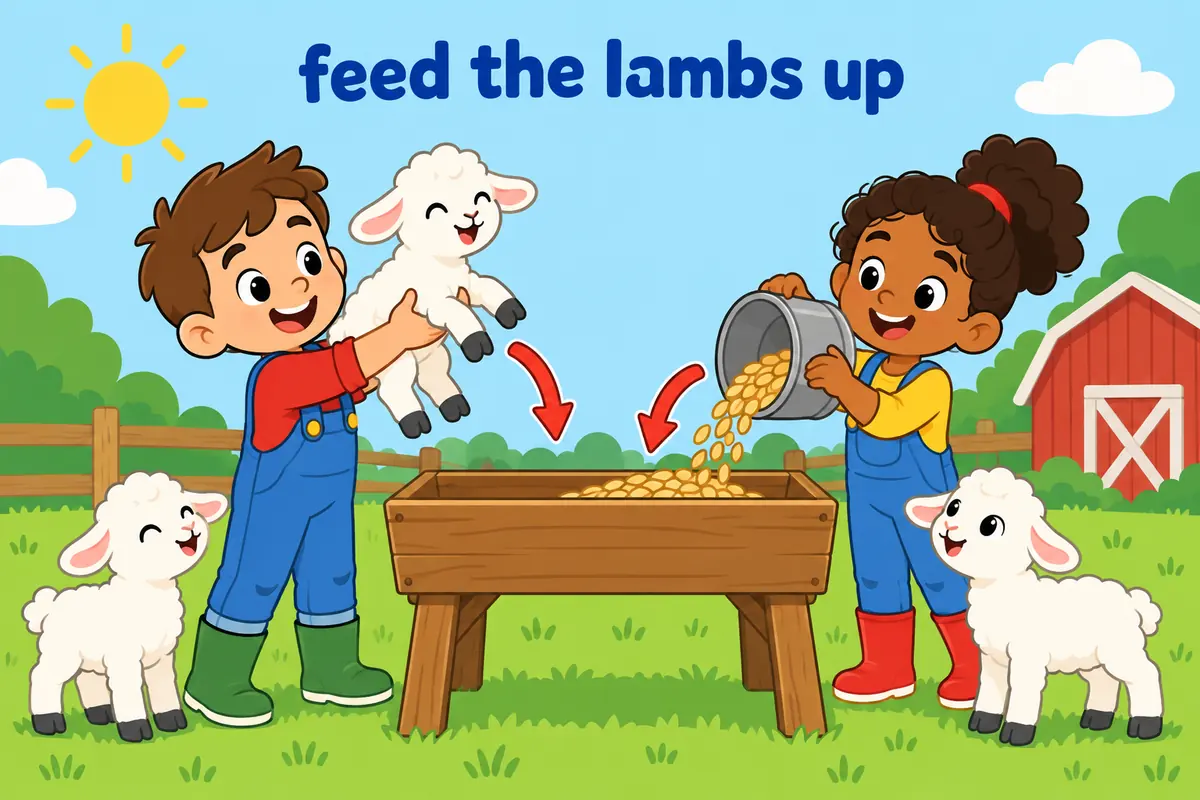
Feed up in a sentence: examples across contexts
Feed up keeps its literal sense of giving extra food across registers, and the object is always a living eater. The eleven sentences below move from a farmyard to a hospital ward, and they would lose precision without supply the kitchen, which describes delivering food rather than fattening anyone.
| Context | Example sentence | Why this works |
|---|---|---|
| Farm and vet | The vet fed up the thin puppy on small meals. | A small eater and rich food suit the sense. |
| Home kitchen | Grandma fed us up on soup and dumplings all winter. | Warm, literal use about a person. |
| Animal shelter | Volunteers fed the kittens up before rehoming them. | Names the purpose behind the extra food. |
| News report | The rescue team fed up the stranded ponies on hay. | Reports a public, practical action. |
| Historical writing | Tenants fed up one pig for the winter market. | Shows the word in an older rural economy. |
| Classroom science | Pupils fed up the tadpoles and recorded their growth. | Links feeding to a measurable result. |
| Hospital note | Staff fed her up slowly after the operation. | The adverb slowly shows a careful routine. |
| Sports nutrition | The coach fed the squad up before the long tour. | Object sits between verb and particle. |
| Conversation | My aunt fed me up whenever I visited. | Affectionate, everyday use about a relative. |
| Wildlife care | Keepers fed up the orphaned cub on a bottle. | The food source follows on. |
| Gardening diary | She fed up the tomato plants with compost tea. | Extends the verb to plants in informal use. |
The last row shows how far the figurative use can stretch: plants are fed up in a loose, idiomatic way, though the strict sense belongs to animals and people.
What is the difference between feed up and fed up?
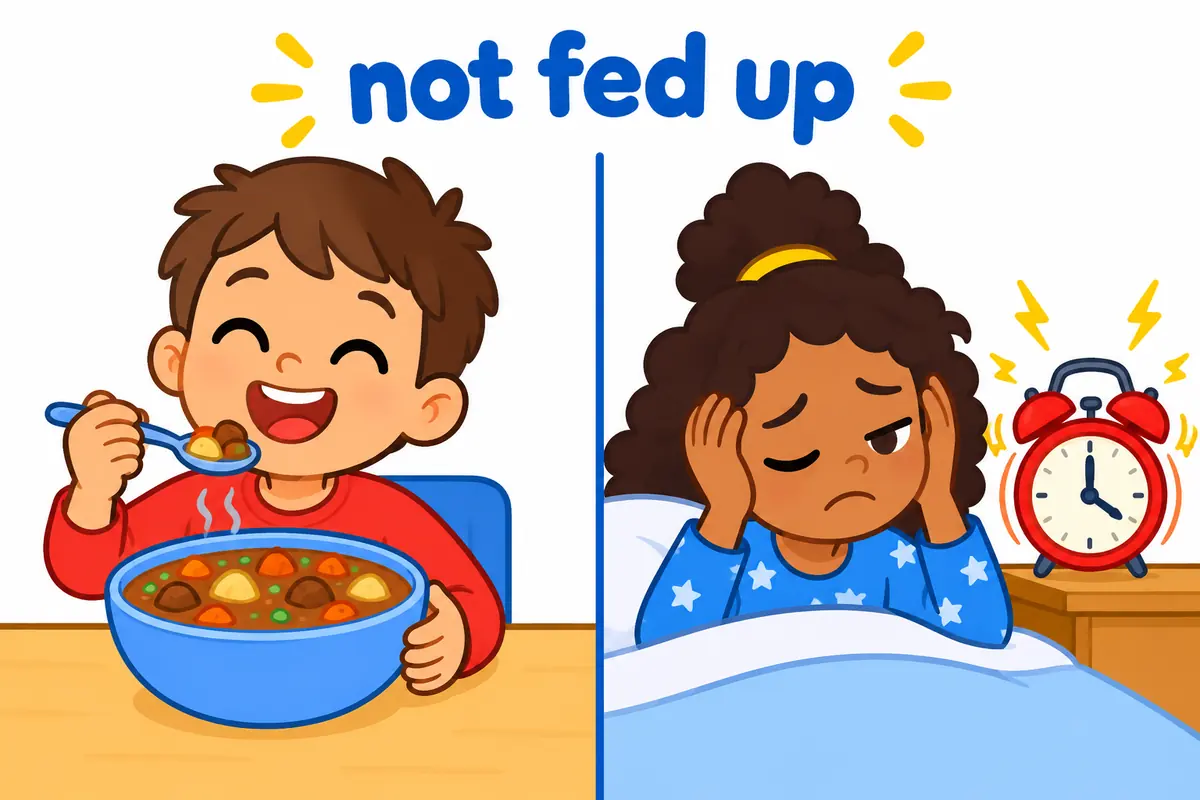
Feed up and fed up look identical in the past tense, and that is the trap. The past participle of feed is fed, so the literal passive of feed up is also fed up, which collides with the fixed idiom. The idiom means annoyed or weary, and its opposite in meaning, when a shortage is the subject, is starve a village of supplies.
| Attribute | feed up | fed up |
|---|---|---|
| Form | Base phrasal verb | Fixed adjective from the past participle |
| Meaning | Give extra food to fatten or strengthen | Be annoyed, bored or weary |
| Typical object | An animal, a patient, a child | Introduced by with: fed up with noise |
| Grammar | Separable verb with an object | Linking verb plus adjective |
| Register | Rural, caring, practical | Everyday and informal |
| Typical sentence | They fed the pig up for market. | I am fed up with the traffic. |
Verdict: choose feed up when food is the subject and an eater gains weight or strength, and use fed up only for the fixed idiom about weariness. Context settles the ambiguity because the idiom almost always carries with.
Word forms and grammar of feed up
Feed is irregular, and that irregularity is what makes the collision with the idiom possible. A child who has been underfed may need care, and the contrast with deprive a child of meals is exactly the opposite action.
| Form | Part of speech | Example |
|---|---|---|
| feed | verb, base form | They feed up the calves each autumn. |
| feeds | verb, third person singular | She feeds up the rescue dogs herself. |
| fed | verb, past and past participle | They fed up the lambs on clover. |
| feeding | verb, present participle | He is feeding up the foal this month. |
| fed up | adjective idiom | We are fed up with the constant drilling. |
| feeded | not standard | They fed the pig up for market. |
Note the last row: feed forms its past tense as fed, so feeded is never correct. The same past form then creates the literal passive the calves were fed up, which reads differently from the idiom.
The passive of feed up
The passive of feed up is used when the eater matters more than the person doing the feeding. In a farm report, the sentence the herd was fed up on silage keeps attention on the animals and the food, and it stays distinct from the idiom because no with follows. The preposition after the passive is the clearest signal: fed up on names food, while fed up with names a nuisance.
A second clue is the subject. Animals, patients and pets are fed up in the literal sense, whereas people are fed up with a situation in the idiom. Where the subject could be either, add the food or the nuisance, because the phrase alone will not tell a reader which meaning you intend.
Common mistakes with feed up
- Incorrect:
I am feed up with this traffic.Correct: I am fed up with this traffic. Rule: the idiom uses the past participle fed, never the base form feed. - Incorrect:
They feeded up the pig.Correct: They fed up the pig. Rule: feed is irregular, so its past tense is fed. - Incorrect:
She fed up it on milk.Correct: She fed it up on milk. Rule: a pronoun must sit between the verb and the separable particle. - Incorrect:
The farmer fed up the field.Correct: The farmer fed up the calves in the field. Rule: the object is the eater, never the place. - Incorrect:
We fed up with the delays.Correct: We were fed up with the delays. Rule: the idiom needs the verb be, because fed up is an adjective.
Practice using feed up
Work through the seven items, then check the reasoning rather than only the answer.
- Fill the gap: The keeper ______ the orphaned cub on a bottle.
- Choose the better word: For simply making an animal fat, use (feed up / fatten).
- Correct the error: They feeded up the lambs before the show.
- Build a sentence: use feed + object + up about a nurse helping a patient gain strength.
- Spot the register: which belongs in a farm report — the herd was fed up on silage, or I am fed up with the herd?
- Separate the senses: The team was fed up. Rewrite it once about food and once about annoyance.
- Rewrite in the passive: The volunteers fed up the kittens. Start with The kittens.
Answers
- fed — the irregular past tense of feed is fed, and up follows the eater.
- fatten — fatten names the goal of gaining weight without the caring tone of feed up.
- They fed up the lambs before the show — feed has no regular past form, so feeded is wrong.
- Model answer: The nurse fed the patient up on soup and toast.
- The herd was fed up on silage — on names food, so the sentence stays literal and fits a farm report.
- Food: The team was fed up on porridge before the race. Annoyance: The team was fed up with the delays.
- The kittens were fed up by the volunteers — the passive keeps fed, and by names the feeder.
The bottom line
Use feed up in a sentence when someone or something is given extra food to gain weight or strength, and keep the particle up next to its object. The two details that settle most sentences are these: the verb is separable, and its past participle fed is identical to the annoyed idiom fed up. Where the eating is excessive rather than nourishing, gorge on sweets is the more exact phrase.
Frequently asked questions about feed up
What does feed up mean?
Feed up means to give a person or animal extra food so that they gain weight or strength. It belongs to farming, veterinary care and recovery, and the object is always the eater. The particle up adds the idea of building someone up to a better condition.
Is feed up the same as fed up?
No. Feed up is a separable verb about giving extra food. Fed up is a fixed adjective idiom meaning annoyed or weary, usually followed by with. They share the past form fed, so context and the preposition tell them apart, but the meanings are unrelated.
Is feed up separable?
Yes. Feed up is a separable phrasal verb, so the eater can sit between the verb and the particle. Feed the lambs up and feed up the lambs are both correct. A pronoun, however, must sit in the middle, giving feed them up rather than feed up them.
Where is feed up used?
Feed up appears in farming, animal care, nursing and older domestic writing, where extra food is given deliberately. It is rarer in everyday conversation than fatten or feed alone. The annoyed idiom fed up, by contrast, is common in speech everywhere, which is why the two are so often mixed up.