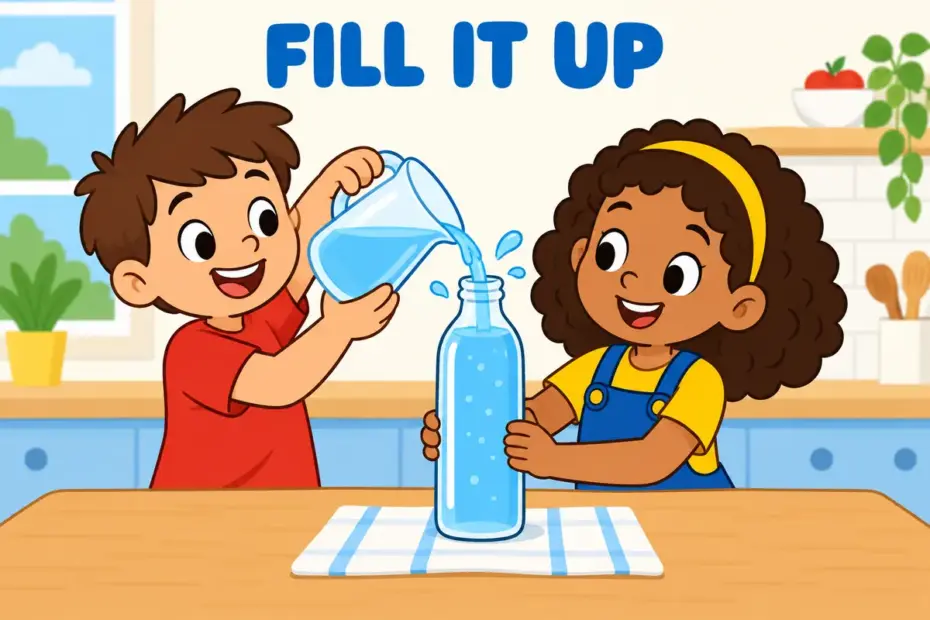
Fill up means to make something full or to become full, and it works both with an object and without one. To use fill up in a sentence, give the verb a container when something is being filled, as in fill up the tank, or leave it bare when a space fills on its own.
Fill up at a glance
- Fill up is a separable phrasal verb meaning to make something full or to become full.
- It is both transitive and intransitive: you fill up a tank, and a room fills up on its own.
- The particle up may move after the object, but a pronoun must sit between: fill it up, never fill up it.
- A useful three-part form is fill up on, which means to eat enough to feel full.
- The commonest error is writing fill up a form, when the correct verb for a form is fill in or fill out.
What does fill up mean?
Fill up is a separable phrasal verb meaning to make something full or, without an object, to become full. It also appears in the three-part form fill up on, which means to eat enough to feel full. The Cambridge entry for fill up records the container sense, and the verb sits opposite empty a container in almost every context.
| Sense | Plain meaning | Example sentence |
|---|---|---|
| Make something full | Put liquid or material in until full | She filled up the kettle before breakfast. |
| Become full | A container or space fills on its own | The concert hall filled up within an hour. |
| Fill up on food | Eat enough to stop feeling hungry | The children filled up on bread before the meal. |
One limitation is worth stating. Fill up is about reaching full, not about topping up a partly full container, which is the job of a different phrase. It also cannot describe completing a form, because that sense belongs to fill in and fill out. The verb also needs a goal, because an object or space is filled to a point, so a sentence about filling the day with tasks sounds slightly odd.
How do you use fill up in a sentence?
Fill up is transitive when something is being filled and intransitive when a space fills by itself. The particle may follow the object or sit before it, but a pronoun must go in the middle. The five patterns below cover the uses a reader meets most often.
| Pattern | Example | What it signals |
|---|---|---|
| fill up + object | Fill up the water bottles before we leave. | The common order, particle before the object. |
| fill + object + up | Fill the bottles up before we leave. | The separable order, object in the middle. |
| fill + pronoun + up | Fill them up before we leave. | A pronoun must sit in the middle; fill up them is wrong. |
| subject + fill up | The stadium filled up by noon. | Intransitive use, with no object at all. |
| fill up on + food | He filled up on soup and skipped dessert. | Eating until full, a fixed three-part form. |
The choice between the two orders is a matter of rhythm rather than meaning, so fill up the kettle and fill the kettle up are equally correct. To describe a container that is only partly full, brim with water suggests full to the very edge, while replenish a supply means to fill something that has been used.
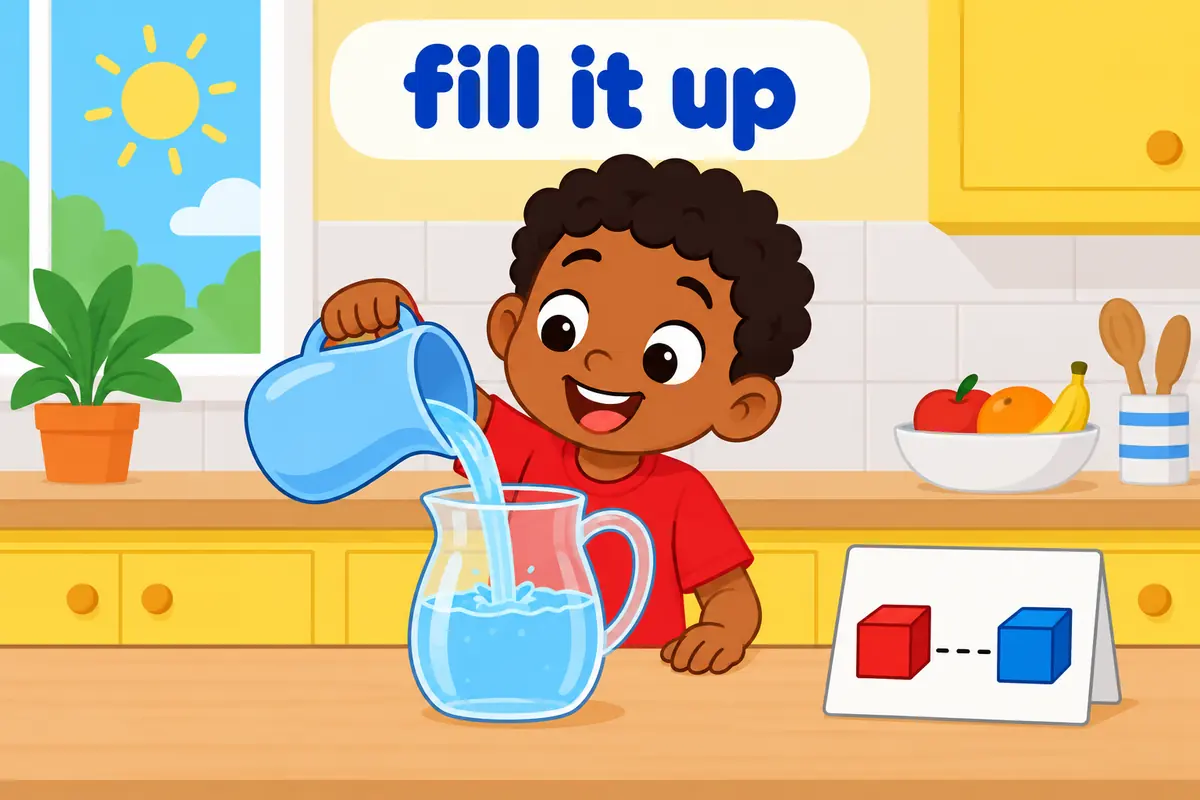
Fill up in a sentence: examples across contexts
The sentences below move from a kitchen to a stadium and back, because the verb keeps its shape while the setting changes. In each one a container, a space or a person reaches the point of being full, which is the idea that holds the senses together.
| Context | Example sentence | Why this works |
|---|---|---|
| Household | Please fill up the dog’s bowl before you go. | The transitive sense with a clear container. |
| Driving | We stopped to fill up with petrol outside the town. | The everyday fuel sense, with the preposition with. |
| Classroom | The register filled up with names on the first morning. | The intransitive sense, no object. |
| Workplace | The hall filled up as the talk was about to start. | A space becoming full on its own. |
| Restaurant | The guests filled up on olives and bread. | The eat-until-full sense with on. |
| Farming | They filled the barn up before the storm came. | The separable order with a noun object. |
| Swimming | The pool slowly filled up with rain over the weekend. | The intransitive sense with with. |
| Recipe | Fill the jar up to the top with dried beans. | A precise instruction with a stated level. |
| News report | The stadium filled up hours before kick-off. | A neutral report of the intransitive sense. |
| Everyday speech | I am full; I filled up on cake at the party. | The casual food sense in the past tense. |
| Bicycle care | He filled the tyres up at the garage. | The separable order with a plural object. |
| Gardening | Rainwater filled the water butt up within days. | The transitive sense with a natural cause. |
| Sports | The stands filled up well before the final whistle. | A crowd space becoming full in the intransitive sense. |
| Packing | He filled his rucksack up with snacks for the trip. | The separable order with a possessive object. |
Fill up vs fill in
Fill up and fill in are the pair learners mix most, because both take an object and both are separable. Fill up makes something full, while fill in means to complete a form or to substitute for a colleague. The objects they accept almost never overlap, so the noun in the sentence usually settles the choice. For forms and blanks, complete a form is the neutral verb behind fill in.
| Attribute | fill up | fill in |
|---|---|---|
| Core job | Make or become full | Complete a form or substitute for someone |
| Typical object | A tank, a room, a person eating | A form, a blank, a shift |
| Separable | Yes: fill it up | Yes: fill it in |
| British extra sense | Fuel and containers | Fill in for a colleague, meaning substitute |
| Register | Neutral and everyday | Neutral and everyday |
Verdict: use fill up for tanks, rooms and hungry people, and fill in for forms, blanks and standing in for someone at work.
Word forms and grammar of fill up
Fill up inflects with fill, and the hyphen appears only in the informal noun. The related verb stuff a bag is a more forceful, informal way to say the same thing, and drain a tank is its opposite.
| Form | Part of speech | Example |
|---|---|---|
| fill up | base phrasal verb | We should fill up before the long drive. |
| fills up | third person singular | The car park fills up early. |
| filled up | past and past participle | The tank was filled up in minutes. |
| filling up | present participle | The room is filling up quickly. |
| fill-up | noun, informal | A fill-up at the pump cost less today. |
| fill in | related phrasal verb | Please fill in your name and address. |
Common mistakes with fill up
- Incorrect:
Fill up the form and return it.Correct: Fill in the form and return it. Rule: A form is completed with fill in or fill out, never fill up. - Incorrect:
Please fill up it before lunch.Correct: Please fill it up before lunch. Rule: A pronoun must sit between the verb and the particle. - Incorrect:
The hall filled up with of people.Correct: The hall filled up with people. Rule: The intransitive sense takes with, and with of is never correct. - Incorrect:
She filled up on the soup bowl.Correct: She filled up on soup. Rule: Fill up on takes the food itself, not its container. - Incorrect:
He filled the glass up it to the brim.Correct: He filled the glass up to the brim. Rule: Never place both an object and the pronoun in the same slot.
Practice using fill up
Work through the six items, then check the reasoning rather than only the answer.
- Fill the gap: We stopped at the garage to ______ the tank before the trip.
- Choose the better word: Please (fill up / fill in) this form with your address.
- Correct the error: The room filled up of excited parents.
- Build a sentence: use fill it up about a thirsty plant’s watering can.
- Spot the register: which suits a recipe — Fill the jar up with dried beans, or Fill the jar up with loads of stuff.
- Rewrite with the noun: We stopped once for petrol. Use a fill-up.
Answers
- fill up — the tank is a container that is made full, so the verb is fill up.
- fill in — a form is completed with fill in, while fill up means make full.
- The room filled up with excited parents — the intransitive sense takes with, not of.
- Model answer: Fill it up before the soil dries out completely.
- Fill the jar up with dried beans — a recipe keeps precise, plain wording.
- We stopped once for a fill-up — the informal noun names the single act of refuelling.
The bottom line
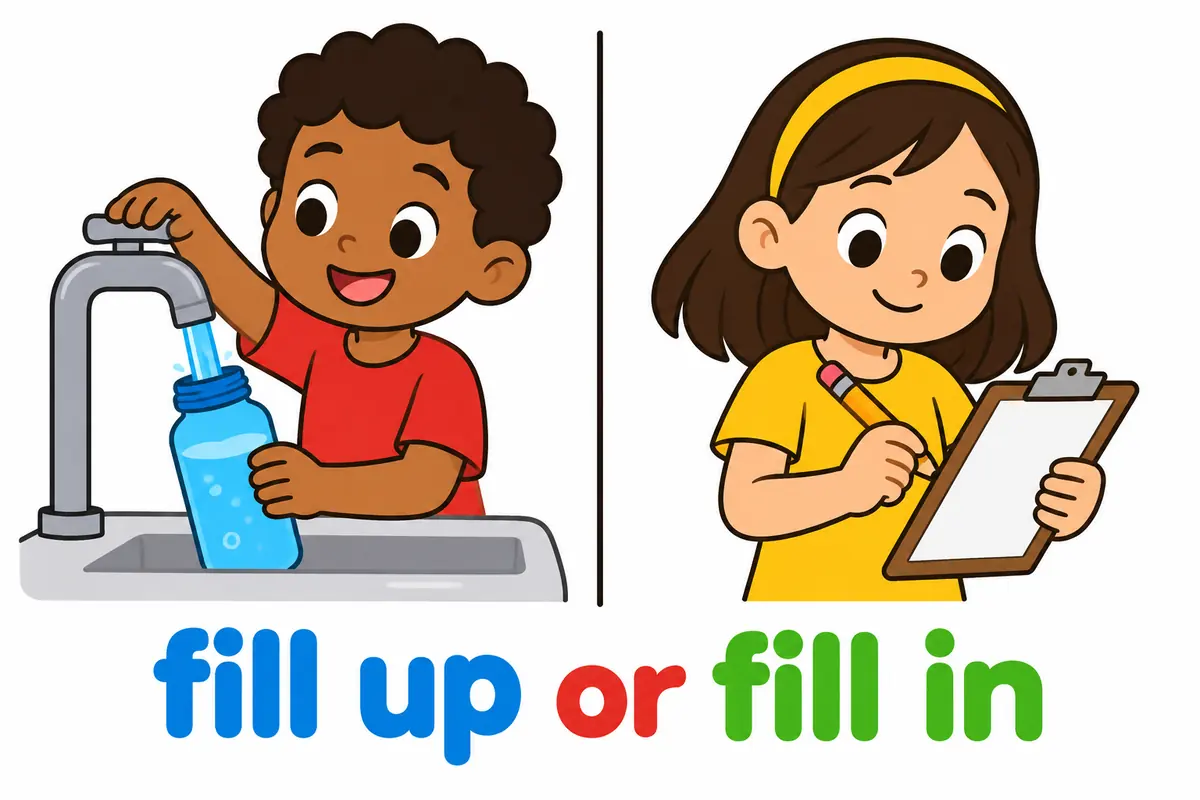
Use fill up in a sentence when a container, a space or a person reaches the point of being full, and split the verb only with a pronoun. The two facts that decide most sentences are that fill up is separable, so a pronoun sits in the middle, and that it never describes completing a form, which needs fill in.
Frequently asked questions about fill up
Is it fill up or fill in?
The two mean different things. Fill up means make a container or space full, as in fill up the tank. Fill in means complete a form or substitute for someone, as in fill in your name or fill in for a colleague. For a form, fill in is correct and fill up is a common error.
Can you say fill it up?
Yes. Fill up is separable, so a pronoun must sit between the verb and the particle, giving fill it up. The order fill up it is not used. When the object is a full noun, either order works, so both fill up the tank and fill the tank up are correct.
What does fill up on mean?
Fill up on means to eat enough of a food to stop feeling hungry. The phrase takes the food itself, so you fill up on bread, not on a bread basket. It often suggests eating something simple or plentiful instead of a full meal, as in the guests filled up on olives and bread.
Is fill up one word or two?
The verb is two words, fill and up, and they stay separate. Only the informal noun takes a hyphen, as in a fill-up at the pump. Keep the verb open and the hyphen for the noun, because the two serve different jobs in a sentence.