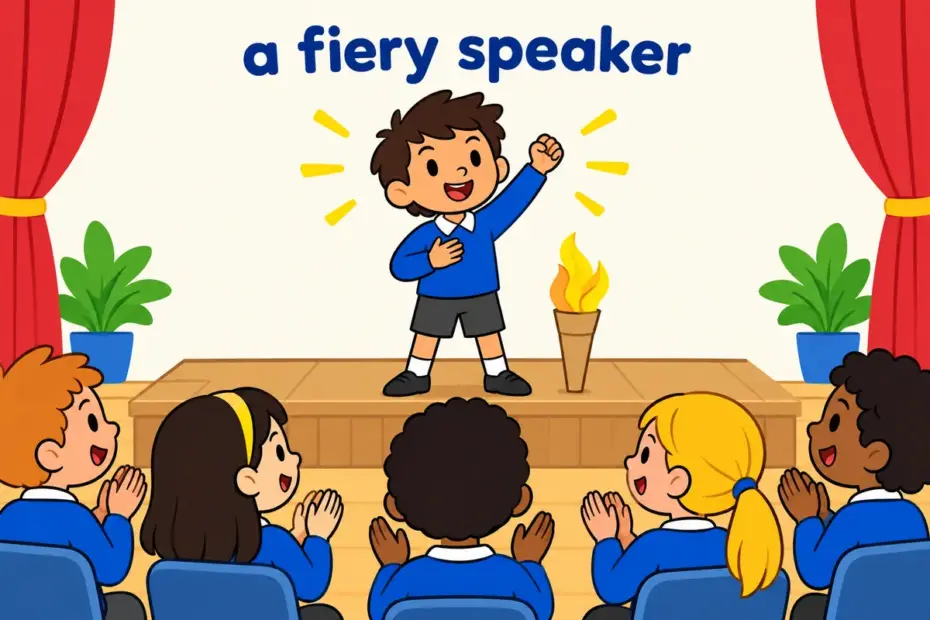
A firebrand is a person who passionately stirs up conflict or reform, often leading others with fiery speeches. In a sentence firebrand names the person, so it behaves like a label: she was a firebrand in the debate club. The word is dramatic and usually carries a hint of danger.
Firebrand at a glance
- Firebrand is a noun for a person; its plural is firebrands.
- It can also be used before another noun, as in a firebrand editor.
- The two senses are a passionate agitator and the literal piece of burning wood.
- The commonest frame is a firebrand who followed by a clause about the cause.
- The usual learner slip is using it as a mild synonym for an energetic person.
What does firebrand mean?
Firebrand is a noun meaning a person who stirs others up with passionate, often provocative speech, or literally a piece of burning wood. The Cambridge entry for firebrand keeps the two senses together, which is useful because the literal fire explains why the label feels dangerous.
| Sense | Plain meaning | Example sentence |
|---|---|---|
| Passionate agitator | A person who stirs conflict or pushes reform hard | The young firebrand won the union vote. |
| Attributive label | The same idea placed before another noun | A firebrand editor took over the paper. |
| Burning wood | A piece of wood that is on fire | A firebrand rolled from the hearth onto the rug. |
One limitation is worth stating plainly. Firebrand is a strong, usually critical label: it suggests disruption, and it can be unfair to someone who simply argues well. A calm campaigner is not a firebrand. Where the tone should stay neutral, activist or reformer is the fairer word, and neither carries the smell of smoke. The word also implies a public audience, so it rarely fits someone who works quietly behind the scenes.
How do you use firebrand in a sentence?
Because firebrand labels a person, it takes a who clause rather than a which clause, and it can sit directly before another noun. Five patterns cover almost every real sentence, and each one keeps the person in view rather than the noise they make.
| Pattern | Example | What it signals |
|---|---|---|
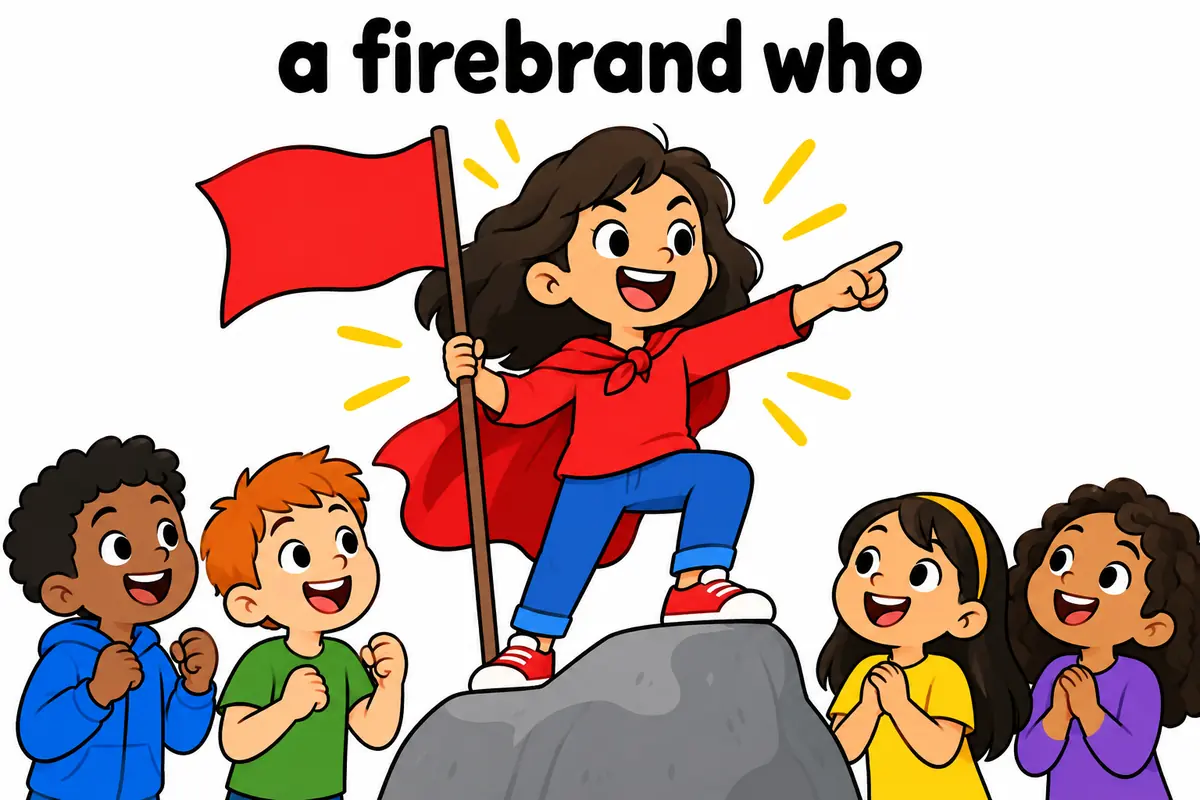
| a firebrand + who | She was a firebrand who refused to compromise. | Defines the person through their cause. |
| the firebrand of + group | He became the firebrand of the student movement. | Marks the leading voice in a group. |
| be called a firebrand | The mayor was called a firebrand by rivals. | Reports the label without endorsing it. |
| firebrand + noun | A firebrand lawyer took the case. | Attributive use, common in journalism. |
| firebrands + plural verb | Two firebrands led the protest. | Names more than one stirring figure. |
The label usually arrives with a cause attached, so a bare firebrand without context sounds incomplete. When the emphasis is on disruption rather than leadership, agitator is the blunter choice, and it removes any admiration the word firebrand might carry.
Firebrand in a sentence: examples across contexts
Firebrand appears wherever a strong personality drives a cause. The nine sentences below move from a school council to a history book, and each one shows who is being described and what they are pushing for.
| Context | Example sentence | Why this works |
|---|---|---|
| Classroom | Our form elected a firebrand who promised to change the lunch menu. | A small, concrete cause makes the label feel playful. |
| Debate club | The youngest speaker was the firebrand of the evening. | Names the person and the setting without overclaiming. |
| Workplace | A firebrand in the design team pushed the redesign through. | Shows leadership on a specific project. |
| News report | The firebrand MP called for an early election. | Attributive use, standard in political reporting. |
| History essay | Later writers cast her as the firebrand of the reform movement. | Frames the label as a judgement others made. |
| Union meeting | Members backed the firebrand who had organised the walkout. | Ties the label to one decisive action. |
| Literary criticism | The novel turns its firebrand into a weary moderate by the last chapter. | Shows the label as a stage a character outgrows. |
| Sports writing | A firebrand captain argued with every decision. | Transfers the political label to a familiar arena. |
| Conversation | My aunt is a bit of a firebrand at family dinners. | The hedge a bit of softens a strong word. |
| Political memoir | The memoir presents its author as a reluctant firebrand. | Shows the label as a self-image the writer resists. |
| Education report | A firebrand head teacher won support for a longer school day. | Applies the label to a leader inside an institution. |
| Local radio | Listeners rang in to defend the firebrand who runs the market stall. | Shows ordinary people adopting the word warmly for a known figure. |
Across all twelve sentences the cause is the hinge: remove it and the word floats free of meaning. That is why a well-built sentence either names the cause or reports it through a clause, so the label lands with the weight it needs.
The last sentence shows the usual conversational fix: speakers rarely apply firebrand to a friend without a hedge, because the word implies that the person is troublesome as well as inspiring.
Firebrand vs hothead and demagogue
Firebrand overlaps with two words and matches neither. Hothead describes temper without a cause, while a demagogue manipulates a crowd for personal power.
| Attribute | firebrand | hothead | demagogue |
|---|---|---|---|
| Core job | Name a passionate leader who stirs a cause | Name a person ruled by anger | Name a leader who exploits a crowd |
| Motive | A cause they believe in | Impulse and temper | Personal power |
| Followers | Often gathers support | Usually acts alone | Deliberately builds a following |
| Connotation | Dramatic, mixed | Negative and dismissive | Strongly negative |
| Register | Journalistic and literary | Everyday and informal | Formal, political |
Verdict: choose firebrand for a stirring, cause-driven figure, hothead for someone who simply loses their temper, and demagogue only when manipulation and self-interest are the point. Each word looks at the same noisy behaviour from a different angle, so motive rather than volume should guide the choice.
Word forms and grammar of firebrand
Firebrand is almost always a noun, and its life as a verb has faded. The table shows the forms in live use and the ones learners invent.
| Form | Part of speech | Example |
|---|---|---|
| firebrand | noun, singular | She was a firebrand from her first speech. |
| firebrands | noun, plural | The party once welcomed firebrands of every stripe. |
| firebrand | noun, attributive | A firebrand campaigner upset the timetable. |
| firebrand | archaic verb | Old texts use it to mean set alight; avoid it today. |
| firebranding | non-standard noun | Write stirring speeches, not firebranding. |
Keep the plural regular: firebrands, never firebrand. A related word with a similar feel but a different job is radical, which can describe an idea as well as a person, while firebrand can only describe the person. The label also resists comparison, so a sentence that says more of a firebrand than someone sounds clumsy; rewording it as a stronger campaigner solves the problem.
Common mistakes with firebrand
- Incorrect:
She is very firebrand.Correct: She is a firebrand. Rule: Firebrand is a noun, so it needs an article or takes attributive position. - Incorrect:
The firebrand angered easily and shouted at everyone.Correct: The hothead angered easily and shouted at everyone. Rule: Temper alone is a hothead; a firebrand has a cause. - Incorrect:
Our quiet treasurer is a firebrand.Correct: Our quiet treasurer is a steady advocate. Rule: Firebrand implies forceful stirring, so it is unfair to a calm person. - Incorrect:
The firebrand that leads the club is new.Correct: The firebrand who leads the club is new. Rule: A person takes who, not that. - Incorrect:
He firebranded the crowd with a speech.Correct: He stirred the crowd with a fiery speech. Rule: The verb sense is archaic; use a modern verb instead.
Practice using firebrand
Work through the six items, then read the reason beside each answer rather than only the key.
- Fill the gap: The club chose a ______ who promised to campaign for longer library hours.
- Choose the better word: The player shouted at the referee all match; he is a (firebrand / hothead).
- Correct the error: She is a firebrand and never speaks about any cause.
- Build a sentence: use a firebrand who about a student campaigning for a later bus.
- Spot the register: which belongs in a news report – the firebrand councillor called for a vote, or my mate is a total firebrand?
- Fix the plural: Two firebrand led the march.
Answers
- firebrand – a person who stirs support for a specific cause.
- hothead – he shows temper without any cause, which is exactly what the word separates.
- She is a firebrand who campaigns for a cause – the definition requires a cause driving her.
- Model answer: Sam is a firebrand who wants a later bus for the drama club.
- The firebrand councillor called for a vote – a report keeps the label neutral and specific.
- Two firebrands led the march – the plural adds s.
The bottom line
Use firebrand in a sentence for a person whose passion drives a cause and who gathers others with fiery speech, and attach that cause so the label earns its drama. The two details that decide most sentences are these: the word is a noun for a person, and it implies disruption as well as inspiration. A firebrand persuades a room to move; nothing in the word says the movement is wise. Where the person simply loses their temper, rebel or hothead is the more accurate word.
Frequently asked questions about firebrand
Is firebrand a compliment or an insult?
It is usually mixed. The word credits passion and leadership, yet it also hints at disruption and unpredictability, so newspapers use it to colour a story. Applied to a friend it often needs a hedge. Only the surrounding sentence, not the word itself, decides whether the tone is admiring or critical.
What is the plural of firebrand?
The plural is firebrands, formed in the regular way. Because the word labels a person, it can describe several people, as in two firebrands led the protest. The form firebrand without an ending is singular and should not be used as a plural.
Can firebrand be an adjective?
It can be used attributively before a noun, as in a firebrand editor, which is common in journalism. What it cannot do is take the usual adjective patterns, so she is very firebrand is wrong. Keep the article if you use it as a noun, or place it directly before another noun.
What is the difference between firebrand and hothead?
A firebrand is driven by a cause and often attracts followers, while a hothead is driven by temper and usually acts alone. The firebrand argues and organises; the hothead simply erupts. That difference in motive is the surest test when the two labels seem to overlap.