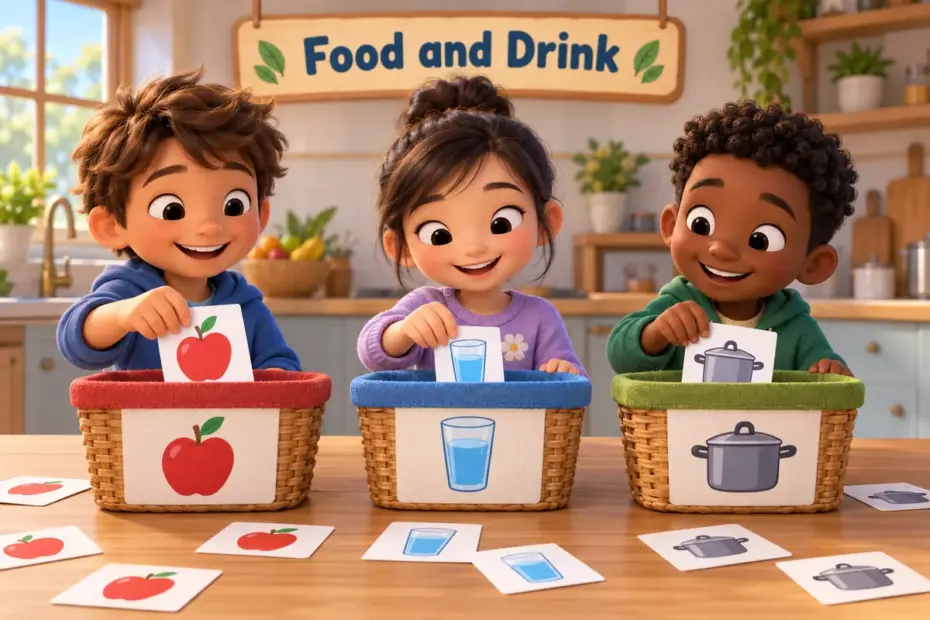
Food and drinks vocabulary in English covers the words for meals, ingredients, tastes, and the verbs used in a kitchen. The set divides neatly into categories such as fruit, drinks, and cooking actions, so “boil the rice” and “a ripe mango” each pull from a clear group. Learning by category keeps the words together in memory.
Food and drinks vocabulary in English at a glance
- The words fall into clear groups: meals, foods, drinks, tastes, and cooking verbs.
- Many food nouns are uncountable, so they take some rather than a.
- Adjectives such as ripe, crisp, and sour describe food and drink.
- Cooking verbs name actions, not objects: chop, boil, roast, whisk.
- The commonest error is adding a or a plural to an uncountable word.
What does food and drinks vocabulary include?
Food and drinks vocabulary gathers the nouns, adjectives, and verbs that describe what people eat and cook. The words sort into categories, and knowing the category tells you the kind of word you need, whether it names an item or an action. The table maps the main groups and where each one appears.
| Category | Examples | Where you meet it |
|---|---|---|
| Meals | breakfast, lunch, dinner, supper | a daily timetable |
| Fruit and vegetables | apple, carrot, spinach, mango | a market or menu |
| Drinks | water, juice, tea, coffee | a cafe or kitchen |
| Meat and fish | chicken, beef, salmon, prawn | a butcher or restaurant |
| Grains and staples | rice, bread, pasta, flour | a pantry or recipe |
| Cooking verbs | boil, fry, roast, chop | a recipe |
| Kitchen tools | pan, whisk, ladle, grater | a kitchen shelf |
Two of the categories matter most in conversation: the food nouns an item is named with, and the cooking verbs that describe what happens to it. A phrase such as “roast the chicken” combines both, which is why recipes teach vocabulary so efficiently.
How do you learn food and drinks vocabulary?
Learning food and drinks vocabulary works best when words are grouped and used, not read in a long list. Each method below trains a different skill, from recall to real use in a sentence.
| Method | In practice | What it trains |
|---|---|---|
| Group by category | Learn all the fruit words together. | memory by theme |
| Pair with an adjective | crispy fries, sour lemon | describing food |
| Use a cooking verb | boil the rice, chop the onion | talking about cooking |
| Picture the item | label a fridge diagram | recall from an image |
| Order in a sentence | I would like a coffee, please. | real use in speech |
The methods reinforce one another. Grouping gives the words a home, and using them in a sentence gives them a purpose, so the pair works better than either alone.
Food and drinks vocabulary in English across contexts
The same vocabulary appears in a cafe, a market, a recipe, and a doctor’s office, and each setting uses a slightly different slice of the list. Ten examples follow, each with the word’s meaning and a natural sentence. More describing words sit in the guide to adjectives for food.
| Context | Word | Meaning | Sentence |
|---|---|---|---|
| Cafe | espresso | strong coffee in a small cup | She ordered an espresso. |
| Market | ripe | fully grown and ready to eat | These mangoes are ripe. |
| Kitchen | simmer | cook just below boiling | Simmer the sauce for ten minutes. |
| Recipe | pinch | a very small amount | Add a pinch of salt. |
| Restaurant | starter | a small first course | The starter was a light soup. |
| Supermarket | aisle | a passage between shelves | The rice is in aisle three. |
| Bakery | wholegrain | made with the whole grain | I bought wholegrain bread. |
| Menu | vegetarian | without meat or fish | They offer a vegetarian curry. |
| Home | leftovers | food left from an earlier meal | We had leftovers for lunch. |
| Health | dairy | milk and milk products | She avoids dairy products. |
Tastes and textures: which word should you use?
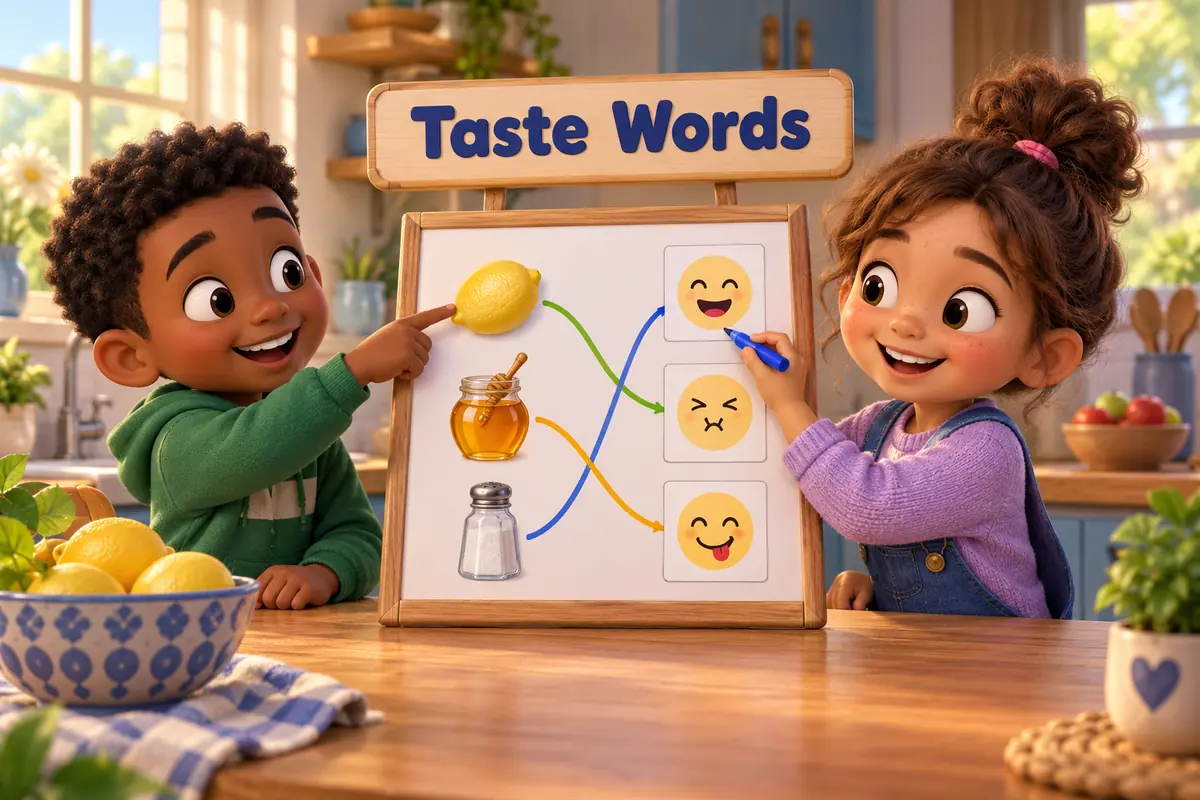
Choosing a taste word means matching the adjective to the exact sensation, because the five basic tastes are distinct and rarely overlap. A precise adjective is clearer than a general one, and the guide to adjectives for drinks extends the same idea to what you pour. The table sets five taste words beside a fitting example.
| Taste | Typical food | Example |
|---|---|---|
| Sweet | sugar, honey | The honey tastes sweet. |
| Sour | lemon, vinegar | The lemon is too sour. |
| Salty | crisps, olives | The olives tasted salty. |
| Bitter | black coffee, dark chocolate | The coffee was bitter. |
| Spicy | chilli, curry | The curry is spicy. |
Name the exact taste rather than a vague word like nice, because sweet, sour, salty, bitter, and spicy each describe a different sensation.
Word forms and grammar of food and drinks vocabulary
Food words carry a grammar of their own, because many are uncountable and cannot be counted directly. A partitive word restores number when it is needed, and this pattern runs through the whole list, from grain to liquid. The idea is not limited to meals; even a phrase like food chain in a sentence shows an uncountable noun used without a number.
| Form | Example | Note |
|---|---|---|
| Countable | an apple, two eggs | can take a number |
| Uncountable | some rice, much water | no plural and no a |
| Partitive | a slice of bread | a unit word makes it countable |
| Adjective | crispy, fresh, ripe | describes food or drink |
| Verb | to chop, to boil | an action in the kitchen |
Common mistakes with food and drinks vocabulary
Five slips appear when learners use food words, and each one breaks the countable rule, the adjective order, or a paired confusion. Reading the wrong version beside the right one makes the fix clear.
Mistake 1: a with an uncountable noun. Incorrect: I need a rice. Correct: I need some rice. Rule: rice is uncountable, so it takes some, not a.
Mistake 2: a plural uncountable. Incorrect: two breads. Correct: two loaves of bread. Rule: an uncountable noun takes a partitive such as loaves.
Mistake 3: the wrong adjective order. Incorrect: a red big apple. Correct: a big red apple. Rule: size comes before colour.
Mistake 4: the wrong cooking verb. Incorrect: Boil the onion into small pieces. Correct: Chop the onion into small pieces. Rule: chop cuts, while boil heats.
Mistake 5: the dessert confusion. Incorrect: We had cake for desert. Correct: We had cake for dessert. Rule: dessert is the sweet course; desert is a dry place.
Practice using food and drinks vocabulary in English
- Fill in the blank: I would like ___ water, please.
- Choose the correct phrase: (a rice / some rice).
- Correct the error: We had cake for desert.
- Build a sentence: write an instruction using “chop the onions”.
- Spot the register: which suits a recipe, (a) Throw the stuff in, or (b) Add the chopped tomatoes and simmer?
- Fill in the blank: two ___ of bread.
Answers
- some, because water is uncountable and takes some.
- some rice, because an uncountable noun cannot take a.
- We had cake for dessert, because dessert is the sweet course.
- Chop the onions finely, because the verb names the cutting action.
- (b), because a recipe uses precise cooking verbs.
- loaves, because loaves is the partitive for bread.
The bottom line
Food and drinks vocabulary in English is easiest to hold when it is grouped, so learn meals, foods, drinks, tastes, and cooking verbs as separate sets. Watch the countable rule, because rice, bread, and water take some rather than a and a partitive when you need a number. Pair each food with a precise adjective, and the words become ready to use.
Frequently asked questions about food and drinks vocabulary in English
How many food and drinks words should a beginner learn?
A beginner can manage with about fifty to a hundred words: the meals, a dozen fruits and vegetables, a handful of drinks, five taste adjectives, and ten cooking verbs. That set covers a cafe, a shop, and a simple recipe. More words can wait until the basics are automatic.
Why are some food words uncountable?
Foods treated as substances rather than separate items are uncountable in English, so rice, bread, and water have no plural and take no a. When a number is needed, a partitive supplies it, as in two slices of bread. The item itself is countable; the substance is not.
What is the difference between cooking verbs and food nouns?
Cooking verbs name actions, such as chop, boil, and roast, while food nouns name the things involved, such as onion, rice, and chicken. A recipe strings the two together, pairing each verb with its object. Learning the verbs alongside their usual nouns is the fastest route to natural cooking talk.
How can I remember food vocabulary faster?
Group the words by theme and connect each one to an image or a sentence you would really say. Label a fridge diagram, order a drink aloud, or write a short recipe. Using the word in a phrase such as a ripe mango fixes it better than reading it alone.