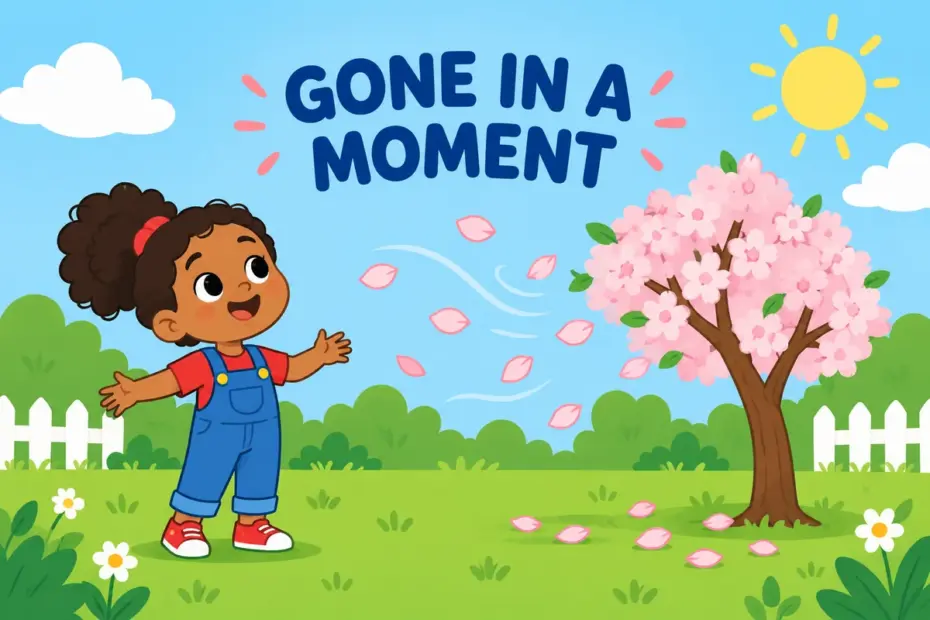
Fugacious is an adjective meaning lasting only a short time, passing away quickly. To use fugacious in a sentence, place it before the noun it describes: “fugacious blossoms,” “a fugacious mood,” “fame is fugacious.” The word suits formal, literary writing and sounds out of place in casual chat.
Fugacious at a glance
- Fugacious is an adjective, and its adverb and noun forms are rare.
- It describes anything that lasts a very short time.
- The everyday synonyms are fleeting and short-lived.
- Typical partners are fugacious beauty, fame and moments.
- The commonest error is confusing it with pugnacious, which means eager to fight.
What does fugacious mean?
Fugacious is an adjective meaning passing quickly and lasting only a short time. The Cambridge entry for fugacious records the general sense and the botanical sense of something shed early. The closest everyday adjective is fleeting, which is far more common in speech.
| Sense | Plain meaning | Example sentence |
|---|---|---|
| Short-lived | Lasting a very short time | The fugacious bloom fell within days. |
| Botanical | Shed quickly from a plant | The fugacious petals drop after one morning. |
How do you use fugacious in a sentence?
The adjective normally stands before the noun, and it works best with abstract things such as beauty, fame, peace or calm. A clause with a linking verb also works, as in the truce was fugacious. Where the word would sound too rare, transient or fleeting keeps the same meaning in a plainer register.
| Pattern | Example | What it signals |
|---|---|---|
| fugacious + noun | a fugacious peace | attributive use before a noun |
| noun + is + fugacious | Their joy was fugacious. | linking verb with a complement |
| the fugacious + noun | the fugacious colours of autumn | a literary, definite phrase |

Fugacious in a sentence: examples across contexts
| Context | Example sentence | Why this works |
|---|---|---|
| Literary writing | Autumn gave the valley a fugacious brightness that vanished by noon. | The adjective sets a brief, poetic mood. |
| Academic prose | The fugacious nature of attention shapes how lessons are designed. | A formal essay uses it to describe transience. |
| News feature | The truce proved fugacious, lasting barely a week. | A report uses it for a short-lived settlement. |
| Book review | The novel treats fame as fugacious and hollow. | A critic applies it to an abstract idea. |
| Botany notes | Fugacious petals leave the stem bare within a day. | The technical sense describes a plant part. |
| Speech | Such fugacious calm is what diplomacy must protect. | A formal address uses it for a fragile state. |
| Essay on memory | A fugacious impression can still shape a life. | The adjective suits reflective writing. |
| Travel writing | The desert light is fugacious, gone the moment it is named. | A literary register fits a scene. |
| Historical writing | The fugacious alliance broke before the treaty was signed. | It compresses a short duration. |
| Poetry commentary | The poet links youth with fugacious blossom. | The word carries an elegiac tone. |
Fugacious vs ephemeral
Both adjectives describe what does not last, and the choice is mostly one of tone. Fugacious is the rarer word and stresses the act of slipping away, while ephemeral is commoner and stresses the shortness of the span. The plainest member of the group, momentary, is the safest in ordinary writing.
| Attribute | Fugacious | Ephemeral |
|---|---|---|
| Core meaning | Lasting a very short time | Lasting for a very short time; once-day |
| Tone | Rare, literary, slightly archaic | More common and neutral |
| Typical subject | Beauty, fame, moods, moments | Trends, pleasures, conditions |
| Frequency | Uncommon outside formal prose | Frequent in current writing |
| Emphasis | The act of slipping away | The shortness of the span |
Use fugacious for a literary flourish, and ephemeral when a general reader must follow at once.
Word forms and grammar of fugacious
The adverb fugaciously and the nouns fugacity and fugaciousness exist but are rare; fugacity belongs to chemistry and physics. The adjective has no common verb, so a phrase such as passes quickly carries the action. Its literal opposite is durable, and a lasting quality is better served by enduring.
| Form | Part of speech | Example |
|---|---|---|
| fugacious | adjective | The fugacious fame faded fast. |
| fugaciously | adverb, rare | The moment passed fugaciously. |
| fugacity | noun, technical | Chemists measure the fugacity of a gas. |
| fugaciousness | noun, rare | The fugaciousness of youth is its theme. |
| fugatious | non-standard spelling | Do not write this; the word is fugacious. |
Common mistakes with fugacious
Confusing it with pugnacious. Incorrect: The fugacious boxer challenged everyone. Correct: The pugnacious boxer challenged everyone. Rule: pugnacious means eager to fight, and the two share only a sound.
Using it for speed. Incorrect: She is a fugacious runner. Correct: She is a fast runner. Rule: fugacious means short-lived in time, not quick in movement.
Placing it after the noun. Incorrect: The calm fugacious passed. Correct: The fugacious calm passed. Rule: the adjective normally precedes the noun it describes.
Using it in casual speech. Incorrect: Our holiday was fugacious! Correct: Our holiday was short. Rule: the word is literary, and a plain adjective fits conversation.
Practice using fugacious
- Fill in the blank: The ____ bloom of the cherry tree lasts only a week.
- Choose better: The truce was short-lived / fugacious, and few readers knew the second word.
- Correct the error: He is a fugacious sprinter who wins every race.
- Write a sentence about fame, using fugacious.
- Which word fits: enduring or fugacious in a formal garden essay about petals?
- Complete the pattern: The ____ beauty of the sunset faded fast.
Answers
- fugacious — the adjective sits before the noun bloom.
- short-lived — a general reader knows the plain adjective at once.
- He is a fast sprinter who wins every race — fugacious means short-lived, not speedy.
- Fame is fugacious and rarely survives the decade — the adjective describes a short duration.
- fugacious — petals that fall quickly suit the literary adjective.
- fugacious — the adjective fits fleeting beauty before the noun.

The bottom line
Fugacious in a sentence describes something that lasts only a moment, and it usually sits just before an abstract noun such as beauty, fame or calm. The word is literary, so fleeting or transient serves ordinary writing better. Its opposite is durable, and its sharpest test is meaning: if nothing is fading, the word does not fit.
Frequently asked questions about fugacious
What is a simple synonym for fugacious?
The plainest synonym is fleeting, with short-lived and transient close behind. Each carries the same core idea of something that does not last, though fleeting is the one that turns up most often in everyday writing and speech. Choose fleeting when you want a word no reader will pause over.
Is fugacious a common word?
Fugacious is uncommon. It belongs to literary fiction, formal essays and older prose, and it rarely appears in conversation or journalism. A reader who knows it will also know fleeting, which does the same work without drawing attention to itself.
Can fugacious describe a plant?
Yes. In botany the adjective describes a part that is shed or falls very early, such as a petal that drops soon after opening. That technical sense grew from the general meaning of lasting only a short time. Gardeners rarely need the term, but plant guides do use it for petals and leaves that fall early.
What part of speech is fugacious?
Fugacious is an adjective, so it modifies a noun, as in a fugacious mood. Its rare adverb is fugaciously and its technical noun is fugacity. It has no common verb, so action is expressed with a phrase such as passes quickly.
Have you ever heard of the word “fugacious”? This intriguing term describes something fleeting, transient, or fleeting in nature. It signifies a brief period of existence or a passing moment, often characterized by its brevity and impermanence.
When used in a sentence, “fugacious” can emphasize the ephemeral nature of a fleeting memory, a passing emotion, or a short-lived experience. This word beautifully captures the essence of something temporary, reminding us of the transient aspects of life that come and go quickly.
7 Examples Of Fugacious Used In a Sentence For Kids
- Butterflies have fugacious wings that flutter around the garden.
- Bubbles are so fugacious, they disappear in the air quickly.
- The rainbow in the sky is very fugacious, it doesn’t stay for long.
- Snowflakes are fugacious and melt when they touch warm hands.
- Soap bubbles are fugacious, but they are fun to pop.
- Candy floss melts in the mouth because it is fugacious.
- The sun sets quickly, its beauty is fugacious.
14 Sentences with Fugacious Examples
- Fugacious moments of peace can be found in the college library during exam season.
- We should cherish the fugacious breaks between classes to catch up with friends.
- The feeling of relaxation after submitting a term paper is fugacious but oh so satisfying.
- Fugacious connections made during college festivals can turn into lifelong friendships.
- It’s important to take advantage of the fugacious opportunity to network with professionals at college events.
- The professor’s fugacious appearance in the cafeteria surprised everyone.
- The joy of finding a vacant spot in the college parking lot was fugacious as others quickly filled in.
- The thrill of solving a complex math problem is fugacious but motivating for further exploration.
- The taste of piping hot chai in the college canteen is truly fugacious and unforgettable.
- The fugacious gossip about the upcoming college trip spread like wildfire among students.
- The sense of freedom during college vacations may feel fugacious but is much-needed after a stressful semester.
- The memory of winning the inter-college debate competition is far from fugacious in my mind.
- The relief of finishing a challenging internship presentation was fugacious as I began to prepare for the next task.
- The fugacious feeling of hope after acing a mock interview can boost confidence for future professional endeavors.
How To Use Fugacious in Sentences?
To use the word Fugacious correctly in a sentence, it is important to understand its meaning and proper placement. Fugacious is an adjective that means something fleeting or passing quickly. Here is a simple guide on how to incorporate it into a sentence:
- Identify a situation or object that is temporary or fleeting.
Example: The beauty of the sunset was fugacious, disappearing behind the mountains in a matter of minutes.
- Ensure that the sentence conveys the idea of something being short-lived or transient.
Example: The feeling of joy she experienced was fugacious, quickly overshadowed by a sense of disappointment.
- Remember to use fugacious in a way that accurately describes the impermanence or brevity of the subject.
Example: The butterfly’s delicate wings were a fugacious sight as it flitted from flower to flower.
By following these guidelines, you can effectively incorporate the word fugacious into your sentences to convey the idea of something fleeting or transient. Practice using it in different contexts to improve your understanding and usage of this unique adjective.
Conclusion
In conclusion, fugacious refers to things that are fleeting, temporary, or transient in nature. The concept of fugaciousness can be seen in various aspects of life, such as the beauty of a sunset, the joy of laughter, or the impermanence of youth. Fugacious moments remind us of the ephemerality of time and the importance of cherishing the present.
By savoring these fugacious moments and being mindful of their fleeting nature, we can cultivate a deeper appreciation for life and all its impermanent wonders. Embracing the fugacious can lead to a greater sense of gratitude, mindfulness, and contentment in our daily lives, reminding us to cherish each passing moment and find beauty in the transient nature of existence.


