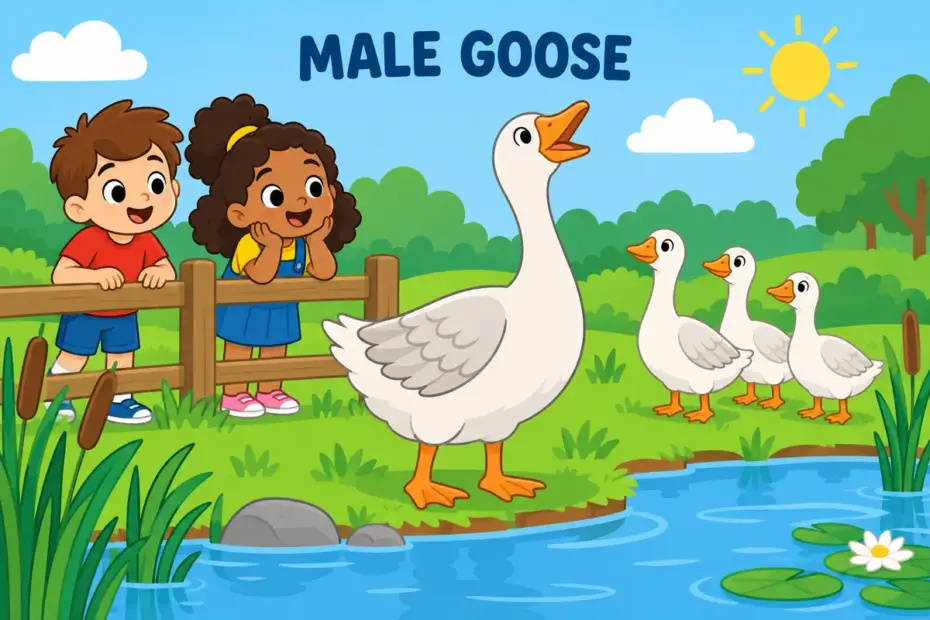
Gander means a male goose, and in informal English it also means a quick look. To use gander in a sentence, reach for take a gander at something when you mean glance: “Take a gander at this map,” while the bird sense needs a goose and gander pair. The register decides which one a reader hears.
Gander at a glance
- Gander is a noun, and its plural is ganders.
- The literal sense is a male goose; the informal sense is a quick look.
- The look sense lives in the fixed phrase take a gander at.
- Common partners are take, have, a quick and a long gander.
- The commonest error is using gander as a verb, as in gander at the menu.
What does gander mean?
Gander is a noun meaning a male goose, and informally it means a quick look. The Cambridge entry for gander records both, and the split is clean: one sense belongs to the farmyard, the other to relaxed conversation. A longer look is nearer a stare, which carries more intensity than the casual gander.
| Sense | Plain meaning | Example sentence |
|---|---|---|
| Male goose | A male of the goose family | The gander hissed at the gate. |
| Quick look | An informal glance at something | Come and take a gander at the new bike. |
One honest limitation: gander is not a formal word for a look. In a report or a formal email, glance or look is safer, and the bird sense only applies to male geese, never to the female or the flock. Using gander for a female bird is simply wrong.
The two senses also differ in how freely they combine. The bird sense takes ordinary modifiers, so a keeper can describe a young gander, a lone gander or an aggressive gander. The look sense is far more restricted: it appears almost always after take or have, and it resists the possessive forms that a synonym like glance allows.
The proverb what is good for the goose is good for the gander is worth knowing because it fixes the word in the language. It uses the bird sense to argue that two people should be treated by the same standard, and the pairing of goose with gander is what makes the line memorable.
How do you use gander in a sentence?
Gander is a noun, so every good sentence either names the bird or uses the fixed look phrase. Four patterns cover almost all real uses.
| Pattern | Example | What it signals |
|---|---|---|
| take a gander at + noun | Take a gander at the map before we set off. | The fixed informal phrase for a quick look. |
| have a gander | Have a gander and tell me what you think. | A British-flavoured variant of the same idiom. |
| a + adjective + gander | She gave the list a long gander. | The look treated as a countable noun. |
| the gander | The gander guards the yard. | The bird sense, always male. |
Keep the phrase intact. English says take a gander at, not take a gander to, and the verb take belongs to the idiom rather than to gander, which never inflects as a verb.
Tone matters as much as grammar here. Take a gander sounds warm and unhurried, which is why it works when you invite somebody to look at something harmless, such as a new bike or a puzzle. Pointed at a person, the same phrase can feel nosy, so writers usually direct it at things rather than at people.

Gander in a sentence: examples across contexts
Gander keeps two separate lives, one in the farmyard and one in chat. The ten sentences below show which sense each context brings out.
| Context | Example sentence | Why this works |
|---|---|---|
| Farmyard | The gander chased the ducks across the yard. | The literal male-goose sense. |
| Nature writing | A gander leads the line of geese at dusk. | Correct sex and singular noun. |
| Conversation | Take a gander at the notice on the door. | The fixed look idiom in speech. |
| Friendly email | Have a gander at the draft when you can. | Casual British-flavoured use. |
| Classroom | Take a gander at the diagram before you answer. | A gentle, informal instruction. |
| Baking | I had a gander at the recipe and started. | The look as a countable noun. |
| News feature | The keeper hand-raised the orphaned gander. | Formal prose still uses the bird sense. |
| Diary | A quick gander at the sky told me to take a coat. | Short evaluative glance. |
| Bookshop | She took a gander at the first page and bought it. | The idiom inside a full narrative sentence. |
| Playground | “Take a gander,” said Sam, holding up the puzzle. | Direct speech suits the informal phrase. |
| Text message | Take a gander at this photo and guess where we are. | Digital chat favours the casual idiom. |
| Market stall | The farmer pointed out a fine young gander. | The bird sense with an ordinary modifier. |
Gander vs goose
Gander and goose are not interchangeable, because one names the male and the other names the species or the female.
| Attribute | gander | goose |
|---|---|---|
| Sex | Male only | Female, or either sex as the general word |
| Plural | Ganders | Geese |
| Informal sense | A quick look | No look sense |
| Idiom | take a gander at | what is good for the goose is good for the gander |
| Example | The gander stood guard. | The goose laid three eggs. |
Verdict: choose gander for a male bird or a casual glance, and goose for the female, the species or the general word. Do not confuse gander with garner, which means to gather or collect.
The safest test is to ask what the sentence is actually doing. If a bird is on the page, or a farmer is talking about one, gander is literal and takes the plural ganders. If somebody wants another person to look at something, the sentence needs the whole phrase take a gander at, with all three words present.
Word forms and grammar of gander
Gander is a plain noun, and the form learners invent most often is a verb that standard English does not use.
| Form | Part of speech | Example |
|---|---|---|
| gander | noun, singular | A gander strutted past the barn. |
| ganders | noun, plural | Two ganders share the pond. |
| take a gander | fixed phrase | Take a gander at the last page. |
| gandered | verb, non-standard | Incorrect: He gandered at the list. Correct: He took a gander at the list. |
The plural of the bird is geese, not ganders, unless you mean several males specifically, so a mixed flock is always a group of geese.
The fixed phrase does not inflect anywhere either. A writer keeps take a gander unchanged and moves the tense onto take, giving took a gander and taking a gander. Adding an ending to gander itself, as in ganders at or gandering, breaks the idiom and marks the sentence as a learner error.
Common mistakes with gander
- Incorrect:
The gander laid three eggs.Correct: The goose laid three eggs. Rule: only the female goose lays eggs, and a gander is male. - Incorrect:
I will gander at the report.Correct: I will take a gander at the report. Rule: gander is a noun, so the verb in the idiom is take. - Incorrect:
Take a gander to the menu.Correct: Take a gander at the menu. Rule: the fixed phrase takes the preposition at. - Incorrect:
The ganders flew south.Correct: The geese flew south. Rule: the plural of the bird is geese; ganders names only males. - Incorrect:
She gave the room a gander of inspection.Correct: She gave the room an inspecting glance. Rule: the look sense belongs to the idiom, not to a formal noun phrase.
Practice using gander
Work through the eight items, then read the reason beside each answer, because the pattern matters more than the key itself.
- Fill the gap: ______ a gander at the timetable on your way out.
- Choose the better word: The bird that laid the egg was a (gander / goose).
- Correct the error: He gandered at the sleeping cat.
- Build a sentence: use take a gander at about a friend’s new painting.
- Spot the register: which belongs in a formal report, a quick glance at the figures, or take a gander at the figures?
- Fill the gap: Two male birds, called ______, guard the farmyard.
- Rewrite in the past tense: We take a gander at the roof.
- Correct the error: The gandering bird scared the ducks away.
Answers
- Take: the fixed idiom is take a gander at.
- goose: a gander is male and cannot lay eggs.
- He took a gander at the sleeping cat: gander is a noun, so take carries the tense.
- Model answer: Take a gander at the painting and tell me what you see.
- A quick glance at the figures: formal writing avoids the informal idiom.
- ganders: the plural names several males specifically.
- We took a gander at the roof: the tense moves onto take, not onto gander.
- The gander scared the ducks away: the bird sense needs the plain noun, not a participle.
The bottom line
Use gander in a sentence as a noun, and decide whether you mean the male goose or a quick look. The bird sense is literal and takes ganders as its plural, while the look sense lives only in the fixed phrase take a gander at. Keep it out of formal writing, where glance is the safer word, and reach for it in relaxed conversation instead.
Frequently asked questions about gander
Is a gander a male goose?
Yes. A gander is specifically a male goose, while goose is the general word and also the word for the female. That is why only a goose lays eggs, and why a mixed flock is called geese rather than ganders. The sex distinction is the whole point of the noun.
What does take a gander mean?
Take a gander means to have a quick, informal look at something, as in take a gander at the menu. The phrase is casual and friendly, common in speech and light writing. A formal document would use glance, look or inspect instead of the idiom.
Can gander be a verb?
No. Gander is a noun, so a sentence such as he gandered at the list is non-standard. The verb in the idiom is take, giving take a gander at. In the farmyard sense you would say the gander walked or the gander hissed, never that it gandered.
Is take a gander formal or informal?
Take a gander is informal and slightly playful, so it suits conversation, friendly emails and light features. Formal writing prefers glance or look. The bird sense of gander is neutral and can appear in any register, from a nature guide to a news report about a farm.