A gavel is a small wooden mallet that a judge, auctioneer or chair strikes to call for order or mark a decision. In a sentence gavel is a countable noun, as in the judge raised the gavel. The verb is rarer and takes an object.
Gavel at a glance
- Gavel is a countable noun; its plural is gavels.
- It also works as a verb meaning to bring a meeting to order with the tool.
- The usual sentence frame keeps the tool after strike, raise or bring down.
- Its home registers are the courtroom, the auction house and the committee room.
- The usual learner slip is calling any hammer a gavel, which the tool is not.
What does gavel mean?
Gavel is a noun meaning a small ceremonial mallet, usually wooden, that a presiding official strikes to demand order or signal a ruling. The Cambridge entry for gavel records both the noun and the rarer verb, and the object is always the tool of authority rather than an ordinary workshop hammer. A judge is the official most often pictured holding it, which is why the word feels formal.
| Sense | Plain meaning | Example sentence |
|---|---|---|
| Judge’s mallet | Call order or mark a ruling | The judge brought down the gavel and the court fell silent. |
| Auctioneer’s mallet | Close a sale or acknowledge a bid | The auctioneer’s gavel fell at ten thousand pounds. |
| Chair’s tool | Open or close a formal meeting | The chair used the gavel to end the debate. |
| Verb, rare | Bring a meeting to order with the tool | The mayor gavelled the meeting to order. |
One limitation is worth stating plainly. A gavel is a specific ceremonial mallet, not a general hammer: it has a short handle and a polished head, and its power comes from the office, not the wood. A garden mallet and a claw hammer are different tools. Where the sentence needs a plain implement, hammer is the honest word.
How do you use gavel in a sentence?
Keep the gavel as a countable noun and let the verb beside it show the action. Five patterns cover almost every real sentence, and the intransitive ones, in which the gavel falls or sounds by itself, are the most dramatic.
| Pattern | Example | What it signals |
|---|---|---|
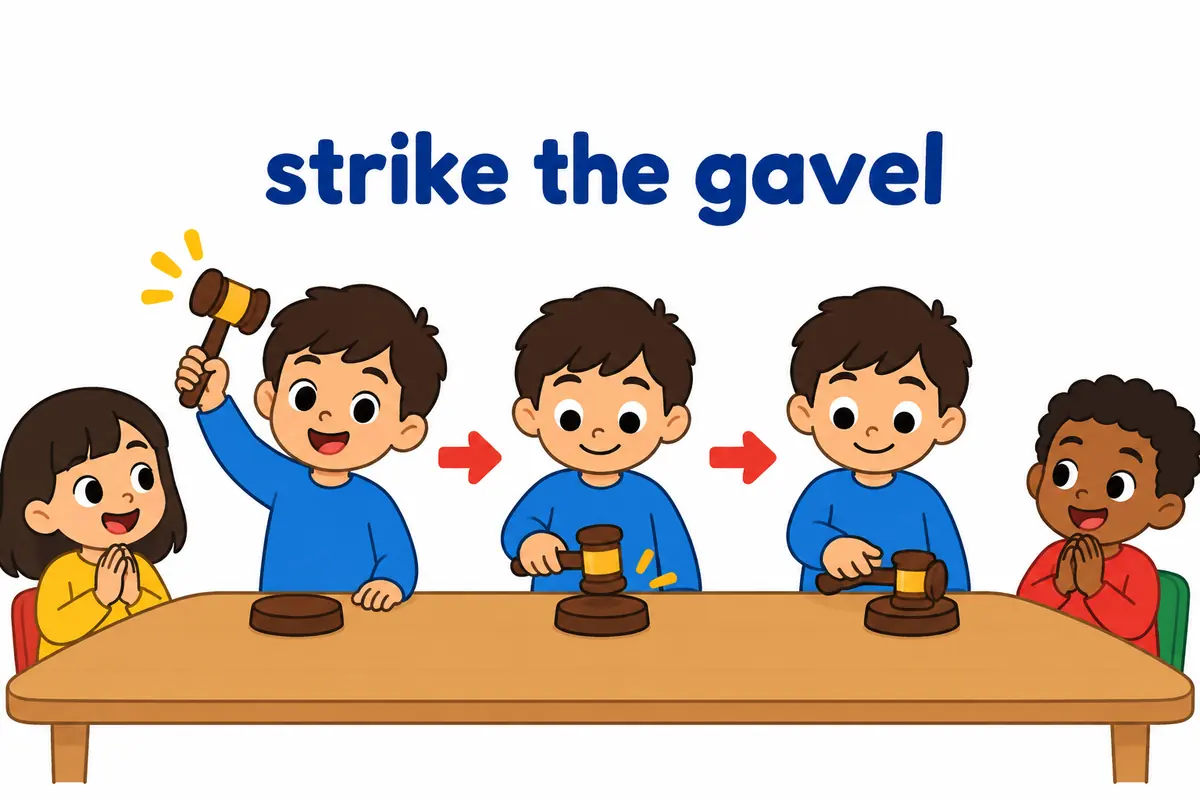
| raise or strike + the gavel | The judge struck the gavel once. | An official act that opens or closes business. |
| bring down + the gavel | She brought down the gavel to silence the room. | A decisive call for order. |
| the gavel + falls or sounds | The gavel fell and the auction was over. | Focus on the moment, not the person. |
| possessive + gavel | The chair’s gavel rested on the desk. | Shows the tool belonging to the office. |
| gavel + object (verb) | The mayor gavelled the meeting to order. | Rare verb use, found in reported speech. |
A related ceremonial tool is the mace carried before a council; both mark authority, but only the gavel is struck to make a ruling heard. The chair stands at the rostrum, gavel in hand, to open the session.
Gavel in a sentence: examples across contexts
Gavel stays close to its court-and-auction home, but the sentences below show how wide that home has become. Each one names who holds the tool and what the strike decides. At an auction the gavel closes the sale as well as calls for order.
| Context | Example sentence | Why this works |
|---|---|---|
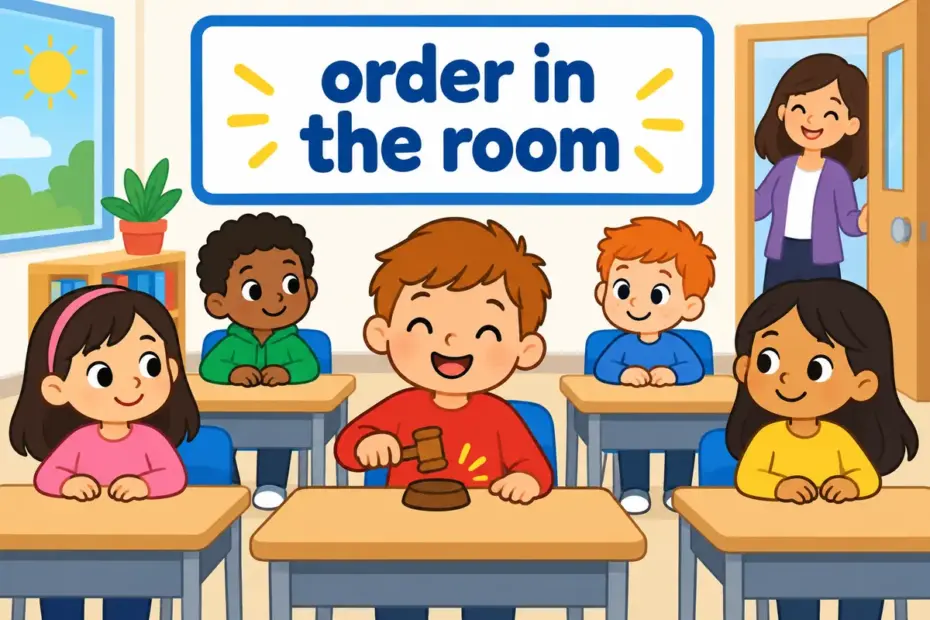
| Classroom | The class chair tapped the gavel to start the debate. | A familiar setting makes the tool feel playful. |
| Court report | The judge raised the gavel and thanked the jury. | Names the officer and the ceremonial act. |
| Auction house | The gavel fell on a painting that had drawn no bids. | The tool as subject keeps the sale impersonal. |
| Committee minutes | The chair struck the gavel twice to end the session. | Precise action suits a formal record. |
| News report | A hush followed the gavel as the verdict was read. | Builds drama around the sound alone. |
| Legal writing | The gavel is a symbol of the court’s authority. | Explains the object rather than an event. |
| Business meeting | The new chair brought a gavel and used it often. | A touch of humour about over-formality. |
| Local politics | The mayor gavelled the council to order at nine sharp. | Shows the rare verb in a real report. |
| History essay | A silver gavel was presented when the hall reopened. | Treats the tool as a commemorative object. |
| Conversation | Dad rapped the table like a gavel and called dinner. | Compares a homely action to the courtroom ritual. |
Only two of the ten sentences describe an actual courtroom. The tool has become a shorthand for any firm call to order, which is why it turns up at dinner tables and in committee rooms alike. That spread is a reminder that the gavel works as a symbol as much as an object.
Gavel vs mallet and hammer
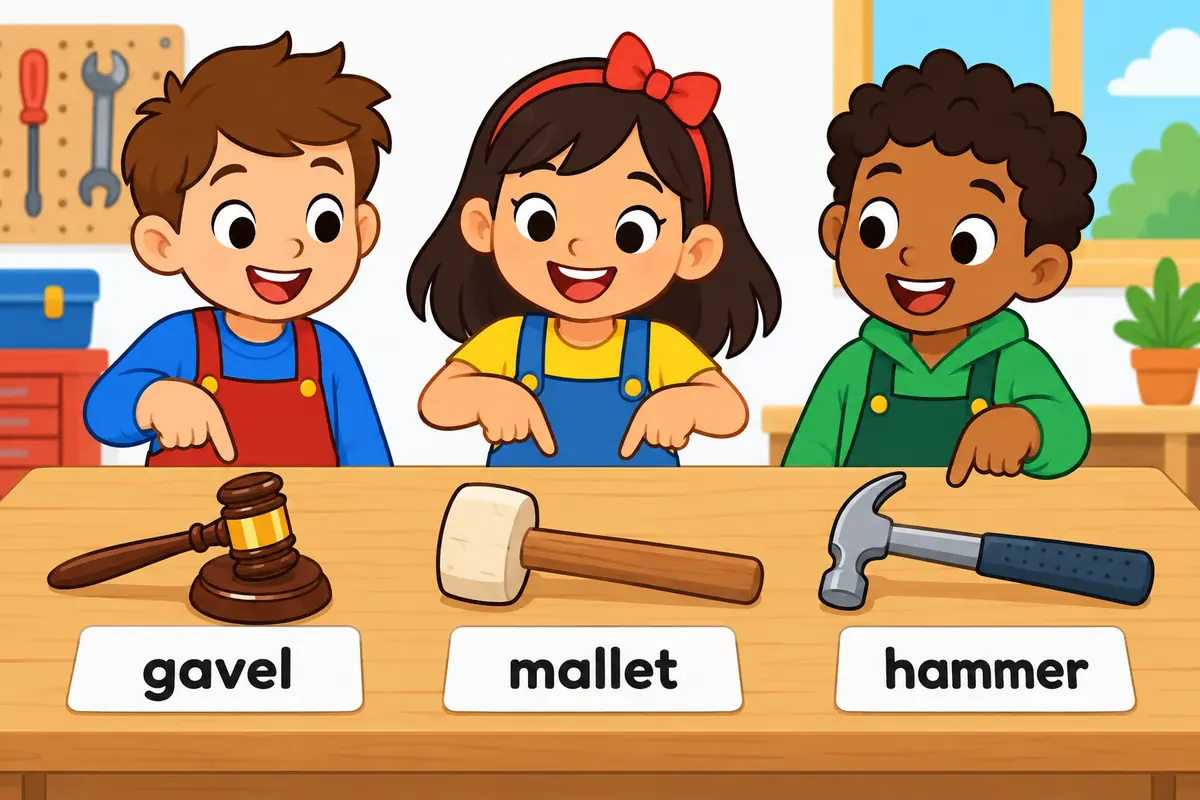
Gavel overlaps with two tools and matches neither. A mallet is any soft-headed striking tool, and a hammer is a harder tool made to drive nails.
| Attribute | gavel | mallet | hammer |
|---|---|---|---|
| Core job | Signal order or a decision | Strike without damaging a surface | Drive or remove nails |
| Head | Small, polished, wooden | Large, wooden, rubber or soft | Metal, flat face and claw |
| Handle | Short | Medium to long | Medium, often steel or fibreglass |
| Typical user | Judge, auctioneer, chair | Craftsperson, cook, gardener | Carpenter, builder |
| Register | Formal, ceremonial | Practical, trade | Practical, everyday |
Verdict: choose gavel for the ceremonial mallet of office, mallet for a soft-headed striking tool, and hammer for a metal tool that drives or removes nails. Only the gavel borrows its authority from an office rather than from its material.
Word forms and grammar of gavel
Gavel is mainly a countable noun, and its verb forms follow the usual American and British split on doubling the final l. The table marks the choices and the spelling learners invent.
| Form | Part of speech | Example |
|---|---|---|
| gavel | noun, singular | The gavel sat on the bench for an hour. |
| gavels | noun, plural | Two gavels were kept for the twin courts. |
| gaveled | verb, past, American | The chair gaveled the meeting to order. |
| gavelled | verb, past, British | The mayor gavelled the session closed. |
| gaveling / gavelling | verb, participle | Gavelling the room quiet took a full minute. |
| gavel-like | adjective, ad hoc | A gavel-like tap ended the talk. |
| gaveler | non-standard | Write the person who wields the gavel, not gaveler. |
The verb is uncommon enough that most writers avoid it and prefer a phrase such as called the meeting to order. When the verb is used, keep the object in place: you gavel a meeting to order, not simply gavel. The noun, by contrast, is completely standard and appears in headlines without any explanation.
Common mistakes with gavel
- Incorrect:
He gaveled a nail into the wall.Correct: He hammered a nail into the wall. Rule: A gavel signals order; it never drives a nail. - Incorrect:
The judge banged the mallet.Correct: The judge banged the gavel. Rule: The courtroom tool has its own name, and it is smaller than a general mallet. - Incorrect:
The gavel was sounded by someone.Correct: Someone struck the gavel. Rule: The passive hides the official, who matters in a formal record. - Incorrect:
A gavel of wood fell on the floor.Correct: A wooden gavel fell on the floor. Rule: Material adjectives sit straight before the noun. - Incorrect:
The mayor gaveled.Correct: The mayor gaveled the meeting to order. Rule: The verb is transitive, so it needs its object. - Incorrect:
She used the gavel to cut the ribbon.Correct: She used the gavel to open the session. Rule: The tool belongs to the meeting, not to a ceremony of cutting.
Practice using gavel
Work through the seven items, then read the reason beside each answer rather than only the key.
- Fill the gap: The auctioneer raised the ______ and the bidding stopped.
- Choose the better word: The carpenter reached for a (gavel / hammer) to drive the nail.
- Correct the error: The judge gaveled to end the hearing.
- Build a sentence: use the gavel fell about a school council vote.
- Spot the register: which belongs in court minutes – the judge brought down the gavel, or the judge whacked the little hammer?
- Change the spelling: rewrite The chair gaveled the meeting to order in British spelling.
- Fix the verb: The mayor gaveled the room quiet. Make the object explicit.
Answers
- gavel – the auctioneer uses the ceremonial mallet to close a sale.
- hammer – a metal hammer drives nails, which a gavel never does.
- The judge gaveled the hearing to a close – the verb needs an object.
- Model answer: When the last vote was counted, the gavel fell.
- The judge brought down the gavel – a formal record prefers the exact term to a slangy whack.
- The chair gavelled the meeting to order – British spelling doubles the final l.
- The mayor gaveled the meeting to order – the object is the meeting, not the room.
The bottom line
Use gavel in a sentence for the small ceremonial mallet that a judge, auctioneer or chair strikes to mark a decision, and keep it as a countable noun after an action verb. The two details that decide most sentences are these: the tool signals order rather than doing work, and its authority comes from the office it belongs to. Where the sentence describes a practical striking tool, mallet and hammer are the words you want instead.
Frequently asked questions about gavel
Is gavel a noun or a verb?
Gavel is chiefly a countable noun, as in the judge raised the gavel. It also works as a transitive verb meaning to bring a meeting to order, as in the chair gaveled the session open. The verb is rare and mostly appears in reported speech or minutes, while the noun carries almost all everyday use.
What is the plural of gavel?
The plural is gavels, formed in the regular way. Because the word is countable, it needs an article in the singular, so write a gavel or the gavel rather than gavel alone. Courts sometimes keep spare gavels, and an auction house may own several.
How is gavel spelled in the past tense?
American writing uses gaveled and gaveling, with a single l, while British writing doubles it as gavelled and gavelling. Both are accepted, and the choice should match the rest of the document. The noun is unaffected and is always gavel in the singular.
Is a gavel the same as a mallet?
No. A mallet is any striking tool with a soft or wooden head, used by craftworkers, cooks and gardeners. A gavel is a specific small mallet carried by an official to command order. All gavels are mallets in shape, but very few mallets are gavels.