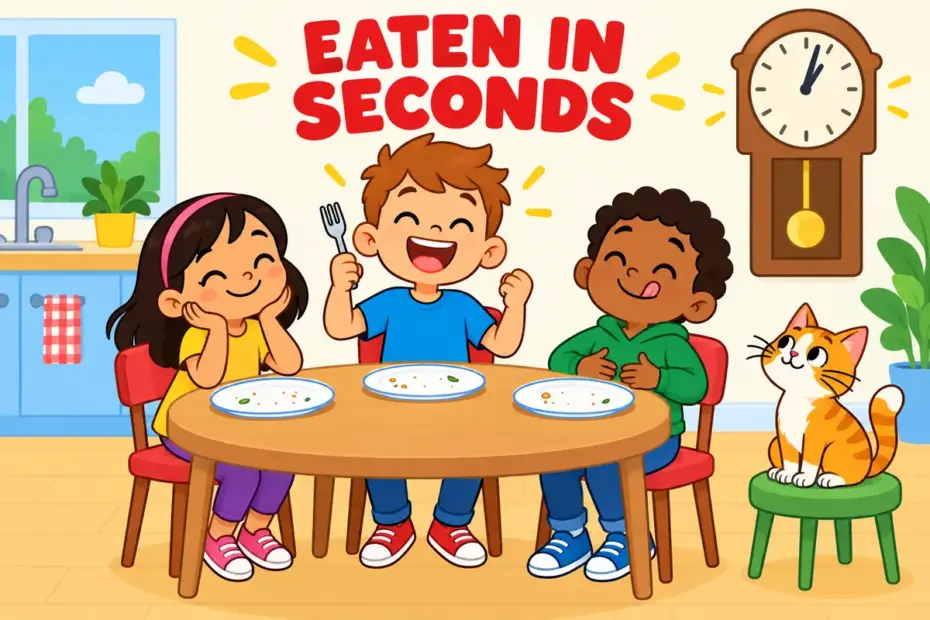
Gobble up means to eat something quickly and greedily, and it also describes using or buying something very fast. To use gobble up in a sentence, put the eater or buyer first and the object second: The children gobbled up the pizza. The phrase is a separable phrasal verb.
Gobble up at a glance
- Gobble up is a transitive phrasal verb; its forms are gobbles up, gobbled up and gobbling up.
- It has a literal sense, eating greedily, and a figurative sense, consuming or buying quickly.
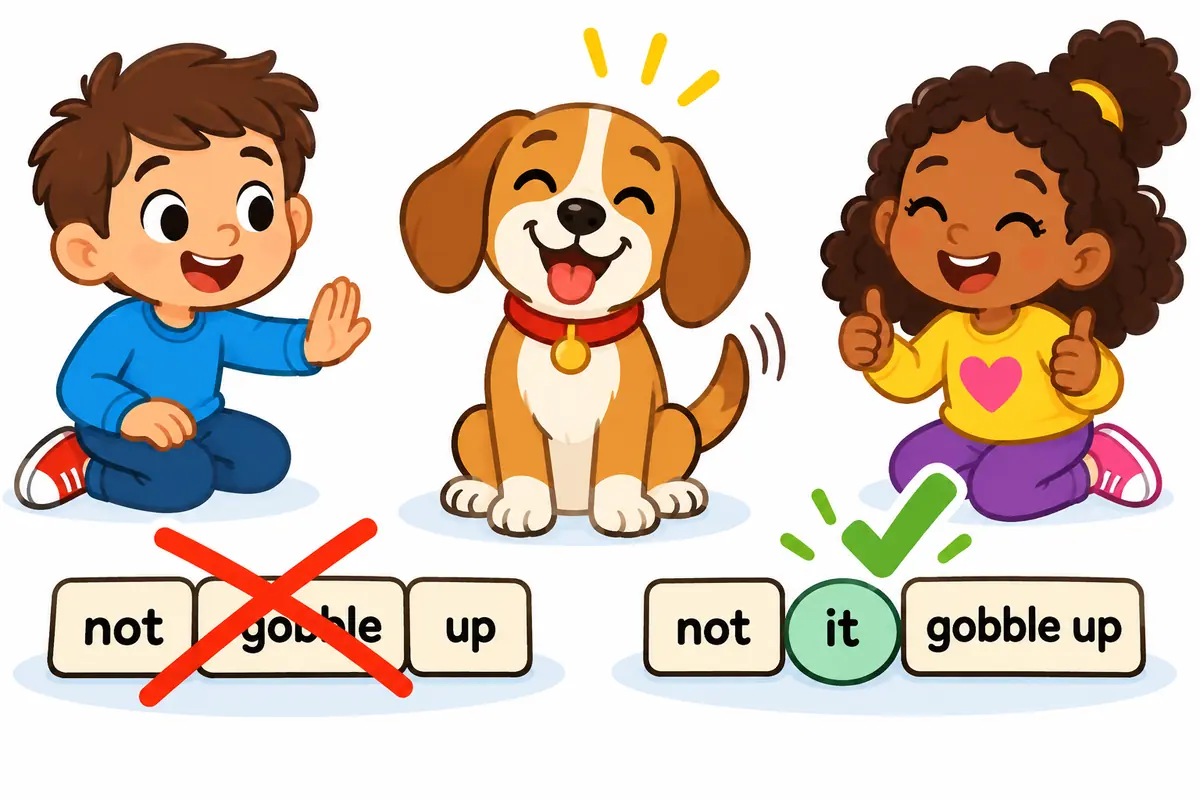
- A pronoun object must sit between the verb and the particle: gobble it up.
- The usual subjects are people, animals and large companies.
- The commonest error is the order gobble up it, which English rejects.
What does gobble up mean?
Gobble up is a phrasal verb meaning to eat food quickly and greedily, or to use up, absorb or buy something at great speed. The Cambridge entry for gobble up covers the eating sense and the figurative one. The literal sense always involves food, while the figurative sense takes resources, space or companies as its object. Where the tone needs to stay formal, consume a resource is the neutral alternative, because gobble up always carries an appetite.
| Sense | Plain meaning | Example sentence |
|---|---|---|
| Eat greedily | Eat food very quickly | The puppy gobbled up its dinner. |
| Consume fast | Use up a resource quickly | The project gobbled up the whole budget. |
| Buy up | Acquire companies or property quickly | The chain gobbled up three rivals. |
One limitation is worth stating plainly. Gobble up is informal in its literal sense and vivid in its figurative one, so it suits a story or a news feature better than a legal contract. It also implies speed and appetite, which is why a phrase such as slowly gobbled up sounds contradictory.
How do you use gobble up in a sentence?
Gobble up is separable, so the object can sit between the verb and the particle. With a full noun either side works, but with a pronoun the object must go in the middle. The particle stays even when the object moves.
| Pattern | Example | What it signals |
|---|---|---|
| gobble up + noun | The crowd gobbled up the free samples. | Standard order with a full object. |
| gobble + noun + up | She gobbled her lunch up in minutes. | Object between verb and particle. |
| gobble + pronoun + up | He gobbled it up. | With a pronoun the object must sit in the middle. |
| gobble up + resource | The new server gobbled up the memory. | Figurative consumption of a resource. |
| be gobbled up | The small firm was gobbled up by a rival. | Passive, common in business news. |
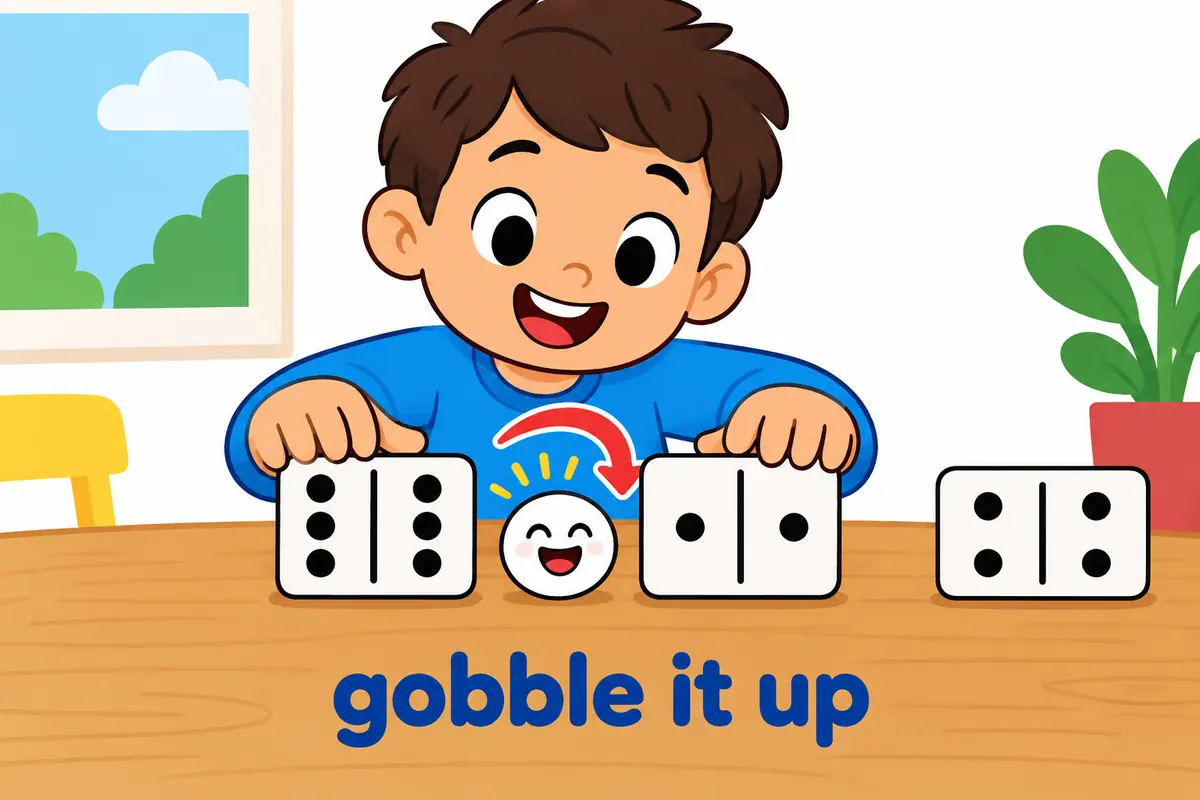
Gobble up in a sentence: examples across contexts
Gobble up moves between the kitchen and the boardroom without changing shape. The nine sentences below keep the same phrasal verb and show how the subject decides the sense. The particle up also appears in other phrasal verbs, such as when you add up a total or back up a claim, and the position rules there work the same way.
| Context | Example sentence | Why this works |
|---|---|---|
| Home | The boys gobbled up the pancakes before the bus came. | Literal eating with a clear time limit. |
| Classroom | Our class gobbled up the new reading books in a week. | Figurative use about enthusiasm for books. |
| News report | The wildfire gobbled up thousands of hectares. | Vivid figurative subject, a natural disaster. |
| Business writing | The fund gobbled up four small startups last year. | Buy-up sense with numbers as proof. |
| Sports report | The defence gobbled up every loose ball. | Consume-fast sense applied to chances. |
| Farming | The goats gobbled up the weeds in the orchard. | Literal sense with animals as subjects. |
| Technology | The render gobbled up every spare hour of processing. | Resource sense with a technical subject. |
| Travel | We gobbled up the miles and reached the coast by noon. | Speed sense applied to distance. |
| Conversation | Eat slowly, or you will gobble it all up. | Pronoun in the middle, as the pattern requires. |
Only the last sentence uses a pronoun object, and that is exactly where the word order rule is easiest to hear. The literal and figurative senses otherwise share every pattern.
Gobble up vs devour
Devour and gobble up both mean to eat fast, but they differ in tone and reach. devour a meal is the more formal and literary choice, and it also describes reading with great eagerness. Gobble up is more casual, more imitative of the sound of eating, and it stretches further into business and news. A plainer verb such as eat a snack stays neutral and carries no appetite at all.
| Attribute | gobble up | devour | eat |
|---|---|---|---|
| Speed implied | Very fast | Fast and eager | No speed implied |
| Formality | Informal to journalistic | Formal and literary | Neutral |
| Typical object | Food, money, firms, land | Food, books, distance | Food, a meal |
| Figurative reach | Wide, common in business | Moderate, reading and travel | None |
| Grammar | Separable phrasal verb | Single verb | Single verb |
Verdict: choose gobble up for a lively, fast tone, devour when you want a formal or literary edge, and eat when speed is not the point.
Word forms and grammar of gobble up
Gobble up behaves like most separable phrasal verbs. The table shows the inflections and the two orders learners mix up.
| Form | Part of speech | Example |
|---|---|---|
| gobble up | phrasal verb, base form | They will gobble up the leftovers. |
| gobbles up | phrasal verb, third person singular | The cat gobbles up its food. |
| gobbled up | phrasal verb, past and past participle | The team gobbled up the chances. |
| gobbling up | phrasal verb, present participle | It is gobbling up storage fast. |
| gobble it up | correct pronoun order | The dog gobbled it up. |
| gobble up it | non-standard order | Use gobble it up instead. |
Common mistakes with gobble up
- Incorrect:
The dog gobbled up it.Correct: The dog gobbled it up. Rule: A pronoun object goes between the verb and the particle. - Incorrect:
The team gobbled up.Correct: The team gobbled up the points. Rule: Gobble up is transitive, so it needs an object. - Incorrect:
The company gobbled the startup.Correct: The company gobbled up the startup. Rule: Keep the particle; without it the verb is incomplete. - Incorrect:
She gobbled up slowly.Correct: She ate slowly. Rule: Gobble up already means fast, so a slow adverb contradicts it. - Incorrect:
The firm was gobbled up by buy.Correct: The firm was gobbled up by a rival. Rule: The passive keeps the object as the subject and names the buyer after by.
Practice using gobble up
Work through the six items, then check the reason beside each answer.
- Fill the gap: The children ______ the cake before the party even started.
- Choose the better word: A formal report would say the program (gobbled up / consumed) the budget.
- Correct the error: The dog gobbled up it in one bite.
- Build a sentence: use gobble up in the passive about a small firm taken over by a chain.
- Spot the register: which belongs in a business article, the fund gobbled up three rivals or the fund, like, ate them?
- Rewrite with a pronoun: The puppy gobbled up the biscuit. Replace the biscuit with it.
Answers
- gobbled up – the children ate fast and greedily.
- consumed – a formal report avoids the informal appetite of gobble up.
- The dog gobbled it up – a pronoun goes in the middle.
- Model answer: The small firm was gobbled up by a national chain.
- The fund gobbled up three rivals – the business sense is standard in news.
- The puppy gobbled it up – the pronoun replaces the biscuit between verb and particle.
The bottom line
Use gobble up in a sentence when food, money, land or companies are consumed quickly and greedily. The two details that decide most sentences are separability, because a pronoun sits between gobble and up, and the particle, which must stay in place. For a neutral tone in formal writing, absorb a cost or consume are the safer choices.
Frequently asked questions about gobble up
Is gobble up separable?
Yes. Gobble up is a separable phrasal verb, so the object can sit between the verb and the particle, as in gobbled the pizza up. The separation is optional with a full noun, but it is required with a pronoun, which gives gobbled it up. The particle never disappears.
What is the difference between gobble up and gobble down?
Both describe fast eating, and they are close in meaning. Gobble up is by far the more common and the one that also means to consume resources or buy companies. Gobble down is used almost only of food. For business and news senses, choose gobble up.
Can gobble up be used figuratively?
Yes, and the figurative use is common in news and business writing. A company gobbles up rivals, a project gobbles up a budget, and a wildfire gobbles up land. The figurative sense keeps the ideas of speed and appetite but removes the food. Context makes the sense clear.
Does gobble up always need an object?
Yes. Gobble up is transitive, so a sentence must name what is eaten, used or bought. A clause such as the team gobbled up is incomplete on its own. When the object is already known, replace it with a pronoun between the verb and the particle, as in gobbled it up.
Have you ever witnessed a hungry crowd swiftly gobble up all the food at a party? To “gobble up” means to eat something quickly and eagerly, often without restraint or hesitation.
This phrase vividly conveys the idea of consuming something with great enthusiasm or voracity. Whether it’s a plate of delicious snacks or a thrilling novel, to gobble up something implies a sense of eager enjoyment and swift consumption.
7 Examples Of Gobble Up Used In a Sentence For Kids
- Gobble up your delicious lunch quickly.
- I love to gobble up yummy mangoes.
- Don’t forget to gobble up your healthy snacks.
- The little bird will gobble up the breadcrumbs.
- Let’s all gobble up our favorite cookies.
- The hungry squirrel will gobble up the nuts.
- Gobble up the tasty fruits at snack time.
14 Sentences with Gobble Up Examples
- After a long day of classes, I always gobble up a quick snack before heading to my next lecture.
- During exam week, it’s common for students to gobble up energy bars and instant noodles for quick meals.
- Whenever there’s a group project deadline approaching, my friends and I tend to gobble up pizzas while working late nights.
- The cafeteria food at the college is so delicious that it’s easy to gobble up multiple servings without even realizing it.
- Sometimes, after a tiring day, I just want to gobble up a comforting bowl of Maggi noodles in my dorm room.
- When attending a sports event on campus, students often gobble up all the popcorn and snacks available at the concession stand.
- During cultural fests, students eagerly gobble up all the street food stalls that offer a variety of treats.
- On lazy weekends, my roommates and I like to gobble up homemade popcorn while binge-watching our favorite TV shows.
- The food trucks that come to our college campus always have students lining up to gobble up their tasty offerings.
- Our college canteen is known for serving delicious biryani that students can’t help but gobble up during lunch breaks.
- To keep up with the demanding academic schedule, many students tend to gobble up caffeinated drinks to stay awake and alert.
- Taking a break from studying, it’s common for students to gobble up ice cream or milkshakes to refresh themselves.
- The mess at the university hostel always has students rushing to gobble up their favorite dishes before they run out.
- When preparing for a late-night study session, it’s convenient to gobble up instant noodles for a quick and filling meal.
How To Use Gobble Up in Sentences?
Gobble Up can be used in a sentence to indicate eating something quickly or eagerly. For example, “The children gobbled up all the cookies as soon as they were out of the oven.”
When incorporating Gobble Up into a sentence, remember to place the phrase after the subject and verb. It is often paired with food-related items but can also be used more figuratively to convey the idea of consuming something eagerly or rapidly.
To use Gobble Up effectively, consider the context of the sentence and the desired tone. Whether you are describing a literal action of quickly eating food or a metaphorical sense of eagerly taking in information, Gobble Up can add vividness and dynamism to your writing.
When using Gobble Up in written communication, try to vary your vocabulary and sentence structure to keep your writing engaging. Experiment with synonyms or different sentence constructions to avoid repetition.
As you become more comfortable with incorporating Gobble Up into your sentences, pay attention to how it affects the overall tone and imagery of your writing. Don’t hesitate to practice using Gobble Up in different contexts to deepen your understanding and mastery of this expressive phrase.
Conclusion
In conclusion, the phrase “gobble up” is commonly used to describe the quick and enthusiastic consumption or acquisition of something. Examples in sentences like “The children will gobble up all the candy in no time” or “Investors quickly gobble up shares of the new tech startup” illustrate this swift and eager action. This expression often conveys a sense of voraciousness or rapid completion, emphasizing the efficient and thorough nature of the activity being described.
Whether referring to devouring food, purchasing items, or seizing opportunities, “gobble up” encapsulates a sense of swift and enthusiastic consumption or acquisition in a vivid and easily understood manner. Its usage in casual conversation or formal writing effectively conveys a sense of urgency, enthusiasm, or completeness, making it a versatile phrase for various contexts.


