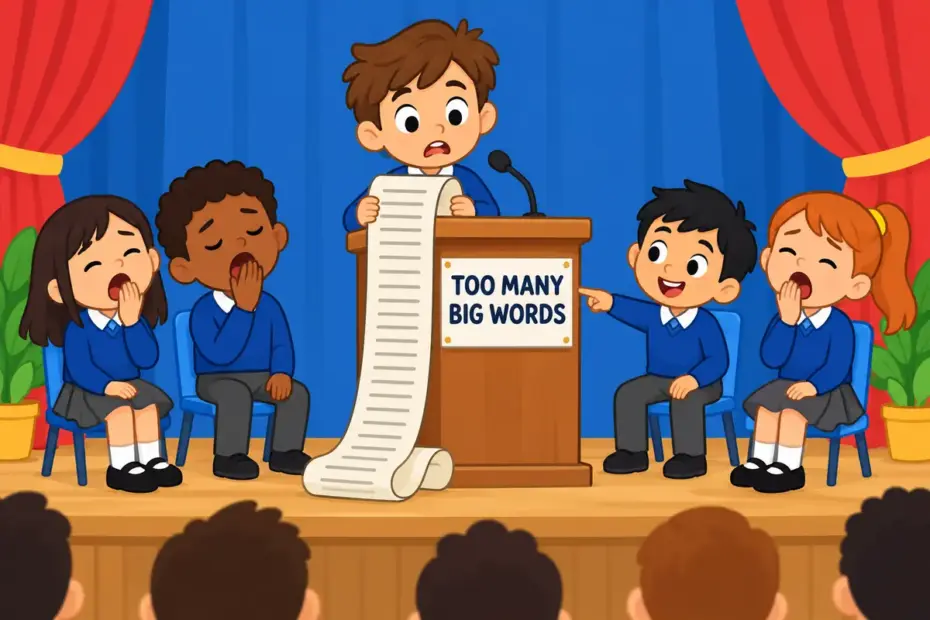
Grandiloquent describes language that is pompously elaborate, using long words to sound impressive rather than clear. To use grandiloquent in a sentence, place it before the noun it judges, as in “a grandiloquent speech” or “his grandiloquent style”. The adjective is almost always critical, so it labels inflated wording rather than simply formal writing.
Grandiloquent at a glance
- Grandiloquent is an adjective; its noun is grandiloquence and its adverb is grandiloquently.
- It describes language that is pompously elaborate, not merely formal or polite.
- The usual targets are speeches, prose, rhetoric, phrases and tributes.
- It appears mostly before a noun, as in a grandiloquent style or grandiloquent language.
- The commonest error is applying it to any long message, even a clear one.
What does grandiloquent mean?
Grandiloquent is an adjective meaning pompously elaborate in language: it describes words chosen to sound impressive rather than to be understood. The Cambridge entry for grandiloquent records that critical note, and the note matters, because the word judges style rather than content.
| What it targets | Example sentence | Effect |
|---|---|---|
| A speech or address | The mayor delivered a grandiloquent tribute. | Praise inflated until it sounds hollow. |
| Written prose | The chapter opens with a grandiloquent description of the sea. | Long words slow the reader and blur the image. |
| Rhetoric or slogans | Grandiloquent rhetoric filled the closing rally. | Emotion is claimed rather than shown. |
| A style or manner | Her grandiloquent manner won no converts. | The speaker seems to perform rather than talk. |
The word is a judgement, not a neutral label. A formal report and a grandiloquent one differ in aim: formality follows the occasion, while grandiloquence strains after importance. Where the writing is merely formal, plain writing is the honest description and grandiloquent overstates the case. Grandiloquent also does not mean eloquent: inflated sentences can be clumsy, and a grandiloquent passage may say very little.
How do you use grandiloquent in a sentence?
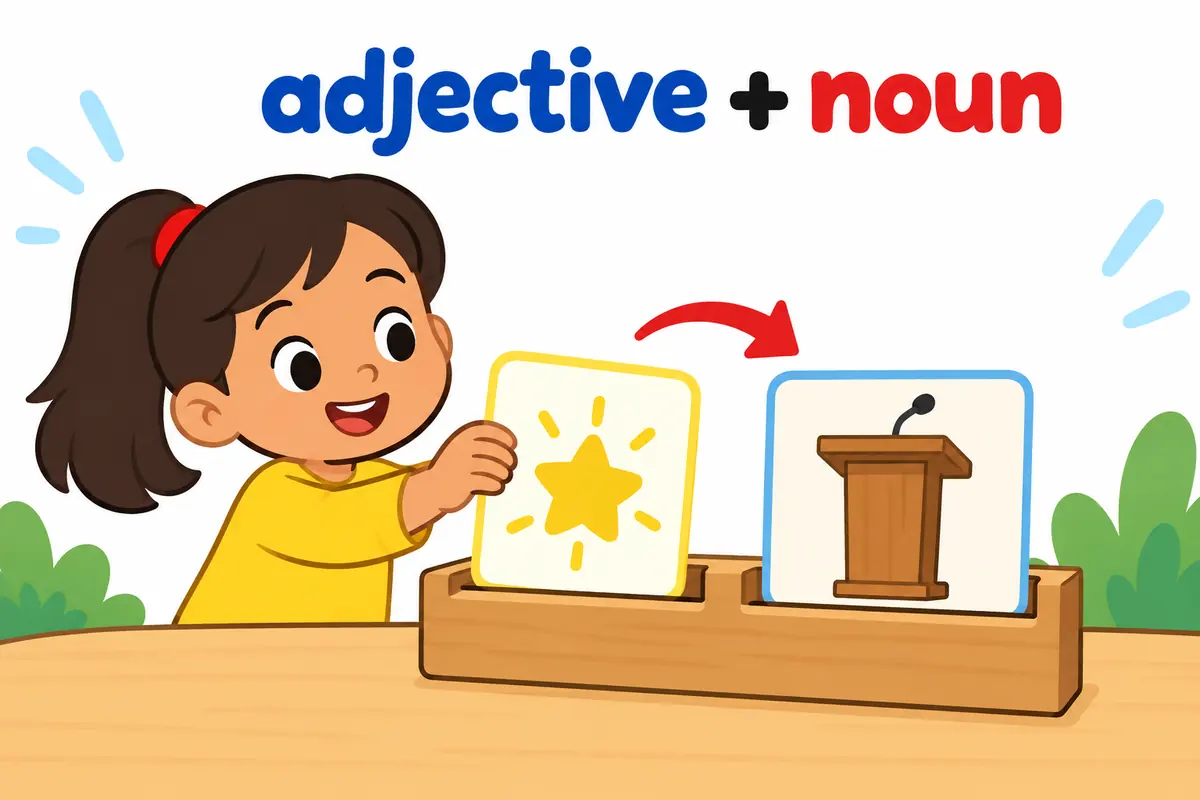
The adjective bends to the noun it describes rather than taking an object. Four patterns cover almost every real sentence, and the attributive one dominates writing because the judgement lands before the reader meets the claim.
| Pattern | Example | What it signals |
|---|---|---|
| grandiloquent + noun | The report ended with a grandiloquent peroration. | The judgement falls on the thing described. |
| be + grandiloquent | The closing speech was grandiloquent from the first line. | The whole utterance is judged at once. |
| grandiloquent + language / rhetoric / prose | Grandiloquent language buried a simple request. | The common collocations name the kind of wording. |
| more / most + grandiloquent | His second draft grew even more grandiloquent. | Compares two styles without changing the noun. |
| grandiloquently + verb | She grandiloquently thanked the committee. | The adverb flags how the action was performed. |
The collocation grandiloquent language sounds native because it names the material being judged; grandiloquent words sounds translated, since speakers reach for big words when they mean individual terms.
Grandiloquent in a sentence: examples across contexts
Grandiloquent travels across registers without changing meaning, but the target shifts from a single phrase to a whole public style.
| Context | Example sentence | Why this works |
|---|---|---|
| Book review | The memoir is grandiloquent where it should be plain. | Contrasts the word with the plainer style the critic wants. |
| Literature essay | Dickens mocks grandiloquent parliamentary speech in the novel. | Names a specific kind of public language. |
| Political commentary | The manifesto’s grandiloquent promises dissolved on contact with the budget. | Sets inflated words against a hard fact. |
| Classroom feedback | Swap the grandiloquent phrases for one clear sentence. | Turns the word into usable advice for a student. |
| Conversation | He gets grandiloquent after two coffees. | Uses the word teasingly about a person’s manner. |
| Editorial writing | A grandiloquent apology convinced nobody. | Judges a public act of language. |
| Speechwriting notes | Cut the grandiloquent opening and start with the number. | Directs a revision with a concrete instruction. |
| Translation review | The translation turned a blunt line into grandiloquent prose. | Compares two versions of the same text. |
| Social media | The caption is grandiloquent for a photo of a sandwich. | Shows the comic mismatch of style and subject. |
Only the review, the essay and the editorial would appear in formal writing; the conversational pair shows the word survives in speech mainly as a tease.
Grandiloquent vs pompous
Grandiloquent and pompous both criticise self-importance, but they aim at different targets: grandiloquent judges the language, pompous judges the person or the manner. A bombastic speech is loud and inflated in delivery, while grandiloquent prose is inflated on the page. Where the aim is to seem cultured rather than merely loud, pretentious is the sharper word.
| Attribute | grandiloquent | pompous |
|---|---|---|
| What it judges | Language and style | A person or manner |
| Core complaint | Words are inflated to impress | Self-importance is displayed |
| Typical target | Speeches, prose, rhetoric | Officials, lectures, ceremonies |
| Part of speech | Adjective | Adjective |
| Closest plain word | Overwrought | Self-important |
Verdict: use grandiloquent when the words are the problem, pompous when the person is, and pretentious when the pose of culture is the problem.
Word forms and grammar of grandiloquent
The adjective has a noun and an adverb built on the same root, and learners sometimes invent a form that does not exist.
| Form | Part of speech | Example |
|---|---|---|
| grandiloquent | adjective | A grandiloquent closing line spoiled the memo. |
| grandiloquence | noun | The speech was all grandiloquence and no plan. |
| grandiloquently | adverb | He grandiloquently announced the results. |
| more grandiloquent | comparative adjective | The rewrite is more grandiloquent than the original. |
| grandiloquous | non-standard adjective | Not used; choose grandiloquent instead. |
Two neighbours share the root without sharing the meaning. Its cousin grandiose judges ambition or scale, while the noun grandiosity names that inflated sense of importance in a person or a plan.
Common mistakes with grandiloquent
- Incorrect:
The speech was very grandiloquently.Correct: The speech was very grandiloquent. Rule: After the verb be, use the adjective, not the adverb. - Incorrect:
The grandiloquence speech impressed the hall.Correct: The grandiloquent speech impressed the hall. Rule: A noun cannot describe another noun; use the adjective before the noun. - Incorrect:
He spoke grandiloquent at the dinner.Correct: He spoke grandiloquently at the dinner. Rule: A verb needs the adverb, not the adjective. - Incorrect:
Her short, clear note was grandiloquent.Correct: Her short, clear note was blunt. Rule: Grandiloquent means inflated and pompous, so it cannot describe plain, clear writing. - Incorrect:
The instructions were grandiloquent and easy to follow.Correct: The instructions were wordy and hard to follow. Rule: Grandiloquent implies the wording obscures the point, not that it helps.
Practice using grandiloquent
These six items mix gap-filling, correction and register choice; check the reason with each answer.
- Fill the gap: The mayor’s ______ tribute lasted twenty minutes and said nothing.
- Choose the better word: The memo was (grandiloquent / plain) because it listed three clear steps.
- Correct the error: She accepted the prize grandiloquent.
- Build a sentence: use grandiloquent about a speech of long words that hides a simple promise.
- Spot the register: which fits a book review — a grandiloquent passage of prose, or a grandiloquent sandwich?
- Rewrite with the noun: The speech was grandiloquent. Use grandiloquence instead.
Answers
- grandiloquent — the empty, inflated tribute is exactly what the adjective judges.
- plain — the memo gives clear steps, so grandiloquent would contradict the evidence.
- She accepted the prize grandiloquently — a verb needs the adverb form.
- Model answer: The closing speech was grandiloquent, promising everything in words nobody could follow.
- A grandiloquent passage of prose — a review judges writing, not a snack.
- The speech was all grandiloquence — the noun needs a verb such as was or became.
The bottom line
Use grandiloquent in a sentence when inflated, pompous wording is the fault, and keep the adjective in front of the noun it judges. Two points settle most cases: the word is a criticism rather than a compliment, and it targets language rather than the speaker. When the writing is merely formal, formal or overwrought describes it without the extra sting.
Frequently asked questions about grandiloquent
Is grandiloquent a compliment?
Grandiloquent is a criticism, not praise. It says the language is inflated to seem important, so a reviewer who calls a speech grandiloquent is faulting its style. A compliment for impressive language would be eloquent or stirring; grandiloquent keeps a note of disapproval.
What is the noun form of grandiloquent?
The noun is grandiloquence, meaning the quality of pompously elaborate language, as in the grandiloquence of the closing speech. The adverb is grandiloquently, as in she addressed the hall grandiloquently. All three share one root and one judgement, so none of the forms is neutral.
Does grandiloquent mean the same as grandiose?
No. Grandiloquent judges language that is pompously elaborate, while grandiose judges plans, claims or scale as absurdly ambitious. A grandiloquent letter uses swollen words; a grandiose scheme aims too high. The roots overlap, but one word targets style and the other targets ambition.
Can grandiloquent describe writing rather than speech?
Yes, and written examples are often clearer: a grandiloquent memo, a grandiloquent tribute, a grandiloquent passage of prose. Because writing can be reread, inflated phrasing stands out on the page. The word works the same way for any language, spoken or written.
In a sentence, grandiloquent describes language or a style that sounds elaborate and self-important, often with a critical edge. Cambridge Dictionary labels the adjective formal and mainly disapproving; use it when the wording seems designed to impress, not merely because a speaker chose a long word.
- Part of speech: adjective.
- Common nouns it modifies: language, speech, style, claim, phrase.
- Tone: formal and usually disapproving.
- Core test: does the wording inflate importance or seek admiration?
What does grandiloquent imply?
Grandiloquent combines elaborateness with an impression of inflated importance. Cambridge’s definition centers on complicated language meant to attract admiration or attention, especially to make someone or something seem important. A genuinely eloquent speech can be elegant and persuasive without being grandiloquent; the latter suggests excess or posturing.
| Word | Main idea | Example |
|---|---|---|
| Grandiloquent | Overly elaborate or self-important language | “The grandiloquent announcement promised a revolution but named no concrete change.” |
| Eloquent | Fluent, expressive, persuasive language | “Her eloquent testimony made the issue clear.” |
| Verbose | More words than needed | “The verbose instructions repeated the same step.” |
| Pretentious | Trying to seem more important or sophisticated | “The pretentious note used jargon where a plain explanation would work.” |
How should grandiloquent be used in a sentence?
Place grandiloquent before a noun such as speech, style, or claim, or after a linking verb: “The speech sounded grandiloquent.” The word has a critical tone, so it can make the writer’s judgment clear even when the sentence is grammatically neutral.
For a sharper sentence, show the gap between grand language and modest substance: “His grandiloquent proposal promised a new era but offered no budget or timetable.” For a neutral description of impressive speaking, choose eloquent, formal, or ceremonial instead. “Long” alone is not enough to establish that a passage is grandiloquent.

Common usage questions
Is grandiloquent always an insult? It is mainly disapproving in Cambridge Dictionary, so it often signals criticism, though a writer can use it playfully or descriptively when context makes the tone clear.
Can a person be grandiloquent? Yes. The adjective can describe a person’s way of speaking or writing, but it more precisely modifies the language, speech, or style itself.
Frequently Asked Questions About Grandiloquent
Is grandiloquent always negative? The adjective is formal and mainly disapproving, according to Cambridge Dictionary, because it often suggests inflated expression. A writer may use it humorously or neutrally, but readers will usually hear a criticism of the style.
What nouns commonly follow grandiloquent? Grandiloquent commonly modifies words such as speech, language, style, claim, or phrase. These nouns identify the expression being judged rather than implying that every formal speaker is pompous.
What is the adverb form of grandiloquent? The adverb is grandiloquently: “The candidate spoke grandiloquently about a plan that remained vague.” The adverb describes how someone speaks or writes and retains the original word’s critical tone.
How is grandiloquent different from eloquent? Eloquent praises clear, expressive, persuasive language; grandiloquent often criticizes language that seems too elaborate or self-important. A speech can be eloquent without being grandiloquent, and can be both if expressive skill is paired with excessive pomp.
Do you find yourself bewildered by grandiloquent language in writing or speech? Grandiloquent refers to extravagant, pompous, or lofty language that is meant to impress or be over-the-top in style.
In literature and formal contexts, grandiloquent language can be used to convey importance or create a dramatic effect. However, it can also come across as pretentious or insincere if not used effectively.
7 Examples Of Grandiloquent Used In a Sentence For Kids
- The king’s speech was grandiloquent and filled with important words.
- She wrote a grandiloquent story with lots of big, fancy words.
- The magician used grandiloquent language to wow the audience.
- The queen’s dress was grandiloquent and sparkly.
- The elephant’s trumpet was grandiloquent and loud.
- The lion roared in a grandiloquent manner to show his strength.
- The peacock displayed his feathers in a grandiloquent fashion.
14 Sentences with Grandiloquent Examples
- Grandiloquent speeches are often delivered by the guest speakers during college events.
- The professor’s grandiloquent vocabulary can sometimes confuse students during lectures.
- Many students tend to use grandiloquent language in their essays to appear more sophisticated.
- The debate team captain’s closing statement was both passionate and grandiloquent.
- Some students find it challenging to decode the meaning behind the professor’s grandiloquent discussions.
- The politician’s grandiloquent promises to improve the education system captured the attention of many college students.
- Grandiloquent language is often employed by students to impress their peers during class presentations.
- The commencement address was filled with grandiloquent phrases inspiring the graduating students.
- The literature professor’s interpretation of the poem was deemed as overly grandiloquent by some students.
- During the Model United Nations conference, delegates engaged in grandiloquent speeches to convey their countries’ positions.
- The student council candidate’s grandiloquent campaign speech captivated the audience during the elections.
- The guest lecturer’s grandiloquent style of delivery made the complex topic more comprehensible to the students.
- The college magazine’s editorial often features grandiloquent language to spark thought-provoking discussions.
- The philosophy professor’s grandiloquent statements led to a lively debate among the students.
How To Use Grandiloquent in Sentences?
To Grandiloquent means to speak or write in a pompous or extravagant manner. Here’s a simple guide on how to use this word in a sentence:
-
Understanding the Meaning: Before using Grandiloquent in a sentence, make sure you understand its definition. Remember that it signifies language that is showy, exaggerated, or overly elaborate.
-
Choosing the Right Context: Decide on a situation where the word Grandiloquent fits best. You could use it to describe a flowery speech, a verbose writer, or an ostentatious speaker.
-
Constructing the Sentence: When constructing your sentence, remember to place Grandiloquent in a way that clearly conveys its meaning. For example, “She delivered a grandiloquent speech filled with excessive flattery and exaggerated promises.”
-
Practice: Try incorporating the word Grandiloquent into everyday conversation or writing to become more familiar with its usage. The more you use it, the more natural it will feel.
-
Seek Feedback: If you’re unsure about your usage of Grandiloquent, don’t hesitate to ask for feedback. This can help you better understand how to incorporate the word effectively.
Remember, using Grandiloquent in a sentence is a great way to impress others with your vocabulary and communication skills. Just practice, seek feedback, and soon you’ll be comfortable incorporating this word into your everyday language.
Conclusion
In conclusion, grandiloquent language, characterized by its extravagant and pompous nature, may be impressive but can also come across as pretentious and insincere. Using grandiloquent sentences in writing or speech can often alienate rather than engage an audience, as it can be perceived as overly ornate and lacking in authenticity. It is important to use language that is clear, concise, and genuine to effectively communicate ideas and connect with others.
While grandiloquent sentences can showcase a wide vocabulary and demonstrate linguistic prowess, it is crucial to strike a balance between eloquence and clarity. By opting for simpler and more straightforward language, one can convey messages with greater impact and resonance. Ultimately, effective communication is about expressing ideas in a way that is easily understood and meaningful to the intended audience, rather than merely showcasing linguistic flamboyance.


