Gravitational Force in a Sentence: Meaning and Examples
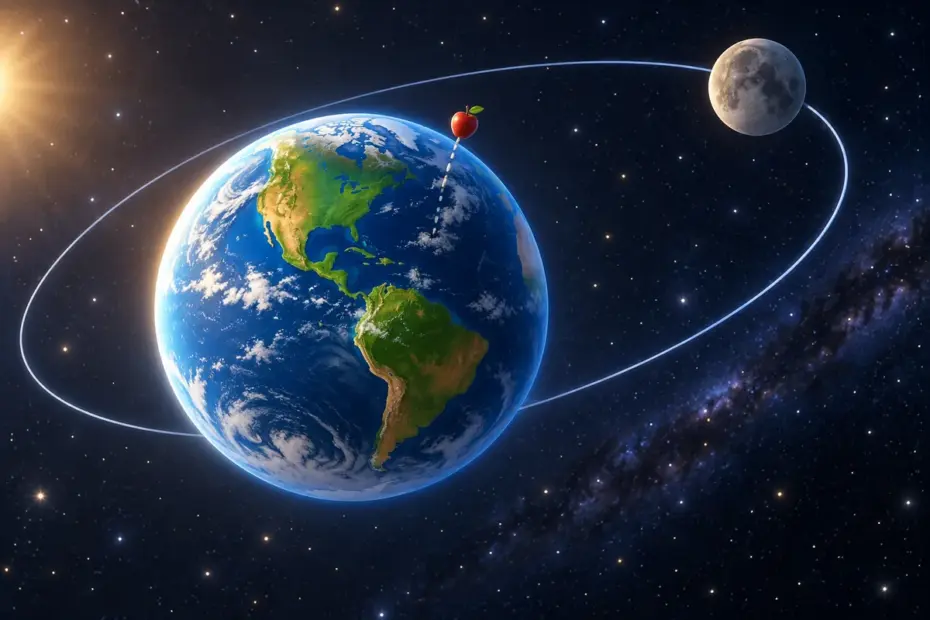
Gravitational force is the attraction between objects with mass. A sentence can use the term for an object’s weight near Earth, the pull between Earth and Moon, or Newton’s law: the force increases with mass and decreases as the square of the distance between the objects’ centers grows.
Key facts at a glance
- Gravitational force attracts any two objects with mass.
- Newton’s law depends on both masses and center-to-center distance.
- Doubling the distance reduces the modeled force to one quarter.
- Near Earth, an object’s weight is its gravitational force.
- Gravity still acts on spacecraft in orbit.
What does gravitational force mean?
Gravitational force is the attractive interaction between objects that have mass. Newton’s law describes the force between two masses as F = Gm₁m₂/r², where m₁ and m₂ are the masses, r is the distance between their centers, and G is the gravitational constant.
The equation makes two relationships clear: increasing either mass strengthens the attraction, while increasing separation weakens it rapidly. This formula is a useful Newtonian model for many ordinary and astronomical examples; precise descriptions of very strong gravity require Einstein’s theory of general relativity.
| Term | Meaning | Example sentence |
|---|---|---|
| gravitational force | Attraction between masses | “Earth’s gravitational force pulls the pebble downhill.” |
| weight | The gravitational force acting on an object | “The astronaut’s weight changes with the local gravity.” |
| gravitational acceleration | Acceleration caused by a gravitational field | “Near Earth’s surface, gravitational acceleration is about 9.8 m/s².” |
How does mass and distance affect the force?
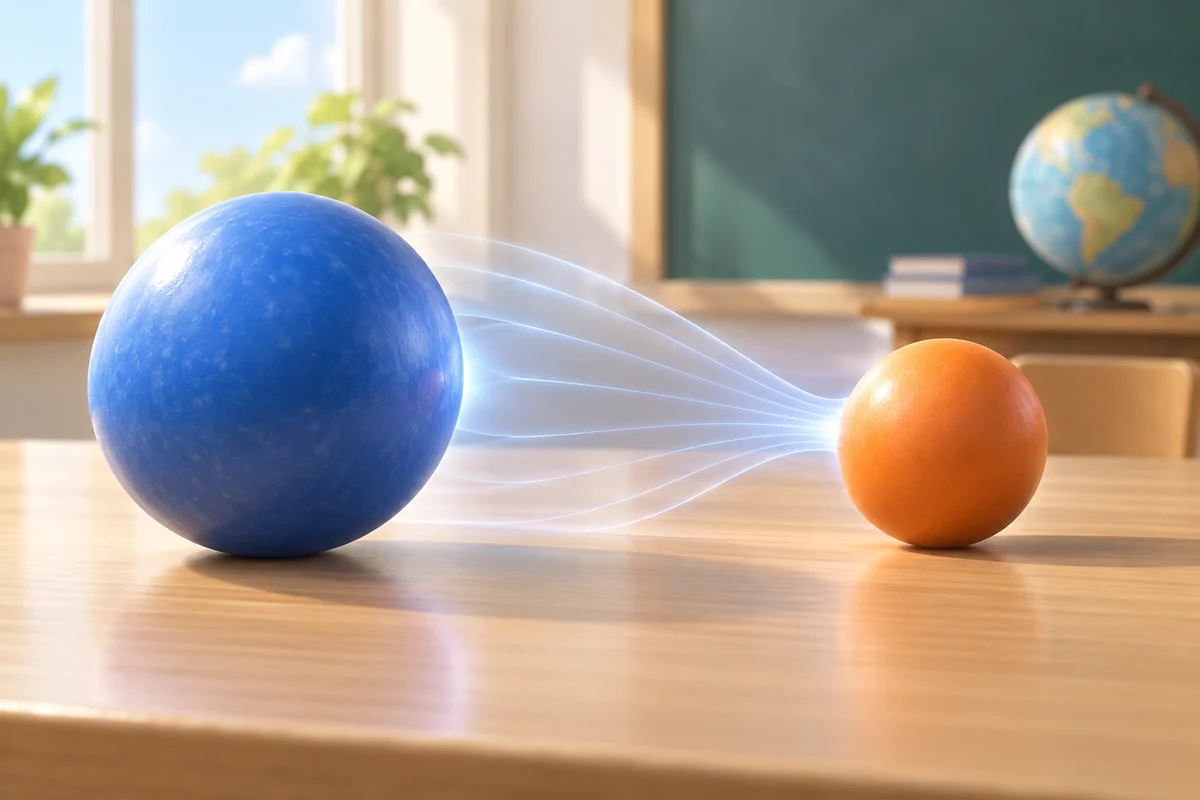
At the same distance, doubling one mass doubles the Newtonian gravitational force. At the same masses, doubling the distance between centers makes the force one quarter as strong because distance is squared in the denominator.
- Double one mass: force becomes 2 times as strong.
- Double both masses: force becomes 4 times as strong.
- Double the distance: force becomes 1/4 as strong.
- Triple the distance: force becomes 1/9 as strong.
For example, two identical balls exert a much smaller gravitational pull on each other than Earth exerts on either one because Earth’s mass is vastly larger. The balls still attract each other; the force is simply too small to notice in an ordinary room.
How is gravitational force different from mass?
Mass is an object property; gravitational force is a pull between masses. Near Earth, NASA expresses an object’s weight as W = mg, where m is its mass and g is local gravitational acceleration. Earth’s surface value is about 9.8 meters per second squared.
A 10-kilogram object therefore has a weight of about 98 newtons near Earth’s surface. On the Moon, its mass remains 10 kilograms, but its weight is lower because the Moon’s gravitational field is weaker. In everyday conversation people often use “weight” for kilograms, but physics distinguishes mass from force.
Does gravitational force disappear in orbit?
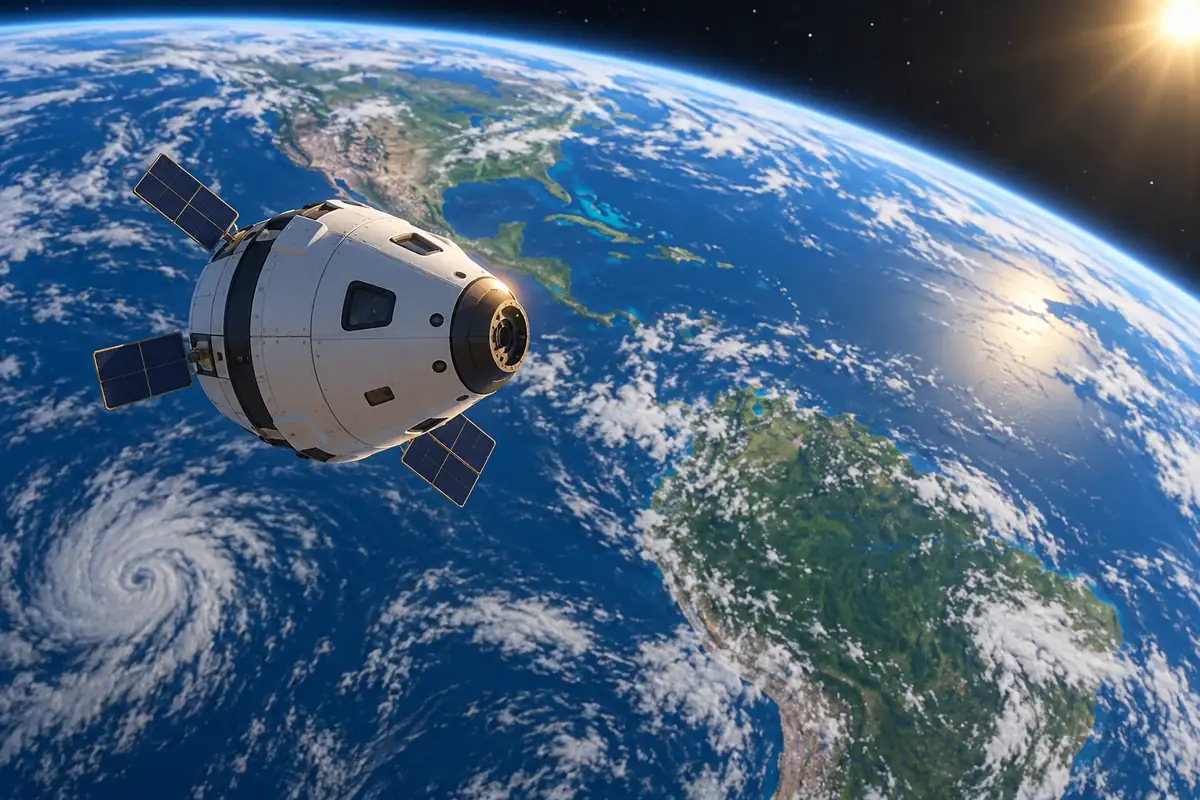
No. Earth’s gravity still pulls on satellites and astronauts in orbit. Their orbital motion creates continuous free fall: they move forward fast enough that their falling path curves around Earth instead of reaching the surface.
That is why “weightless” does not mean that gravity has stopped acting. NASA’s orbital examples show that a spacecraft hundreds of miles above Earth still experiences most of the gravitational acceleration found at the surface. The phrase apparent weightlessness more accurately describes the sensation inside a freely falling spacecraft.
Frequently asked questions
What makes gravitational force stronger?
Gravitational force grows when either object has more mass and weakens as the distance between their centers increases. Newton’s equation uses the product of the two masses divided by distance squared: doubling one mass doubles the force, while doubling the distance reduces it to one quarter.
Is there gravity in orbit?
Yes. Objects in orbit remain under Earth’s gravitational pull; their sideways speed makes them continually fall around the planet rather than directly to the ground. NASA notes that a spacecraft in low Earth orbit still has substantial weight, so “zero gravity” is an imprecise shorthand for apparent weightlessness.
Is gravitational force the same as mass?
No. Mass measures how much matter an object contains, while gravitational force is an interaction between masses. Near Earth, an object’s weight is the force of Earth’s gravity on it; the same object has the same mass on the Moon but a different weight because the local gravitational field is weaker.
How can I use gravitational force in a sentence?
Use gravitational force as a noun phrase naming the attraction between masses: “The gravitational force between Earth and the Moon helps shape the Moon’s orbit.” For an everyday example, write “The gravitational force of Earth pulls the dropped ball toward the ground.”
Conclusion
Use gravitational force for the attraction between masses, and distinguish that force from mass itself. Newton’s equation makes the effects of mass and distance explicit; near Earth, weight is the familiar gravitational force on an object, and it remains present in orbit.
Sources
Have you ever wondered what exactly is meant by the term “gravitational force”? Well, gravitational force is a fundamental concept in physics that describes the attractive force exerted between two masses due to their mass and proximity. It is responsible for keeping the planets in orbit around the sun and objects grounded on Earth.
Understanding gravitational force is essential for comprehending many phenomena in the universe, such as why objects fall towards the Earth or why the moon stays in orbit around our planet. By exploring the effects of gravity on various objects, scientists and researchers can make accurate predictions and calculations about celestial bodies and their motions.
7 Examples Of Gravitational Force Used In a Sentence For Kids
- Gravitational force pulls things towards the ground.
- We feel the gravitational force every day.
- The moon has gravitational force too.
- Gravitational force helps us stay on the earth.
- Planets have gravitational force too.
- Gravitational force keeps us from floating away.
- Without gravitational force, we would all float in space.
14 Sentences with Gravitational Force Examples
- Gravitational force is what keeps us grounded on the earth’s surface.
- Understanding the concept of gravitational force is crucial in physics lectures.
- The calculations involving gravitational force can be quite complex but rewarding.
- To fully comprehend gravitational force, one must grasp the principles of Newton’s laws of motion.
- The importance of gravitational force can be seen in the orbits of planets around the sun.
- Gravitational force plays a key role in determining the weight of objects on different planets.
- College students often conduct experiments to observe the effects of gravitational force.
- Studying the effects of gravitational force on falling objects can help in understanding motion concepts.
- Gravitational force is what allows us to walk on the surface of the moon despite the lower gravity.
- The University’s physics department offers advanced courses on gravitational force and its applications.
- Examining the relationship between mass, distance, and gravitational force can lead to insightful discoveries.
- College laboratories provide equipment to measure and analyze the effects of gravitational force accurately.
- The study of gravitational force is essential for various engineering disciplines, including aerospace and civil engineering.
- College projects often involve calculating the gravitational force acting on different objects to predict their motion accurately.
How To Use Gravitational Force in Sentences?
Gravitational force is the attraction that two objects with mass have for each other. This force depends on the masses of the objects and the distance between them. Here is how you can use “Gravitational Force” in a sentence:
- “The gravitational force between the Earth and the Moon keeps the Moon in orbit around our planet.”
To use “Gravitational Force” in a sentence, first, identify the two objects that are exerting the force. Then, mention how the force is acting between them. You can also describe how the force affects the objects involved.
- “The gravitational force pulls the apple downward towards the Earth when it falls from the tree.”
Remember to mention the direction in which the force is acting. In this case, the apple is being pulled downward towards the Earth by the force of gravity.
- “The gravitational force between two massive stars can cause them to orbit each other in space.”
When discussing celestial bodies, you can highlight how gravitational force plays a crucial role in keeping them in their respective orbits or causing them to move around each other.
By following these examples, you can effectively incorporate “Gravitational Force” into your sentences, explaining how it influences the interactions between objects with mass.
Conclusion
In conclusion, sentences with “gravitational force” describe the mutual attraction between objects with mass. For example, “The gravitational force between the Earth and the Moon causes tides to occur” illustrates how this force influences natural phenomena. Another sentence like “The gravitational force of the Sun keeps the planets in orbit around it” demonstrates how this fundamental force governs the motion of celestial bodies in our solar system.
Understanding gravitational force is crucial in explaining the motion and interactions of objects in the universe. By recognizing its significance, we can comprehend phenomena ranging from the fall of an apple to the formation of galaxies. These sentences provide simple and clear explanations of gravitational force, shedding light on its pervasive influence in the cosmos.