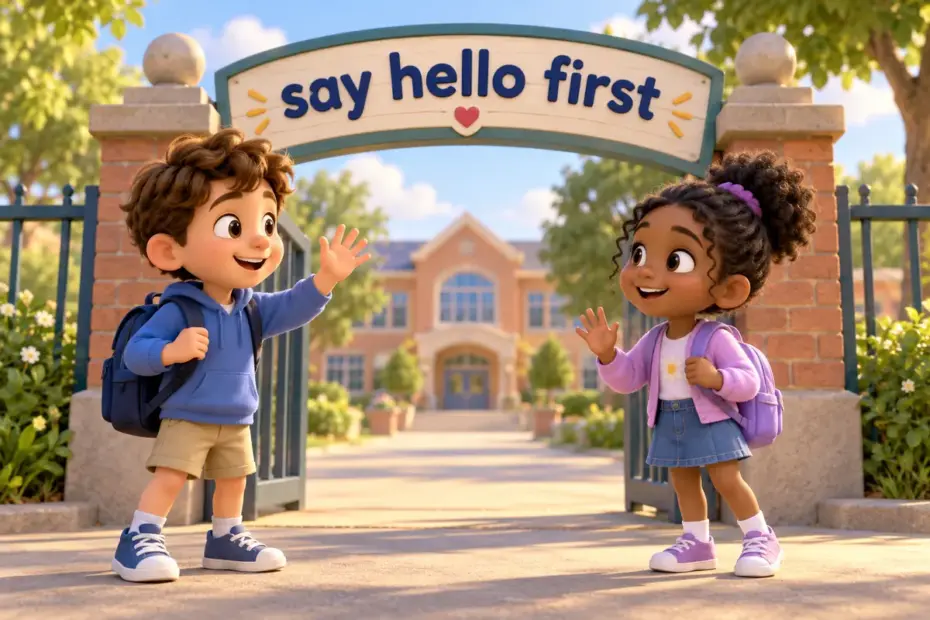
Greetings in English for kids are the short phrases that open a conversation, such as hello, hi, good morning and good afternoon. Each greeting fits a time of day or a level of politeness, so children learn to choose one and expect a reply. “Good morning, Miss Lee,” greets a teacher at the start of class.
Greetings in English for kids at a glance
- A greeting is a short opening phrase such as hello, hi or good morning.
- Greetings change with the time of day, the person and the setting.
- Children learn greetings fastest by copying adults and saying them out loud.
- A greeting usually expects a reply, so hello is often answered with hello.
- The commonest mistake is using a casual hi with a teacher on a formal occasion.
What are greetings in English for kids?
A greeting in English for kids is a fixed opening phrase that starts a conversation or marks an arrival. The phrases fall into clear groups: time-of-day greetings such as good morning, friendly greetings such as hi and hey, and formal greetings such as good evening. Which group a child uses depends on who is being greeted and where the meeting takes place.
| Group | Examples | Example sentence |
|---|---|---|
| Time of day | good morning, good afternoon, good evening | Good morning, everyone. |
| Friendly | hi, hey, hello there | Hi, Ben, it is nice to see you. |
| Formal | good evening, welcome, how do you do | Good evening, Dr Patel. |
| Farewell | goodbye, bye, see you later | Goodbye, see you tomorrow. |
| Celebration | happy birthday, happy new year | Happy birthday, Grandma. |
Time-of-day greetings carry the clearest rule, because the words name the part of the day. Morning runs from waking until noon, afternoon runs until early evening, and evening covers the rest of the day. A child who checks the hour first rarely says good morning at bedtime, which is the slip teachers hear most often. One honest caution is worth stating plainly: a greeting opens an exchange and then stops, so it cannot replace a question, a thank-you or an apology.
How do you use greetings in English for kids?
Every greeting follows a small pattern that a child can reuse with a new name or a new time of day. The pattern tells the listener who is being greeted and how friendly the moment should sound.
| Pattern | Example | What it signals |
|---|---|---|
| Greeting + name | Hello, Mia. | polite and personal |
| Greeting + name + question | Hi Sam, how are you? | friendly, invites a reply |
| Greeting + title | Good morning, Mr Jones. | respect toward an adult |
| Time greeting + group | Good afternoon, class. | addresses many people at once |
| Greeting + farewell promise | Bye, see you tomorrow. | warm and specific goodbye |
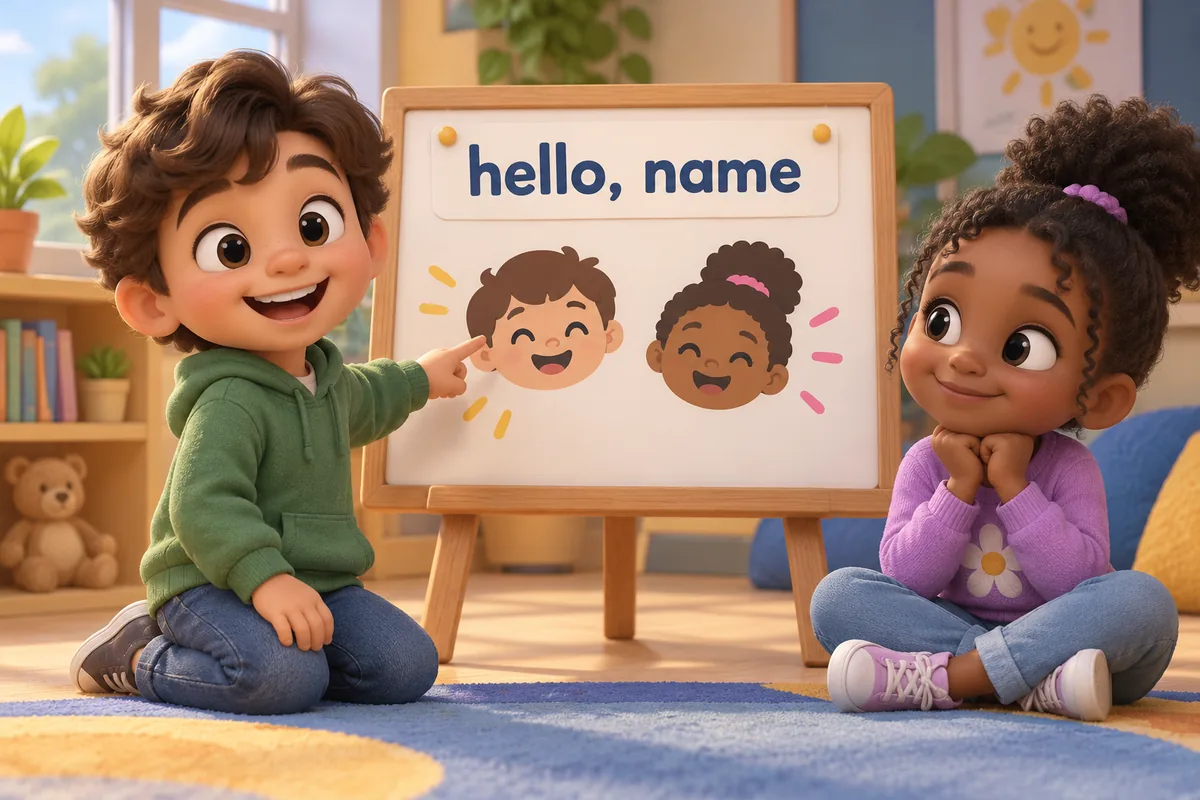
Greetings in English for kids across contexts
Greetings appear wherever children meet people, from the school gate to a video call. New words make the greetings easier to vary, and lists such as a words for kids and b words for kids give children fresh vocabulary to slot into everyday exchanges.
| Context | Example sentence | Why this works |
|---|---|---|
| Classroom entry | Good morning, Miss Lee. | time greeting with a title |
| School assembly | Good morning, everyone. | greets the whole group |
| Playground | Hi, Aisha, want to play? | casual opener with an invitation |
| Family breakfast | Morning, Dad. | short and warm at home |
| Answering the phone | Hello, who is calling? | neutral and clear |
| Shop counter | Good afternoon, may I have a bag? | polite in public |
| Doctor waiting room | Good morning, I have an appointment. | calm and respectful |
| Birthday card | Happy birthday, and many more. | a celebration greeting in writing |
| Bedtime | Good night, sleep well. | correct farewell before sleep |
| Sports club | Hey team, ready to warm up? | friendly address to peers |
| Video call | Hello everyone, can you hear me? | greets a group on screen |
| Visiting a neighbour | Good evening, thank you for having us. | formal warmth at a doorway |
Which greeting should a child choose?
The right greeting matches the setting and the person, not the child’s mood. A quick check of the hour and the audience settles it in a second.
| Setting | Best choice | Weaker choice | Reason |
|---|---|---|---|
| To a teacher | Good morning, Sir. | Hi, mate. | the formal register suits adults |
| To a friend at noon | Hi, Aisha! | Good evening, Aisha. | a time greeting must match the hour |
| Leaving for bed | Good night, Mum. | Good evening, Mum. | good night is said before sleep |
| Joining a group call | Hello everyone. | Hey you. | a group needs a clear, kind opener |
| Welcoming a visitor | Welcome, please come in. | Hey. | a guest is greeted with warmth and manners |
Two habits make the choice automatic. The first is to look at the person, because a name or a title such as Mr or Doctor signals the formal set, while a nickname signals the friendly set. The second is to listen to the reply, since people usually answer with the same warmth they receive. Matching that warmth keeps an exchange comfortable for both sides, and it teaches a child to read the moment rather than repeat one phrase.
Words and phrases linked to greetings
A greeting belongs to a family of words, and seeing the whole family helps a child pick the right form. Young readers can group goodbye and goodnight with compound words for kids, then describe the mood of a greeting with adjectives for kids such as warm, polite and cheerful.
| Word | Type | Example |
|---|---|---|
| greet | verb | I greet my neighbour each morning. |
| greeting | noun | She gave me a warm greeting. |
| greetings | noun, plural | Greetings to your whole family. |
| greeted | past verb | We greeted the new pupil at the door. |
| goodbye | compound noun | He waved a cheerful goodbye. |
Common mistakes with greetings
Mistake 1: greeting at the wrong time. Incorrect: Good night, Miss Lee, good morning. Correct: Good morning, Miss Lee. Rule: good night is a farewell before sleep, never an arrival greeting.
Mistake 2: using a casual opener with an adult. Incorrect: Hey, Dr Patel, good to see you. Correct: Good morning, Dr Patel. Rule: match the greeting to the formality of the person.
Mistake 3: leaving the greeting without a name. Incorrect: Hello, you. Correct: Hello, Sam. Rule: adding the name makes a greeting personal.
Mistake 4: forgetting the capital letter. Incorrect: hello, everyone. Correct: Hello, everyone. Rule: a greeting starts a sentence, so it takes a capital.
Mistake 5: writing hi in a formal letter. Incorrect: Hi Sir, I am writing to apply. Correct: Dear Sir, I am writing to apply. Rule: letters open with dear, not with a spoken greeting.
Mistake 6: mixing two greetings awkwardly. Incorrect: Hello good morning, everyone. Correct: Good morning, everyone. Rule: one greeting is enough in a single line.
Practice using greetings in English for kids
- Fill in the blank: ___ morning, class, please sit down.
- Choose the better greeting: (Hi, Tom / Good evening, Tom) at two o’clock in the afternoon.
- Correct the error: Good night, teacher, as she walks in at nine.
- Build a sentence: greet a friend and invite them to play.
- Spot the register: which greeting suits a letter to a head teacher, (a) Hello, or (b) Dear Sir or Madam?
- Fill in the blank: Good ___ , Mum, I am going to bed.
Answers
- Good, because a class at the start of the day takes a time greeting.
- Hi, Tom, because good evening belongs to the evening, not the afternoon.
- Good morning, teacher; good night is only a farewell before sleep.
- Hi, Sam, do you want to play in the garden?
- (b), because a formal letter opens with dear, not with a spoken greeting.
- night, because good night is the farewell said before bed.
The bottom line
Greetings in English for kids are short, fixed phrases that open a conversation, and the useful skill is choosing the right one for the person and the hour. Time greetings such as good morning suit the classroom, casual ones such as hi fit friends, and good night closes the day at bedtime. Practise them out loud and a child will use each correctly without thinking.
Frequently asked questions about greetings in English for kids
Which greeting is best for a shy child?
A very short greeting reduces the pressure, so hello or good morning with just the person’s name works well. Practising the phrase at home beforehand helps a shy child deliver it without freezing. A one-word opener still counts as a full and polite greeting, and confidence grows from there.
Is hi less polite than hello?
Both are friendly and acceptable, but hello is the safer choice with adults and in public settings. Hi sounds more casual and fits friends, classmates and family. In a formal letter neither is used, because written openings begin with dear rather than with a spoken greeting.
How do I teach greetings to a preschooler?
Model the greeting first and let the child copy it, because young children learn phrases by imitation rather than by rules. Practise with a puppet or a teddy, then use the same greeting at the same moment each day. Repetition at breakfast and bedtime makes the phrase automatic.
Do children need formal greetings early?
Yes, a few are worth teaching early because they appear at school and family events. Good morning, good evening, welcome and happy birthday cover most occasions a young child meets. The formal set can be small, and the friendly set can carry everyday conversation.