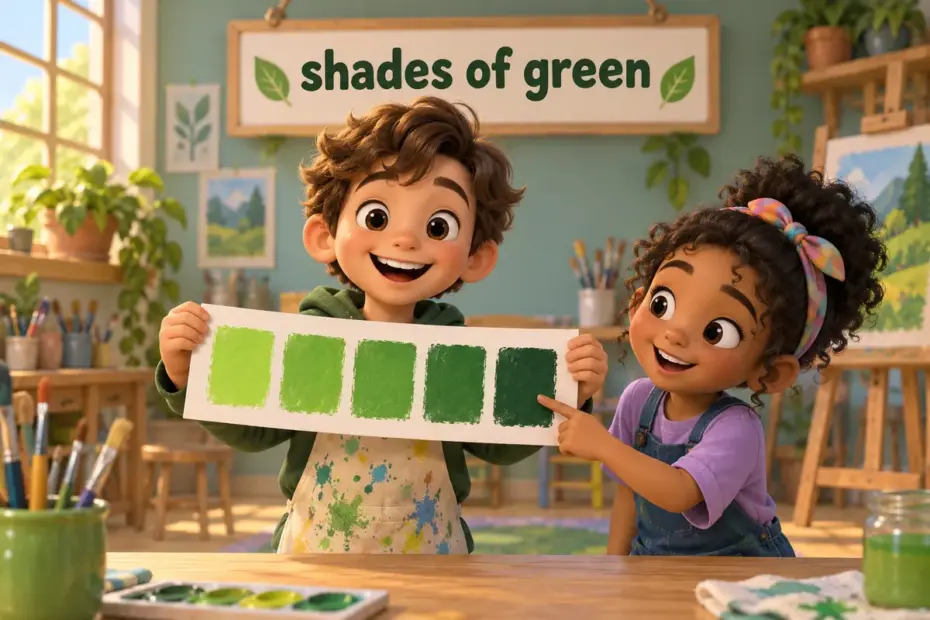
Green color names describe the shades that sit between yellow and blue, from bright lime and soft mint to deep forest green. Each name borrows its shade from a plant, a jewel or a stone, so the word carries both a colour and a picture. Emerald is a jewel green.
Green color names at a glance
- Green is the plain base word, and it works as both an adjective and a noun.
- Named greens such as emerald, jade and olive borrow their shade from a jewel, a stone or a fruit.
- Warm names such as lime and chartreuse lean toward yellow, while cool names such as teal lean toward blue.
- Green forms fixed phrases such as green with envy, a green thumb and as green as grass.
- The commonest error is misspelling the comparative as greenner instead of greener.
What are green color names?
Green color names are the words English uses for the shades that sit between yellow and blue, ranging from the plain word green to specific names borrowed from plants, jewels and minerals. A jewel name such as emerald points to a clear, rich green, while a plant name such as olive points to a dull, yellow-green. A wider family of describing words sits in adjectives for green.
| Name | Shade it suggests | Example |
|---|---|---|
| Green | the plain word for the colour of grass | The field turned green after the rain. |
| Lime | bright, sharp yellow-green | A lime green scarf stood out. |
| Mint | pale, soft green with a cool tone | She painted the bedroom mint. |
| Emerald | rich, clear jewel green | Emerald eyes caught the light. |
| Jade | soft, milky blue-green | A jade bracelet lay on the cloth. |
| Olive | dull, greyish yellow-green | He wore an olive jacket. |
| Sage | soft, grey-green herb tone | Sage walls keep a room calm. |
| Forest green | deep, dark green of trees | Forest green curtains framed the window. |
| Moss | muted, earthy green | Moss green tiles covered the floor. |
| Teal | dark blue-green | A teal shirt matched her bag. |
| Sea green | light blue-green | Sea green water filled the bay. |
| Chartreuse | bright yellow-green | Chartreuse next to pink looks loud. |
| Hunter green | dark, traditional green | Hunter green paint suits a study. |
One honest limit belongs here: green color names are not a fixed standard. Teal sits between green and blue, chartreuse can look almost yellow, and two people may read the same swatch differently. Where a designer needs an exact match, a numbered code serves better than a name, and the plain word green is enough in everyday speech.
How do you use green color names in a sentence?
Green works as an adjective before a noun, and a named shade behaves the same way, often as a compound before the noun it describes.
| Pattern | Example | What it signals |
|---|---|---|
| green + noun | A green door opened slowly. | a simple colour description |
| shade + noun as a compound | A forest-green coat hung by the door. | a specific named shade |
| the + shade + of + noun | The emerald green of the lake was striking. | a colour taken from a thing |
| noun + turns / goes + green | The leaves turn green in spring. | a change of colour |
| green + with + feeling | She was green with envy. | a figurative use of the colour |
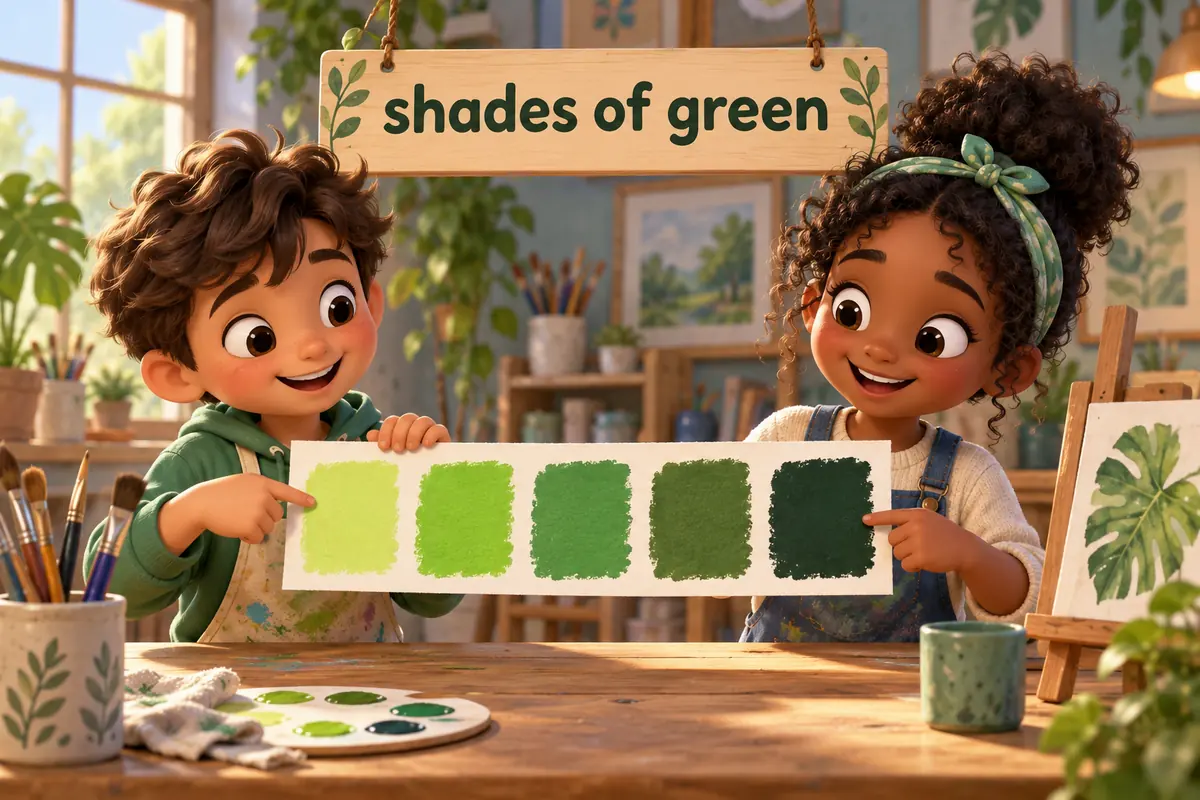
Green color names: examples across contexts
Each setting draws on a different green, and the name usually tells the reader which. The same colour family appears in color adjectives, and a bright contrast sits in adjectives for color blue.
| Context | Example sentence | Why this works |
|---|---|---|
| Classroom | Sort the green swatches from lime to forest green. | a clear sorting task |
| Gardening | The moss green lawn needs less water. | a practical detail |
| Fashion | She chose an olive green jacket. | a specific shade |
| Interior design | Mint walls make a small room feel cool. | a design effect |
| Painting | Add a touch of teal to the green wash. | a mixing instruction |
| Nature writing | Emerald dragonflies skim the pond. | a vivid image |
| Weather | The grey sky showed a band of sea green. | a colour detail |
| Story | His jade green scarf flapped in the wind. | narration |
| Science | Chlorophyll gives leaves their green colour. | a factual note |
| Conversation | Is that jumper sage or olive? | an everyday question |
Which green color name should you use?
Match the name to the surface you are describing, because a jewel green and a plant green give different pictures.
| Situation | Pick | Example |
|---|---|---|
| Painting a calm room | sage or mint | Sage walls keep a room calm. |
| Describing a jewel | emerald | An emerald ring caught the light. |
| Naming a leaf or fruit skin | olive | Olive leaves look duller than grass. |
| A coastal scene | sea green or teal | Sea green water filled the bay. |
| A bold design accent | lime or chartreuse | A lime green scarf stood out. |
The safe default is the plain word green, and a named shade is worth adding only when the reader needs the exact tone. Warm names such as lime suit energy and accents, while cool names such as sage and teal suit calm surfaces and water. Naming the source, as in emerald green or olive green, tells a reader which tone you mean.
Word forms and grammar of green color names
Green changes shape in predictable ways, and the comparative spelling catches most learners.
| Form | Part of speech | Example |
|---|---|---|
| green | adjective | A green bowl sat on the shelf. |
| green | noun | Green is her favourite colour. |
| greens | plural noun | Wash the greens before cooking. |
| greener | comparative adjective | This paint is greener than that one. |
| greenest | superlative adjective | That field is the greenest of all. |
| greenish | adjective | The water looked greenish. |
| greenness | noun | The greenness of the valley surprised us. |
| greenery | noun | Greenery filled the garden. |
Common mistakes with green color names
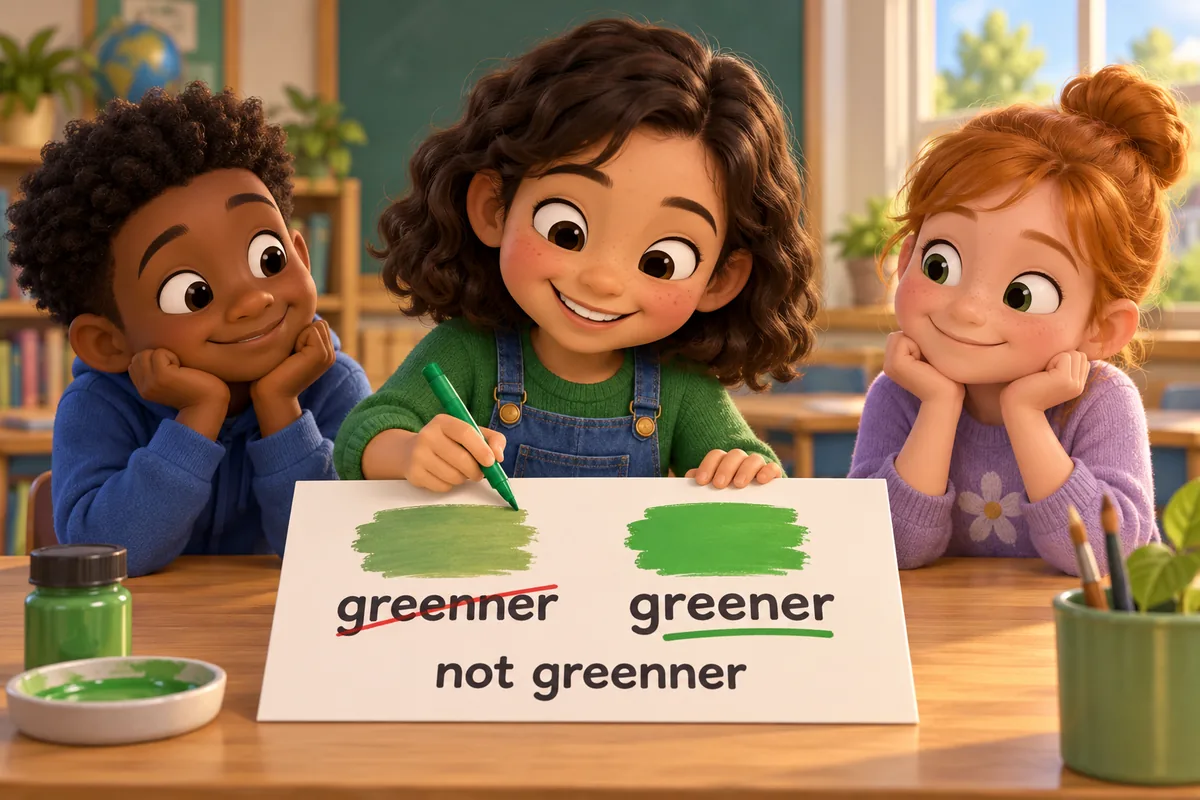
Mistake 1: a faulty comparative. Incorrect: This shade is greenner than that one. Correct: This shade is greener than that one. Rule: green adds -er directly, so the comparative keeps a single n.
Mistake 2: calling teal a pure green. Incorrect: Teal is just a bright green. Correct: Teal is a dark blue-green. Rule: teal sits between green and blue, so a pure-green label is too narrow.
Mistake 3: mixing up greens and green. Incorrect: She cooked some green for dinner. Correct: She cooked some greens for dinner. Rule: the plural noun greens means leafy vegetables, while green is the colour.
Mistake 4: the wrong adjective order. Incorrect: a velvet green old coat. Correct: an old green velvet coat. Rule: age comes before colour, and colour comes before the noun material.
Mistake 5: capitalising an ordinary colour name. Incorrect: She wore a Green hat. Correct: She wore a green hat. Rule: a colour name takes a capital only inside a proper name or a title.
Practice using green color names
- Fill in the blank: A clear, rich jewel green is called ___.
- Choose the better word: Sea water often looks (teal / pure green).
- Correct the error: This leaf is greenner than the last one.
- Build a sentence: use “the + shade + of + noun” with emerald about a lake.
- Spot the register: which suits a paint label, (a) It is sort of greenish, or (b) A soft sage green with a grey undertone?
- Fill in the blank: The leaves turn ___ again in spring.
Answers
- emerald, because emerald is the jewel name for a clear, rich green.
- teal, because teal is the dark blue-green of sea water.
- This leaf is greener than the last one; the comparative adds -er to green.
- The emerald green of the lake was striking.
- (b), because a paint label gives a precise, specific shade.
- green, because leaves gain their colour again in spring.
The bottom line
Green color names turn one broad colour into a precise family, from warm lime and chartreuse to cool teal and sea green. Use the plain word green as the everyday default, add a named shade only when the reader needs the exact tone, and keep the comparative as greener. A figurative use of the colour appears in green eyed monster in a sentence, and a familiar simile sits in green as grass in a sentence.
Frequently asked questions about green
What are some green color names?
Common green color names include lime, mint, emerald, jade, olive, sage, forest green, moss, teal, sea green, chartreuse and hunter green. Each name points to a slightly different tone, so a picture beside the word helps a reader see the shade the writer means.
Is teal a green or a blue?
Teal sits between green and blue, and most people read it as a dark blue-green. In colour terms it leans blue enough that a teal shirt may match blue trousers, so calling it a pure green is too narrow for careful writing.
What does green with envy mean?
Green with envy means feeling jealous of someone else. The phrase treats jealousy as a colour, and the same idea appears in the older expression the green-eyed monster, which stands for jealousy itself rather than a real creature in the room.
Why is the comparative greener and not greenner?
The adjective green adds -er directly to form greener, and the superlative adds -est to form greenest. English does not double the final n here, so greener keeps a single n, unlike short words such as big, which doubles to bigger.