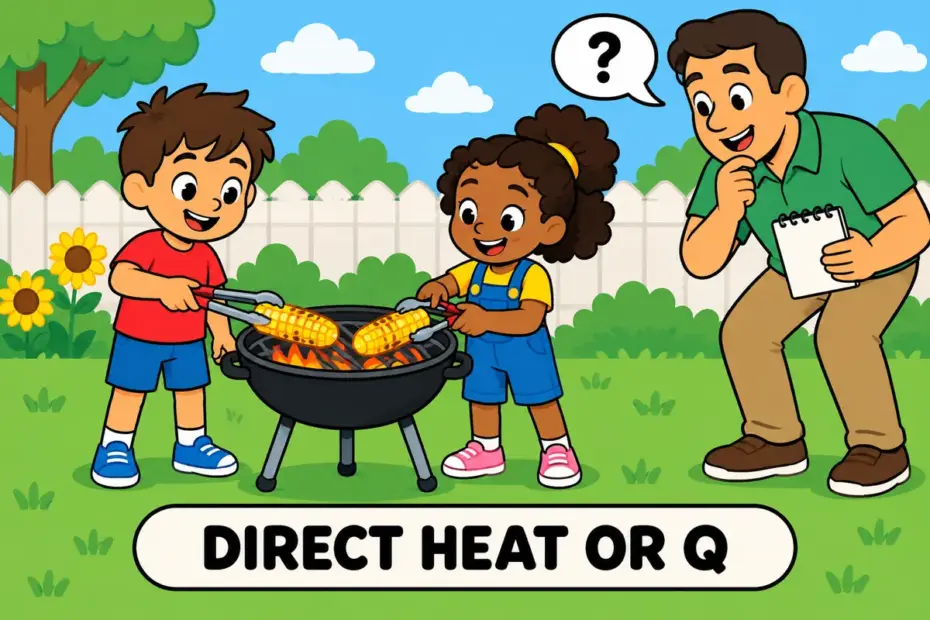
Grill is a noun for the frame you cook on and a verb meaning to cook over high heat or to question someone relentlessly. To use grill in a sentence, match the sense to the object: you grill vegetables, and you also grill a witness.
Grill at a glance
- Grill is both a noun and a verb; the noun is the frame or the meal, and the verb means to cook on it or to question someone hard.
- As a verb it is transitive: you grill vegetables, and you also grill a witness.
- The questioning sense is informal and often implies pressure or hostility.
- Its forms are grills, grilled and grilling, and the derived noun grilling names a harsh questioning.
- The commonest error is using grill for gentle cooking, which calls for bake or steam instead.
What does grill mean?
Grill is a noun meaning a metal frame for cooking over heat, and a verb meaning either to cook on that frame or to question someone intensely. The Cambridge entry for grill lists both the cooking and the questioning senses, and the split matters because one is neutral and the other carries a note of pressure. Where you want a gentle method, cook the vegetables is the plain, method-free verb.
| Sense | Plain meaning | Example sentence |
|---|---|---|
| Noun: cooking frame | A metal grate for cooking over heat | Clean the grill before you use it. |
| Verb: cook | Cook over direct high heat | Grill the peppers until they char. |
| Verb: question | Question someone intensely | Reporters grilled the minister for an hour. |
One limitation is worth stating. Grill is informal in its questioning sense, so a neutral report says questioned or interviewed instead. For cooking, grill names dry, direct high heat, which makes it the wrong verb for boiling, steaming or slow oven cooking, where the accurate words are bake, steam and boil.
How do you use grill in a sentence?
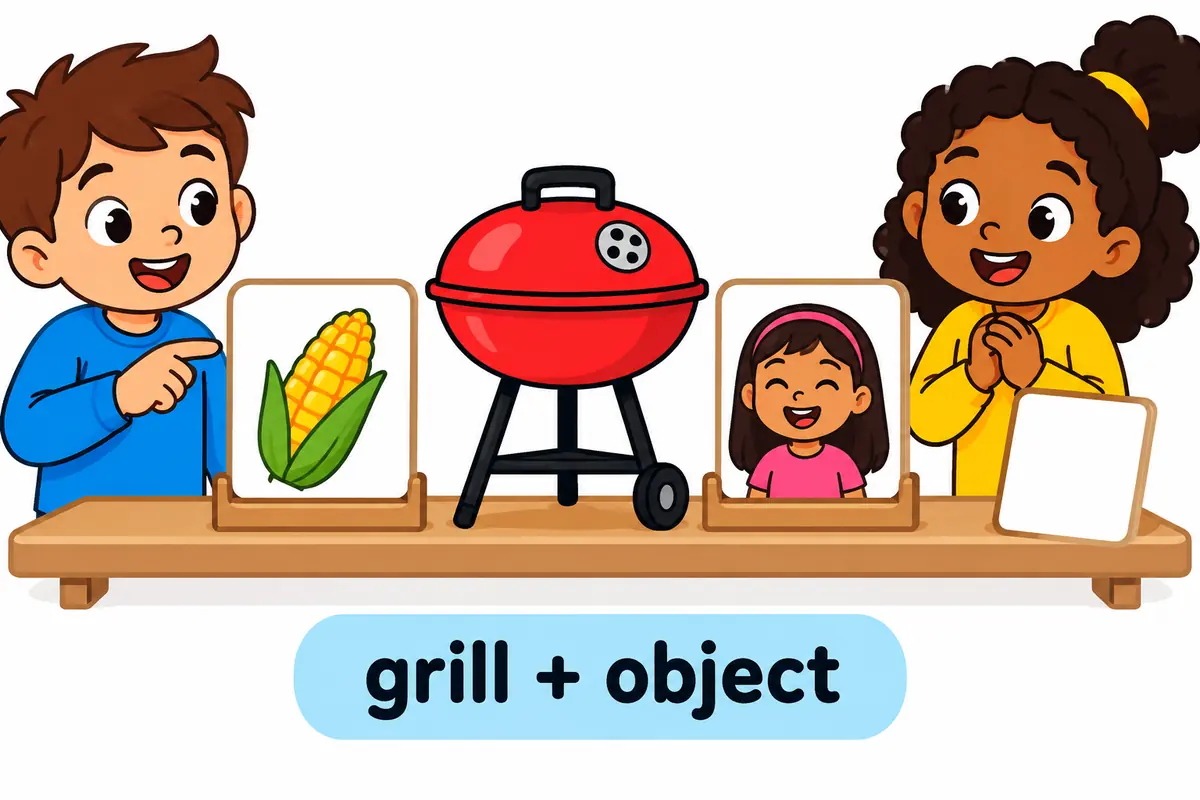
Both senses of grill are transitive, so a direct object follows at once with no preposition in between. In the cooking sense that object is food; in the questioning sense it is a person, and the topic of the questions follows on or about. The passive is very common in the questioning sense, because reporters and panels usually act on someone.
| Pattern | Example | What it signals |
|---|---|---|
| grill + food | Grill the corn for ten minutes. | The object is what you cook. |
| grill + person + on/about + topic | They grilled her about the missing file. | The object is a person; the topic follows on or about. |
| be grilled | The witness was grilled for two hours. | Passive, usual in the questioning sense. |
| grill + person + for + thing | They grilled him for details. | Names what the questioners wanted. |
| the grilling | The grilling lasted an hour. | The derived noun names the event. |
To barbecue the ribs is close to grill but slower and smokier, which is why the two words are not interchangeable on a menu. In the questioning sense, to interrogate a suspect is the formal, often legal verb, while grill stays informal.
Grill in a sentence: examples across contexts
Grill keeps its grammar while its subject changes from food to people. The nine sentences below move from a restaurant menu to a courtroom, and each one makes clear which sense is meant. In a formal report, to examine the evidence often replaces the questioning sense.
| Context | Example sentence | Why this works |
|---|---|---|
| Kitchen | Grill the halloumi until both sides are golden. | The plain cooking sense with a direct object. |
| Backyard | We grilled corn while the sun went down. | Shows the everyday outdoor meal. |
| Restaurant menu | All main dishes are grilled or roasted. | Names the dry, high-heat method. |
| News report | Reporters grilled the minister about the missing files. | The questioning sense with a person as object. |
| Classroom | The teacher grilled the class on their spelling rules. | A mild, structured version of the questioning sense. |
| Workplace | The panel grilled each candidate for twenty minutes. | Shows pressure in a formal interview setting. |
| Sports | The coach grilled the captain after the defeat. | Informal pressure from a superior. |
| Legal writing | Counsel grilled the witness on the timeline. | The verb in a courtroom, though question is more neutral. |
| Conversation | My aunt grilled me about the wedding plans. | Everyday exaggeration for lots of questions. |
Notice how the cooking sense nearly always takes food as its object, while the questioning sense nearly always takes a person, which is the quickest way to tell them apart.
Grill vs roast, grind and gripe
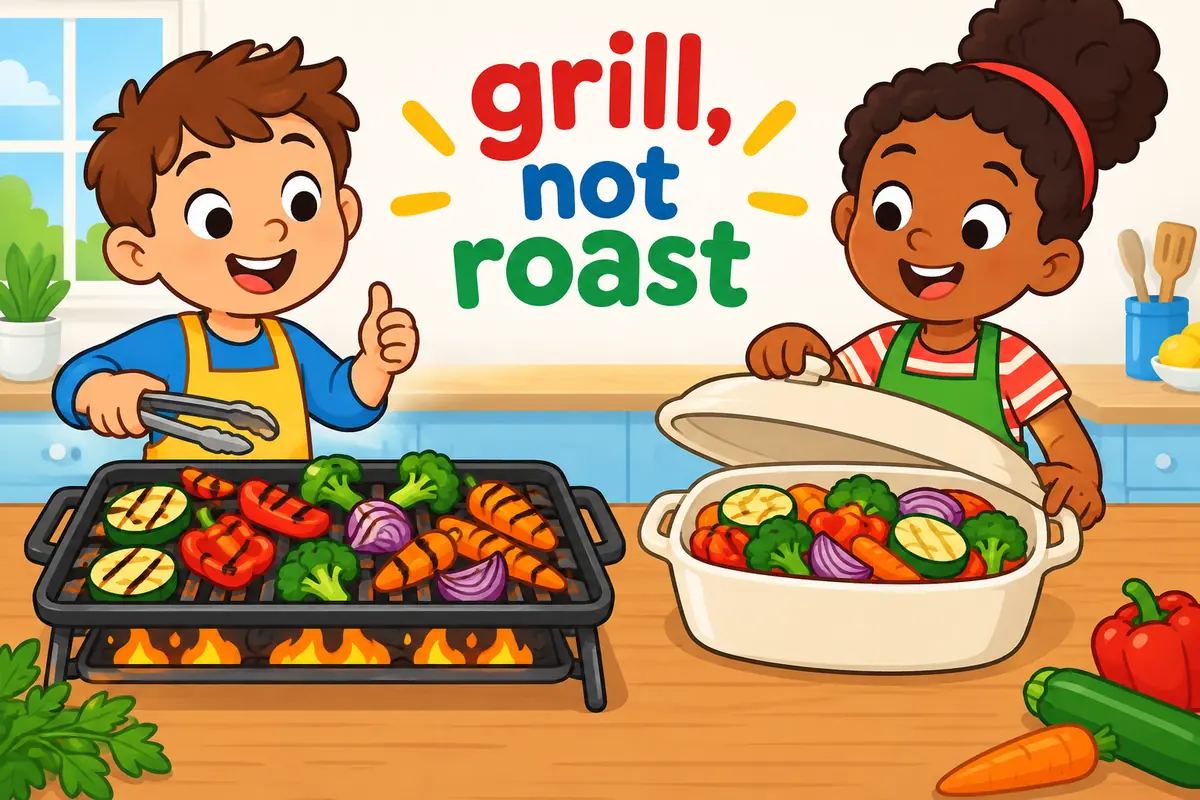
Grill is confused with one cooking word and two words that merely look alike. To roast the vegetables uses oven heat rather than a grate, while grind means to crush into powder and gripe means to complain.
| Attribute | grill | roast | grind | gripe |
|---|---|---|---|---|
| Core meaning | Cook on a grate or question hard | Cook with dry circulating heat | Crush into powder | Complain peevishly |
| Usual target | Food, or a person | Meat, vegetables, nuts | Grain, teeth, a routine | A person who grumbles |
| Direct heat | Yes | No, oven heat | Not cooking | Not cooking |
| Register | Neutral; questioning sense informal | Neutral | Neutral | Informal |
| Common trap | The grilling noun | Roast is oven, not grate | Spelled grind, not grill | A complaint, not a question |
Verdict: choose grill for direct high heat or hard questioning, roast for oven heat, grind for crushing, and gripe for grumbling, and never let the shared first letters decide it.
Word forms and grammar of grill
Grill is regular in both its jobs, and the participle doubles as an adjective. The table keeps the noun and verb apart, because the same spelling hides two different jobs.
| Form | Part of speech | Example |
|---|---|---|
| grill | noun | Put the pan on the grill. |
| grills | plural noun | The restaurant has six grills. |
| grill | base verb | Grill the bread on both sides. |
| grills | third person singular | He grills the halloumi first. |
| grilled | past and past participle | We grilled the vegetables outside. |
| grilling | participle and noun | She is grilling the fish; the grilling was tough. |
Two small consequences follow. Because the questioning verb is transitive, you cannot end at grilled without saying who was grilled, and because the noun grilling can mean the event, a sentence can describe both the act and its result.
Common mistakes with grill
- Incorrect:
They grilled to her about the report.Correct: They grilled her about the report. Rule: Grill is transitive, so no preposition stands before the person. - Incorrect:
She was grill by the panel.Correct: She was grilled by the panel. Rule: Use the participle in the passive, not the base form. - Incorrect:
Boil the chicken on the grill.Correct: Grill the chicken. Rule: Grill means direct high heat, so it never means boiling. - Incorrect:
The reporters grilled about the scandal.Correct: The reporters grilled the minister about the scandal. Rule: The verb needs a person as its object. - Incorrect:
He griped the witness.Correct: He grilled the witness. Rule: gripe means to complain, and only grill means to question hard.
Practice using grill
Work through the six items, then check the reasoning rather than only the answer.
- Fill the gap: The hostels committee ______ the treasurer about the missing receipts.
- Choose the better word: For a soft result, (grill / bake) the potatoes slowly in the oven.
- Correct the error: The committee grilled about the delay.
- Build a sentence: use be grilled about a player after a match.
- Spot the register: which fits a news report — The minister was grilled for an hour, or They totally grilled him, wow?
- Rewrite with the noun: The panel questioned her harshly for two hours. Use grilling.
Answers
- grilled — the treasurer is the person the questioning targets.
- bake — grill is direct high heat, while baking is gentle oven heat.
- The committee grilled the treasurer about the delay — the verb needs a person object.
- Model answer: The captain was grilled by reporters after the final whistle.
- The minister was grilled for an hour — a report keeps the neutral passive.
- The panel gave her a two-hour grilling — the noun names the event.
The bottom line
Use grill in a sentence for direct high heat or for hard questioning, and let the object tell a reader which sense you mean. Two facts decide most sentences: the verb is transitive, so a food or a person must follow it, and the questioning sense is informal while the cooking sense is neutral. For gentle heat, bake is the safer verb.
Frequently asked questions about grill
Is grill a noun or a verb?
Grill is both. The noun names the metal frame you cook on, or the meal cooked on it, as in a mixed grill. The verb means either to cook over direct high heat or to question someone hard. The cooking verb belongs to recipes, while the questioning verb belongs to news and conversation.
What does it mean to grill someone?
To grill someone is to question them intensely and repeatedly, usually until they answer. The word carries a note of pressure, so a friendly chat does not grill anyone. It suits reporters, interview panels and parents who ask endless questions, and it is informal enough to be a mild exaggeration.
What is the difference between grill and roast?
Grill cooks food directly over or under high heat, giving charred lines and a smoky taste. Roast cooks food with dry circulating heat inside an oven, so the surface browns evenly without charring. A recipe that says grill expects a grate, while one that says roast expects an oven.
Why is a grilling different from a question?
A question is one request for information, while a grilling is a long stretch of hard questioning that leaves the person drained. The noun grilling turns the verb into an event, so reporters give a minister a grilling rather than a question. It signals sustained pressure, not ordinary curiosity.
Grilling is a popular cooking method that involves cooking food over an open flame or heat source. The process imparts a unique smoky flavor and creates delicious, charred marks on the food’s surface.
Whether you’re grilling juicy steaks, fresh vegetables, or flavorful burgers, mastering the art of grilling can elevate your culinary skills. With endless possibilities for creativity and flavor combinations, grilling is a versatile technique that is perfect for outdoor gatherings, weeknight dinners, or weekend BBQs.
7 Examples Of Grill Used In a Sentence For Kids
- Let’s have a barbecue and cook on the grill.
- We can make yummy sandwiches on the grill.
- The grill is hot, so be careful!
- I like to hear the sizzle when food goes on the grill.
- My dad is a master at grilling chicken on the grill.
- The grill makes food taste so delicious.
- We can have a picnic and grill some vegetables.
14 Sentences with Grill Examples
- Grill the vegetables before adding them to your sandwich for added flavor.
- Don’t forget to bring your portable grill for a barbecue with friends on the college campus.
- You can easily grill chicken or paneer on a sandwich maker as a quick and tasty snack.
- Experiment with different marinades when you grill tofu for a vegetarian meal.
- Use a mini grill in your dorm room to make delicious grilled cheese sandwiches.
- Host a grill party in the college lawn for a fun and casual gathering with classmates.
- Grill some kebabs and serve them with a side of mint chutney for a flavorful meal.
- Enjoy a cozy evening by the bonfire as you grill marshmallows with your friends.
- Gather with your roommates in the common area to grill some burgers and hot dogs.
- A small electric grill can be handy for making grilled vegetables in your hostel room.
- Organize a potluck where everyone brings their favorite ingredients to grill together.
- Bring out the grill for a weekend brunch with your college buddies in the nearby park.
- Prepare a grill station at a college event and offer grilled snacks to fellow students.
- Make use of the community grill area in the college premises for an outdoor cooking session.
How To Use Grill in Sentences?
Grilling is a popular method of cooking that imparts a unique smoky flavor to food. The grill can be used to cook a variety of dishes, from meats to vegetables to even fruits. To use grill in a sentence, simply follow these steps:
-
Choose the food you want to grill. For example, “I want to grill some chicken for dinner.”
-
Place the food on the grill. For instance, “I placed the vegetables on the grill to cook.”
-
Turn on the grill and heat it to the desired temperature. You can say, “I preheated the grill to high heat.”
-
Cook the food on the grill for the recommended amount of time. For example, “I grilled the steak for 10 minutes on each side.”
-
Once the food is cooked to your liking, remove it from the grill. You can mention, “I took the burgers off the grill when they were done.”
-
Serve the grilled food hot and enjoy! You can say, “Let’s eat the grilled vegetables while they’re still warm.”
By following these simple steps, you can easily incorporate the word grill into your sentences when talking about cooking delicious food.
Conclusion
In conclusion, sentences with “grill” vary in meaning and context, from cooking techniques to interrogative inquiries or even decorative structure references. The word “grill” can be used in cooking recipes to indicate the cooking method, such as grilling vegetables or meat over fire or on a grill pan. Additionally, it can be part of questions like “What’s on the grill tonight?” which references the food being cooked. Moreover, in architectural terms, mentioning a “grill” may refer to a decorative element made of metal bars. Overall, the word “grill” is versatile in the English language, adapting to different scenarios and meanings with ease.


