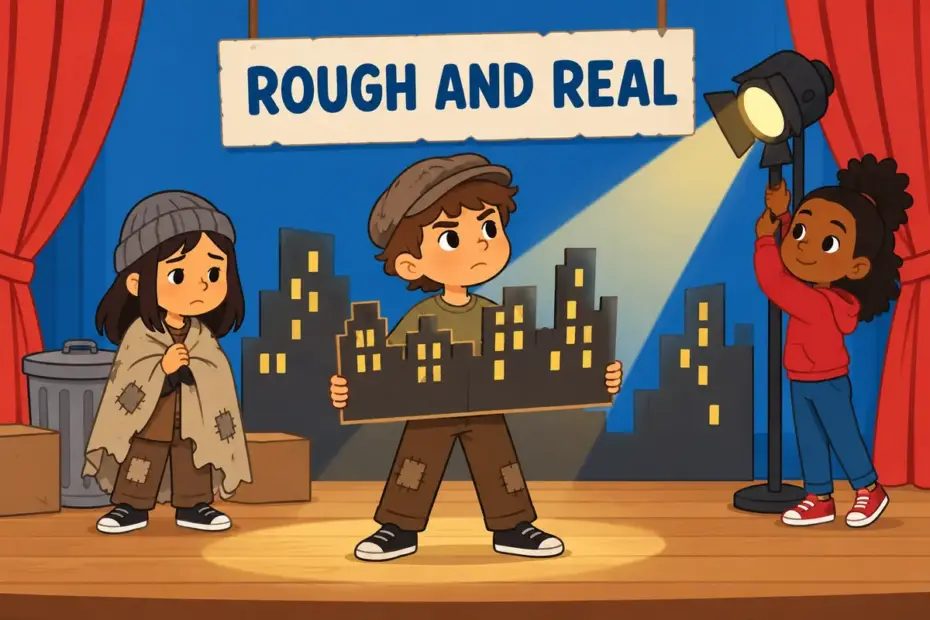
Gritty describes something full of grit, something harshly realistic, or someone showing tough determination. To use gritty in a sentence, put it before the noun: “a gritty surface”, “a gritty drama” or “a gritty performance”. The meaning shifts with the noun, so the context decides which sense a reader hears.
Gritty at a glance
- Gritty is an adjective, with grittier and grittiest as its comparative forms.
- The three senses are a coarse texture, a harshly realistic style, and stubborn courage.
- The dominant pattern is gritty + noun: a gritty road, story or display.
- The word is neutral to positive: gritty realism can be praise, and gritty determination always is.
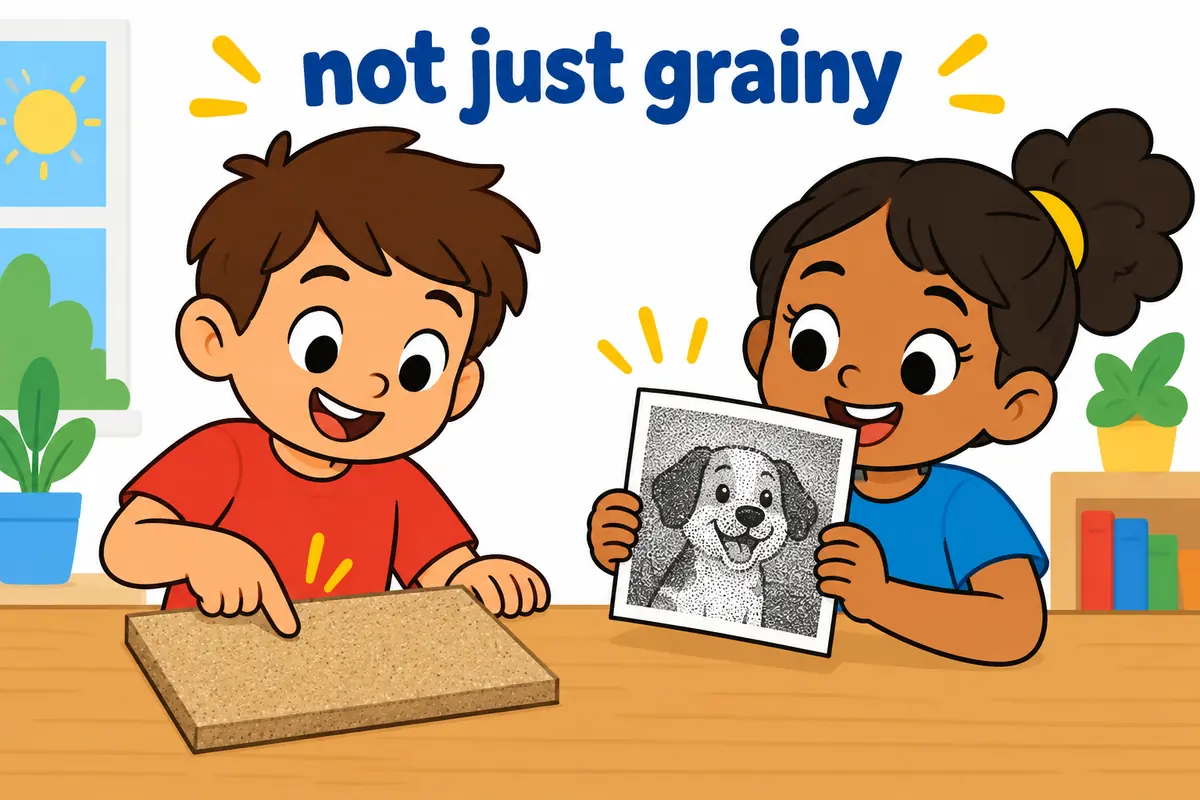
- The commonest error is confusing gritty with grainy, which describes visible granules or image noise.
What does gritty mean?
Gritty is an adjective meaning covered with grit, unflinchingly realistic, or courageously determined. The Cambridge entry for gritty records the literal sense of something containing hard particles and the figurative senses of harsh realism and toughness. The three are connected by the idea of something rough that does not pretend to be smooth: sand underfoot, a story without comfort, and a person who keeps going. Where the surface shows even granules rather than loose grit, grainy texture is the more exact description.
| Sense | Plain meaning | Example sentence |
|---|---|---|
| Literal texture | Covered with grit or small hard particles | The path was gritty under their boots. |
| Harsh realism | Unpolished, showing hardship without comfort | The novel offers a gritty view of city life. |
| Determination | Tough, plucky, refusing to give up | It was a gritty comeback after two defeats. |
| Physical discomfort | Feeling as though grit is in the eyes | Smoke left their eyes gritty and sore. |
One limitation is worth stating plainly. Gritty is not simply a synonym for sad or dirty. A gritty story earns the word by showing real hardship honestly, and calling a cheerful, well-lit scene gritty would confuse the reader. When you only mean unpleasant, harsh or bleak is the clearer word.
How do you use gritty in a sentence?
The adjective sits before a noun, and the noun selects the sense. Five patterns cover the usual cases, and each one points the reader toward texture, style or character.
| Pattern | Example | What it signals |
|---|---|---|
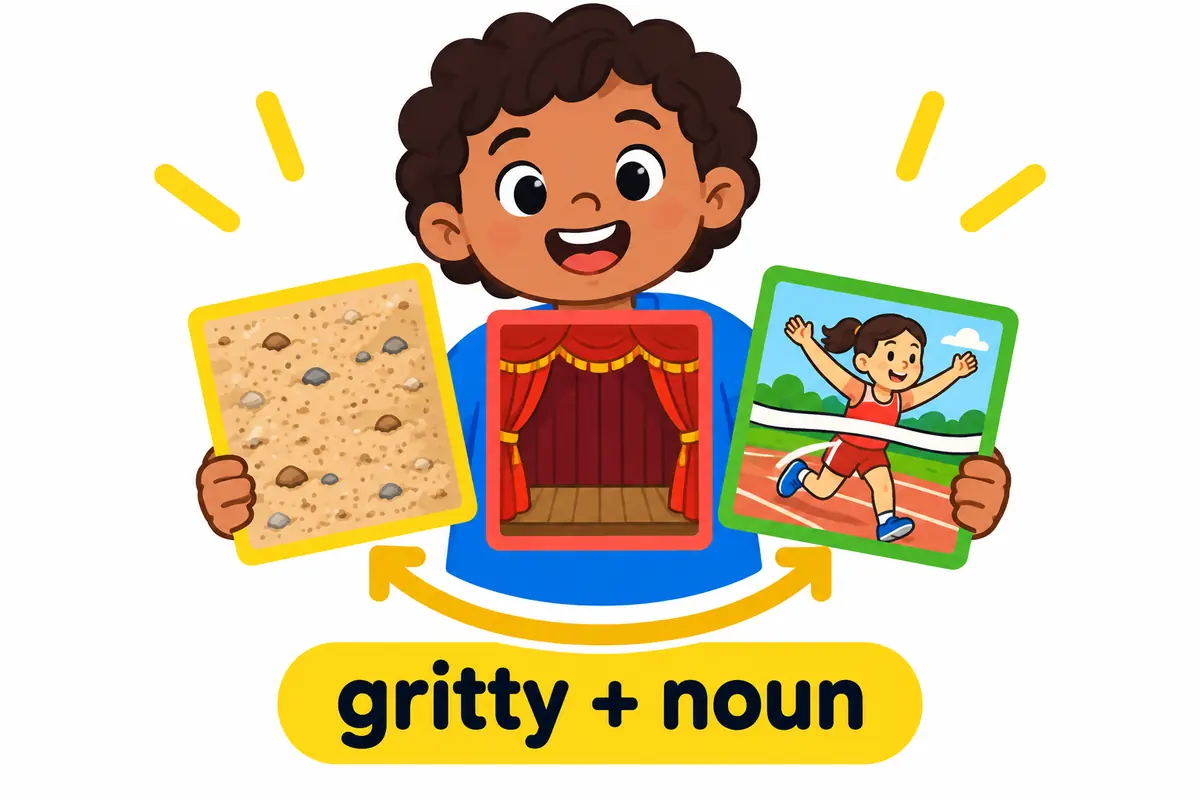
| gritty + surface noun | The floor was gritty with sand. | The literal sense: loose grit you can feel. |
| gritty + art noun | Critics praised the gritty documentary. | The style sense: unflinching realism. |
| gritty + performance noun | She gave a gritty display in the final. | The character sense: tough and determined. |
| be + gritty | The whole estate looked gritty and worn. | Describes atmosphere as a settled fact. |
| gritty + realism/reboot | The studio ordered a gritty reboot. | A fixed media phrase for a tougher remake. |
Because so much depends on the noun, a vague sentence such as the film was gritty tells the reader very little. Name the quality the film shows, and the adjective starts doing useful work.
Gritty in a sentence: examples across contexts
The word moves easily from a sandy road to a stage review, and each sentence below makes the sense explicit.
| Context | Example sentence | Why this works |
|---|---|---|
| Home | Sand from the beach left the hallway gritty. | The literal sense, with a visible cause. |
| Travel writing | The market district is loud, crowded and gritty. | Lists the word beside other sensory details. |
| Film review | It is a gritty thriller with no easy answers. | Signals tone and the refusal to comfort. |
| Television | The series is known for its gritty realism. | Uses the fixed media phrase precisely. |
| Sports report | The visitors produced a gritty defensive display. | Applies the determination sense to a team. |
| News report | Residents described the estate as gritty but close-knit. | Shows the word can sit beside warmth. |
| Academic prose | The photographer’s gritty portraits refuse to flatter. | Connects style to a deliberate artistic choice. |
| Music writing | The band’s gritty sound owes much to the amplifier. | Transfers the texture sense to sound. |
| Classroom | The sandpit left everyone’s hands gritty. | A concrete everyday image makes the sense clear. |
| Conversation | That was a gritty win, but they deserved it. | The determination sense in casual praise. |
| History essay | The memoir gives a gritty account of the strike. | Frames unflinching detail as a source’s strength. |
Notice how often the word appears with realism, thriller and display. Those collocations tell a learner more about natural use than any single definition. A gritty film often trades in raw emotion, and the effect depends on realistic detail rather than shock.
Gritty vs grainy, coarse and raw
Gritty overlaps with three descriptive words and matches none of them exactly. The choice depends on whether you mean loose particles, even granules, large fragments or emotional bareness.
| Attribute | gritty | grainy | coarse |
|---|---|---|---|
| Core meaning | Covered with loose grit | Showing visible granules | Made of large particles |
| Typical subject | Road, floor, eyes | Photo, film, wood | Sand, cloth, voice |
| Implied roughness | Rough and loose | Evenly speckled | Large and uneven |
| Figurative use | Harsh realism, courage | Poor image quality | Rude or vulgar speech |
| Register | Neutral to journalistic | Neutral, technical | Neutral, can be critical |
Verdict: use gritty for loose particles or hard-won realism, grainy for a speckled surface or a noisy image, coarse for large rough fragments, and raw when the point is emotion laid bare. Coarse sand is a texture fact, while a gritty account is a judgement about honesty.
Is gritty a compliment?
It can be, and the noun normally decides. Gritty determination and a gritty comeback are clear praise, because they recognise courage under pressure. A gritty drama or novel is a critical judgement about style, and reviewers usually mean it well, though a reader who wants comfort may hear it as a warning. Only when gritty is used loosely for dirty or unpleasant does it become faint criticism.
The register is the clue. In sports writing and film criticism the word is positive or at least admiring, while in a housing report it can quietly signal neglect. If you are unsure how a reader will take it, add the quality you have in mind: gritty and determined for courage, gritty and unflinching for realism.
Word forms and grammar of gritty
The adjective inflects with -ier and -iest and derives a noun and adverb. The table also pairs it with the noun at its root.
| Form | Part of speech | Example |
|---|---|---|
| gritty | adjective | The track surface was gritty and dry. |
| grittier | comparative adjective | The sequel is grittier than the original. |
| grittiest | superlative adjective | It was the grittiest match of the season. |
| grittily | adverb | The film is grittily photographed. |
| grittiness | noun | Reviewers admired the grittiness of the setting. |
| grit | noun and verb | She showed real grit and gritted her teeth. |
The noun grit carries both the physical sense and the sense of courage, which is why gritty can describe sand and stamina with the same word. A tough and determined effort is the closest plain paraphrase of the positive sense.
Common mistakes with gritty
- Incorrect:
The photograph was gritty with noise.Correct: The photograph was grainy with noise. Rule: Grainy describes visible granules and image noise; gritty means loose grit or harsh realism. - Incorrect:
The story was gritty and cheerful.Correct: The story was gritty and unsentimental. Rule: Gritty implies hardship shown honestly, so cheerful pulls against it. - Incorrect:
They gritty the path in winter.Correct: They grit the path in winter. Rule: Gritty is an adjective; the verb is grit, as in grit the road. - Incorrect:
The film was very gritty realism.Correct: The film was a gritty piece of realism. Rule: Gritty is an adjective, so it needs a noun to describe rather than standing alone. - Incorrect:
Her eyes were gritty and tired with grit.Correct: Her eyes were gritty and tired. Rule: The adjective already contains the sense of grit, so the noun repeats it.
Practice using gritty
Work through the seven items, then check the reason beside each answer.
- Fill the gap: Wind off the dunes left the picnic ______.
- Choose the better word: The black-and-white photo was (gritty / grainy).
- Correct the error: The team produced a grittily performance.
- Build a sentence: use gritty realism about a television series.
- Spot the register: which belongs in a sports report — a gritty win, or a tough old win?
- Rewrite with the noun: The setting was gritty. Use grittiness.
- Choose the better word: Smoke made everyone’s eyes (gritty / coarse).
Answers
- gritty — loose sand on a surface is the literal sense of the adjective.
- grainy — the speckled texture of a photograph is grain, not grit.
- The team produced a gritty performance — a linking verb takes the adjective, not the adverb.
- Model answer: The series is praised for its gritty realism about working life.
- A gritty win — the sports register prizes the determination sense of the adjective.
- The grittiness of the setting surprised critics — the noun turns the quality into a subject.
- gritty — eyes irritated by grit take the adjective, while coarse describes particles or speech.
The bottom line
Use gritty in a sentence when something is covered in grit, shows hardship without polish, or meets difficulty with courage, and let the noun carry the sense. The two decision points are the sense and the neighbour: a gritty road is physical, a gritty drama is a style, a gritty display is praise, and a grainy image is a different word entirely. Choose grainy texture for granules and gritty for everything rough, real and determined.
Frequently asked questions about gritty
What does gritty mean in a film review?
In a review it almost always means harshly realistic. A gritty film shows hardship, danger or messy life without softening it, and the praise is for honesty rather than comfort. Critics often pair it with realism, thriller or drama to signal that unflinching tone.
Is gritty slang?
No, it is a standard adjective with a long history. Its literal sense describes surfaces covered in grit and its figurative senses describe realism and courage. It appears in formal criticism and news writing as freely as it does in conversation, so no register barrier applies.
Does gritty mean dirty?
Not exactly. Dirty is a straightforward physical judgement, while gritty suggests roughness or hardship and often carries a note of respect. A gritty neighbourhood is usually described with tough affection, not disgust. If you only mean unclean, the plainer word dirty is clearer and more honest.
Can gritty describe a person?
Yes, it can describe someone determined and resilient, as in a gritty competitor. It usually describes a quality or a performance rather than a whole personality, because the word praises how someone responds to difficulty. For lasting character, resilient or determined sounds more natural.