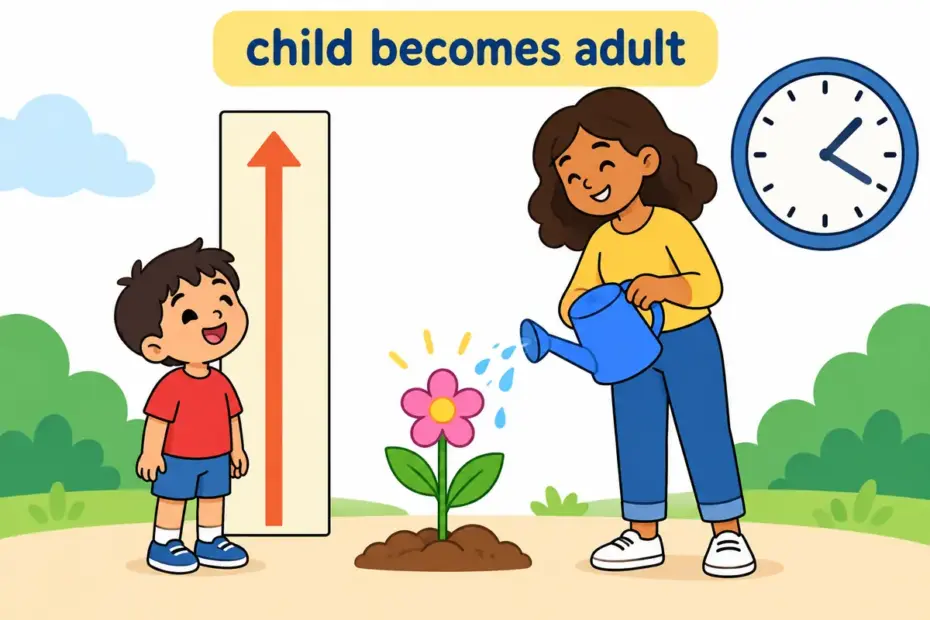
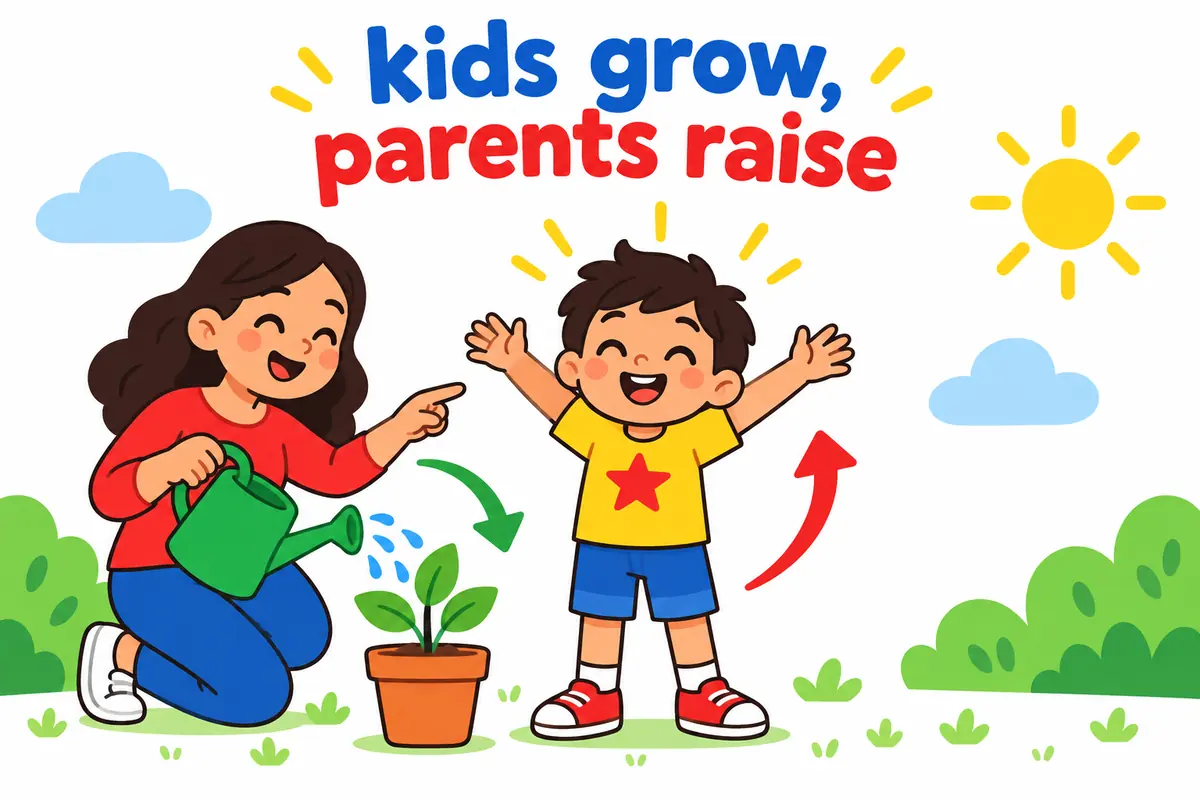
Grow up in a sentence describes the process of becoming an adult, or tells someone to stop behaving childishly. The phrasal verb is intransitive, so nobody grows up somebody else: a child grows up, while a parent raises that child. Consider “She grew up in Cairo.”
Grow up at a glance
- Grow up is an intransitive phrasal verb; its forms are grows up, grew up, grown up and growing up.
- The main sense is to pass from childhood into adulthood; a second sense is a command to act maturely.
- The particle up stays fixed after the verb: you say she grew up here, never she grew here up.
- Usual collocations are grow up in a place, grow up with siblings, grow up fast and grow up poor.
- The noun and adjective grown-up is hyphenated, as in a grown-up decision.
- The commonest error is treating the verb as transitive, as in she grew up her son.
What does grow up mean?
Grow up is an intransitive phrasal verb meaning to pass from childhood into adulthood. The Cambridge entry for grow up records the core sense and a second, sharper command sense. In the first, the subject simply matures: “He grew up in a fishing town.” In the second, an adult is told to stop acting childishly: “Oh, grow up.” Where the change is gradual and open-ended, evolve is a better fit, and the plain verb age means only to get older, which is not the same as reaching adulthood.
| Sense | Plain meaning | Example sentence |
|---|---|---|
| Become an adult | Spend childhood and reach adulthood | She grew up on a farm in Kent. |
| Behave maturely | Stop acting childishly (a command) | Grow up and take responsibility. |
| Develop gradually | A place or thing comes into being | A new town grew up beside the harbour. |
One limitation is worth stating. Grow up says nothing about quality: a person can grow up wealthy or grow up neglected, and the verb treats both the same. It also cannot mean to raise a child, so where a parent is the subject, use bring up or raise instead.
How do you use grow up in a sentence?
The verb is inseparable and intransitive, so nothing goes between grow and up and nothing follows it as an object. Five patterns cover almost every real sentence.
| Pattern | Example | What it signals |
|---|---|---|
| subject + grow up + place | Her cousins grew up in Osaka. | The place where childhood happened. |
| subject + grow up + with + person | He grew up with two older sisters. | Childhood companions and household. |
| subject + grow up + adjective | They grew up poor but resourceful. | The conditions surrounding a childhood. |
| grow up (imperative) | Grow up and stop sulking. | A blunt command to act maturely. |
| place + grow up | A whole suburb grew up around the mill. | Gradual development, not a person. |
Because up is a particle and not a preposition, it never takes an object of its own. The wrong sentence she grew up her children mistakes the verb for a transitive one; the fix is to make the children the subject of grow up and the parent the subject of raise.
Grow up in a sentence: examples across contexts
A place can be the subject too. To describe a settlement appearing slowly, the verb develop works almost as well, but grow up keeps the sense of organic change. Nine sentences show the same verb moving from a playground to a history essay.
| Context | Example sentence | Why this works |
|---|---|---|
| Classroom | Mina grew up in Seoul before her family moved here. | A place plus a past tense frames a whole childhood in one clause. |
| Workplace email | I grew up in retail, so I understand seasonal pressure. | The verb carries experience, not a literal childhood. |
| Memoir | We grew up fast the year the factory closed. | The adjective after up compresses the circumstances. |
| Conversation | Where did you grow up? | The question pattern is the commonest use in speech. |
| News report | The two rivals grew up on the same street. | Names a shared past as background to a present story. |
| Travel writing | The village grew up around a single well. | A place is the subject, so up signals slow development. |
| Academic prose | Children who grow up bilingual often switch codes easily. | Present tense generalises the pattern across a population. |
| Sports feature | The striker grew up dreaming of this stadium. | The participial phrase explains a later achievement. |
| History essay | A trading port grew up where the river met the sea. | Place as subject keeps the focus on geography, not a person. |
Only the last sentence is a question; the rest keep a person as the subject, the use learners meet first.
Grow up vs bring up and raise
Grow up is often mixed up with bring up and raise, but the three verbs split the work of childhood between the child and the adults. When a person becomes more assured over time, mature overlaps with grow up, though mature also describes a wine or a plan.
| Attribute | grow up | bring up | raise |
|---|---|---|---|
| Who is the subject | The child | A parent or guardian | A parent or guardian |
| Core meaning | Mature into adulthood | Care for a child as they grow | Care for a child until adulthood |
| Takes an object | No | Yes, the child | Yes, the child |
| Register | Neutral and everyday | Common in British English | Common in American English |
| Typical sentence | She grew up by the sea. | They brought her up in Leeds. | They raised her in Ohio. |
| What it implies | A finished childhood | Daily care and upbringing | Provision and discipline |
A child who is well cared for can flourish while they grow up, which is why the two ideas sit in the same sentence. Verdict: choose grow up when the child is the subject, bring up for British everyday speech about parenting, and raise for the same idea in American English.
Word forms and grammar of grow up
Grow up inflects like the base verb grow, and only the verb changes; the particle stays put. Phrasal verbs with up behave very differently: add up takes an object, while grow up never does.
| Form | Part of speech | Example |
|---|---|---|
| grow up | phrasal verb, base form | Young animals grow up quickly. |
| grows up | phrasal verb, third person singular | She grows up surrounded by cousins. |
| grew up | phrasal verb, past | We grew up in the same village. |
| grown up | phrasal verb, past participle | The children have grown up since then. |
| growing up | phrasal verb, present participle | Growing up here taught me patience. |
| grown-up | noun or adjective, hyphenated | Every grown-up needs a break. |
Do not build growed up as a past form; it is non-standard. The hyphen appears only in the noun and adjective grown-up.
Common mistakes with grow up
- Incorrect:
She grew up her son in a quiet town.Correct: She raised her son in a quiet town, and he grew up there. Rule: Grow up is intransitive, so a parent raises a child and the child is the subject of grow up. - Incorrect:
He grew here up.Correct: He grew up here. Rule: Up is a particle and stays immediately after grow. - Incorrect:
I have growed up in this city.Correct: I grew up in this city. Rule: The past is grew and the past participle is grown; growed is never standard. - Incorrect:
Please grow up your handwriting.Correct: Please improve your handwriting. Rule: Grow up means to mature, not to make something better. - Incorrect:
When I was young, I was growing up by my grandparents.Correct: When I was young, my grandparents raised me. Rule: Use the passive of raise or bring up when the adults are the doers.
Practice using grow up
Work through the six items, then check the reasoning rather than only the answer.
- Fill the gap: My father ______ in a village with no electricity.
- Choose the better word: Her parents (grew up / raised) her in Lagos.
- Correct the error: The puppies growed up in the barn.
- Build a sentence: use grow up with about a childhood spent alongside cousins.
- Spot the register: which belongs in a formal report — I grew up poor, or my family had limited means during my childhood?
- Rewrite with a place as the subject: A settlement slowly appeared around the mine. Use grow up.
Answers
- grew — the past of grow is grew, and up follows immediately.
- raised — the parents are the subject, so raise is transitive; grow up cannot take an object.
- The puppies grew up in the barn — growed is not a standard past form.
- Model answer: I grew up with four cousins in one house, which made every summer noisy.
- My family had limited means during my childhood — a formal report avoids the informal grow up poor.
- Model answer: A settlement grew up around the mine as the seam was worked.
The bottom line
Use grow up in a sentence when the person who matures is the subject, and keep the particle fixed after the verb. Two nuances decide most sentences: the verb is intransitive, so the adults are raised by someone else, and a place can also be the subject when something develops gradually. For the parenting sense, choose bring up or raise.
Frequently asked questions about grow up
Is grow up one word or two?
As a verb it is always two words: grow up. The hyphenated grown-up is a different part of speech, acting as a noun or an adjective, as in a grown-up brother or the grown-ups at the table. Keep the verb open and hyphenate only the noun and adjective form.
Can you say grow up somebody?
No. Grow up is intransitive, so it cannot take a direct object. The acceptable pattern is somebody grows up, and if you mean the adults who care for a child, use bring up or raise instead. The sentence they grew up their children is not standard English.
Does grow up always mean becoming an adult?
No. Besides the everyday sense of passing from childhood to adulthood, grow up can tell an adult to behave more maturely, as in grow up and stop sulking. A place can also grow up when it develops gradually, as in a town grew up around the harbour.
Is the command grow up rude?
It can be. Said to a child by a teacher, grow up means act your age and stays mild, but said to an adult it often signals irritation and can end an argument. In formal writing, describe the behaviour instead of issuing the command.
Have you ever wondered what it truly means to “grow up”? The phrase often evokes thoughts of maturity, responsibility, and personal development.
To grow up means to mature and evolve in various aspects of life, such as emotional intelligence, behaviour, and decision-making. It involves gaining independence and becoming more self-reliant as one navigates the challenges and experiences that come with adulthood.
7 Examples Of Grow Up Used In a Sentence For Kids
- Grow up to be strong and kind.
- Be patient and grow up one day.
- We all grow up when we eat healthy food.
- Let’s remember to grow up to be brave and honest.
- Every child has the potential to grow up into a good person.
- We need to work hard as we grow up into responsible adults.
- It’s important to have big dreams as we grow up into successful individuals.
14 Sentences with Grow Up Examples
- Grow up, college is a time to take responsibility for your own actions.
- Sure, having fun is important, but it’s also crucial to grow up and prioritize your studies.
- It’s time to grow up and start thinking about your future career prospects.
- Grow up and learn how to manage your time effectively to balance academics and extracurricular activities.
- As college students, it’s important to grow up and handle conflicts maturely and respectfully.
- Grow up and start making informed decisions about your health and well-being.
- It’s time to grow up and start developing a strong work ethic to succeed in the real world.
- Don’t be afraid to ask for help when needed, it’s a sign of maturity and willingness to grow up.
- Grow up and recognize the importance of networking and building professional relationships.
- It’s essential to grow up and acquire financial literacy skills to manage your expenses responsibly.
- Grow up and learn to communicate effectively in both personal and professional settings.
- College is a great opportunity to grow up and become an independent individual.
- Remember, part of being a college student is to grow up and learn from your mistakes.
- Grow up and take the initiative to seek out new experiences and opportunities for personal growth.
How To Use Grow Up in Sentences?
To use “Grow Up” in a sentence, you must first understand its meaning. “Grow Up” refers to the process of maturing and becoming an adult.
When constructing a sentence using “Grow Up,” it is important to make sure that the phrase is used in the correct context. For example, you could say “I want to grow up to be a successful business owner” to express your desire to mature and achieve a goal.
To enhance your sentence, consider adding additional details or emotions to convey your message effectively. For instance, you could say “I hope to grow up to be a reliable and compassionate leader in my community.” This sentence not only communicates your desire to mature but also provides insight into the type of adult you aspire to become.
Remember to always use proper grammar and punctuation when incorporating “Grow Up” into your sentences. This will ensure clarity and coherence in your communication. Practice using “Grow Up” in different sentences to become more comfortable and proficient in its usage.
In conclusion, using “Grow Up” in a sentence is a simple way to express the idea of maturing and becoming an adult. By following these guidelines and practicing regularly, you will become more confident in incorporating this phrase into your conversations effectively.
Conclusion
In conclusion, through the examples provided, it is evident that “grow up” is a common phrase used to describe the process of maturing and becoming an adult. From narratives about childhood memories to reflections on personal development, the phrase “grow up” is versatile in capturing the transitions and changes individuals experience as they mature.
Whether it is in nostalgic recollections of youthful adventures or in discussions about taking on adult responsibilities, the expression “grow up” encapsulates the journey of self-discovery and personal growth that is inherent to the human experience. Ultimately, as we navigate through life’s stages and challenges, the phrase “grow up” serves as a reminder of the continuous evolution and learning that shapes us into the individuals we are meant to become.


