
Guttural describes a deep, harsh sound made at the back of the throat. To use guttural in a sentence, place it before the sound it describes: “A guttural growl came from the doorway.” The adjective suits voices, coughs, languages and animal noises, while the rare noun names a throaty speech sound.
Guttural at a glance
- Guttural is an adjective meaning produced in the throat and sounding harsh, deep or rasping.
- It is also a rare noun for a throaty speech sound, with the plural gutturals.
- The adjective comes before its noun: a guttural voice, a guttural laugh, a guttural accent.
- Its usual partners are voice, sound, cry, laugh and accent.
- The commonest error is reaching for guttural for any unpleasant voice, when it names a throat-based sound.
What does guttural mean?
Guttural is an adjective meaning produced in the throat, especially a sound that is harsh, deep or rasping. The Cambridge entry for guttural records both the sound-production sense and the looser voice-quality sense, and the difference matters: one names where a sound is made, the other describes how it sounds. A speaker who wants a plain description rather than a phonetic one often prefers the word throaty.
| Sense | Plain meaning | Example sentence |
|---|---|---|
| Sound production | Made at the back of the throat | The word begins with a guttural consonant. |
| Voice quality | Deep, harsh and throaty | His guttural laugh filled the small room. |
| Animal or engine noise | Low and rough | A guttural rumble came from the old engine. |
| Noun, phonetic | A throaty speech sound | Some languages use gutturals that English lacks. |
One limitation is worth stating plainly. Guttural is not a synonym for ugly, angry or stupid, and it says nothing about whether a voice is pleasant. A guttural voice can be warm and intimate, and a guttural accent is simply one built on throat sounds rather than on a judgement about the speaker.
How do you use guttural in a sentence?
Guttural behaves like most adjectives of quality: it normally sits before the noun, and its noun can be a person, a sound or a manner of speaking. Five patterns cover the sentences learners actually need.
| Pattern | Example | What it signals |
|---|---|---|
| guttural + noun | She answered in a guttural whisper. | Attributive adjective, the commonest use by far. |
| a guttural + noun | A guttural cry broke the silence. | Countable use that introduces one specific sound. |
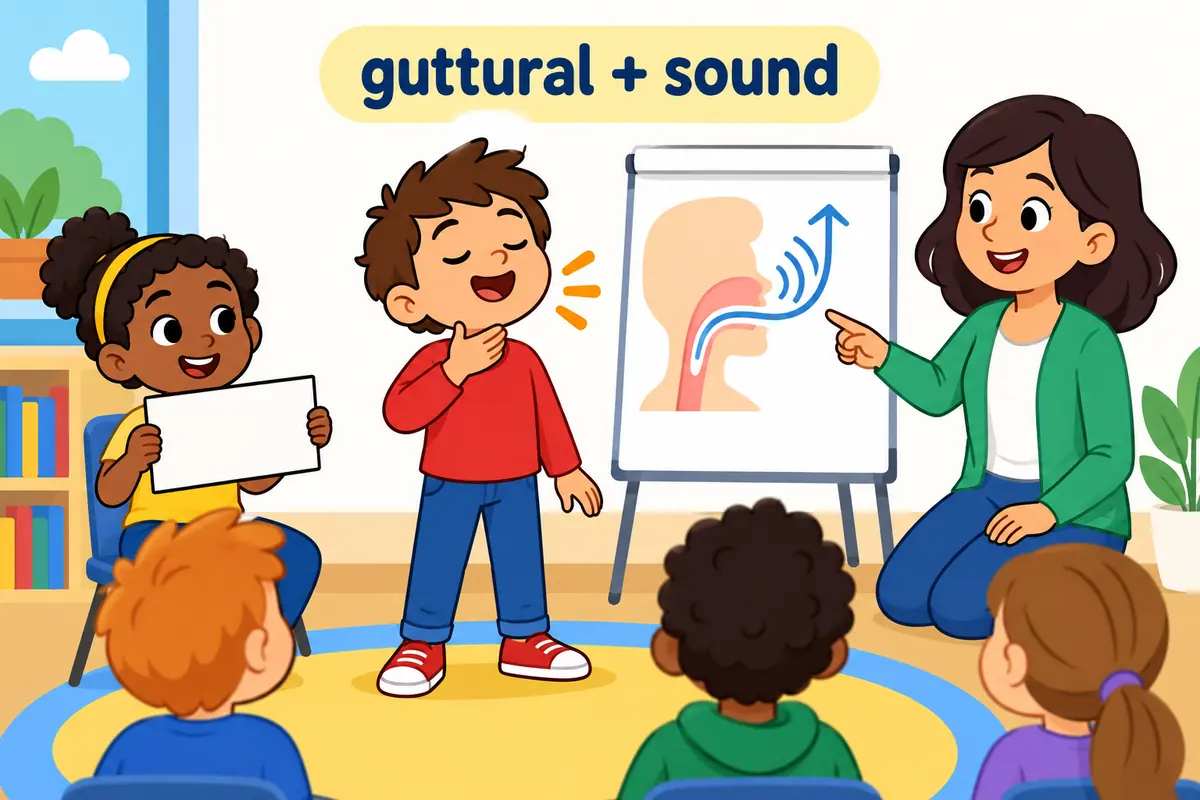
| guttural + sound word | The language is full of guttural consonants. | Names a phonetic quality rather than a mood. |
| be + guttural | The accent is unmistakably guttural. | Predicative adjective describing a whole voice. |
| guttural + -ly | He cleared his throat gutturally. | Adverb form that modifies how an action is done. |
Because guttural describes a physical quality, it rarely takes a comparative. A writer who wants to grade the sound says very guttural or more guttural still rather than gutturaler, and the formal comparative sounds clumsy.
Guttural in a sentence: examples across contexts
Guttural keeps its meaning wherever it appears, but the noun beside it decides the register. The nine sentences below range from a classroom to a film review, and each one names the sound the adjective is describing.
| Context | Example sentence | Why this works |
|---|---|---|
| Classroom | Our teacher showed how a guttural sound starts at the back of the mouth. | Anchors the word to a physical position children can point to. |
| Creative writing | A guttural snarl rolled out from behind the door. | Pairs the adjective with a vivid sound noun to build atmosphere. |
| News report | Witnesses described a guttural roar seconds before the collapse. | Quotes a sensory detail that reporting can carry. |
| Language study | Arabic and Hebrew both contain guttural consonants. | Uses the technical sense with the plural noun. |
| Film review | The villain speaks in a guttural murmur that never quite rises. | Describes a performance through its sound quality. |
| Medical note | The patient reported a guttural cough that worsened at night. | Links the adjective to a specific clinical symptom. |
| Conversation | Her guttural laugh always gave the joke away. | Shows the word in relaxed speech about a familiar voice. |
| Sports commentary | A guttural shout went up from the travelling supporters. | Applies the word to a crowd rather than one person. |
| Travel writing | The market filled with guttural calls in a language I did not know. | Uses the word to evoke a place and its sounds. |
Notice that a good writer always names the sound, a growl, a laugh, a cough, before reaching for guttural. The adjective supports a concrete noun; it does not replace it.
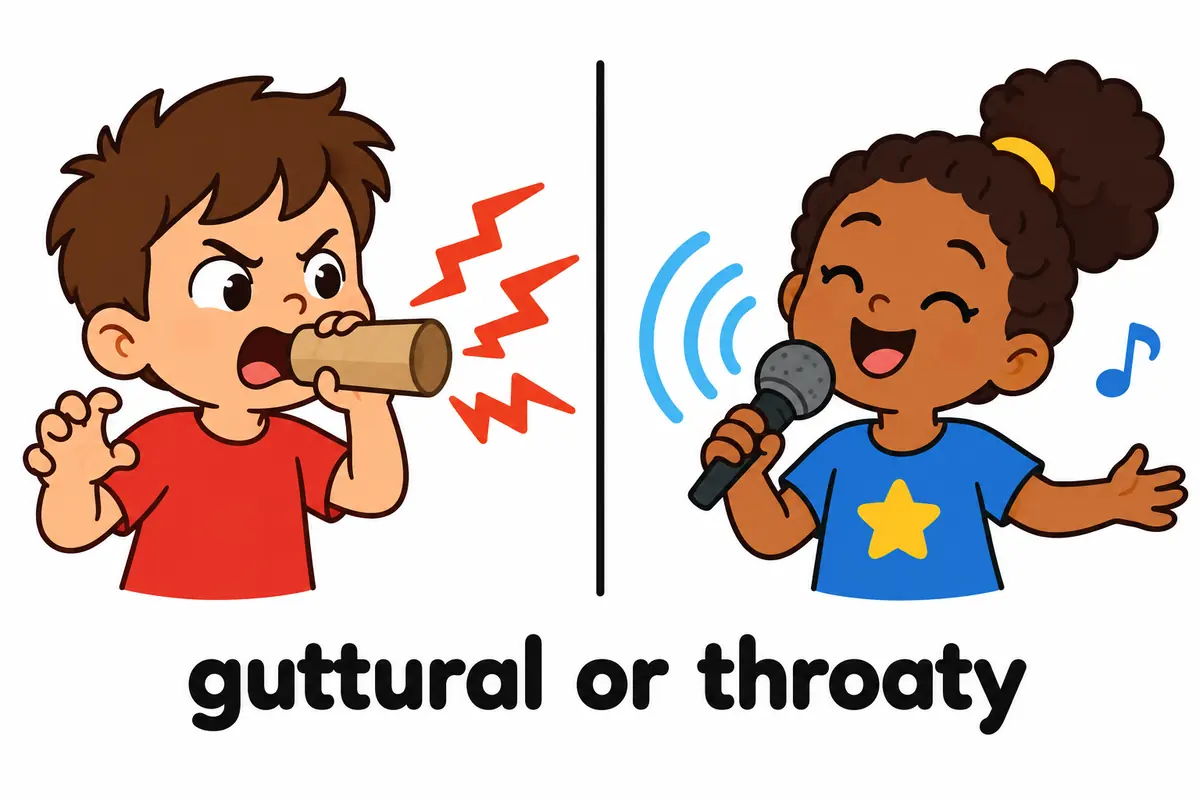
Guttural vs throaty
Guttural and throaty overlap so closely that dictionaries rarely separate them, yet writers can. The near-synonyms gravelly, husky and harsh shade the meaning further.
| Attribute | guttural | throaty |
|---|---|---|
| Core meaning | Produced at the back of the throat | Sounding as if it comes from the throat |
| Technical edge | Often used of consonants and languages | Rarely used of individual speech sounds |
| Register | Literary, descriptive and phonetic | Literary and conversational |
| Typical noun | growl, cry, consonant, accent | voice, laugh, whisper, sigh |
| What it stresses | Place of articulation | Warmth and depth of tone |
Verdict: choose guttural when the sound is genuinely made deep in the throat or when you are naming a consonant, and choose throaty when you simply want to describe a rich, resonant voice. Its clearest opposite is dulcet, a sweet and smooth tone.
Word forms and grammar of guttural
Guttural is regular, and its noun use is rare enough to surprise learners. The table also lists the adverb and the misspelling that marks a careless draft.
| Form | Part of speech | Example |
|---|---|---|
| guttural | adjective | A guttural note opened the song. |
| guttural | noun | English has no true guttural of that kind. |
| gutturals | noun, plural | Learners practise the gutturals first. |
| gutturally | adverb | He spoke gutturally, low and rough. |
| guttural — not gutteral | spelling | The double t marks the Latin root guttur, throat. |
Keep the adjective invariable: guttural sounds and guttural voices, with no ending on guttural in either case. Only the noun adds the plural -s.
Common mistakes with guttural
- Incorrect:
The music was guttural and boring.Correct: The bass line was guttural, a low rasping throb. Rule: Guttural describes a throaty sound quality, not a general judgement of taste. - Incorrect:
She gave a guttural of surprise.Correct: She gave a guttural cry of surprise. Rule: The noun use needs an article and a countable sense; guttural is chiefly an adjective. - Incorrect:
The guttural sound came from her throat.Correct: The guttural sound came from her. Rule: Guttural already means produced in the throat, so adding from her throat repeats the idea. - Incorrect:
His voice was thin, high and guttural.Correct: His voice was thin and high, not guttural but reedy. Rule: A high, thin voice is not made deep in the throat, so the adjective contradicts the description. - Incorrect:
The crowd let out a gutteral cheer.Correct: The crowd let out a guttural cheer. Rule: The word is spelled guttural, from the Latin guttur for throat.
Practice using guttural
Work through the six items, then study the reasoning rather than only the answers.
- Fill the gap: A ______ rumble rolled through the tunnel before the train appeared.
- Choose the better word: The singer’s warm low voice was (guttural / throaty).
- Correct the error: She replied in a guttural from the doorway.
- Build a sentence: use guttural + sound noun about a dog at a gate.
- Spot the register: which belongs in a phonetics essay — the language is rich in gutturals, or it sounds really gutteral?
- Rewrite with the adverb: He coughed in a guttural way all night. Use gutturally.
Answers
- guttural — the adjective modifies rumble, a low throaty sound.
- throaty — the sentence praises warmth and depth, so the softer near-synonym fits better.
- She replied in a guttural whisper from the doorway — the adjective needs its noun.
- Model answer: The dog answered with a guttural growl from behind the gate.
- The language is rich in gutturals — a formal essay uses the technical noun and avoids really.
- Model answer: He coughed gutturally all night — the adverb replaces the phrase in a guttural way.
The bottom line
Use guttural in a sentence to describe a sound made deep in the throat, and always name the sound or the consonant it qualifies. The two nuances that decide most sentences are these: the word is chiefly an adjective, so a guttural cry beats a guttural on its own, and it describes a physical quality rather than a judgement, so it can describe a voice that is warm as easily as one that is rough.
Frequently asked questions about guttural
Is guttural a negative word?
Guttural is best treated as neutral. It names a sound produced at the back of the throat, so it can describe a menacing snarl or an intimate, attractive low voice. Readers infer disapproval only when the surrounding words are negative, so the adjective itself carries no insult.
What does guttural mean in a voice description?
In a voice description, guttural means deep, rough and produced low in the throat. A writer who calls a voice guttural is pointing to its texture rather than its volume or pitch. If the intended meaning is simply warm and resonant, the adjective throaty is usually the safer choice.
Can guttural be a noun?
Guttural can be a noun, but only in phonetics, where it names a speech sound made in the throat. The plural is gutturals, as in some languages use gutturals that English lacks. Outside technical writing the noun is rare, so the adjective remains the everyday form.
Where is a guttural sound made?
A guttural sound is made at the back of the mouth and in the throat, where the tongue moves towards the soft palate. English has few of them, while Arabic, Hebrew and Scottish Gaelic use them far more. That physical location is the idea the adjective always carries.
Have you ever heard someone speak with a deep, throaty sound that seems to come from the gut? This type of voice is known as “guttural.”
Guttural refers to sounds that are produced using the throat or back of the mouth, resulting in a rough or harsh quality. It is often associated with certain languages or dialects, as well as specific vocal techniques used in singing or acting.
7 Examples Of Guttural Used In a Sentence For Kids
- Guttural sounds are made in the back of our throats.
- Say the word “frog” with a guttural sound.
- Lions make a guttural roar in the jungle.
- Remember to use your guttural voice in music class.
- Some languages have a lot of guttural sounds.
- Practice your guttural pronunciation with your friends.
- Can you make a guttural noise like a dinosaur?
14 Sentences with Guttural Examples
- Guttural sounds are commonly found in the phonetics of many Indian languages.
- Some students find it challenging to accurately produce guttural sounds in their pronunciation.
- It is important for language learners to practice guttural sounds to improve their fluency.
- The professor demonstrated the proper articulation of guttural sounds during the linguistics class.
- College students in India often have to learn the differences between guttural and palatal sounds in language studies.
- Understanding the significance of guttural sounds can enhance one’s ability to communicate effectively.
- The dialect in that region is characterized by its distinct use of guttural tones.
- Students attending language workshops were encouraged to practice producing guttural sounds.
- Certain vocal exercises can help students strengthen their ability to pronounce guttural sounds accurately.
- Many Indian classical music compositions include intricate guttural elements in their vocal performances.
- The debate team member’s guttural delivery of their argument captivated the audience.
- Improving proficiency in using guttural sounds can be beneficial in mastering diction and enunciation.
- The teacher provided feedback on the students’ guttural accents during their language presentations.
- Bollywood actors often undergo training to perfect their guttural pronunciation for specific roles.
How To Use Guttural in Sentences?
To use the word Guttural in a sentence, follow these steps for beginners:
-
Understand the meaning: Guttural is an adjective that describes sounds produced in the throat. These sounds are often rough, deep, and sometimes harsh.
-
Choose the appropriate context: Consider using Guttural when describing a person’s voice, animal sounds, or certain languages known for their throaty sounds.
-
Construct a sentence: Begin by selecting a subject or object that fits the Guttural description. For example, “The singer’s Guttural growl captivated the audience,” or “The Guttural sounds of the wild boar echoed through the forest.”
-
Adapt the tone: Depending on the context, adjust the tone of your sentence to reflect the rough or deep nature of Guttural sounds. You can convey emotions like strength, intensity, or even darkness through the use of this word.
-
Practice using Guttural in different sentences: Experiment with various scenarios to become more comfortable using this word. Remember, practice makes perfect!
By following these simple steps, you can effectively incorporate Guttural into your vocabulary and enhance your writing with descriptive and evocative language.
Conclusion
In conclusion, sentences with guttural sounds are characterized by the forceful and intense vibrations originating from the throat. These types of sentences often convey emotions such as anger, frustration, or aggression through their distinct sound. Examples of guttural sentences include “He let out a guttural growl as he confronted his enemy” and “The guttural sound of the engine indicated a problem with the car.”
The use of guttural sentences can add depth and realism to writing, as they capture primal and visceral reactions. By incorporating guttural sounds into dialogue or descriptions, writers can effectively evoke a sense of raw emotion or urgency, making the writing more dynamic and engaging for the reader.


