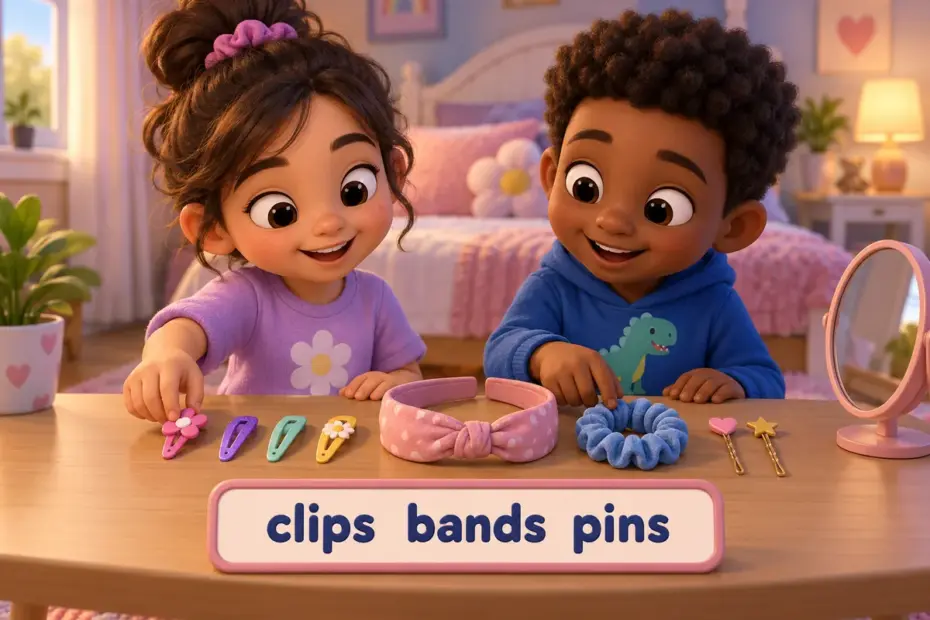
Hair accessories types and images together name the small objects worn in the hair, from a simple clip to a jewelled comb. Each accessory has one main job, either holding a style in place or decorating it, and the name usually describes the shape or the function.
Hair accessories types and images at a glance
- Hair accessories are items worn in or over the hair to hold or decorate it.
- Clips, bands, ties and pins each do a different job.
- A bobby pin grips a small strand; a hairpin holds a bun.
- Most accessory names form a regular plural: clip becomes clips.
- Images help learners match each name to the object it names.
What are hair accessories?
Hair accessories are small items worn in or over the hair, used either to hold a style in place or to decorate it. The group is large, but a learner can master the common names quickly because each object has a clear shape and one main job. A look at the word hair in a sentence confirms that the base word stays uncountable in these compounds.
| Accessory | What it does | Example sentence |
|---|---|---|
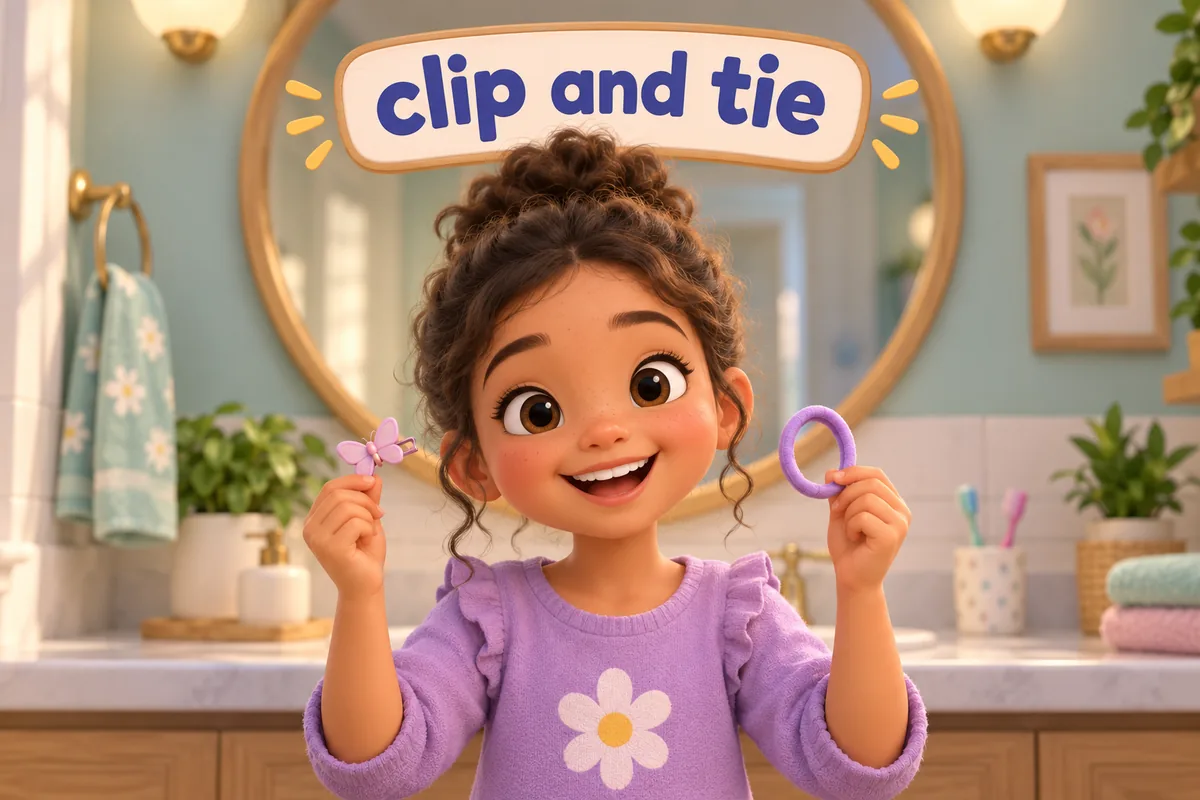
| Hair clip | holds a section in place | She fastened a blue clip above her ear. |
| Headband | runs over the head to keep hair back | He wore a green headband for the match. |
| Hair tie | gathers hair into a bunch | She pulled her hair into a tie. |
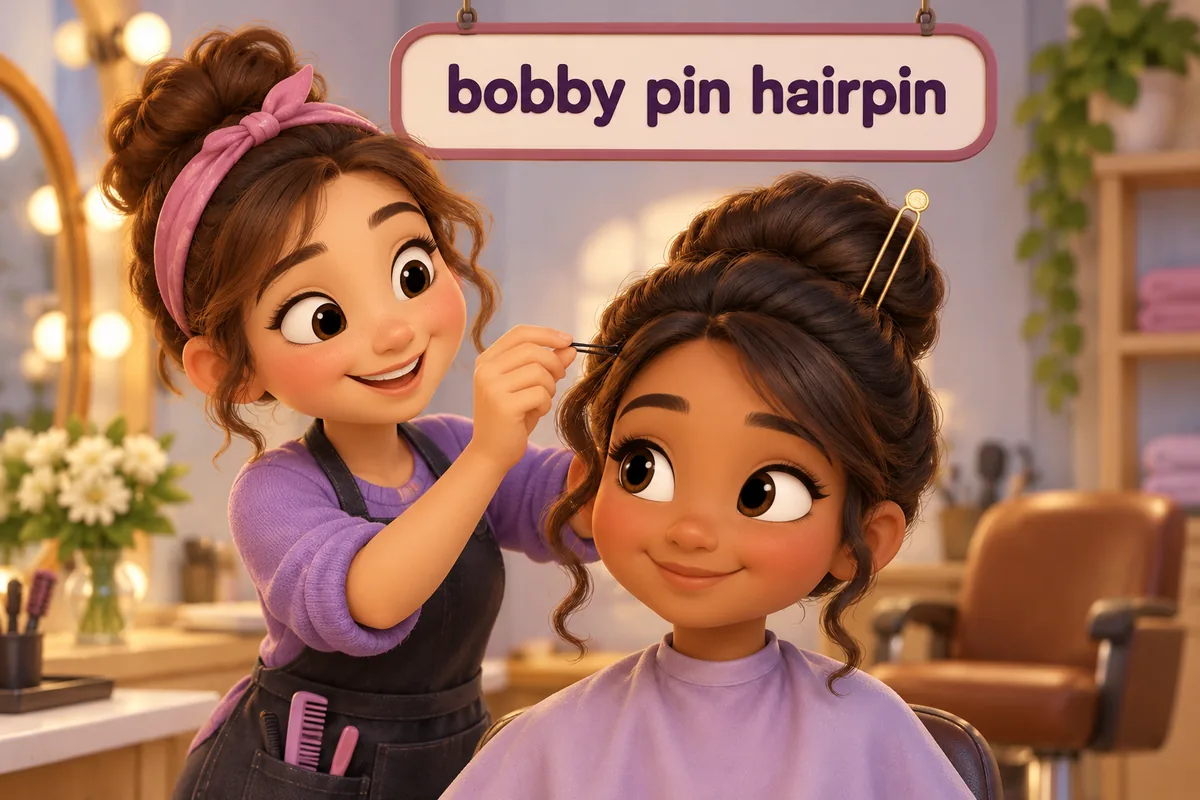
| Bobby pin | grips a small strand | Two bobby pins fixed the loose curl. |
| Hairpin | holds a bun with a long U shape | A silver hairpin kept the bun neat. |
| Scrunchie | a soft fabric ring that gathers hair | A velvet scrunchie matched her dress. |
How do you name hair accessories in a sentence?
Everyday patterns carry the meaning here: an article introduces the object, a purpose verb explains its job, and a material adjective adds colour or finish. The names fall into two clear families: pieces that grip the hair and pieces that decorate it, and both families use the same word order. The table collects the frames learners use most.
| Pattern | Example | What it signals |
|---|---|---|
| a / an + accessory | She wore a wide headband. | introduces any single item |
| accessory + to + verb | Use a clip to hold the fringe. | gives the item a purpose |
| verb + hair + with + accessory | She tied her hair with a ribbon. | names the tool of the action |
| plural accessories | The drawer held clips and bands. | groups several small items |
| adjective + accessory | a silver hairpin | describes material or colour |
Hair accessories types and images across contexts
The same small objects appear in a classroom worksheet, a salon and a shopping list, and each setting chooses its own nouns. Eight sentences show the range, and the page on accessories in a sentence adds more frames.
| Context | Example sentence | Why this works |
|---|---|---|
| Classroom | The class labelled a headband, a clip and a tie on the worksheet. | each name sits beside its picture |
| Fashion blog | A pearl barrette lifted the plain ponytail. | a material adjective sets the style |
| Sports kit list | Pack a hair tie, a headband and a spare comb. | a list suits a checklist |
| Salon chat | The stylist pinned each curl with a bobby pin. | the tool names the action |
| Everyday request | Could I borrow a hair tie, please? | a short question fits conversation |
| Short story | A single hairpin glinted in the low light. | a specific noun paints the scene |
| Formal event | A jewelled comb crowned the bride’s bun. | a precise noun lifts the register |
| Shop sign | New headbands and clips, two for one. | the plural keeps a sign short |
Which pin should you choose?
The two pins confuse learners because the names sound alike, yet the objects and their jobs differ. One is a plain grip and the other is a shaped pin, and the table separates them. A quick glance at the shape usually settles the choice before the first strand is lifted.
| Attribute | Bobby pin | Hairpin |
|---|---|---|
| Shape | Straight with a ridged end | An open U or V shape |
| Job | Grips a small strand in place | Holds a bun or a twist |
| Visibility | Usually hidden in the hair | Often left visible |
| Material | Light metal or plastic | Metal, wood or decorated |
| Example | Two bobby pins fixed the curl. | A silver hairpin secured the bun. |
Verdict: reach for a bobby pin to grip a loose strand, and a hairpin when you need a longer pin to hold a bun or a twist.
Word forms and grammar of hair accessories
The names behave like ordinary nouns, and the only common trap is the word hair itself, which stays uncountable in these compounds. The collection of adjectives for hair supplies the colour and texture words that so often sit beside these names.
| Form | Part of speech | Example |
|---|---|---|
| hairband | noun | A hairband kept her fringe clear. |
| hairbands | plural noun | The shop sells bright hairbands. |
| hair tie | noun phrase | He carried a spare hair tie. |
| scrunchie | informal noun | A scrunchie gathered the ponytail. |
| barrette | noun | A barrette clipped the side hair. |
| pin | verb | She pinned the braid across her head. |
Common mistakes with hair accessories
Most slips come from treating hair as a countable object. The five pairs below show the fault beside its repair.
Incorrect: She wore a hairs clip. Correct: She wore a hair clip. Hair is uncountable when it means the mass on the head, so it stays singular in a compound.
Incorrect: He tied his hairs back. Correct: He tied his hair back. The mass of hair takes no plural ending.
Incorrect: I bought three headband. Correct: I bought three headbands. A countable accessory takes the plural when the number is more than one.
Incorrect: The bobby pin are on the shelf. Correct: The bobby pin is on the shelf. A singular subject takes is, not are.
Incorrect: She fixed it with a hairpins. Correct: She fixed it with a hairpin. One pin is singular, so the article a cannot sit beside a plural.
Practice naming hair accessories
Six tasks mix fill-in-the-blank, error correction and sentence building. Picture each object as you write, then check the reasoning.
- Fill the gap: She gathered her ponytail with a ______.
- Fill the gap: A wide ______ kept the sun off her face.
- Correct the error: He brushed his hairs before the photo.
- Correct the error: I need two bobby pin for this style.
- Build a sentence about a wedding, using the word comb.
- Name the accessory that grips a single strand.
Answers
- hair tie. The tie is the accessory that gathers hair into a bunch.
- headband. A headband runs over the head and holds the hair back.
- He brushed his hair before the photo. Hair is uncountable when it names the mass.
- I need two bobby pins for this style. A plural number requires the plural noun.
- A jewelled comb crowned the bride’s bun at the reception. The comb decorates a formal style.
- A bobby pin grips a single strand; a hairpin is longer and holds a bun.
The bottom line
Hair accessories types and images pair each name with a clear shape and a single job, which is what makes the vocabulary easy to hold. A clip holds a section, a tie gathers a bunch, a headband sweeps hair back, and the two pins grip or shape in different ways. Keep hair uncountable in these compounds, add the plural only to the accessory, and every sentence about hair will read cleanly.
Frequently asked questions about hair accessories
What is the difference between a bobby pin and a hairpin?
A bobby pin is short, straight and ridged, and it grips a small strand out of sight. A hairpin is longer and shaped like an open U or V, and it holds a heavier style such as a bun. Both fix hair, but the shape decides the job.
Is hair a countable noun?
Usually not. When hair means the mass on a person’s head, it is uncountable, so you say her hair is long, not her hairs are long. The plural hairs appears only for single strands, as in a few grey hairs on the collar.
What is the accessory that gathers a ponytail?
A hair tie, also called an elastic or a band, gathers hair into a bunch. A scrunchie does the same job with a soft fabric cover. Both wrap around the hair and hold a ponytail, a bun or a braid in place through the day.
How do images help learners remember these names?
An image ties each word to a visible shape, so a learner stores the noun with the object rather than with a translation. Seeing a bobby pin beside a hairpin, for example, fixes the difference in shape that the similar names hide. A picture also makes the plural easy to show.