
Hash out is a phrasal verb meaning to discuss something thoroughly until the people involved reach agreement or a solution. To use hash out in a sentence, name the issue and the outcome: the two teams hashed out a schedule before lunch.
Hash out at a glance
- Hash out is a transitive phrasal verb meaning to discuss something until an agreement or decision is reached.
- Its forms are hashes out, hashed out and hashing out, and the particle out never changes.
- It separates when the object is a pronoun: hash it out, never hash out it.
- It takes an issue, a plan or terms as its object, often followed by with and a person.
- The commonest error is using it where no agreement or solution is the goal, which calls for discuss instead.
What does hash out mean?
Hash out is a transitive phrasal verb meaning to discuss an issue until the people involved reach agreement or settle its details. The Cambridge entry for hash out treats it as informal, which fits its home in meetings, emails and family kitchens. Where no agreement is the goal, discuss the plan is the neutral verb, because hash out quietly promises a result.
| Sense | Plain meaning | Example sentence |
|---|---|---|
| Reach agreement | Talk until the people involved agree | They hashed out a compromise after hours. |
| Sort out details | Work through the parts of a problem | The team hashed out who would do what. |
One limitation is worth stating. Hash out is informal, so a contract or a dissertation should use resolve or negotiate instead. It is also the wrong verb when nothing is being settled: two friends can discuss a film for an hour, but they cannot hash it out, because no decision is waiting at the end.
How do you use hash out in a sentence?
Hash out is transitive, which means it always needs an object, and it is separable, which means that object can sit inside the verb. A full noun may go either side of out, but a pronoun must go between them, so you write hash it out. The particle never strands at the end, and the verb has no special passive beyond the ordinary one.
| Pattern | Example | What it signals |
|---|---|---|
| hash out + noun | The leaders hashed out a joint statement. | The object is what the discussion produces. |
| hash out + noun + with + person | She hashed out the rota with her deputy. | Names the other party in the talk. |
| hash + pronoun + out | We hashed it out over lunch. | A pronoun object must sit inside the verb. |
| hash out + wh-clause | They hashed out what to do next. | The object can be a clause naming the question. |
| be hashed out | The details were hashed out in private. | Passive, usual in reports of talks. |
A meeting that ends well may have settled the terms, which is the neutral paraphrase for a formal report. The practitioner rule is simple: if you can add the words and reach agreement, hash out fits, and if you cannot, it does not.
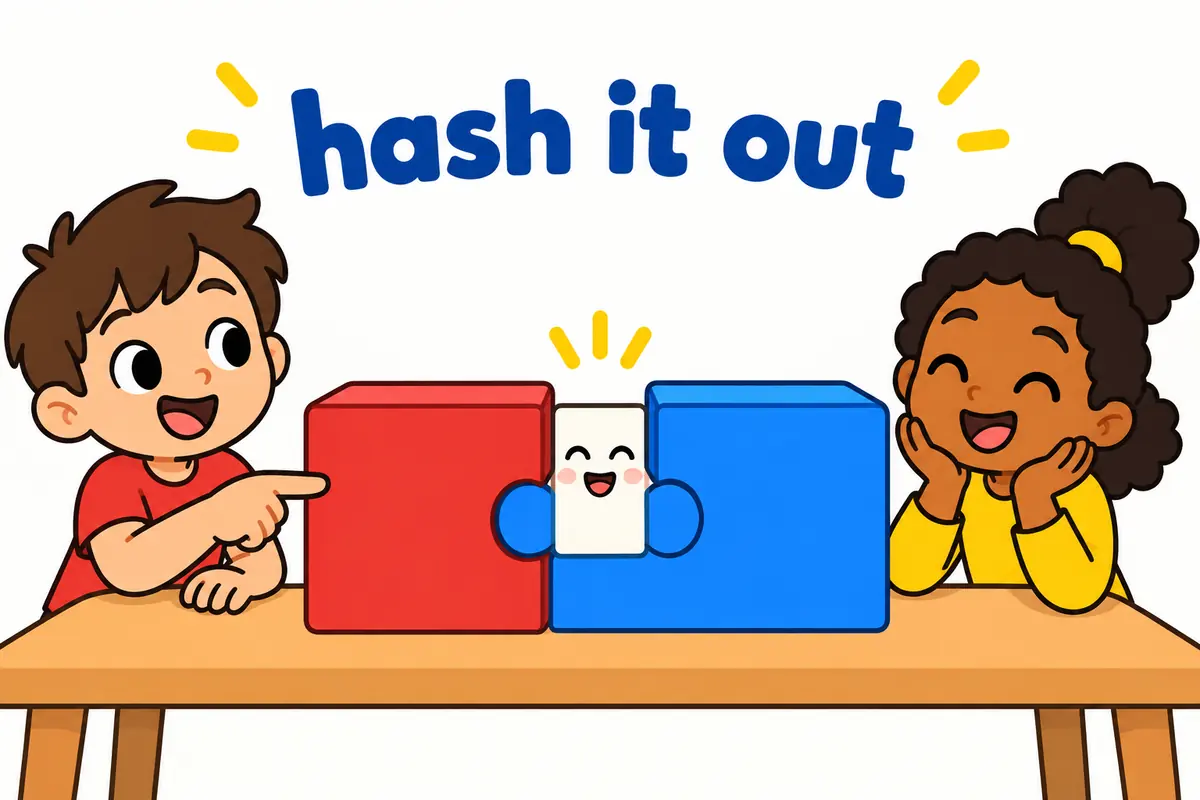
Hash out in a sentence: examples across contexts
Hash out keeps one meaning across registers. The nine sentences below move from a classroom to a government briefing, and each one shows what the people were trying to settle. Negotiators negotiate a deal in formal language, while colleagues casually hash out the same thing.
| Context | Example sentence | Why this works |
|---|---|---|
| Classroom | The group hashed out who would present each part of the project. | Names a small decision reached together. |
| Workplace email | Let us hash out the budget in Thursday meeting. | Invites discussion toward a decision. |
| News report | Negotiators hashed out a draft agreement overnight. | Compresses a long negotiation into one clause. |
| Family | The sisters hashed out a plan for the summer holidays. | The informal setting suits a phrasal verb. |
| Sports | The coaches hashed out a training schedule before the season. | Names the thing produced by the discussion. |
| Government | Both sides hashed out the terms behind closed doors. | Formal reporting with the verb kept low-key. |
| Academic | The panel hashed out the criteria for the award. | Shows the verb in a structured committee. |
| Conversation | We can hash it out later, so do not worry now. | The separated form with a pronoun object. |
| Volunteer group | They hashed out the details of the fundraiser in one evening. | Everyday collective planning. |
The verb rarely appears without an object and an outcome, which is why every sentence above could be rewritten with the phrase reach agreement.
Hash out vs thrash out, sort out and talk over
Hash out sits in a family of talking verbs, and the differences are about intensity and purpose. To thrash out a settlement is to argue hard until it is done; to sort out a schedule is to organise it; to talk over a topic is simply to discuss it.
| Attribute | hash out | thrash out | sort out | talk over |
|---|---|---|---|---|
| Core job | Reach agreement | Resolve by long argument | Organise or fix | Discuss casually |
| Process | Back-and-forth | Intense and confrontational | Practical | Relaxed |
| Outcome | A decision | A settlement | A tidy result | Understanding |
| Register | Informal workplace | Informal, forceful | Neutral | Informal |
| Typical object | An issue, a plan, terms | A problem, differences | A mess, a schedule | A topic |
Verdict: use hash out for a friendly push toward agreement, thrash out when the argument is heated, sort out for practical fixing, and talk over when you only want to exchange views.
Word forms and grammar of hash out
Hash out inflects on the verb, and the particle stays put. The table also shows the separated form, which is the one that trips up learners. The verb resolve a dispute is the formal single-word option.
| Form | Part of speech | Example |
|---|---|---|
| hash out | base phrasal verb | We should hash out the plan today. |
| hashes out | third person singular | She hashes out every contract herself. |
| hashed out | past and past participle | They hashed out the price quickly. |
| hashing out | present participle | We are hashing out the last details. |
| hash it out | separated form | Just hash it out with him. |
Two grammar points follow. Because the verb is separable, a pronoun object like it or them must sit between hash and out, and because the verb is transitive, no sentence can end at hashed out without an object somewhere in the clause.
Common mistakes with hash out
- Incorrect:
We hashed out on the details.Correct: We hashed out the details. Rule: Hash out is transitive, so no preposition stands before the object. - Incorrect:
Let us hash out it tomorrow.Correct: Let us hash it out tomorrow. Rule: A pronoun object goes between the verb and the particle. - Incorrect:
We hashed out after the meeting.Correct: We hashed out the schedule after the meeting. Rule: The verb needs an object; it cannot stand alone. - Incorrect:
They hashed the issue up.Correct: They hashed out the issue. Rule: The particle is out, never up. - Incorrect:
We hashed out about the budget.Correct: We hashed out the budget. Rule: Do not add about before the object; the object follows at once.
Practice using hash out
Work through the six items, then check the reasoning rather than only the answer.
- Fill the gap: The two sides met to ______ a fair price.
- Choose the better word: They (hashed out / discussed out) the terms by email.
- Correct the error: We hashed out it at the kitchen table.
- Build a sentence: use hash out the details about a class trip.
- Spot the register: which fits a meeting email — Can we hash out the plan on Thursday?, or Let us hash the plan up, yeah?
- Rewrite for a report: The teams talked until they agreed a schedule. Use hash out in the passive.
Answers
- hash out — the verb means to talk until an agreement is reached.
- hashed out — discuss is not a phrasal verb, so discussed out is impossible.
- We hashed it out at the kitchen table — the pronoun sits inside the verb.
- Model answer: The class hashed out the details of the trip before choosing a date.
- Can we hash out the plan on Thursday? — the tidy verb fits a workplace message.
- The schedule was hashed out by the two teams — the passive keeps it neutral for a report.
The bottom line
Use hash out in a sentence when people need to talk something through until they agree, and keep the issue or plan as the object. Two facts decide most sentences: the verb is separable, so a pronoun goes inside, and it is transitive, so nothing is left dangling. For formal writing, resolve and negotiate are the safer choices.

Frequently asked questions about hash out
Is hash out one word or two?
Hash out is always two words, and the particle out stays separate from the verb. When the object is a pronoun, that pronoun sits between them, giving hash it out. Like other transitive phrasal verbs, it never joins into a single word, so hashout is not standard English.
Does hash out mean the same as discuss?
Not quite. Discuss is neutral and needs no result, so a team can discuss a topic for an hour and decide nothing. Hash out adds the goal of reaching agreement or a solution, which is why it usually appears with words like agreement, deal, terms and compromise.
Can you say hash it out?
Yes, and with a pronoun you must. A pronoun object cannot follow the particle, so hash it out is correct while hash out it is not. With a full noun both orders appear, so writers choose hash out the details or hash the details out.
Is hash out formal enough for a report?
On its own it is informal workplace English, but the passive hashed out fits a neutral report well. A news item can say the terms were hashed out overnight without sounding casual. In legal or academic writing, negotiate or resolve is the safer choice.
Are you familiar with the phrase “hash out”? This common expression means to discuss or settle an issue or topic thoroughly.
When people hash out something, they engage in a detailed conversation or debate in order to reach a resolution or understanding. It often involves exploring different perspectives, sharing thoughts and opinions, and working towards a mutual agreement.
7 Examples Of Hash Out Used In a Sentence For Kids
- Let’s *hash out what colors we want to use for our drawing.*
- We can hash out our favorite animals during show-and-tell.
- Why don’t we hash out a plan for our group project together?
- Let’s hash out our favorite games to play during recess.
- We can hash out which storybook we want to read next.
- Let’s hash out the different shapes we see in our classroom.
- We can hash out what snacks to bring for our picnic.
14 Sentences with Hash Out Examples
- Let’s hash out our group project ideas over a cup of chai.
- We need to hash out our roommate agreement before the semester starts.
- It’s important to hash out your doubts with your professors during office hours.
- Let’s hash out a study schedule for the upcoming exams.
- We should hash out the details of our budget for the college trip.
- Don’t forget to hash out the logistics for the cultural fest event.
- Before the debate competition, we need to hash out our arguments and strategies.
- Let’s hash out the presentation details for our entrepreneurship project.
- It’s best to hash out any misunderstandings with your classmates before they escalate.
- Before signing up for any extracurricular activities, make sure to hash out the time commitment.
- We should hash out the plan for the research paper before we start writing.
- Let’s hash out the course selection for next semester during our study group meeting.
- It’s a good idea to hash out any potential issues with your roommates early on.
- Before joining any college committees, ensure you hash out the responsibilities and expectations.
How To Use Hash Out in Sentences?
To use Hash Out in a sentence, start by identifying the main points or issues that need to be discussed or decided upon. Then, when writing your sentence, make sure to clearly address and resolve these points.
For example, “During the meeting, we need to hash out the details of our upcoming project deadlines.” In this sentence, the phrase hash out indicates that the team will discuss and finalize the specific details regarding project deadlines.
Remember that Hash Out is commonly used to mean discussing or resolving a problem in a thorough and detailed way. It is important to use this phrase when there is a need for a comprehensive discussion or decision-making process.
Here are some additional examples of how to use Hash Out in a sentence:
- “Let’s hash out the budget concerns before moving forward with the proposal.”
- “The team spent hours hashing out a solution to the technical glitch.”
- “We need to hash out a compromise that satisfies all stakeholders.”
By incorporating the phrase Hash Out into your sentence, you can effectively convey the idea of discussing, resolving, or finalizing important points or issues. Remember to use this phrase when there is a need for detailed and thorough decision-making or problem-solving.
Conclusion
In conclusion, hashing out details or issues involves thoroughly discussing and resolving them. Whether it’s finalizing plans, resolving conflicts, or reaching agreements, hashing out is a crucial step in problem-solving and decision-making processes. By engaging in open communication, addressing different viewpoints, and seeking common ground, individuals can successfully hash out any challenges they face.
Effective communication and active listening play vital roles in hashing out sentences, enabling individuals to understand each other’s perspectives and work towards mutually beneficial outcomes. Taking the time to hash out differences can lead to clearer understanding, improved relationships, and ultimately, successful resolutions.


