
How do you use hear in a sentence?
Use hear in a sentence to describe perceiving a sound: “I can hear the rain against the window.” Hear also means receive information, listen to someone’s account, or consider a case. The past tense and past participle are both heard, as in “We heard the announcement yesterday.”
- Hear is a verb; hearing can be a verb form or a noun.
- The principal forms are hear, heard, and heard.
- Use hears with he, she, or it in the simple present.
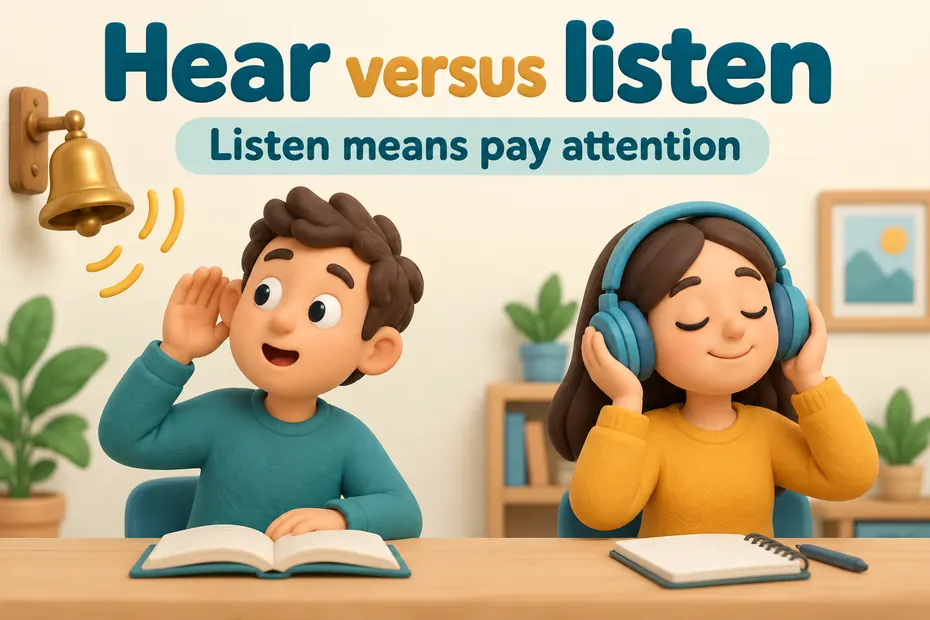
- Hear a sound; listen to a sound when deliberately paying attention.
- Hear from someone means receive a communication from that person.
What does hear mean?
Hear commonly describes sound reaching your awareness. “I hear a dog barking” reports perception, whether or not you intended to notice the dog. By contrast, “I am listening to the dog” describes attention. A person can hear a conversation without listening closely enough to follow it.
Other meanings depend on the object. “The judge will hear the case” describes considering evidence or arguments. “I hear you” may literally mean that a voice is audible, or conversationally acknowledge someone’s concern. To avoid ambiguity in a telephone call, say “I can hear your voice clearly.”
Cambridge’s explanation of hear and listen distinguishes perception from deliberate attention. This distinction is useful when choosing instructions: “Listen carefully to the directions” asks for an action, whereas “Can you hear the directions?” checks audibility.

Hear in a sentence: forms and examples
| Form | Example | Purpose |
|---|---|---|
| hear | I hear traffic every morning. | A regular experience |
| hears | She hears the bell from her office. | Third-person singular present |
| heard | We heard thunder last night. | Completed past event |
| have heard | I have heard that song before. | Past experience relevant now |
| can hear | You can hear the waterfall nearby. | Sound currently perceptible |
| hearing | They are hearing evidence today. | An ongoing proceeding |
After did or didn’t, return to the base form: “Did you hear the doorbell?” and “I didn’t hear it.” After a modal such as can, will, or might, also use hear: “She might hear us.” Do not write “Did you heard?” or “She can hears.”
For immediate sound perception, “I can hear music” is usually more natural than “I am hearing music.” Continuous forms remain appropriate in other senses, including “The committee is hearing complaints.” This is a usage distinction, not a rule that hearing is always incorrect.
Which preposition follows hear?
Hear takes different prepositions for different relationships. The preposition changes the meaning, so choose the whole expression rather than substituting words mechanically.
- Hear about: “I heard about the exhibition yesterday.” You learned information about an event or topic.
- Hear of: “Have you heard of this author?” You ask whether someone knows the author exists.
- Hear from: “We hope to hear from Maya tomorrow.” Maya is the expected source of a message.
- Hear out: “Please hear me out before deciding.” You ask someone to let you finish explaining.
Hear directly takes a sound as its object: “I heard a crash,” without to. Listen requires to before its object: “I listened to the recording.” “Hear about the recording” means learn something concerning it, which does not establish that you played the audio.
Hear someone sing or hear someone singing?
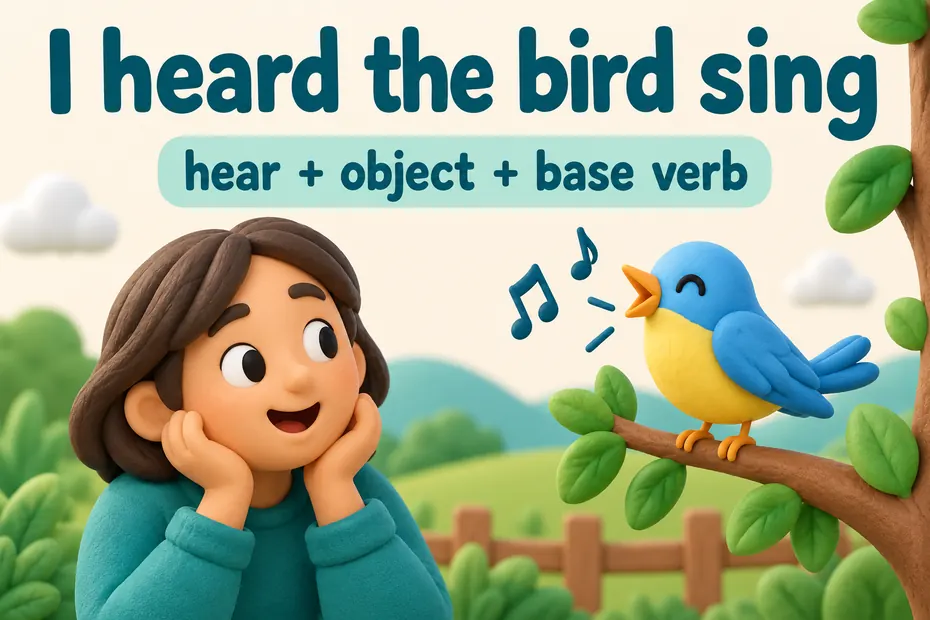
Both patterns are grammatical. “I heard the bird sing” presents the singing as an event; “I heard the bird singing” emphasizes activity in progress. The base verb follows the object without to in the first pattern.
Cambridge’s guide to perception verbs explains this difference between an infinitive without to and an -ing form. Compare “We heard the door slam” with “We heard people talking next door.” The second sentence does not imply that the conversation began or ended while you were listening.
Object pronouns matter: write “I heard him sing,” not “I heard he sing.” In a passive construction, to returns: “He was heard to say that the meeting was canceled.” This formal pattern is especially common when reporting a witnessed statement.
Common mistakes and a quick writing check
Some older examples below use hear as a command where listen would be clearer. “Hear the guidelines” is understandable, but “Listen to the guidelines” naturally asks for attention. “Hear from the guest speaker” works well as a description of receiving information; “Listen to the guest speaker” is the direct instruction.
Check a sentence in three steps: identify the meaning, choose the tense, then choose the object or preposition. For “Yesterday I ___ my friend,” use heard if you perceived their voice; add from if you received their message. These small changes express different events.
Frequently asked questions
Is hear the same word as here?
No. Hear concerns sound or receiving information, while here identifies a place. They sound alike in many accents. “Come here so you can hear me” contains both: here tells someone where to move, and hear tells them what becomes possible at that location.
Can hear be used without an object?
Yes, when the context supplies what is heard. “Speak up; I can’t hear” is a complete conversational sentence. For a standalone example, an object often adds useful precision: “I can’t hear the announcement.” The shorter version emphasizes the listener’s difficulty rather than identifying the sound.
What does glad to hear that mean?
“Glad to hear that” expresses happiness about information someone has just provided. It does not necessarily describe a sound. You can write the phrase in response to a message saying that a friend arrived safely. A fuller form is “I’m glad to hear that you arrived safely.”
How can children practice the verb?
Ask children to name a real sound and write “I can hear ___.” Then change the sentence to yesterday: “Yesterday I heard ___.” This exercise connects meaning with the irregular past form. When choosing hear in a sentence, a specific sound makes the example easy to understand.

Have you ever struggled with understanding the difference between “hear” and “listen”? These two words are often used interchangeably, but they actually have distinct meanings.
While both involve the act of perceiving sound, “hear” simply refers to the reception of sound through the ears, while “listen” involves paying attention to the sound being heard.
7 Examples Of Hear Used In a Sentence For Kids
- Can you hear the birds chirping outside?
- I hear a funny noise coming from the kitchen.
- Let’s hear a story together before nap time.
- Do you hear the sound of the rain on the roof?
- We can hear music playing in the distance.
- Hear the sound of the bell ringing for recess.
- Listen carefully and hear the sound of your own heart beating.
14 Sentences with Hear Examples
- Hear the professor clearly during lectures to ensure you understand the concepts being taught.
- It’s important to hear feedback from your peers on group projects to improve your work.
- Make sure to hear different perspectives in class discussions to broaden your understanding.
- Hear advice from seniors about which elective courses are the most interesting.
- Hear the announcements about campus events to stay informed about opportunities.
- Hear about internship opportunities through the college career center.
- Hear from alumni about their experiences in the job market to gain insights.
- Hear about upcoming exams and assignments in advance to prepare accordingly.
- Don’t hesitate to hear out your classmates’ ideas during brainstorming sessions.
- Hear the guidelines for submitting assignments to avoid any penalties for late submissions.
- Hear from the guest speakers invited to campus events for industry insights.
- Hear the important dates for registration and fee payment to avoid missing deadlines.
- Take the time to hear out your peers’ concerns and offer support when needed.
- Hear about extracurricular activities that interest you to balance academics with other pursuits.
How To Use Hear in Sentences?
To use Hear in a sentence, follow these steps:
-
Identify when you want to use the word Hear in your sentence. Hear is a verb that is used to refer to the action of perceiving sound through the ears.
-
Make sure you understand the context in which you are using the word Hear. It could be used to describe the act of listening to someone or something, or the simple act of perceiving a sound.
-
Choose the subject and object of your sentence. The subject is the person or thing performing the action (e.g. I, she, the dog) and the object is the person or thing that the action is being done to (e.g. the music, him, the birds).
-
Construct a sentence using the word Hear in the appropriate tense (past, present, future) based on the context of the sentence.
-
Ensure that the sentence is grammatically correct and makes sense. For example, “I heard a bird singing outside my window” or “She can hear the waves crashing on the shore.”
-
Practice using the word Hear in various sentences to become more comfortable with its usage. This will help you become more confident in incorporating it into your everyday speech and writing.
Remember, the key to mastering the use of Hear in a sentence is practice and understanding its meaning in different contexts.
Conclusion
In conclusion, the sentences presented demonstrate the diverse ways in which the word “hear” can be used in different contexts. From active listening to passive perception, these examples highlight the important role that the act of hearing plays in communication and understanding. By exploring these sentences, we can appreciate the nuances of language and how simple words like “hear” can convey a wide range of meanings.
Whether it’s overhearing a conversation, listening to music, or hearing a secret, the word “hear” captures the essence of receiving sound through our ears. Through these various sentence structures, we see how “hear” can be employed to express auditory experiences, opinions on listening, and the act of processing information through hearing. Overall, the sentences with “hear” exemplify the richness of language and how a single word can evoke different emotions and interpretations.


