
Hear is a verb meaning perceive sound, listen, or learn about something. Here usually indicates this place or point in a discussion. Write “I hear music” for sound and “The music is here” for location. Both words can appear together correctly: “I can hear the music from here.”
Hear vs here: key facts
- Hear and here usually sound alike.
- Hear describes hearing or receiving information.
- Here points to a place or position.
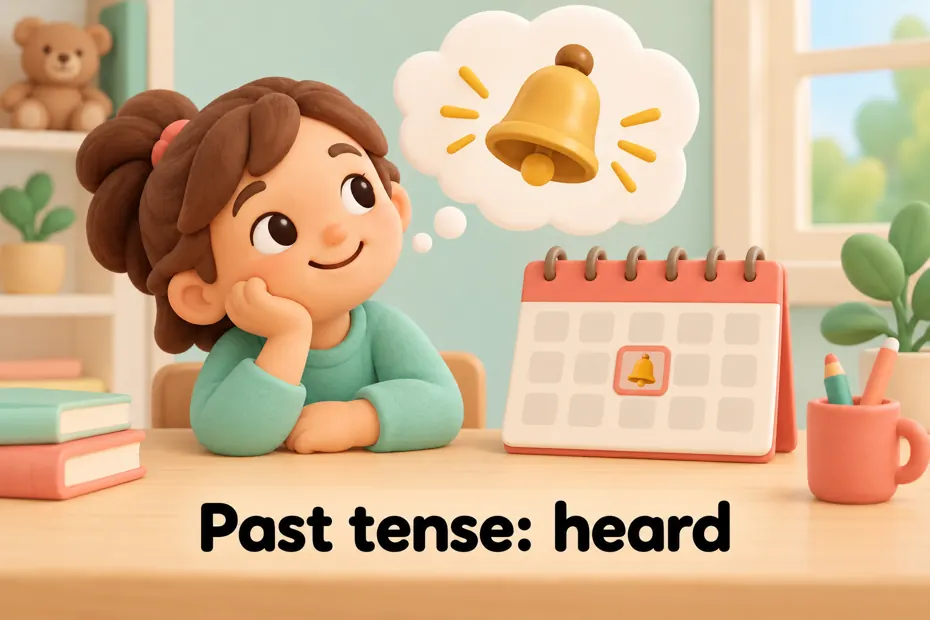
- The past tense and past participle of hear are heard.
- Hear, hear expresses agreement; it is not spelled here, here.

Which word fits the sentence’s job?
Find the action first. “I hear the bell” uses hear as a verb. Then find any location: “The bell is here” uses here to identify where it is. The distinction is grammatical as well as meaningful. In “We heard the bell here yesterday,” heard supplies the action, here supplies the location, and yesterday supplies the time.
| Meaning | Word | Original example |
|---|---|---|
| Perceive a sound | hear | Can you hear the rain? |
| Receive news | hear | I hope to hear the result soon. |
| Listen to someone’s account | hear | Please hear her explanation. |
| This location | here | Leave the notebook here. |
| This point in a discussion | here | Here the argument changes direction. |
| Past sound perception | heard | We heard the announcement yesterday. |
Merriam-Webster’s hear entry records the hearing, listening, and receiving-information senses, with heard as the past form. Its here entry records the place meaning and related uses. The examples here illustrate those distinctions in original sentences.

How does hear change with tense?
Write hear, hears, heard, and hearing. “She hears the chime” is present tense. “She heard the chime” describes the past. “She has heard it before” uses the past participle. Do not write heared for these ordinary forms. Here does not become heard because the spelling concerns a different word.
After did, use the base form hear: “Did you hear the announcement?” and “I did not hear it.” With can or will, the base form also remains: “I can hear it” and “You will hear the result.” Check the helping verb before adding an ending to the main verb.
How do here is and here are work?
When presenting something, match the verb to what follows: “Here is the key” and “Here are the keys.” Here introduces the location or presentation, while key or keys controls the singular or plural verb. It is not the hearing verb in either sentence.
Compare “Here is the answer” with “I hear the answer clearly.” The first presents an answer; the second describes hearing it. In a message accompanying a document, “Here is the file” is the relevant construction. Writing “Hear is the file” would substitute an action word where a location or presentation word belongs.
Useful phrases and spelling checks
“Hear from someone” concerns receiving a message: “We heard from Priya this morning.” “Hear about something” concerns learning information: “I heard about the new schedule.” “Here and there” concerns places: “Books were scattered here and there.” Read the whole expression rather than deciding from the shared sound.
For the agreement expression, write hear, hear. It calls attention to what was said and expresses support. In a location statement, here remains correct: “The meeting is here.” If an expression feels unfamiliar, a plain alternative such as I agree may be clearer than inserting a phrase whose spelling you are uncertain about.
Practice with original examples
Complete these gaps: “Can you ___ the birds?” “Please wait ___.” “We ___ the news yesterday.” “___ are the notes.” The answers are hear, here, heard, Here. The last answer starts a sentence, so it takes a capital letter; the plural notes requires are.
For a mixed sentence, read “I hear that the class will meet here.” The first word concerns receiving information, while the second concerns location. Underline the idea each word contributes. A spell-checker may accept either because both are real English words, so meaning remains the decisive test.
Frequently asked questions
Is it hear you go or here you go?
Write here you go when handing something over or presenting it. Here points to what you are providing. Hear is the verb for sound or receiving information and does not express that presentation. For a more explicit alternative, write “Here is your book” or “Here are your notes.”
What is the past tense of hear?
The past tense is heard, and the past participle is also heard. Write “I heard the song yesterday” and “I have heard that song before.” After did, use hear: “Did you hear it?” The location word here has no past-tense form because it is a separate word.
Can hear mean learn information?
Yes. “I heard that the meeting moved” means the speaker received that information. It does not necessarily describe a specific sound heard at that moment. When clarity matters, name the source or method: “I learned from the email that the meeting moved.” Here still concerns a place or position.
Original article and examples
Have you ever found yourself confused between “hear” and “here”? Don’t worry, you’re not alone. These two words may sound similar, but they have completely different meanings. As an expert writer, I’ve encountered this common mistake time and time again. In this text, I’ll guide you through the proper usage of “hear” and “here” to ensure that you never mix them up again. We’ll explore their definitions, provide examples, and offer some helpful tips to keep in mind. So, let’s immerse and master the art of using “hear” and “here” appropriately.
Key Takeaways
- “Hear” refers to the perception of sound, while “here” is used to indicate a specific location or position.
- “Hear” is a verb that describes the action of perceiving sounds, while “here” is an adverb that indicates a location or place.
- “Hear” is commonly used in discussions about sound, listening, and communication, while “here” is often used in conversations about spatial or temporal references.
- Proper usage of “hear” involves understanding contexts such as perceiving sounds, comprehending speech, and appreciating music.
- Proper usage of “here” involves contexts such as referring to a specific location, indicating a place in a document, expressing proximity, and describing a situation or circumstance.
- Tips to differentiate between “hear” and “here” include understanding their definitions, identifying their functions, paying attention to context, and looking for signal words.
Definition and Differences between “Hear” and “Here”
As an expert writer, I understand the confusion that can arise between the words “hear” and “here”. It’s important to have a clear understanding of their definitions and differences to use them appropriately in your writing. Let’s investigate into their meanings and distinctions.
Definition of “Hear”:
When we talk about “hear,” we are referring to the perception of sound through our ears. It is the ability to receive auditory sensations and process them mentally. Whether it’s the sound of a bird chirping, a song playing on the radio, or someone speaking to you, the act of hearing allows us to be aware of and interpret the sounds around us. Hearing is one of our primary senses and plays a crucial role in our everyday lives.
Definition of “Here”:
On the other hand, when we say “here,” we are indicating a specific location or place. It refers to the present location or position of something or someone. It could be used to point out a physical place, like “I am here in the park,” or to refer to a specific point in a conversation or text, like “Let’s stop here and discuss our next steps.” “Here” helps us establish spatial and temporal references in communication.
Differences between “Hear” and “Here”:
Now that we have a clear understanding of their definitions, let’s explore the differences between “hear” and “here” to avoid any further confusion:
- Meaning: “Hear” refers to the perception of sound, while “here” is used to indicate a specific location or position.
- Function: “Hear” is a verb that describes the action of perceiving sounds, whereas “here” is an adverb that indicates a location or place.
- Context: “Hear” is commonly used in discussions about sound, listening, and communication. On the other hand, “here” is often used in conversations about spatial or temporal references.
- I can hear the birds singing outside my window. (perception of sound)
- Are you hearing me? (listening and understanding)
- Meet me here at the café. (indicating a specific location)
- The answer to the question is **
Using “Hear” in Context
When it comes to using the word “hear” in context, it’s important to understand its definition and how it differs from “here”. Let’s investigate into the specifics to ensure that you can use “hear” appropriately in your writing.
Definition of “Hear”: “Hear” refers to the perception of sound through the ears. It involves the ability to process auditory information and understand what is being said or conveyed. It’s an essential aspect of our ability to communicate and engage with the world around us.
Let’s explore some common ways in which “hear” is used in different contexts:
- Hearing Sounds: One of the primary uses of “hear” is to describe the act of perceiving sounds. For example, you might say, “I can hear the sound of birds chirping outside my window.” This sentence indicates your ability to perceive and understand the sound of birds.
- Hearing Speech: “Hear” is also commonly used to indicate the act of listening to and comprehending speech. For instance, you could say, “I can’t hear what the professor is saying because the room is too noisy.” In this case, “hear” implies your ability to understand spoken words.
- Hearing Music: Also, “hear” is used when referring to the act of listening to and appreciating music. Consider this sentence: “I love to hear classical music while studying.” Here, “hear” conveys the enjoyment and experience of listening to music.
Understanding the appropriate contexts for using “hear” can prevent confusion and ensure effective communication in your writing. Remember, “hear” relates specifically to perceiving and understanding sounds, making it an indispensable word in our daily lives.
Examples of Correct Usage of “Hear”
When it comes to using the word “hear” correctly, understanding its appropriate contexts is key. Here are some examples that illustrate its proper usage:
- Perceiving Sounds: I can hear the birds chirping outside my window.
- The word “hear” is used to indicate the act of perceiving sounds through the ears. In this example, it conveys the ability to perceive the sound of birds chirping.
- Comprehending Speech: Can you hear me clearly through the phone?
- Here, “hear” is used to describe the act of understanding or comprehending speech. It suggests the ability to receive and process the spoken words.
- Appreciating Music: I love to hear classical music live in concert.
- In this context, “hear” is used to express the enjoyment or pleasure derived from listening to music. It implies experiencing the sound of the music firsthand.
- Understanding Instructions: I didn’t hear what the teacher said because of the noisy classroom.
- This example highlights using “hear” to convey the inability to perceive or understand instructions due to external factors, such as a noisy environment.
- Receiving Information: I heard the news about the upcoming event from a friend.
- “Hear” is used here to indicate receiving or becoming aware of information through someone else. It implies being informed or informed about a specific event or news.
Remember, using “hear” correctly involves using it in the appropriate contexts described above. Familiarizing yourself with these examples will help you avoid confusion and effectively communicate your ideas in writing.
Using “Here” in Context
When it comes to using the word “here,” it’s essential to understand its correct context to avoid any confusion. The term “here” is used to indicate a specific location or position. Let’s explore some common contexts where you would use “here” and see examples of how it is appropriately employed.
- Pointing out a location: One of the primary uses of “here” is to refer to a specific place or position. For example, when you want to attract someone’s attention to your current whereabouts, you might say, “Come over here.” This usage clearly indicates the intended destination to the person you’re speaking to.
- Indicating a place in a document: When referring to a particular spot in a document or text, “here” is the word to use. For instance, if you want to draw attention to a specific paragraph in an article, you might say, “Please refer to the information provided here for more details.”
- Expressing proximity: “Here” can also be used to express proximity or presence. For instance, if you’re attending an event and want to express your presence, you can say, “I’m here,” signifying that you are present at the location.
- Describing a situation or circumstance: Another common use of “here” is to describe a situation or circumstance. For example, if you want to emphasize the current state of affairs, you might say, “Here’s the problem,” and proceed to explain the issue at hand.
Remember, using “here” accurately in your writing and conversations helps to provide clear and concise information to your audience. Understanding its correct usage within various contexts goes a long way in effective communication.
In the next section, we’ll explore the appropriate contexts for using the word “hear.” Stay tuned to enhance your understanding of this commonly confused word.
Examples of Correct Usage of “Here”
To further enhance your understanding of the proper usage of “here,” let me provide you with some examples:
- Pointing out a location: When referring to a specific place or position, “here” is used to indicate proximity or presence. For example:
- “I am standing right here in front of the monument.”
- “Please place the books on the table here.”
- Indicating a place in a document: In written texts, “here” is often used to direct attention to a specific point or passage. Consider these examples:
- “As mentioned here, the company experienced significant growth last year.”
- “To find more information, refer to the guidebook provided here.”
- Expressing proximity: “Here” can also be used to describe being close to a person, object, or event. Take a look at the following examples:
- “I can’t believe I’m here at the concert, so close to the stage!”
- “The store is just around the corner from here.”
- Describing a situation or circumstance: “Here” can be used to refer to the present situation or the current state of affairs. Here are a couple of examples:
- “The competition is fierce, and we must step up our game if we want to succeed here.”
- “The data clearly shows the challenges we are facing here.”
By using “here” accurately in your writing and conversations, you can provide clear and concise information to your audience. Remember, understanding the appropriate contexts for using “here” will help you avoid confusion and effectively communicate your intended meaning.
In the next section, I’ll explore the appropriate contexts for using the word “hear” and provide examples to illustrate its correct usage.
Tips to Differentiate Between “Hear” and “Here”
As a writer, it is important to understand the distinction between “hear” and “here” to use them correctly in your writing. Let me provide you with some useful tips to differentiate between these commonly confused words.
1. Understand the Definitions:
- Hear refers to the perception of sound through the ears. It is the action of receiving auditory information.
- Here, on the other hand, is used to indicate a specific location or position.
2. Identify the Functions:
- Hear is a verb that describes the act of perceiving sound.
- Here, on the other hand, can function as an adverb, noun, or interjection, depending on the context.
3. Pay Attention to Context:
- When discussing sound or auditory perception, use hear. For example, “I can hear the birds singing outside my window.”
- When referring to a specific location or position, use here. For example, “I am currently standing right here in the park.”
4. Look for Signal Words:
- Signal words such as “listen,” “sound,” or “noise” often indicate the use of hear. For example, “Listen carefully, and you’ll hear the sound of waves crashing on the shore.”
- Signal words such as “this,” “that,” or “here” often indicate the use of here to refer to a specific location. For example, “I left my keys right here on the table.”
- “Can you hear me clearly through the phone?”
- “The teacher asked us to come here and gather around.”
- “I love to hear the sound of rain falling on the roof.”
- “The doctor is here to see you now.”
By keeping these tips in mind, you can develop a better understanding of when to use “hear” and “here” in your writing. Remember, clarity and accuracy in your language usage is essential for effective communication. So practice using them correctly to ensure that your message is delivered precisely.
Conclusion
Understanding the difference between “hear” and “here” is crucial for effective communication. By grasping the definitions and functions of these words, you can ensure accurate usage in your writing. Context plays a significant role in distinguishing between the two, so paying attention to the surrounding words and phrases is essential. Also, identifying signal words can help guide your decision when choosing between “hear” and “here.”
Throughout this article, I have provided examples that demonstrate the correct usage of “hear” and “here” in various contexts. By using these words accurately, you can convey your message clearly and concisely to your audience. Remember, precision in language is key to effective communication.
Mastering the proper use of “hear” and “here” will enhance your writing skills and prevent any confusion or misunderstanding. So, next time you sit down to write, keep these tips in mind and confidently use “hear” and “here” in the appropriate context.
Frequently Asked Questions
Q: What is the article about?
A: The article provides tips to differentiate between the commonly confused words “hear” and “here.”
Q: Why is it important to understand the definitions of “hear” and “here”?
A: Understanding the definitions helps to use the words correctly in writing.
Q: What are the tips provided in the article?
A: The tips include paying attention to context and looking for signal words.
Q: Can you provide examples of using “hear” and “here” correctly?
A: Yes, the article gives examples to illustrate the proper usage in different contexts.
Q: How does using these words accurately benefit the audience?
A: Using these words accurately provides clear and concise information to the audience.


