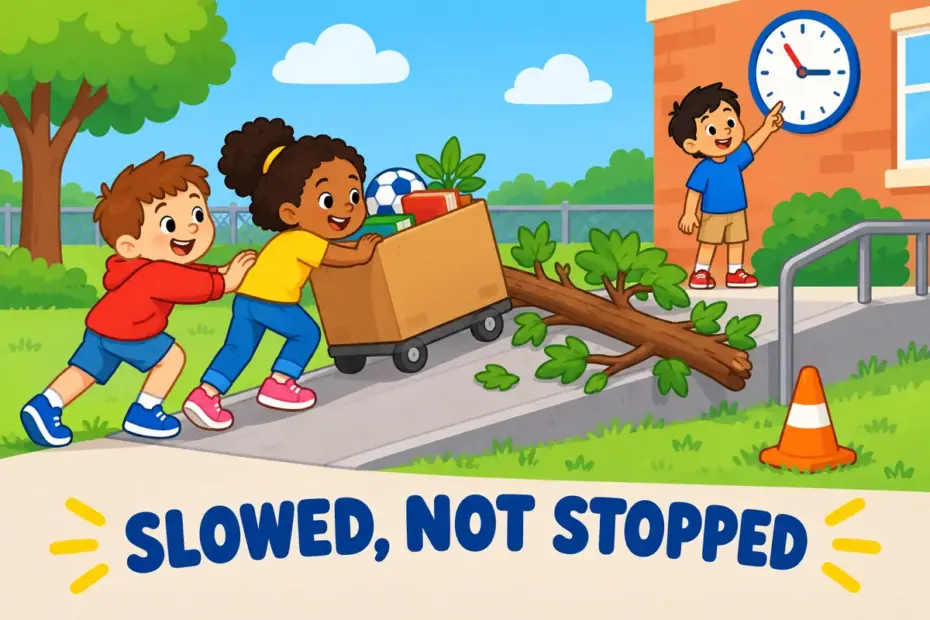
Hinder means to slow something down or make it harder to do, without stopping it completely. To use hinder in a sentence, name what is being held back and what is holding it back: “Heavy rain hindered the rescue team.” The verb is transitive, so the obstructed person, plan or process must appear as its object.
Hinder at a glance
- Hinder is a transitive verb; its forms are hinders, hindered and hindering.
- It means to slow or obstruct progress rather than to stop it outright.
- The usual subjects are weather, traffic, cost, rules or a lack of funds.
- Hinder belongs to formal and report-style writing more than to casual talk.
- The commonest error is dropping the object that is being hindered.
What does hinder mean?
Hinder is a transitive verb meaning to make an action or process more difficult, usually by slowing it down. The Cambridge entry for hinder gives the same core sense, and adds the idea of limiting what someone or something can do. Hinder rarely means a total stop, so when the outcome is failure, hamper the effort or prevent is the sharper choice.
| Sense | Plain meaning | Example sentence |
|---|---|---|
| Slow a process | Make a task take longer than it should | Power cuts hindered the vaccination drive. |
| Hold back a person | Stop somebody moving or working freely | Thick mud hindered the search party. |
| Limit growth | Keep something below its full level | High fees hinder first-time buyers. |
One limitation matters. Hinder does not mean stop, and it does not mean forbid. A hindered project still finishes, only later. Where the result is that something never happens, prevent, block or ban is the accurate verb, because each of those describes a closed door rather than a slow one.
How do you use hinder in a sentence?
Put the obstruction first and the thing it slows second: something hinders somebody. Five patterns cover almost every real sentence, and the from-ing pattern is the one learners most often miss. To describe a blocking effect stronger than delay, writers reach for impede progress instead.
| Pattern | Example | What it signals |
|---|---|---|
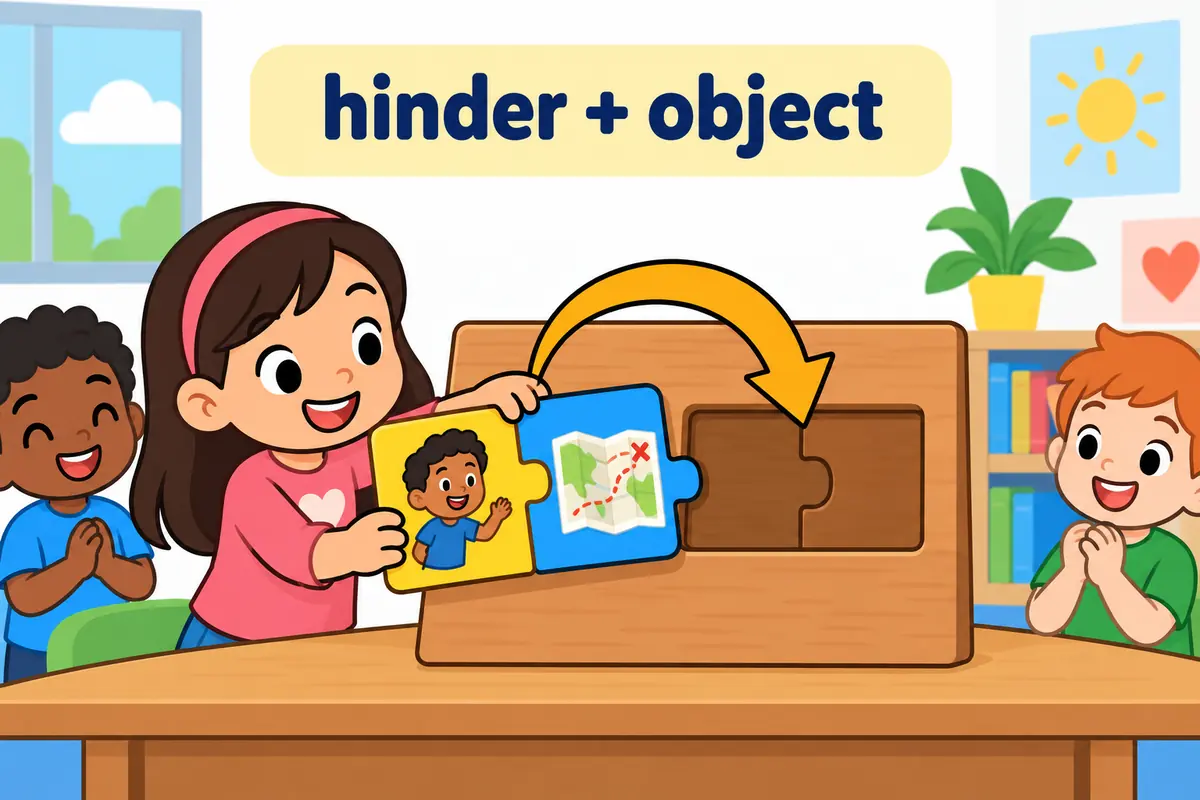
| hinder + object | The storm hindered the harvest. | The thing slowed is named directly after the verb. |
| hinder + somebody from + -ing | Poor lighting hindered her from reading the map. | The blocked action is named with from and an -ing verb. |
| be hindered by | The launch was hindered by a late delivery. | The passive keeps the obstruction in focus. |
| hinder + progress, growth or development | Rigid rules hinder growth. | Abstract nouns are the typical object here. |
| hinder rather than help | Extra paperwork hinders rather than helps. | A fixed contrast used to criticise a measure. |
Hinder in a sentence: examples across contexts
Hinder changes register more than meaning. The nine sentences below keep the same verb while moving from a classroom to a weather bulletin, and each one names the obstacle doing the work.
| Context | Example sentence | Why this works |
|---|---|---|
| Classroom | A broken projector hindered the presentation, so the class moved to the library. | A concrete fault supplies the obstacle a reader can picture. |
| Workplace email | Late approvals hindered the release schedule by two weeks. | Names the delay and its size, which is what a manager needs. |
| News report | Floodwater hindered rescuers through the night. | The subject is a condition, which keeps the report impersonal. |
| Legal writing | A missing signature hindered enforcement of the order. | Precise procedural language, not everyday talk. |
| Sports report | A run of injuries hindered the team but did not thwart its title run. | Sets the delay against the outcome it failed to stop. |
| Science writing | Cold storage can inhibit growth without killing the culture. | Distinguishes slowing from destroying. |
| Travel | Fog hindered flights out of the northern airports. | Weather as subject is the most idiomatic pattern of all. |
| Academic prose | Small sample sizes hinder firm conclusions. | An abstract noun object suits a cautious claim. |
| Conversation | Traffic really got in our way. | Daily speech prefers this phrase to the formal verb. |
The last row is the one to notice. In speech most people replace hinder with got in the way, and that swap is the clearest sign of which register the verb belongs to.
Hinder vs prevent
The two verbs are close in meaning and different in result. Hinder slows a thing that still happens; prevent states that it never happens at all.
| Attribute | hinder | prevent |
|---|---|---|
| Core meaning | Slow something down | Stop it happening at all |
| Result | The thing happens, later or only partly | The thing never happens |
| Typical object | Progress, effort, movement, growth | An event, accident, mistake or access |
| Grammar | hinder somebody from doing | prevent somebody from doing |
| What it implies | Delay and difficulty | A closed door |
| Register | Formal and report-style | Neutral and common everywhere |
Verdict: choose hinder when something is delayed or made harder but still goes ahead, and prevent it entirely when the point is that it never happens.
Word forms and grammar of hinder
Hinder inflects regularly, and its noun hindrance is the form learners most often misspell. The table also lists the wrong noun that appears in student writing.
| Form | Part of speech | Example |
|---|---|---|
| hinder | verb, base form | Poor roads hinder trade. |
| hinders | verb, third person singular | Red tape hinders small firms. |
| hindered | verb, past and past participle | Fog hindered the flight. |
| hindering | verb, present participle | Low pay is hindering recruitment. |
| hindrance | noun | The crowd was a hindrance, not a help. |
| hinderance | non-standard spelling | Incorrect: a real hinderance. |
Common mistakes with hinder
- Incorrect:
The rain hindered.Correct: The rain hindered the match. Rule: Hinder is transitive, so the object cannot be dropped. - Incorrect:
The noise hindered him to sleep.Correct: The noise hindered him from sleeping. Rule: Use from plus an -ing verb, never to. - Incorrect:
The rules will hinder that people apply.Correct: The rules will hinder applicants. Rule: Hinder takes a noun phrase, not a that-clause. - Incorrect:
The injury was a hinder to her season.Correct: The injury was a hindrance to her season. Rule: The noun is hindrance, not hinder. - Incorrect:
Bad weather hindered the match to start.Correct: Bad weather prevented the match from starting. Rule: When nothing happened at all, prevent is the right verb.
Practice using hinder
Work through the six items, then check the reasoning as well as the answer.
- Fill the gap: Traffic ______ the ambulance, but it still reached the hospital.
- Choose the better word: The closed road (hindered / prevented) the race altogether.
- Correct the error: The leak hindered the crew to finish the repair.
- Build a sentence: use be hindered by about a picnic spoiled by wind.
- Spot the register: which belongs in a project report, the delays hindered delivery or the delays really got in our way?
- Rewrite with the noun: The crowds hindered the medics. Use hindrance instead.
Answers
- hindered — traffic slowed the ambulance but did not stop it, so the transitive verb fits.
- prevented — the race never took place, and prevent means a total stop.
- The leak hindered the crew from finishing the repair — hinder takes from plus -ing, not to.
- Model answer: Our picnic was hindered by a sudden gust that scattered the paper plates.
- The delays hindered delivery — a report keeps the formal verb and drops the casual phrase.
- The crowds were a hindrance to the medics — the noun needs an article and a to.
The bottom line
Use hinder in a sentence when something is made harder or slower but still goes ahead, and make the obstacle the subject. The two deciding factors are these: the verb is transitive, so the slowed thing must always be named, and the from-ing pattern carries the blocked action cleanly. Where the outcome is that nothing happens at all, prevent is the more precise word.
Frequently asked questions about hinder
Is hinder a formal word?
Hinder sits in formal, report-style writing, where an obstacle is named as the subject of the sentence. In everyday speech most people say got in the way of or slowed down instead. A weather report or an accident summary would use hinder, while a text to a friend probably would not.
What is the noun form of hinder?
The noun is hindrance, as in the crowd was a hindrance to the rescue. A common misspelling is hinderance with an extra e, which is not standard. Hinder stays the verb, so a sentence needs either to hinder something or a hindrance to something, never hinder as a noun.
Can hinder be used without an object?
No. Hinder is transitive, so every sentence needs something that is hindered. Saying the rain hindered leaves the reader asking what. To report only that conditions were bad, use a phrase such as the rain caused delays, which needs no object at all.
Is hindering a real word?
Yes. Hindering is the present participle, used in continuous tenses and as a describing word. The sentence low pay is hindering recruitment uses a continuous verb, while hindering rules uses an adjective before a noun. Both are standard, and neither should be confused with the noun hindrance.
Are you familiar with the word “hinder”? In simple terms, to hinder means to create obstacles or difficulties that slow down progress or success.
Imagine trying to complete a task but facing constant hinderances that prevent you from moving forward smoothly. These hindrances can come in various forms, such as physical obstacles, mental barriers, or external factors, ultimately impeding your ability to achieve your goals.
7 Examples Of Hinder Used In a Sentence For Kids
- Running with untied shoelaces can hinder you from moving fast.
- Carrying a heavy bag may hinder your ability to walk quickly.
- Standing too close to a door can hinder it from opening fully.
- Tying your hair in front of your eyes can hinder you from seeing clearly.
- Eating too quickly can hinder proper digestion.
- Not wearing warm clothes in winter may hinder you from staying cozy.
- Talking loudly in class can hinder others from hearing the teacher.
14 Sentences with Hinder Examples
- Late night studying can **hinder your ability to concentrate during lectures the next day.
- Lack of a reliable internet connection can hinder your research for college assignments.
- Social media can hinder your productivity if not used in moderation.
- Procrastination can hinder your academic performance in the long run.
- Poor time management can hinder your ability to balance coursework and extracurricular activities.
- A cluttered study space can hinder your focus while preparing for exams.
- Skipping classes can hinder your understanding of complex subjects.
- Negative self-talk can hinder your confidence during presentations.
- Peer pressure to participate in all social events can hinder your study schedule.
- Not seeking help from professors or tutors when needed can hinder your learning progress.
- Comparing yourself to others can hinder your self-esteem and motivation.
- Health issues, such as lack of sleep or poor nutrition, can hinder your overall well-being and academic performance.
- Distracting roommates can hinder your ability to focus on assignments.
- Being in a toxic relationship can hinder your emotional well-being and academic success.
How To Use Hinder in Sentences?
To use the word Hinder in a sentence, it is important to understand its meaning and proper usage. Hinder means to create difficulties for something or someone, making it harder for them to achieve their goals or make progress. Here is a simple guide on how to use Hinder in a sentence:
-
Identify the situation where progress or success is being impeded.
Example: The heavy rain hindered their ability to finish the outdoor event. -
Insert the word Hinder in the appropriate place in the sentence.
Example: The heavy rain hindered their ability to finish the outdoor event. -
Ensure that the sentence conveys the intended meaning clearly.
Example: The heavy rain hindered their ability to finish the outdoor event, causing them to postpone it to another day.
By following these steps, you can effectively use the word Hinder in a sentence. Remember to consider the context of the situation and choose appropriate words to express the intended meaning. Experiment with using Hinder in different sentences to become more comfortable with its usage.
Conclusion
In conclusion, hinder means to create difficulties or obstacles that slow down progress or development. When hindrances are present, tasks can become more challenging, making it harder to achieve desired goals or outcomes. For instance, a lack of funding can hinder a company’s ability to expand, and poor communication may hinder a team’s collaboration efforts.
Identifying and addressing the factors that hinder progress is essential for overcoming obstacles and achieving success. By recognizing and working to remove hindrances, individuals and organizations can streamline processes, increase efficiency, and move forward towards their objectives with greater ease and effectiveness.


