Thwart means to stop someone from doing what they intended, or to keep a plan from succeeding. To use thwart in a sentence, name the plan and the force that blocks it: “The storm thwarted their attempt to cross.” The verb is transitive and appears most often in the passive voice in news writing.
Thwart at a glance
- Thwart is a transitive verb; its forms are thwarts, thwarted and thwarting.
- It means to stop a plan, attempt or ambition from succeeding.
- The dominant pattern is thwart + a plan or attempt, and the passive be thwarted by is common in reporting.
- Thwart belongs to news, sport and formal writing rather than everyday conversation.
- The commonest error is using thwart for something merely delayed rather than defeated.
What does thwart mean?
Thwart is a transitive verb meaning to stop an effort from reaching its goal, usually by blocking it at a decisive moment. The Cambridge entry for thwart records this single core sense, and the rows below separate the kinds of thing that get stopped. In every case the attempt has ended, which is what keeps thwart apart from a word such as hinder.
| Sense | Plain meaning | Example sentence |
|---|---|---|
| Prevent a plan | Stop an attempt from succeeding | Heavy rain thwarted their picnic plans. |
| Block an ambition | Keep somebody from reaching a goal | Injury thwarted his bid for the title. |
| Foil an attack or plot | Defeat an opposing move before it lands | Guards thwarted the attempt to break in. |
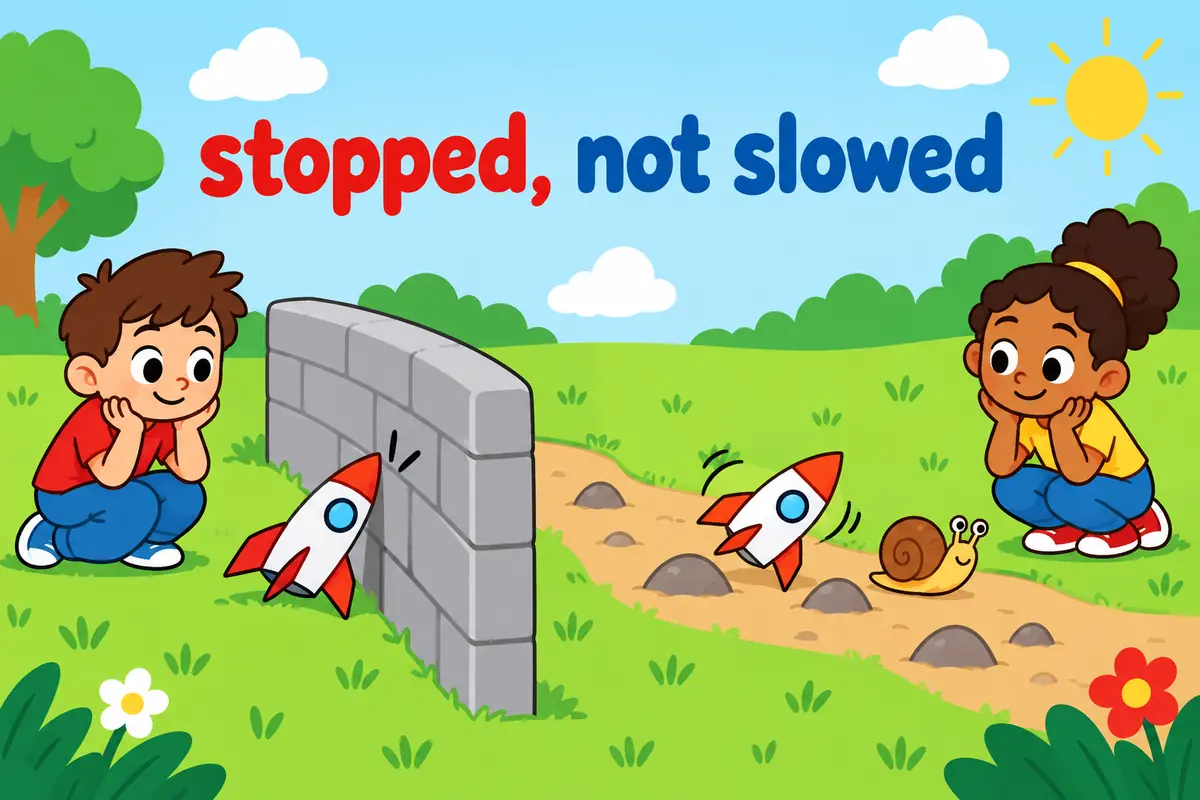
One limitation is worth stating plainly. Thwart says the attempt was stopped, not slowed, and it does not describe an obstacle that was never faced. When progress continues at a lower speed, hinder is the right verb, and when the outcome never began at all, prevent is plainer still.
How do you use thwart in a sentence?
Put the plan, attempt or ambition immediately after the verb, and let the blocker enter as the subject or after by. Five patterns cover almost every real sentence, and the passive is the one newspapers use most because it keeps attention on the plan that failed.
| Pattern | Example | What it signals |
|---|---|---|
| thwart + plan or attempt | Bad weather thwarted the rescue. | The object is the thing that was stopped. |
| thwart + ambition or goal | Injury thwarted her Olympic dream. | The object is a hoped-for outcome. |
| be thwarted by + cause | The launch was thwarted by a last-minute fault. | Passive, which foregrounds the cause in reporting. |
| thwart + person + in + noun | They thwarted him in his ambition. | An older, more formal way to name the person. |
| thwart + attempt | Police thwarted an attempt to break into the depot. | The standard opening of a crime report. |
Where an opposing scheme is beaten, foil a plot is the close synonym writers reach for, and where the outcome never began, prevent is simpler than thwart.
Thwart in a sentence: examples across contexts
The nine sentences below keep the same verb while changing the plan that fails. Each row names the plan and the force that stopped it, which is the pair thwart always needs.
| Context | Example sentence | Why this works |
|---|---|---|
| Classroom | A broken projector thwarted the class presentation. | A small everyday obstacle makes the verb concrete. |
| Workplace email | The supplier strike thwarted our plans to ship on Friday. | Names the cause and the plan in one clause. |
| News report | Customs officers thwarted an attempt to smuggle the goods. | Matches the standard crime-report opening. |
| Legal writing | The injunction thwarted the developer’s bid to build. | A formal order is the force that blocks the plan. |
| Sports report | A stubborn defence thwarted every attack in the second half. | The blocking force is collective and repeated. |
| Academic prose | Poor funding thwarted the survey before it could start. | The cause is structural rather than personal. |
| Travel | Heavy snow thwarted our journey over the pass. | The plan is a journey and the blocker is weather. |
| History essay | A rival alliance thwarted the king’s plan to expand east. | Sets ambition against a named opposing force. |
| Conversation | The traffic completely thwarted my plan to be early. | Casual use keeps the verb but lightens the tone. |
Notice how often the sentence is passive, as in the launch was thwarted. The passive suits thwart because the reader usually cares more about the plan that failed than about the force that stopped it.
Thwart vs foil, hinder and prevent
Thwart overlaps with three verbs of obstruction and is interchangeable with none of them. Foil is close but leans toward defeating a scheme, hinder means slowing, and prevent means stopping before anything starts. The table separates the four by how complete the blockage is.
| Attribute | thwart | foil | hinder | prevent |
|---|---|---|---|---|
| Core meaning | Stop a plan from succeeding | Defeat an opposing scheme | Slow progress down | Keep something from starting |
| Completeness | Complete | Complete | Partial | Complete, before the start |
| Typical object | A plan, attempt or ambition | A plot or plotter | Progress or movement | An event or outcome |
| Typical example | The fault thwarted the launch. | They foiled the robbery. | Rain hindered the search. | Vaccines prevent disease. |
| Register | Journalistic and formal | Formal and literary | Neutral | Neutral |
Verdict: use thwart when a plan was underway and got stopped, foil when an opponent’s scheme was beaten, hinder when progress merely slowed, and prevent when nothing had begun. A problem that leaves everyone stuck rather than defeated calls for stymie instead.
Word forms and grammar of thwart
Thwart inflects regularly, and its past participle is the form that dominates news headlines. The table also notes the older senses of the word, which survive in ships and in old poetry but not in ordinary prose. The participle thwarted is the one learners meet first.
| Form | Part of speech | Example |
|---|---|---|
| thwart | verb, base form | Nothing will thwart their plan. |
| thwarts | verb, third person singular | A single fault thwarts the whole launch. |
| thwarted | verb, past and past participle | The attempt was thwarted within minutes. |
| thwarting | verb, present participle | They succeeded in thwarting the raid. |
| thwart | noun, technical | The rower shifted on the thwart. |
| thwart | adverb, archaic | Old verse still uses thwart for across. |
The noun thwart, meaning a rower’s seat, and the archaic adverb meaning across are unrelated to most modern uses, so a sentence about being stopped should keep to the verb sense.
Common mistakes with thwart
- Incorrect:
The rain thwarted the match for an hour.Correct: The rain delayed the match for an hour. Rule: Thwart means stopped, so it cannot describe a pause that later ends. - Incorrect:
He thwarted to reach the summit.Correct: The storm thwarted his attempt to reach the summit. Rule: Thwart takes a noun object, not an infinitive. - Incorrect:
The delay thwarted.Correct: The delay thwarted our plans. Rule: Thwart is transitive, so the plan that failed must appear. - Incorrect:
She thwarted him from leaving.Correct: She prevented him from leaving. Rule: Prevent pairs with from; thwart does not. - Incorrect:
The goal thwarted the goalkeeper.Correct: The goalkeeper thwarted the attack. Rule: The blocker is the subject and the plan is the object, not the reverse.
Practice using thwart
Work through the six items, then check the reasoning rather than only the answer.
- Fill the gap: A last-minute technical fault ______ the rocket launch.
- Choose the better word: Roadworks (thwarted / hindered) traffic all morning without stopping it.
- Correct the error: The alarm thwarted the thieves from entering.
- Build a sentence: use be thwarted by about a picnic ruined by rain.
- Spot the register: which belongs in a news report — Officers thwarted a planned robbery, or The cops totally stopped a robbery plan?
- Rewrite with a synonym: replace thwart in They thwarted the plot with foil.
Answers
- thwarted — the fault stopped the launch completely, which is the core sense.
- hindered — traffic continued slowly, so the blockage was partial.
- The alarm thwarted the thieves’ attempt to enter — thwart takes a noun object, not from plus a verb.
- Model answer: The picnic was thwarted by a sudden downpour.
- Officers thwarted a planned robbery — a report uses neutral words and the standard crime-report verb.
- They foiled the plot — foil suits a scheme that was defeated.
The bottom line
Use thwart in a sentence when a plan was already underway and something stopped it from succeeding, and put that plan straight after the verb. Two nuances decide most sentences. Thwart means stopped rather than slowed, so hinder is the word for a delay, and the passive be thwarted by suits news writing because it foregrounds the failed plan.
Frequently asked questions about thwart
Is thwart always negative?
Thwart usually reports a setback, so it is negative for whoever had the plan. The sentence itself stays neutral, which is why it suits news reporting: officers thwart a robbery, and the thief is the one whose plan failed. The word simply records that an attempt did not succeed.
How do you pronounce thwart?
Thwart is pronounced to rhyme with short and sport, with a silent-looking w that is not heard at all. The vowel is the same long aw sound as in water. Because the spelling looks hard, learners often add the w, but the standard pronunciation drops it completely.
What is the past tense of thwart?
The past tense and past participle are both thwarted. The attempt was thwarted last night uses it in the passive, and heavy snow thwarted the search uses the same form in the active. The regular ending means there is no irregular form to memorise.
Can thwart be used in the passive?
Yes, and the passive is very common because readers usually care about the plan that failed. The launch was thwarted by a fault names the cause after by, while the active version puts the cause first. Both are correct, so choose whichever keeps the important thing in focus.
Have you ever struggled to find the right word to express an idea or feeling? A thesaurus is a powerful tool that can help you improve your writing by providing synonyms and antonyms for words when you feel stuck or want to enhance your vocabulary.
Thwart, meaning to prevent someone from accomplishing a goal, is just one of the many words you can explore in a thesaurus. By using a thesaurus, writers can uncover a range of alternative words that can add depth and variety to their writing, making it more engaging and impactful.
7 Examples Of Thwart Used In a Sentence For Kids
- Don’t let anyone thwart your dreams.
- Try your best to thwart the obstacles in your way.
- It’s important to find ways to thwart any difficulties.
- You can always find a solution to thwart your problems.
- Work together with your friends to thwart any challenges.
- Remember, you have the power to thwart anything standing in your path.
- Stay positive and you will be able to thwart any troubles.
14 Sentences with Thwart Examples
- Some students tried to thwart the professor’s strict attendance policy by forging signatures.
- The unexpected power outage thwarted their plans to work on their group project online.
- Unforeseen technical glitches thwarted their attempts to submit their assignments before the deadline.
- A sudden downpour thwarted their idea of having an outdoor study session.
- The lack of study materials thwarted their efforts to prepare thoroughly for the upcoming exam.
- Inadequate transportation options thwarted their plan to attend a career fair on campus.
- A last-minute change in the exam schedule thwarted their carefully planned study timetable.
- Limited library hours thwarted their intention to borrow a crucial reference book for their research paper.
- Poor internet connectivity thwarted their attempt to participate in an important virtual lecture.
- The cancellation of a guest lecture thwarted their opportunity to gain insights from industry experts.
- A sudden illness thwarted their participation in a major college event.
- Financial constraints thwarted their dream of participating in a study abroad program.
- Unexpected maintenance work thwarted their plan to access the computer lab for project work.
- A disagreement within their study group thwarted their smooth progress on a collaborative assignment.
How To Use Thwart in Sentences?
To thwart means to prevent someone from accomplishing something or to stop something from happening. When using the word thwart in a sentence, keep in mind that it is typically used to describe acts of obstruction or hindrance.
Here are a few examples of how to use thwart in a sentence:
- The police were able to thwart the bank robbery before any money was stolen.
- Despite their efforts to thwart her progress, she still managed to succeed in her presentation.
- The security measures in place were enough to thwart any potential threats to the event.
- The team’s strong defense strategy helped them thwart the opponent’s scoring attempts.
- The spy’s mission was to thwart the enemy’s plans and gather crucial information.
When constructing a sentence with thwart, make sure to convey the idea of blocking, stopping, or preventing something from happening. It is a strong and direct word that implies an intentional act of obstruction or interference.
By following these guidelines, you can effectively incorporate thwart into your vocabulary and improve your communication skills. Experiment with different sentence structures and contexts to deepen your understanding of how to use this word effectively.
Conclusion
In conclusion, the examples of sentences with the keyword “thwart” illustrate how this word is used to describe actions that prevent something from happening or achieving its intended purpose. Whether referring to a plan, an attempt, or an outcome, thwarting implies a deliberate obstruction or hindrance.
By showcasing a range of scenarios where thwart is applicable, from thwarting an attacker to thwarting a scheme, these sentences highlight the versatility and impact of this word. Understanding how to use thwart effectively can enhance one’s communication skills and provide clarity when describing actions that impede progress or success.


