Hit up means to ask someone for something, often money, or simply to contact them. To use hit up in a sentence, put the person after the verb and add for before the thing: ‘She hit up her brother for a loan.’ The phrase is informal and separable.
Hit up at a glance
- Hit up is an informal transitive phrasal verb.
- Its forms are hit up, hits up, hit up (past) and hitting up.
- Ask for the thing with for: hit someone up for money.
- The verb is separable, so a pronoun goes in the middle: hit him up.
- The commonest error is using it in formal writing, where ask or contact fits.
What does hit up mean?
Hit up is an informal phrasal verb meaning to ask someone for something or to make contact with them. The Cambridge entry for hit up notes the sense of asking for money, and the same shape extends to any request or message. The verb therefore covers both a plea and a friendly message, depending on the object.
Two senses are worth separating. The request sense needs for and names what is wanted: hit someone up for a favour. The contact sense needs no for and simply means reach out: hit me up when you arrive. The second is warm and neutral, while the first can sound blunt if the request is a large one.
| Sense | Plain meaning | Example sentence |
|---|---|---|
| Request | Ask someone for money or a favour | He hit up his uncle for a loan. |
| Contact | Reach out to someone | Hit me up after the match. |
Hit up is not rude by itself, but its informal tone matters. In an email to a client, plain ask or contact a supplier is safer, and when the request is official, request a favour sounds more professional. Reserve hit up for friends, family and colleagues you already know well.
The phrase also carries a hint of energy: to hit someone up is to make the approach rather than wait to be asked. That active flavour suits favours and quick messages but can feel pushy when the request is large. A friend who hits you up for a lift is making a small, equal request; a stranger who does the same is imposing.
How do you use hit up in a sentence?
The verb is separable and transitive, and the request sense takes a second preposition. The most common frame is hit + person + up + for + thing.
| Pattern | Example | What it signals |
|---|---|---|
| hit up + person + for + thing | She hit up her brother for a loan. | Full request frame. |
| hit + person + up | I will hit you up tomorrow. | Pronoun in the middle; contact sense. |
| hit up + person | He hit up his old coach. | Noun after up; contact or request. |
| hit + person + up + for + thing | They hit me up for tickets. | Both splits at once. |
| be + hit up | The charity was hit up by many callers. | Passive, less common. |
| hit up + person + about + topic | I hit her up about the plans. | Contact made to discuss something. |
| hit up + place | Let us hit up the market first. | Casual sense of visiting. |
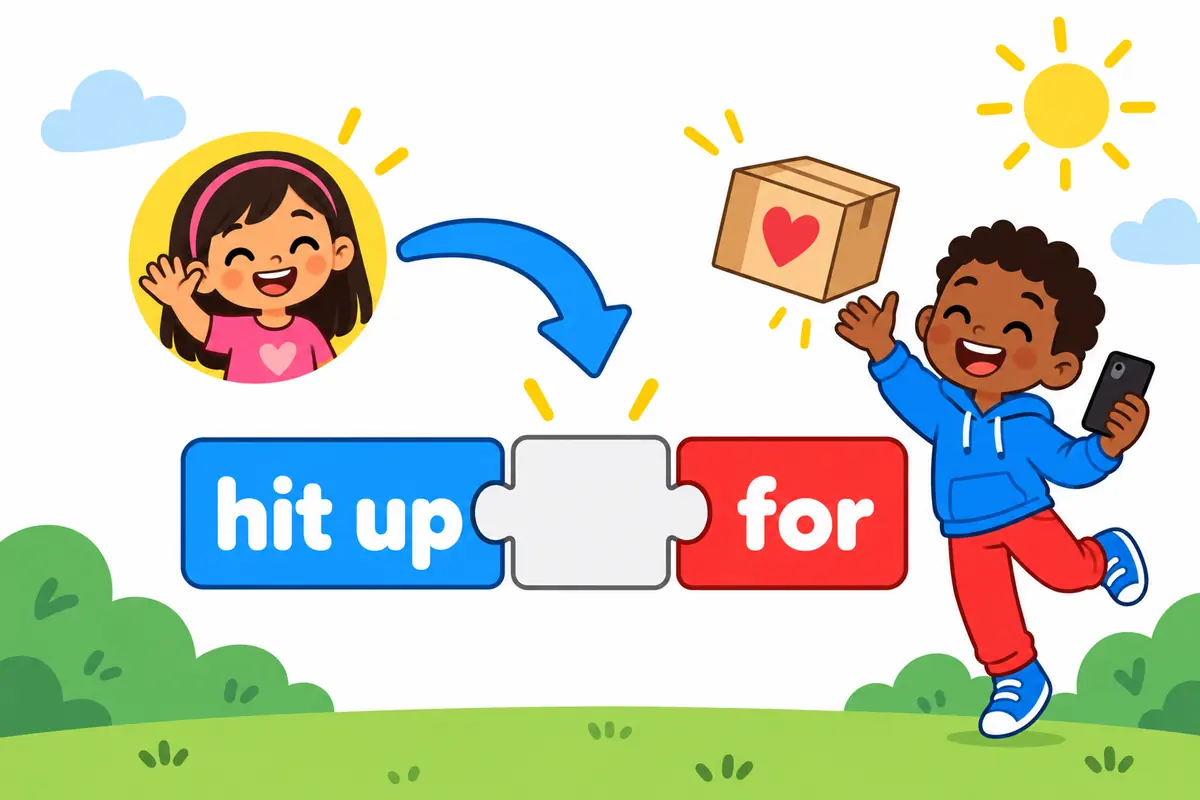
The pronoun rule matches other separable phrasal verbs: hit him up is correct, while hit up him is not. In the contact sense, hit me up is a friendly sign-off. When the request is money, the plainer solicit a donation is more direct, and in formal contexts call a friend or approach a colleague replaces hit up entirely.
Hit up in a sentence: examples across contexts
| Context | Example sentence | Why this works |
|---|---|---|
| Text message | Hit me up when you reach the station. | Warm contact sense with a pronoun. |
| Borrowing money | He hit up his cousin for twenty pounds. | Request sense with for and an amount. |
| Asking a favour | She hit up a neighbour for a lift. | Request sense without money. |
| Night out | Let us hit up that new cafe on Friday. | Contact and visit combined in casual speech. |
| Sales | The rep hit up old clients for renewals. | Work context, informal. |
| Fundraising | They hit up local shops for raffle prizes. | Plural object and for-phrase. |
| Job search | I hit up a former manager for a reference. | Request framed as a favour. |
| Conversation | Do not hit him up for cash again. | Negative with the pronoun in the middle. |
| Study group | I hit up the group chat for the notes. | A request in a familiar setting. |
| Neighbour | She hit up the family next door for a ladder. | Borrowing something small. |
| Freelance work | He hit up an old client for more hours. | A work request kept informal. |
| Sports team | They hit up the coach for an extra session. | A request made to an authority, playfully. |
The contact examples carry no for because nothing is being requested; the request examples all supply for and a thing. Where the request is a formal appeal, solicit a donation is the colder, more appropriate verb, and where the goal is simply a reply, contact a supplier works best.
All of these examples share the same friendly, low-stakes mood. The phrase would feel out of place in a formal email to a new client, but it is exactly right between people who already know each other. When in doubt, match the register to the relationship rather than to the request. A British speaker may prefer to tap a friend for cash when the amount is small.
Hit up vs ask
| Attribute | hit up | ask |
|---|---|---|
| Core meaning | Informally request or contact | Put a question or request to someone |
| Register | Casual, conversational | Neutral, works everywhere |
| Typical object | A friend, relative or client | Anyone, including officials |
| Extra word | for before the thing requested | for or a direct question |
| Best in | Texts, chats, informal talk | Email, school, business, writing |
| Risk | Can sound pushy if the favour is large | Neutral and considered |
Choose hit up for a friendly, low-pressure request, and ask for anything that needs a neutral or respectful tone. The two can describe the same act, but only hit up tells the reader that the relationship is relaxed. Keep it out of a formal email.
Tone is the deciding factor in most sentences. A message that begins hit me up later sounds friendly and open, while the same construction aimed at a stranger can sound presumptuous. Ask keeps the relationship at a safe distance, which is why it survives in offices, schools and customer service.
Word forms and grammar of hit up
| Form | Part of speech | Example |
|---|---|---|
| hit up | phrasal verb, base | They hit up friends for advice. |
| hits up | phrasal verb, third person | She hits up her sister every week. |
| hit up | phrasal verb, past | He hit up his boss for a raise. |
| hitting up | phrasal verb, -ing | Hitting up strangers is not polite. |
| hit him up | correct pronoun order | The pronoun sits in the middle. |
| hit up him | non-standard | Wrong order; the pronoun cannot follow up. |
| hit-up | noun, rare | A casual approach; avoid it in formal prose. |
Common mistakes with hit up
-
She hit up him for a lift.Correct: She hit him up for a lift. Rule: a pronoun goes between hit and up. -
Please hit up the client for the signed contract.Correct: Please ask the client for the signed contract. Rule: formal requests need a neutral verb. -
He hit up his uncle a loan.Correct: He hit up his uncle for a loan. Rule: the request sense needs for. -
I will hit up to you tomorrow.Correct: I will hit you up tomorrow. Rule: no to is used with this phrasal verb. -
They hitted up the manager for tickets.Correct: They hit up the manager for tickets. Rule: the past tense of hit is hit. -
I was hit up by my friend for money.Correct: My friend hit me up for money. Rule: prefer the active voice with this informal phrase.
Practice using hit up
- Fill in the blank: She hit ______ up for a small loan. (pronoun)
- Fill in the blank: I will hit you ______ when the tickets go on sale.
- Choose the better word: In a formal email, (hit up / ask) the supplier for a quote.
- Correct the error: He hit up his friend a favour.
- Build a sentence: use hit up + person + for about borrowing a book.
- Spot the register: which sentence belongs in a group chat – “Hit me up later” or “Please contact me at your earliest convenience”?
- Rewrite with a pronoun: They hit up their tutor for help.
- Write a contact sentence using hit up.
Answers
- her or him; the pronoun goes in the middle.
- up; the particle completes the phrasal verb.
- ask; formal writing needs a neutral verb.
- He hit up his friend for a favour; the request sense needs for.
- Model: I hit up my classmate for a copy of the book.
- The first; a chat keeps the informal tone.
- They hit him up for help; the pronoun goes in the middle.
- Model: Hit me up when the tickets go live.
The bottom line
Hit up is an informal phrasal verb for asking someone for something or reaching out to them, and the request sense needs for. A pronoun must sit in the middle, as in hit him up, so hit up him is never right. To use hit up in a sentence safely, keep it for people you know well.
Frequently asked questions about hit up
Is hit up rude?
Not by itself. Hit up is casual rather than offensive, and friends use it for ordinary requests and messages. It can feel blunt only when the request is large or the relationship is formal. In those cases ask, request or contact sounds more considerate and keeps the same meaning.
Can you hit someone up for money?
Yes, and that is one of the phrase’s best-known uses. The pattern is hit up someone for money, or hit someone up for money with a pronoun in the middle. Because the request is direct, the phrasing suits a friend or relative but sits badly in a formal or professional message.
Is hit up used in British English?
Hit up began as American slang and remains most common in North American English, especially in speech and texting. British English speakers understand it and increasingly use it, but may prefer ask, tap or give me a shout. Either way, the phrase stays informal wherever it appears.
What does hit someone up mean?
To hit someone up is to contact them, or to ask them for something. A message saying hit me up means get in touch, while hit him up for a lift means ask him for a ride. Context decides which sense is active, and for usually signals a request rather than a simple message.