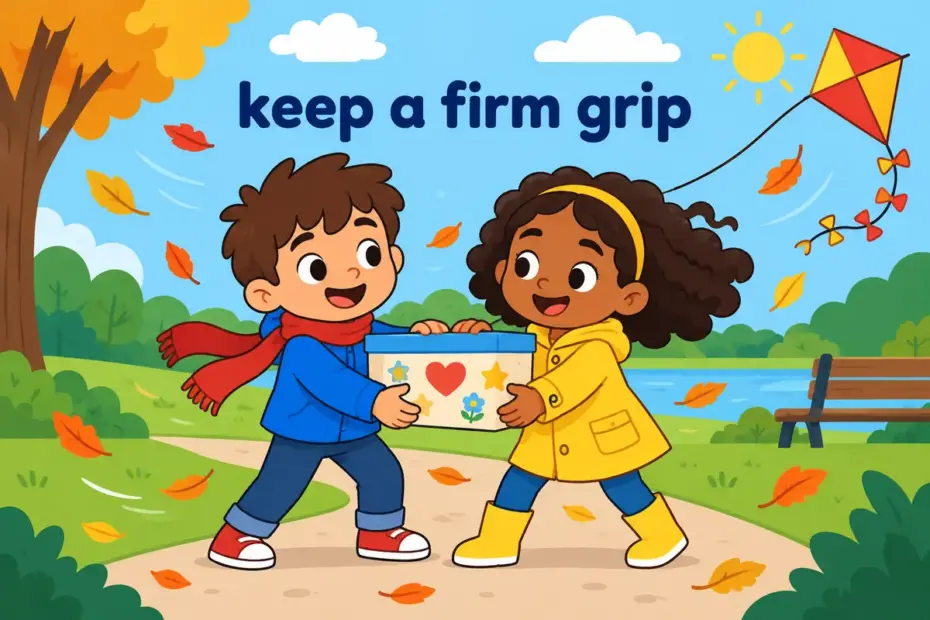
Hold onto means to keep something or to grip it tightly so that it does not slip away. To use hold onto in a sentence, put the thing you keep straight after the phrase: “Hold onto your ticket.” The expression is slightly informal and works for objects, money, memories and hope.
Hold onto at a glance
- Hold onto is a prepositional phrasal verb, not a single word.
- It means to keep possession of something or to grip it so it does not fall.
- The base form is hold onto, the past is held onto and the participle is holding onto.
- The usual objects are receipts, keys, savings, memories, hope and old friendships.
- The object always follows onto, so you hold onto it, never hold it onto.
- The commonest error is dropping the object, which turns hold onto into hold on.
What does hold onto mean?
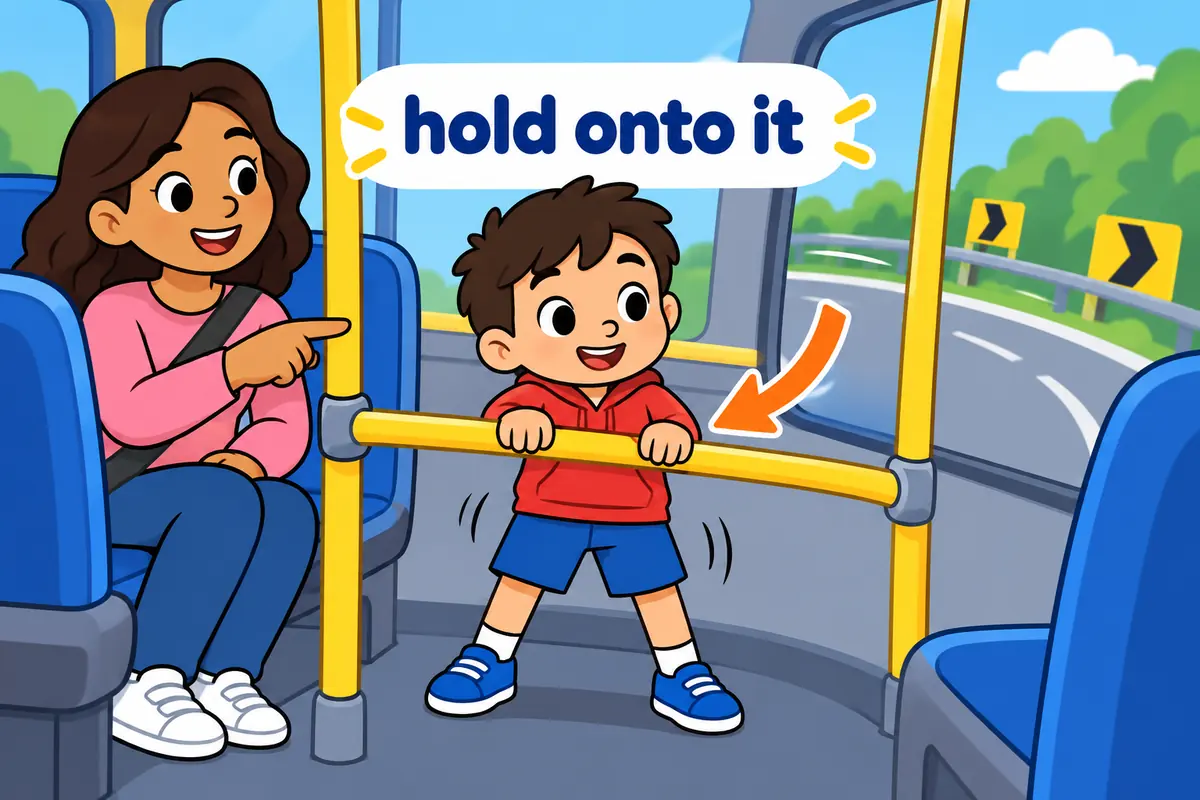
Hold onto is a phrasal verb meaning to keep possession of something or to grip it firmly. The Cambridge entry for hold onto records the physical sense first, and that sense is the easiest to picture: you hold onto a railing so you do not fall. The same verb extends to anything you are reluctant to lose, from savings to a memory. A separate phrase, hold on, means to wait, and confusing the two produces most of the errors on this page.
| Sense | Plain meaning | Example sentence |
|---|---|---|
| Grip physically | Keep a firm hold so something does not fall | Hold onto the rail while the bus turns. |
| Keep possession | Retain something you might otherwise lose | Hold onto the receipt in case you return the coat. |
| Keep emotionally | Refuse to let go of a feeling or hope | She held onto the hope that he would write. |
One honest limitation belongs here. Hold onto is not the same as own or buy, because you can only hold onto something you already have, and the phrase hints that the thing could slip away. That is why it suits a physical grip or something precious. Where the tone should stay neutral, keep is the plainer choice, and retain is the formal cousin that turns up in contracts and reports.
How do you use hold onto in a sentence?
Hold onto behaves like a preposition, so nothing may come between hold and onto. The five patterns below cover the tenses and the three-word variant, and the last one is a fixed idiom with its own meaning.
| Pattern | Example | What it signals |
|---|---|---|
| hold onto + noun | Hold onto your passport at the airport. | The object follows onto directly. |
| held onto + noun | She held onto the old letters for years. | Past tense; shows a long retention. |
| holding onto + noun | He is holding onto a grudge. | Stresses an ongoing refusal to let go. |
| hold on to + noun | Hold on to your seatbelt. | The three-word form; the to belongs to the noun. |
| hold onto your hat | Hold onto your hat when the results arrive. | Fixed idiom meaning prepare for a surprise. |
The object never moves between the two halves of this phrase. Unlike a separable phrasal verb such as turn it off, you cannot say hold it onto the rail; the words stay joined and the object follows. grasp the handle tightly, and you hold onto the bar without thinking about the grammar at all.
Hold onto in a sentence: examples across contexts
Hold onto keeps one meaning while moving from a crowded bus to a family argument. The eleven sentences below each show exactly what is being kept and why it might be lost.
| Context | Example sentence | Why this works |
|---|---|---|
| Travel | Hold onto the handrail when the train starts. | Uses the physical grip that anchors the phrase. |
| Classroom | Hold onto your notes; the test covers everything. | Keeps a concrete object for practical reasons. |
| Personal finance | She held onto the shares when prices wobbled. | Shows retention under pressure. |
| News report | The family held onto the farm through three hard years. | Turns a private choice into a public story. |
| Workplace email | Please hold onto the originals and send scans. | Gives a clear instruction about documents. |
| Medical advice | Patients should hold onto a copy of every scan. | Applies the word to records rather than objects. |
| Conversation | I am holding onto this jacket until it wears out. | Adds a reason and a plan to keep something. |
| Literary writing | He held onto the memory of that summer. | Extends the phrase to something you cannot touch. |
| Sport report | The keeper held onto the ball despite the challenge. | Names a physical grip under pressure. |
| Motivational writing | Hold onto hope even when the timings slip. | Uses an abstract object, the commonest extended sense. |
| Business writing | The firm held onto its best clients through the merger. | Puts retention in a commercial setting. |
The finance, news and business rows all use held onto, because past retention is the natural thing to report. A cling to something is closer to fear than to care, since it suggests you cannot let go even when you should.
Hold onto vs hold on
Hold onto and hold on share their first word and almost nothing else. Hold on means to wait, or to grip something for a moment, and it stands alone without an object. Hold onto means to keep something and always needs the thing being kept. A phone caller who is told to hold on is being asked to wait; a caller told to hold onto the ticket is being asked to keep it.
| Attribute | hold onto | hold on |
|---|---|---|
| Core meaning | Keep or grip something | Wait, or grip a moment |
| Needs an object | Always | Never |
| Typical sentence | Hold onto your receipt. | Hold on, I am nearly ready. |
| Opposite act | Let go, release | Go ahead, proceed |
| Tone | Practical advice or emotion | Informal and immediate |
| Part of speech | Prepositional phrasal verb | Intransitive phrasal verb |
Verdict: choose hold onto when something is being kept, and hold on when somebody is being asked to wait. The opposite of keeping is release or let go, while abandon is stronger and suggests giving something up for good.
Word forms and grammar of hold onto
Hold onto changes only through the verb hold, and the phrase keeps its shape around it. The table lists the forms writers actually use, including the three-word variant that many style guides allow.
| Form | Part of speech | Example |
|---|---|---|
| hold onto | phrasal verb, base | Hold onto the map so we do not get lost. |
| holds onto | phrasal verb, third person | She holds onto every ticket she buys. |
| held onto | phrasal verb, past | He held onto the letters for a decade. |
| holding onto | phrasal verb, participle | They were holding onto the rope together. |
| hold on to | three-word variant | Hold on to your proof of purchase. |
| hold onto your hat | fixed idiom | Hold onto your hat when the results come in. |
| not allowed | Write hold onto it, never hold on it. |
The three-word form hold on to and the two-word form hold onto mean exactly the same thing, and both are standard. Keep whichever form you choose consistent within one document, and never write hold onto to, because onto already contains the idea of to.
Common mistakes with hold onto
- Incorrect:
Please hold on a moment.Correct: Please hold onto a moment. Rule: Hold onto needs a real object, and a moment is something you wait through, not keep. - Incorrect:
Hold onto, the manager is coming.Correct: Hold on, the manager is coming. Rule: Asking somebody to wait uses hold on, which takes no object. - Incorrect:
Hold on your passport.Correct: Hold onto your passport. Rule: The object of keeping follows onto, not on. - Incorrect:
She held onto to the rope.Correct: She held onto the rope. Rule: Onto already means on to, so adding to doubles the preposition. - Incorrect:
He held onto that the plan would work.Correct: He held onto the hope that the plan would work. Rule: Hold onto takes a noun phrase, never a that-clause. - Incorrect:
Hold it onto until I return.Correct: Hold onto it until I return. Rule: The pronoun object cannot sit between hold and onto.
Practice using hold onto
Work through the seven items, then read the reasons, because each reason names the rule at work.
- Fill the gap: ______ the handles while the cable car moves.
- Choose the better phrase: The line is busy, so please (hold on / hold onto) for a moment.
- Correct the error: She held onto to her grandmothers ring.
- Build a sentence: use hold onto about keeping a school report for a parent.
- Spot the register: which fits a bank letter, please retain the documents, or hang onto the paperwork?
- Rewrite in the past tense: They hold onto every letter. Change the verb only.
- Explain the contrast: write one sentence where hold on is the correct phrase.
Answers
- Hold onto — the handles are the object being gripped, so onto is required.
- hold on — the caller is asked to wait, which takes no object.
- She held onto her grandmothers ring — onto already contains to, so no second to is needed.
- Model answer: Hold onto this report and show it to your parents tonight.
- Please retain the documents — a bank letter keeps a formal verb and avoids the informal hang onto.
- They held onto every letter — only the verb changes, to its past form held.
- Model answer: Hold on while I find the file, then I will read the number aloud.
The bottom line
Use hold onto in a sentence to say that something is being kept or gripped, and put the object directly after the phrase. Two points decide most sentences: hold onto always needs a real object, while hold on means to wait and stands alone, and nothing may come between hold and onto. For a neutral tone, keep is the plainer verb and retain the more formal one.
Frequently asked questions about hold onto
Is it hold onto or hold on to?
Both are correct and they mean the same thing. Hold onto joins the words into one phrase, while hold on to spells out the preposition separately. British and American writers use both, and many style guides accept either. The one form to avoid is hold onto to, which repeats the preposition needlessly.
What does hold onto mean?
Hold onto means to keep possession of something or to grip it firmly so it does not fall. It covers a physical hold, as in hold onto the rail, and a figurative one, as in hold onto your hope. The phrase always needs an object, so it never stands alone the way hold on does.
Can you hold onto an idea or a feeling?
Yes, and this is one of the commonest uses. People hold onto hope, memories, beliefs and even grudges. When the object is abstract, the phrase often suggests that letting go would be painful, so it carries more emotion than keep. Writers choose it deliberately for that sense of strain.
Is hold onto formal or informal?
Hold onto sits somewhere in the middle and works in most contexts, including workplace writing. Its three-word form hold on to is slightly more formal. In a contract or a legal notice, writers usually prefer retain or keep because those verbs avoid the hint of emotion that hold onto carries.