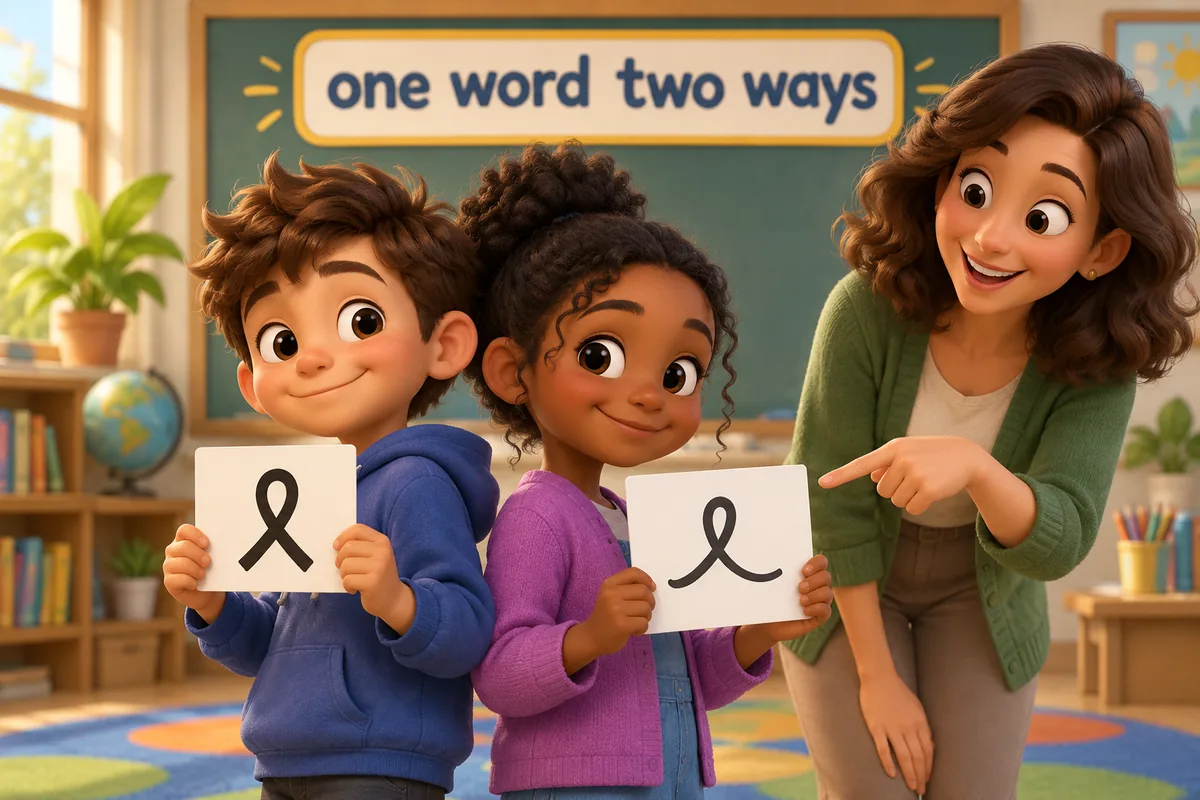
Homonyms meanings and examples cover the words that share a form but still mean different things, such as bank for a riverside and bank for money. The umbrella term gathers two groups: words that sound alike and words that are spelled alike. This guide sets out both, the confusing pairs and the way to choose the right word.
Homonyms meanings and examples at a glance
- A homonym is a word that shares a sound or a spelling with another word.
- Homophones sound alike but may be spelled differently, as in to, too and two.
- Homographs are spelled alike but may sound different.
- Context and part of speech decide which meaning is intended.
- The commonest error is swapping your for you are in writing.
What is a homonym?
A homonym is a word that is either pronounced like another word or spelled like another word while carrying a different meaning. The broad term covers both the sound-alikes and the look-alikes, which is why bear the animal and bear the verb count, and so do to, too and two. The table gives common homonyms with two meanings each, and further examples sit in vocabulary in a sentence.
| Homonym | Meaning one | Meaning two |
|---|---|---|
| bear | a large wild animal | to carry or endure |
| bat | a flying mammal | a club for hitting a ball |
| bank | the side of a river | a place that keeps money |
| bark | the sound of a dog | the outer coat of a tree |
| match | a small fire stick | a sporting contest |
| ring | a circle of metal | to make a bell sound |
| spring | the season after winter | a coiled metal or a jump |
| watch | a small clock | to look at something |
| saw | a cutting tool | the past tense of see |
| seal | a sea animal | to close something tightly |
The two types of homonym
Homonyms divide into homophones, which share a sound, and homographs, which share a spelling. A pair can belong to both groups when it is written and said the same way, as with the two senses of bank. The table compares the types, and the structure behind them sits in word structure in a sentence.
| Type | What it shares | Example |
|---|---|---|
| Homophone | sound, not spelling | to, too and two |
| Homograph | spelling, sometimes not sound | lead (metal) and lead (guide) |
| Homonym that is both | sound and spelling | bank (river) and bank (money) |
| Heteronym | spelling, but a different sound | wind (air) and wind (turn) |
Homonyms arise for two reasons. Some grow from a single word that developed several senses over time, as with the many uses of spring. Others come from two unrelated words that happened to fall together in sound or spelling, as with the two senses of bank. The reason does not change how a reader uses the word, but it explains why the two meanings can sit so far apart.

Homonyms meanings and examples across contexts
The right meaning appears from the sentence, so reading the whole line matters more than any rule. Each sentence below uses a homonym in a setting that points to one sense, and more example frames sit in noun in a sentence.
| Context | Sentence | Sense in use |
|---|---|---|
| Nature walk | A bear crossed the path. | the animal |
| Moving house | I cannot bear the noise. | to endure |
| Riverside picnic | We sat on the river bank. | the land beside water |
| Shopping trip | She went to the bank for cash. | the money business |
| Sports club | He swung the bat too hard. | the hitting tool |
| Night garden | A bat flew over the hedge. | the flying mammal |
| Camping | They lit a match for the stove. | the fire stick |
| Football news | The match ended in a draw. | the contest |
| Gardening | The tree bark was rough. | the tree coat |
| Street at night | The dog gave a loud bark. | the dog sound |
Which homophones confuse writers most?
Homophones cause the spelling errors that readers notice, because the sound is right but the letters are wrong. Learning each pair with its job keeps the two apart, and the patterns echo the same problem in pronounce in a sentence.
A useful habit is to learn each homophone group as a set with its jobs rather than as a list of separate definitions. Writing to for direction, too for also and two for the number fixes the three at once. The same trick covers there for a place, their for possession and the contraction for they are, all in one review.
| Sound | Words | Job of each |
|---|---|---|
| tu | to, too, two | direction, also, the number |
| thair | there, their, they are | place, belonging, contraction |
| yor | your, you are | belonging, contraction |
| rait | right, write, rite | correct, mark letters, ceremony |
| see | sea, see | ocean, look at |
| flaur | flour, flower | baking powder, bloom |
| mail, male | letters, the male sex | |
| brake | brake, break | stopping part, to damage |
Word forms and parts of speech of homonyms
Many homonyms split by part of speech, so the grammar of the sentence points to the sense. A noun in front of a verb and a verb in front of an object often carry the two different meanings of one spelling.
| Word | Form one | Form two |
|---|---|---|
| watch | noun: a small clock | verb: to look |
| ring | noun: a circle of metal | verb: to phone or chime |
| match | noun: a contest | verb: to go well with |
| spring | noun: a season | verb: to jump up |
| seal | noun: a sea animal | verb: to close |
| bear | noun: an animal | verb: to carry or endure |
Common mistakes with homonyms
Mistake 1: there for their. Incorrect: There bags are heavy. Correct: Their bags are heavy. Rule: their shows belonging, and there names a place.
Mistake 2: to for too. Incorrect: The soup is to hot. Correct: The soup is too hot. Rule: too means also or excessively, and to points toward something.
Mistake 3: your for you are. Incorrect: Your going the wrong way. Correct: You are going the wrong way. Rule: your shows belonging, while you are is a subject and verb.
Mistake 4: its for it is. Incorrect: Its raining again. Correct: It is raining again. Rule: it is shortens to the form with an apostrophe, and the other shows belonging.
Mistake 5: reading one sense only. Incorrect: She sat on the money bank by the river. Correct: She sat on the river bank by the water. Rule: the words around a homonym decide its sense.
Practice using homonyms
- Choose the sense: The bat flew at dusk, or He held the bat ready?
- Pick the right word: They are building (their / there) house.
- Correct the error: Your going to love this match.
- Build a sentence: use bank once for a river and once for money.
- Name the type: to, too and two share a sound, so they are ______.
- Spot the sense: in The dog bark was loud, is bark a noun or a verb?
Answers
- The bat flew at dusk uses the animal; He held the bat ready uses the hitting tool.
- their house; their shows belonging.
- You are going to love this match; you are replaces the possessive form here.
- Sample: We rested on the bank, then walked to the bank; the same spelling carries two senses.
- homophones, because the sound is shared.
- bark is a noun here; it is the dog sound.
The bottom line
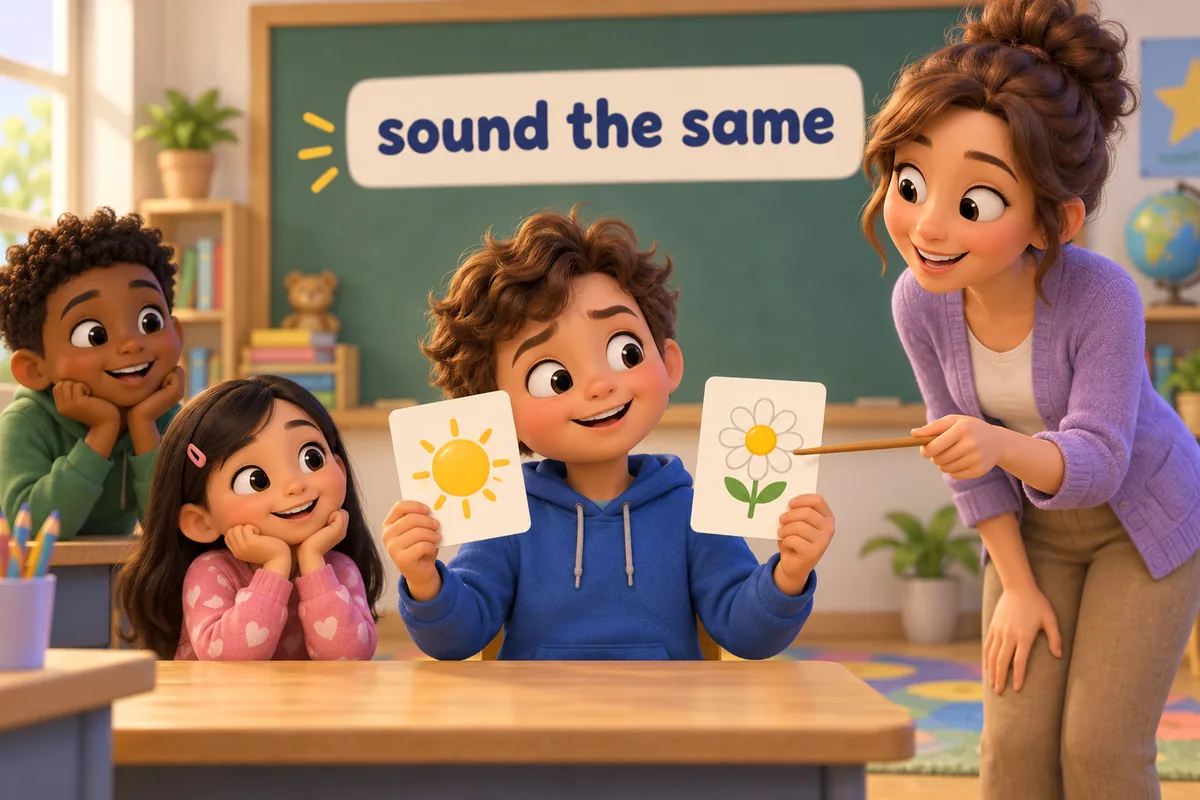
Homonyms meanings and examples come down to one idea: a shared sound or a shared spelling can carry two separate senses. Learn the sound-alike pairs such as to, too and two alongside the shared-spelling pairs such as bank and bat. Read the sentence, check the part of speech, and the right word becomes obvious.
Frequently asked questions about homonyms
What is a homonym?
A homonym is a word that shares either its sound or its spelling with another word but has a different meaning. The term covers both sound-alikes such as to and two and shared spellings such as bank and bank. Context tells a reader which sense is meant.
What is the difference between a homonym and a homophone?
A homophone shares a sound, as flour and flower do, while a homonym is the wider term that also includes words sharing a spelling. Every homophone is a homonym, but not every homonym is a homophone. A shared-spelling pair such as lead and lead is a homonym but not a homophone.
Can a homonym be a homograph too?
Yes. When a pair is written the same way and said the same way, it is both a homonym and a homograph, as with the two senses of bank and bat. When the spelling is shared but the sound differs, as with wind, the pair is a homograph and a heteronym as well.
How do I choose the right homonym?
Read the whole sentence and ask what part of speech fits, because a noun and a verb often carry the two senses. Then check the surrounding words for a clue, such as river for bank or cash for bank. Sound alone cannot decide a homophone.