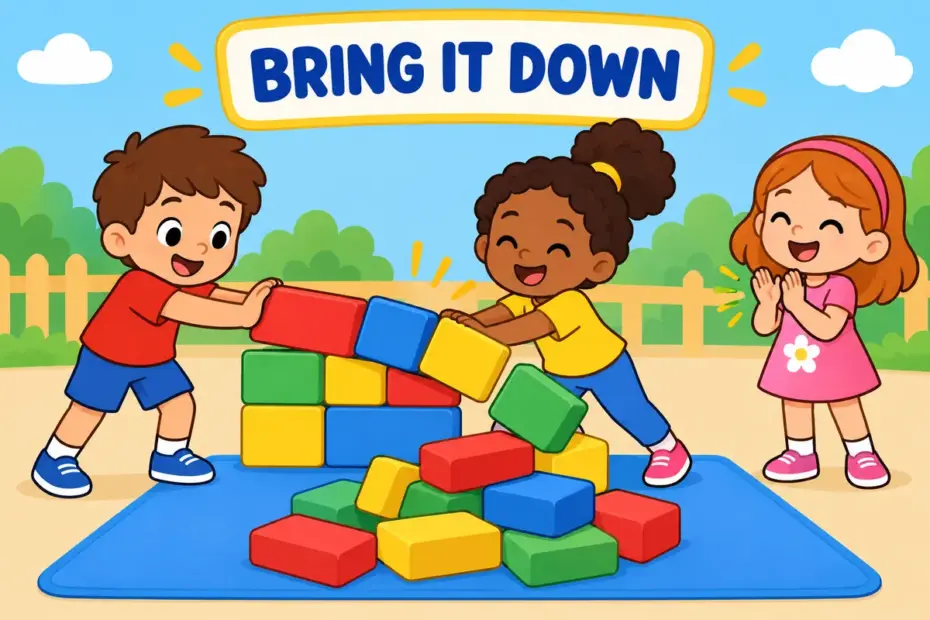
Knock down means to make something fall, to demolish a structure, to cut a price, or to sell an item at auction. To use knock down in a sentence, keep the object flexible: “Workers knocked the wall down” and “Workers knocked down the wall” are both correct. A pronoun must sit between the two words.
Knock down at a glance
- Knock down is a separable phrasal verb with a noun object.
- Its senses are to strike to the ground, to demolish, to lower a price, and to sell at auction.
- A pronoun object must sit between knock and down: knock it down.
- The passive is common: the flats will be knocked down next spring.
- The commonest error is writing knock down it instead of knock it down.
What does knock down mean?
Knock down is a separable phrasal verb with four related senses: to strike something to the ground, to demolish a structure, to reduce a price, and to sell at auction. The Cambridge entry for knock down records the demolish and auction senses, and a single image ties them together, the idea of bringing something low. One honest limitation is worth stating: knock down is broad and informal, so a formal demolition report prefers demolish a building. The phrase also never means to finish work, which belongs to knock off.
| Sense | Plain meaning | Example sentence |
|---|---|---|
| Strike to the ground | Hit something or someone so they fall | A gust knocked the fence down. |
| Demolish | Take a structure apart completely | The council will knock down the old library. |
| Lower a price | Reduce the asking price of something | They knocked the wardrobe down to forty pounds. |
| Sell at auction | Sell an item to the highest bidder | The clock was knocked down for two hundred pounds. |
All four senses stay close to the physical image, which is why they rarely confuse a reader. A price is brought down, a building is brought down, and an auction hammer brings the bidding to a close. The grammar is what learners must watch, because the phrase is separable and the particle is essential.
How do you use knock down in a sentence?
The phrase has two orders with a noun object and one fixed order with a pronoun. Five patterns cover almost every real sentence, including the auction and price senses.
| Pattern | Example | What it signals |
|---|---|---|
| knock down + object | Workers knocked down the partition wall. | The object follows the whole phrase. |
| knock + object + down | The gale knocked two fence panels down. | The separable order, common with longer objects. |
| knock + pronoun + down | The cat knocked it down again. | A pronoun must sit between verb and particle. |
| knock down + to + price | They knocked the price down to forty pounds. | Shows a reduction to a named figure. |
| be knocked down for | The painting was knocked down for a record sum. | Passive, standard in auction reports. |
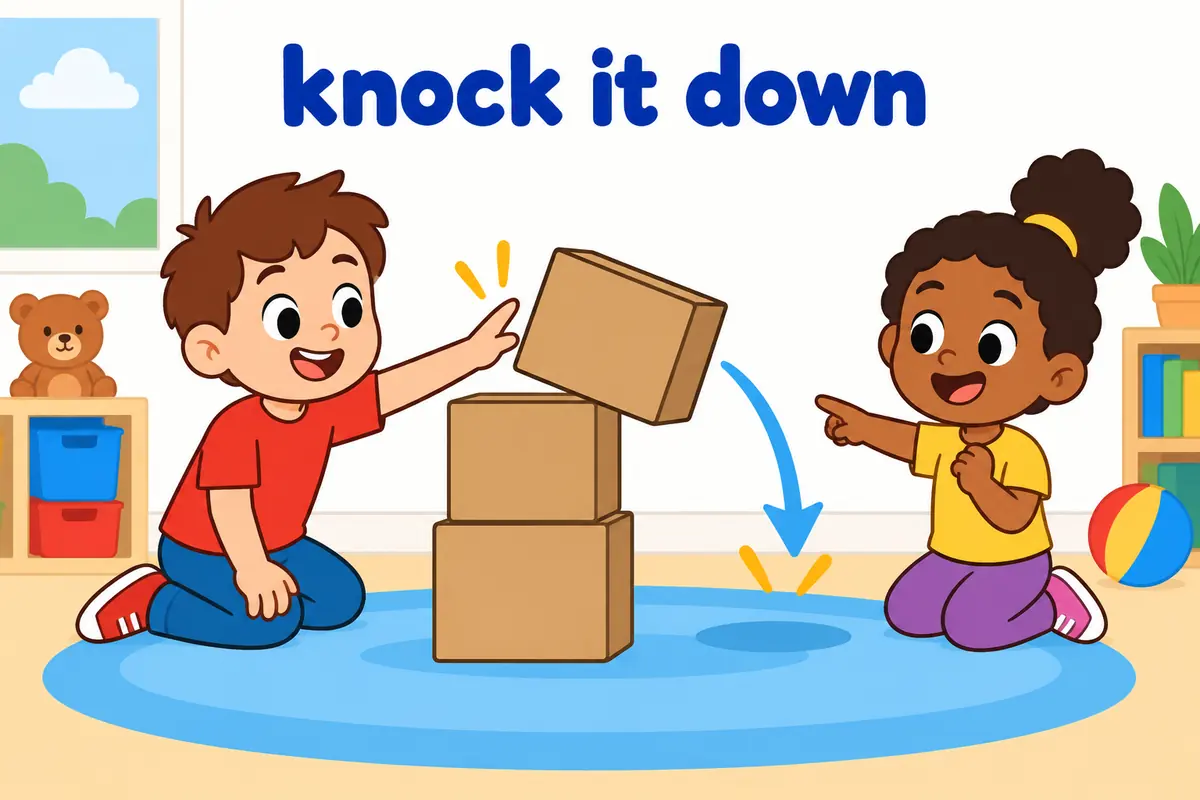
Knock down in a sentence: examples across contexts
Knock down moves easily from a building site to an auction room. The eight sentences below keep the same verb while changing the object, and each one shows why that object fits.
| Context | Example sentence | Why this works |
|---|---|---|
| Construction | Workers knocked down the partition wall in an afternoon. | A demolition sense with a specific structure. |
| Auction | The painting was knocked down to a telephone bidder. | Uses the fixed auction sense and its for or to phrase. |
| Retail | The manager knocked the sofa down to clear old stock. | The price sense with a business reason. |
| Weather | The gale knocked two fence panels down overnight. | A force of nature as the subject. |
| News report | The council will knock down the derelict flats next spring. | Names an authority, a building and a date. |
| Road safety | A cyclist was knocked down at the busy junction. | The passive form used in a careful report. |
| Conversation | The cat knocked the plant down again. | Everyday use with a pronoun-eligible object. |
| Property | They knocked the asking price down after the survey. | The reduction sense in a property deal. |
The pattern is clear across the table. Physical objects take the topple or demolition sense, prices take the reduction sense, and auction items take the passive. A crew will knock down an old building and erect a new hall in its place, while an engineer may flatten the boxes of rubble as the work proceeds.
Knock down vs demolish
Knock down and demolish overlap in the building sense, but only one of them reaches prices and auctions. The table sets out the differences that decide which word fits.
| Attribute | knock down | demolish |
|---|---|---|
| Core meaning | Cause to fall, or reduce a price | Take a structure apart completely |
| Main object | Anything that can be struck or lowered | Buildings and large structures only |
| Register | Informal to neutral | Neutral and formal |
| Typical subject | A person, wind, storm or auctioneer | A company, council or crew |
| Effort implied | A single blow or action | Planned work over time |
| Second sense | Sell at auction, or cut a price | None |
Verdict: choose knock down for a single fall, an informal demolition, a price cut or an auction, and choose demolish for planned, formal removal of a structure. A small accident with a glass is to knock over a glass, and a small reduction at the till is to knock off a few pounds, so neither of those phrases belongs to the demolish family. A tower that sways before it collapses may topple a tower more slowly than one clean blow.
Word forms and grammar of knock down
Only the verb knock inflects, and the one-word form knockdown is a different part of speech. The table lists the real forms and marks the neighbour that shares the base verb.
| Form | Part of speech | Example |
|---|---|---|
| knock down | phrasal verb, base form | They plan to knock down the shed. |
| knocks down | third person singular | The wind knocks down the sign every winter. |
| knocked down | past and past participle | The old mill was knocked down in 2019. |
| knocking down | present participle | Crews are knocking down the last wall. |
| knockdown | noun or adjective, one word | The shop sold it at a knockdown price. |
| knock off | phrasal verb — different meaning | They knocked a few pounds off the bill. |
The separable order is the grammar that learners must practise, because it is the one place a mistake is easy to make. Longer noun objects usually follow the whole phrase, and pronouns must sit between the parts, which is why the fixed shape of knock it down is so useful.
Common mistakes with knock down
- Incorrect:
The storm knocked down it.Correct: The storm knocked it down. Rule: A pronoun object must sit between knock and down, never after the particle. - Incorrect:
They knocked the old house.Correct: They knocked the old house down. Rule: The particle is part of the verb, so leave it out and the meaning disappears. - Incorrect:
They knocked the price down by to twenty pounds.Correct: They knocked the price down to twenty pounds. Rule: Use by for the amount of the cut and to for the final figure, never both together. - Incorrect:
The painting knocked down for two hundred pounds.Correct: The painting was knocked down for two hundred pounds. Rule: In the auction sense the item is the patient, so the passive is required.
Practice using knock down
Work through the six items, then check the reasoning rather than only the answer.
- Fill the gap: The crew will ______ the old garages to make room for a garden.
- Choose the better word: The developer plans to (knock down / knock off) the whole row of shops.
- Correct the error: The storm knocked down them before dawn.
- Build a sentence: use knock + pronoun + down about a stack of boxes.
- Spot the register: which belongs in an auction report — the vase was knocked down for nine hundred pounds, or the vase got knocked down for nine hundred quid?
- Rewrite in the passive: They knocked the chimney down in June. Begin with The chimney.
Answers
- knock down — the crew demolish the garages, which is the whole-phrase order before a long object.
- knock down — demolishing a building is knock down, while knock off means to deduct or to finish work.
- The storm knocked them down before dawn — the pronoun goes between knock and down.
- Model answer: I knocked the stack of boxes down while reaching for the tape.
- The vase was knocked down for nine hundred pounds — a formal report uses the passive and pounds, while quid is informal.
- The chimney was knocked down in June — the passive takes was with the past participle and the time phrase at the end.
The bottom line
Use knock down in a sentence when a force makes something fall, when a structure is demolished, or when a price is cut or an item is sold at auction. The two nuances that decide most sentences are these: the phrase is separable, so a pronoun goes between knock and down, and the auction and price senses are fixed expressions rather than free uses. When the action is planned demolition of a building, demolish is the more formal word.
Frequently asked questions about knock down
Is knock down one word or two?
As a verb it is two words, as in they will knock down the wall. The single word knockdown is a noun or an adjective, as in a knockdown price or a knockdown blow. The spelling therefore depends on the job the word is doing, and the joined form never takes an object the way the verb does.
What does knocked down mean at an auction?
At an auction, an item is knocked down when the auctioneer sells it to the highest bidder, usually by bringing the hammer down. The phrase takes for or to before the price or buyer, as in the clock was knocked down for two hundred pounds. It is a fixed expression in sale reports.
Can you separate knock and down?
Yes. Knock down is separable, so the object may follow the whole phrase or sit between the two parts. A pronoun must go between them, which is why the storm knocked it down is correct and the storm knocked down it is not. Longer noun objects usually follow the full phrase.
What does it mean to knock down a price?
To knock a price down is to reduce it, often after inspection or to clear stock. Use by for the amount of the cut and to for the final amount, as in they knocked it down by ten pounds to fifty. The sense is informal and common in shops, markets and property deals.
Have you ever heard someone mention “knock down” in conversation and found yourself unsure of its meaning? In simple terms, to “knock down” means to cause something to fall or collapse by striking it forcefully.
This phrase is commonly used to describe the action of knocking over or demolishing objects, buildings, or even ideas. Understanding this term is crucial in various contexts, from construction and demolition to casual conversations and everyday situations.
7 Examples Of Knock Down Used In a Sentence For Kids
- The strong wind can knock down a tree.
- Please be gentle so you don’t knock down those blocks.
- Watch out for the ball, it might knock down the cups.
- The bulldozer can easily knock down the old building.
- Don’t run too fast, you might accidentally knock down your friend.
- The loud noise might knock down the birds from their nest.
- Be careful not to knock down the tower of blocks you built.
14 Sentences with Knock Down Examples
- Knock down the textbooks on your list one by one as you finish studying them.
- Make sure to knock down the correct answers during your exam to avoid losing marks.
- Don’t forget to knock down the pins in a game of bowling with your friends.
- It’s important to knock down unhealthy habits and replace them with better ones.
- The professor’s lecture really knocked down my misconceptions about that subject.
- Knock down the barriers that are holding you back from reaching your full potential.
- Sometimes you need to knock down your ego in order to learn and grow.
- Let’s all work together to knock down the obstacles preventing us from achieving our goals.
- Don’t let failure knock you down, use it as a stepping stone to success.
- Knock down your fears and take that leap of faith towards your dreams.
- The new college rules really knocked down our freedom to organize events.
- It’s important to knock down the language barriers to better communicate with your peers.
- Knock down those negative thoughts and focus on the positives in your life.
- Sometimes you need to knock down your pride and ask for help when you’re struggling.
How To Use Knock Down in Sentences?
To use Knock Down in a sentence, start by identifying the object that is being knocked down. For example, “I accidentally knocked down the vase on the table.” In this sentence, the action of knocking down is being done to the vase.
Next, determine the subject or person who is doing the knocking down. For instance, “The strong wind knocked down the tree in the yard.” Here, the wind is the subject that is causing the tree to fall.
It is important to place Knock Down after the subject and before the object that is being affected. This helps to clarify who or what is performing the action and what the action is being done to.
Additionally, you can include adverbs or adjectives before or after Knock Down to provide more detail or context to the sentence. For example, “The construction workers carefully knocked down the old building.” In this case, the adverb “carefully” adds information about how the action was performed.
Remember to always conjugate the verb “knock” according to the subject performing the action (knock/knocks/knocking) and use the appropriate tense (knocked down/knocking down) based on the context of the sentence. With these guidelines in mind, you can effectively use Knock Down in a sentence to describe the action of causing something to fall or collapse.
Conclusion
In conclusion, “knock down” refers to the act of physically causing something to fall or collapse, whether intentionally or accidentally. Examples include “The strong winds knocked down power lines,” “The bulldozer knocked down the old building,” and “The collision knocked down the pedestrian.” The phrase is commonly used to describe destruction, demolition, or bringing something to a lower position.
Overall, “knock down” conveys a sense of forceful impact leading to a change in the physical state of an object or structure. It is a straightforward term that vividly captures the image of something being toppled or brought down, making it a clear and effective way to describe such occurrences in everyday language.


