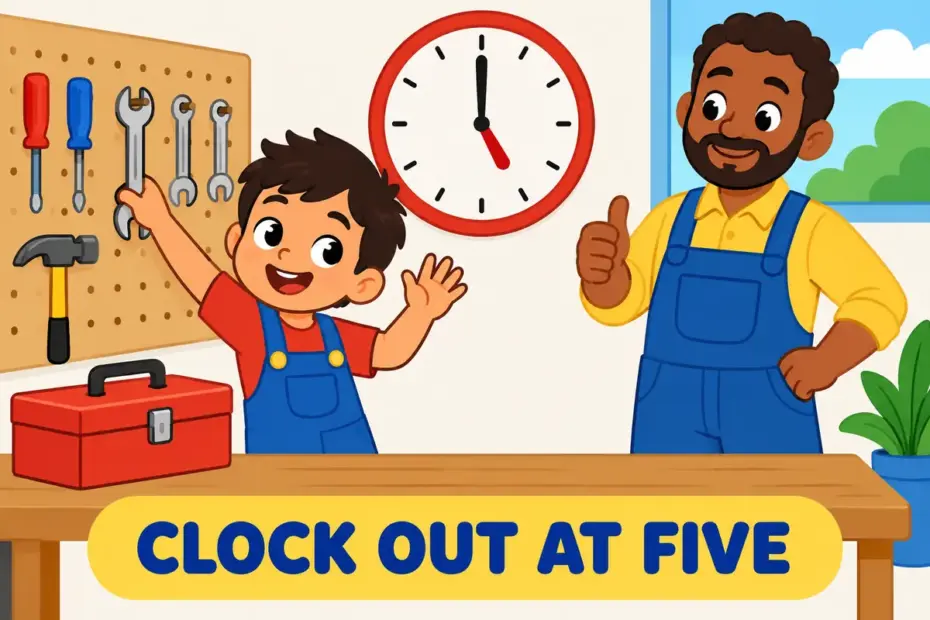
Knock off is a phrasal verb with several senses: to stop work, to reduce a price, to finish something quickly, or, informally, to steal. In a sentence it takes an object, and it is separable, so you can knock a price off or knock off a price. “We knock off at five” shows the intransitive use.
Knock off at a glance
- Knock off is a separable phrasal verb; its forms are knocks off, knocked off and knocking off.
- Its main senses are to stop work, to deduct an amount, to finish quickly and to steal.
- The particle can strand after the object, as in knock the mud off.
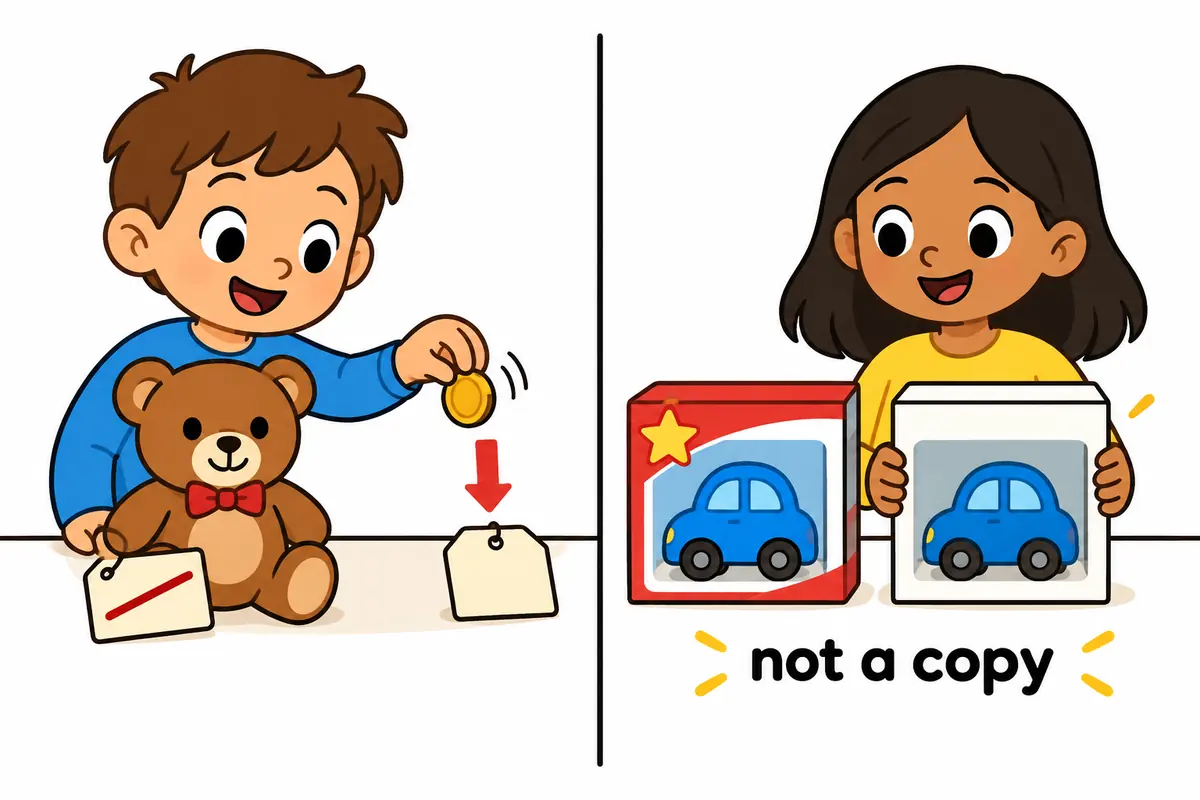
- The one-word noun knockoff is a different word meaning a cheap imitation.
- The commonest error is using knock off for stealing in formal writing, where it sounds too casual.
What does knock off mean?
Knock off is a phrasal verb meaning to stop working, to remove an amount from a price, to finish something quickly, or, in casual speech, to steal. The Cambridge entry for knock off lists the work sense and the price sense, and the two behave differently: the first can stand alone, the second needs an object. Where a reduction is official rather than casual, omit an item or discount is the safer wording in a formal document.
| Sense | Plain meaning | Example sentence |
|---|---|---|
| Stop work | End the working day | We knock off at five on Fridays. |
| Deduct an amount | Take money off a price | The seller knocked twenty pounds off the bike. |
| Finish quickly | Complete a task briskly | She knocked off the whole report before lunch. |
| Steal | Take something unlawfully, informally | Someone knocked off his bike outside the shop. |
One limitation is worth stating plainly. Knock off is informal in every sense except the price one, so a police report says stolen rather than knocked off, and a contract says deducted rather than knocked off. The noun knockoff, meaning a copied product, is a separate word with no verb sense at all.
How do you use knock off in a sentence?
The verb is transitive except in the stop-work sense, and it is separable, so a short object may sit between knock and off. With an amount, the pattern is knock the amount off the total.
| Pattern | Example | What it signals |
|---|---|---|
| subject + knock off | The staff knock off at six. | The intransitive stop-work sense, with no object. |
| knock + object + off | Knock the mud off your boots. | The separable pattern, with the particle stranded after the object. |
| knock + amount + off + price | The shop knocked ten pounds off the chair. | Deducting a sum from a stated total. |
| knock off + task | He knocked off two chapters in an hour. | Finishing work quickly and without fuss. |
| knock off + possession | Thieves knocked off three laptops. | The informal theft sense, rare in formal writing. |
When the object is a pronoun it must go between the two parts: knock it off, never knock off it. That single rule accounts for most learner errors with this verb.
To finish a task briskly is the plain verb behind the casual sense, and to stop work for the day is the neutral phrasing that knock off replaces in speech.

Knock off in a sentence: examples across contexts
The verb keeps one shape while moving between a workshop, a market and a news desk. These nine sentences show each sense in its natural setting.
| Context | Example sentence | Why this works |
|---|---|---|
| Workshop | We knock off as soon as the last bench is tidy. | The stop-work sense needs no object. |
| Office email | I will knock off the summary before the meeting. | Finishing a task quickly, with an object. |
| Market stall | The trader knocked a pound off the strawberries. | The deducting pattern with amount, off and price. |
| School | The bell means we can knock off and go home. | Uses the intransitive sense in a familiar routine. |
| News report | Burglars knocked off three bikes from the shed. | Shows the theft sense, kept informal on purpose. |
| Sports writing | The champion knocked off two sets in forty minutes. | Finishing a contest briskly, with an object. |
| Conversation | Knock it off, you two, before someone gets hurt. | A fixed command using the stranded pronoun object. |
| Business note | They knocked off the delivery charge for members. | Deducting a fee, which stays neutral in tone. |
| Academic prose | Students who knock off a draft in one sitting rarely revise it. | Finishing too quickly, read here as a mild caution. |
Only the theft and stop-work rows sit at the informal end; the price and task senses travel easily into ordinary writing.
Knock off vs knock down and knockoff
Three near neighbours cause most confusion, and two of them share the base verb knock. Knock down a price can also lower a cost, but it usually means to demolish something or to sell at auction, while the noun knockoff means a copied product.
| Attribute | knock off | knock down | knockoff |
|---|---|---|---|
| Core job | Stop, deduct, finish or steal | Demolish, or sell at auction | Name a copied product |
| Part of speech | Verb | Verb | Noun |
| Usual subject | Workers, shops, thieves | Builders, auctioneers | A buyer or a market |
| Separable | Yes | Yes | Not applicable |
| Register | Informal, except in pricing | Neutral | Informal and often critical |
Verdict: choose knock off for stopping work or taking an amount off a price, knock down for demolition or an auction sale, and knockoff only as the one-word noun for an imitation.
Word forms and grammar of knock off
Knock off inflects regularly, but it has a one-word relative that looks identical in speech and behaves completely differently in writing.
| Form | Part of speech | Example |
|---|---|---|
| knock off | phrasal verb, base | We knock off at five. |
| knocks off | verb, third person singular | She knocks off early on Fridays. |
| knocked off | verb, past and past participle | They knocked off the last box together. |
| knocking off | verb, present participle | He is knocking off the final invoices now. |
| knockoff | noun, one word | The market sold cheap knockoffs of the coat. |
| knock-off | adjective, hyphenated | It was a knock-off watch, not the real brand. |
The two-word verb and the one-word noun are never interchangeable, and the same false pair appears with knock back, which is an entirely different verb.
Common mistakes with knock off
- Incorrect:
Please knock off it before the meeting.Correct: Please knock it off before the meeting. Rule: With a pronoun object, the particle must follow it. - Incorrect:
The shop knocked off ten pounds the chair.Correct: The shop knocked ten pounds off the chair. Rule: The deducing pattern is knock + amount + off + item. - Incorrect:
The police said the van was knocked off.Correct: The police said the van was stolen. Rule: The theft sense is informal and belongs in speech, not official reports. - Incorrect:
He bought a knock off jacket.Correct: He bought a knockoff jacket. Rule: The noun and adjective are written as one word or hyphenated, not as two. - Incorrect:
We knocked off from work the meeting early.Correct: We knocked off early. Rule: The stop-work sense is intransitive, so it takes no object at all.
Practice using knock off
Work through the six items, then read the reason beside each answer.
- Fill the gap: The assistant ______ fifty pence off the total.
- Choose the better word: We usually (knock off / knock down) at half past five.
- Correct the error: She knocked off it in ten minutes.
- Build a sentence: use knock off in the deducting sense about a train fare.
- Spot the register: which belongs in a police statement — the tools were knocked off, or the tools were stolen?
- Rewrite with a pronoun: Knock the dust off your coat. Replace the object with it.
Answers
- knocked — past simple carries the deducting pattern knock + amount + off.
- knock off — stopping work is the intransitive sense, and knock down means demolish.
- She knocked it off in ten minutes — the pronoun object goes between verb and particle.
- Model answer: The guard knocked two pounds off the fare for students.
- The tools were stolen — an official statement avoids the informal theft sense.
- Knock it off your coat — the pronoun sits before the particle.
The bottom line
Use knock off in a sentence for stopping work, taking an amount off a price, finishing a task quickly, or, informally, stealing. The two details that decide most sentences are these: the verb is separable, so a pronoun object always sits between knock and off, and the theft sense stays out of formal writing. For a copied product, the one-word noun steal-free spelling is knockoff.
Frequently asked questions about knock off
Is knock off informal?
It depends on the sense. The deducting sense is neutral enough for a business note, as in they knocked ten pounds off the bill. The stop-work and finish-quickly senses are informal but widely accepted in speech. The theft sense is distinctly casual and should give way to steal or stolen in any formal document.
What is the difference between knock off and knockoff?
Knock off is a two-word phrasal verb meaning to stop work, deduct an amount, finish quickly or steal. Knockoff is a one-word noun, and sometimes a hyphenated adjective, naming a cheap copy of a branded product. The spelling is the whole difference: two words for the action, one word for the imitation.
Can knock off mean to steal?
Yes, in casual speech knock off can mean to steal, as in someone knocked off my bike. The sense is informal and often playful in tone, so it rarely appears in serious reporting. A news report or a police statement uses steal, stole or stolen instead, which keeps the register factual.
Where does the object go with knock off?
With a noun object it can go either side of the particle, so knock off the lid and knock the lid off are both correct. With a pronoun object it must go between the parts, giving knock it off and never knock off it. The intransitive stop-work sense takes no object at all, as in we knock off at five.
Have you ever heard of the term “knock off”? In the world of products, a knock off refers to a copy or imitation of a popular item, usually sold at a cheaper price.
These knock offs are often made to resemble the original product closely, but may lack the same level of quality or authenticity. Retailers may offer knock offs of designer clothing, handbags, electronics, and more, attempting to capitalize on the success of the original without the same level of craftsmanship or brand recognition.
7 Examples Of Knock Off Used In a Sentence For Kids
- Let’s knock off our shoes before entering the house.
- Please remember to knock off your pencil shavings into the trash bin.
- It’s time to knock off our socks and put on our slippers.
- Can you help me knock off the dust from this book?
- We should knock off the sand from our feet before going inside.
- Remember to knock off any excess paint from the brush before using it.
- It’s important to knock off any dirt from the vegetables before cooking them.
14 Sentences with Knock Off Examples
- Knock off all those unnecessary expenses and start saving money.
- Don’t forget to knock off the lights before leaving the room to conserve energy.
- It’s time to knock off the procrastination and start working on your assignments.
- Let’s knock off a quick study session before the exam tomorrow.
- Make sure to knock off any distractions while studying to stay focused.
- Remember to knock off any plagiarized content from your research paper.
- It’s important to knock off any negative thoughts and stay positive during exams.
- Don’t knock off your workout routine, even during busy exam weeks.
- Knock off those unhealthy junk food habits and opt for nutritious meals.
- Take a break and knock off some stress by hanging out with friends.
- It’s time to knock off those late-night cramming sessions and prioritize your sleep schedule.
- Knock off the habit of skipping classes and prioritize your education.
- Don’t forget to knock off your phone before entering the library to avoid distractions.
- Make sure to knock off any negative influences in your life and surround yourself with supportive friends.
How To Use Knock Off in Sentences?
To use Knock Off in a sentence, follow these easy steps:
Step 1: Identify the Knock Off item or concept you want to mention in your sentence.
Step 2: Place the phrase Knock Off before the item or concept you want to refer to. For example, “She bought a Knock Off designer purse.”
Step 3: Make sure to capitalize the words “Knock Off” to indicate it is a specific term referring to a counterfeit or imitation product.
Step 4: Provide additional context or information about the Knock Off item in your sentence, if necessary. For example, “He couldn’t believe the quality of the Knock Off headphones he purchased online.”
Step 5: Knock Off can also be used as a verb to indicate removing or displacing something. For example, “She accidentally knocked off the vase from the table.”
By following these steps, you can effectively incorporate the term Knock Off into your sentences. Remember to use it accurately and provide context to ensure your message is clear to your readers or listeners.
Conclusion
In summary, sentences that include “knock off” typically refer to counterfeit or imitation products that mimic the original but are of lower quality. These knock off items often infringe on intellectual property rights and deceive consumers by appearing similar to the real product. For example, “I bought a knock off designer handbag that fell apart after a few uses.” Additionally, “Be cautious of purchasing knock off electronics as they may not meet safety standards.”
It is important for consumers to be aware of knock off products and understand the potential risks associated with buying them. Choosing authenticity over knock offs helps support original creators, ensures quality, and prevents the spread of fraudulent goods in the market. By being informed and making conscious purchasing decisions, individuals can help protect themselves and the integrity of brands and products.


