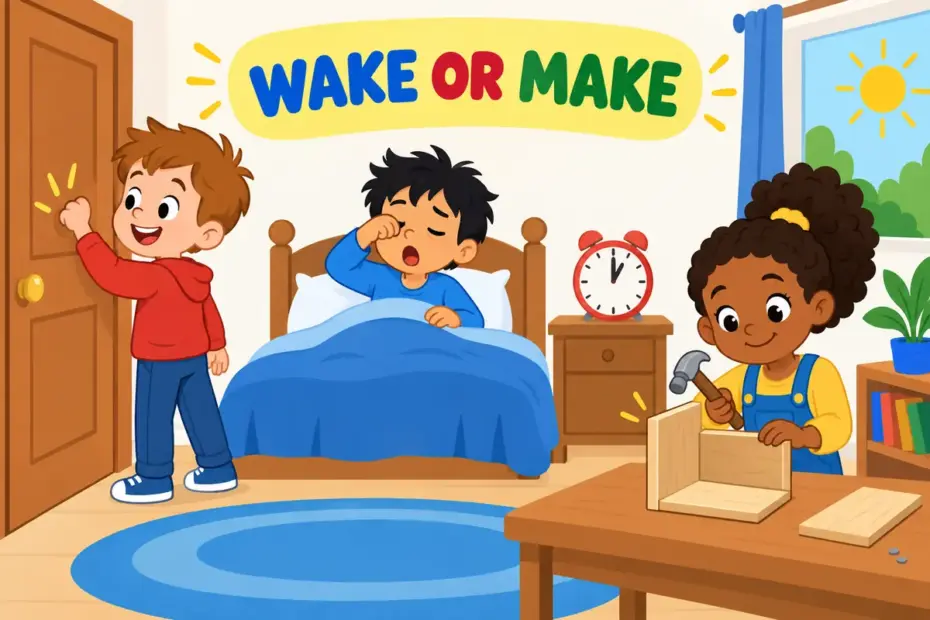
Knock up means to wake someone by knocking on their door in British English, or to make something quickly. To use knock up in a sentence, name the person or the object: “Knock me up at seven” or “She knocked up a quick supper.” The phrase is separable.
Knock up at a glance
- Knock up is a separable phrasal verb; its forms are knocks up, knocked up and knocking up.
- Its two main senses are waking somebody (British) and making something quickly.
- As a hyphenated noun, knock-up means a short practice before a tennis match.
- In American slang the phrase can be vulgar, so learners should use it with care abroad.
- Knock up is chiefly spoken and informal, so formal writing prefers wake or make.
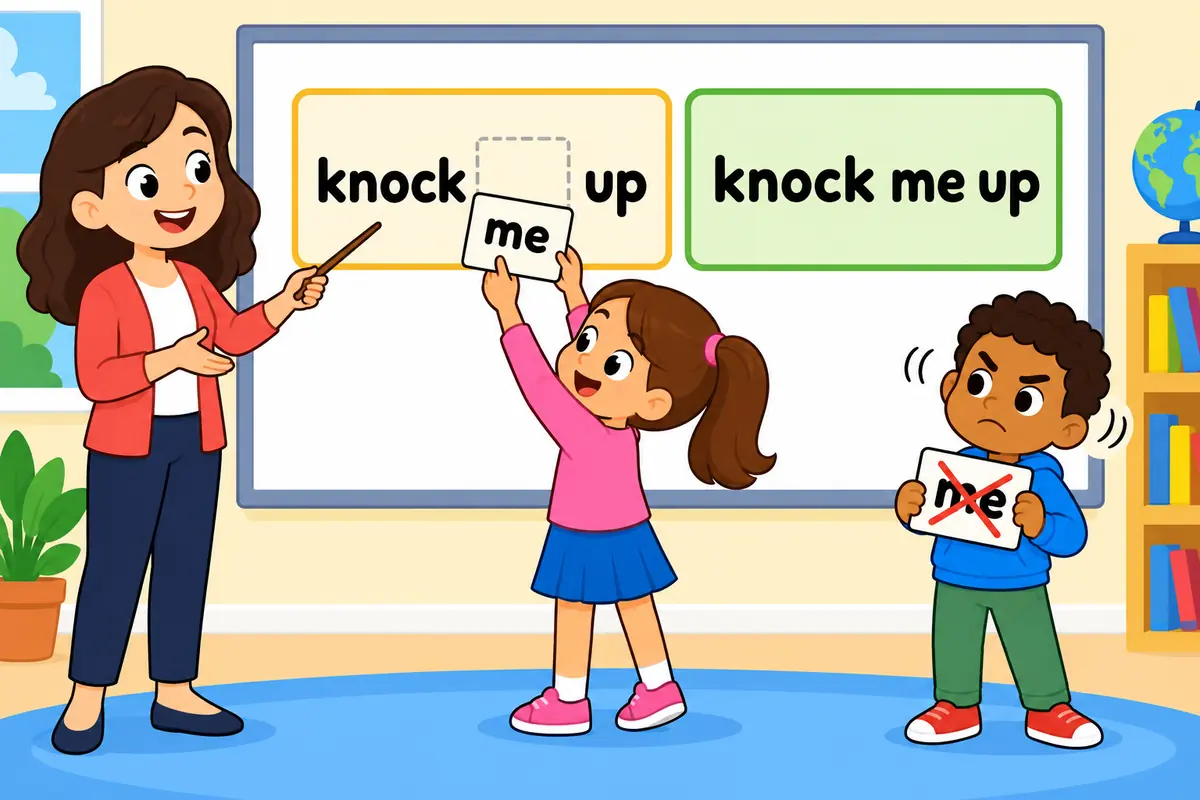
- The commonest error is the word order in knock up me instead of knock me up.
What does knock up mean?
Knock up is a phrasal verb meaning to wake somebody by knocking on their door, or to make or build something quickly. The Merriam-Webster entry for knock up records the British waking sense and the make-quickly sense and flags a vulgar American use, while the Cambridge entry keeps the British waking sense at the front.
| Sense | Plain meaning | Example sentence |
|---|---|---|
| Wake somebody (British) | Knock on a door to wake a person | Please knock me up at half past six. |
| Make quickly | Build or prepare something fast | He knocked up a shelf from old planks. |
| Noun: warm-up | A short practice before a match | They had a knock-up before the final. |
One honest limitation belongs here rather than in a footnote. In American slang the phrase can carry a crude meaning, which dictionaries mark as vulgar, so the British request to be woken is easily misunderstood in the United States. Use knock up for waking only in British contexts; elsewhere, rouse someone early or say wake up instead. Context usually settles the sense before the end of a sentence, since a time and a pronoun signal waking while a material or a dish signals making.
How do you use knock up in a sentence?
Knock up is separable, so the object may follow the phrase or sit between the verb and up, and a pronoun must take the middle position. That makes it the opposite of an inseparable phrase such as call for, and close to other knock verbs that also split, like knock down a wall. When the sense is making something, writers often choose assemble the parts or mend a fence for anything more careful than a rough job.
| Pattern | Example | What it signals |
|---|---|---|
| knock + somebody + up | The porter knocked us up at dawn. | The pronoun sits in the middle, as it must. |
| knock up + noun | She knocked up a quick lunch. | The object follows the whole phrase. |
| knock + noun + up | He knocked a table up in an hour. | The object splits the phrase, same meaning. |
| be knocked up | A shelter was knocked up from crates. | Passive voice, common for the build sense. |
| a knock-up (noun) | The players warmed up with a knock-up. | The hyphenated noun names a practice. |
The separable pattern also explains the passive. When a shelter is knocked up, the phrase keeps its build sense and the doer drops out, which suits a report that cares about the result rather than about who hammered the boards.
Knock up in a sentence: examples across contexts
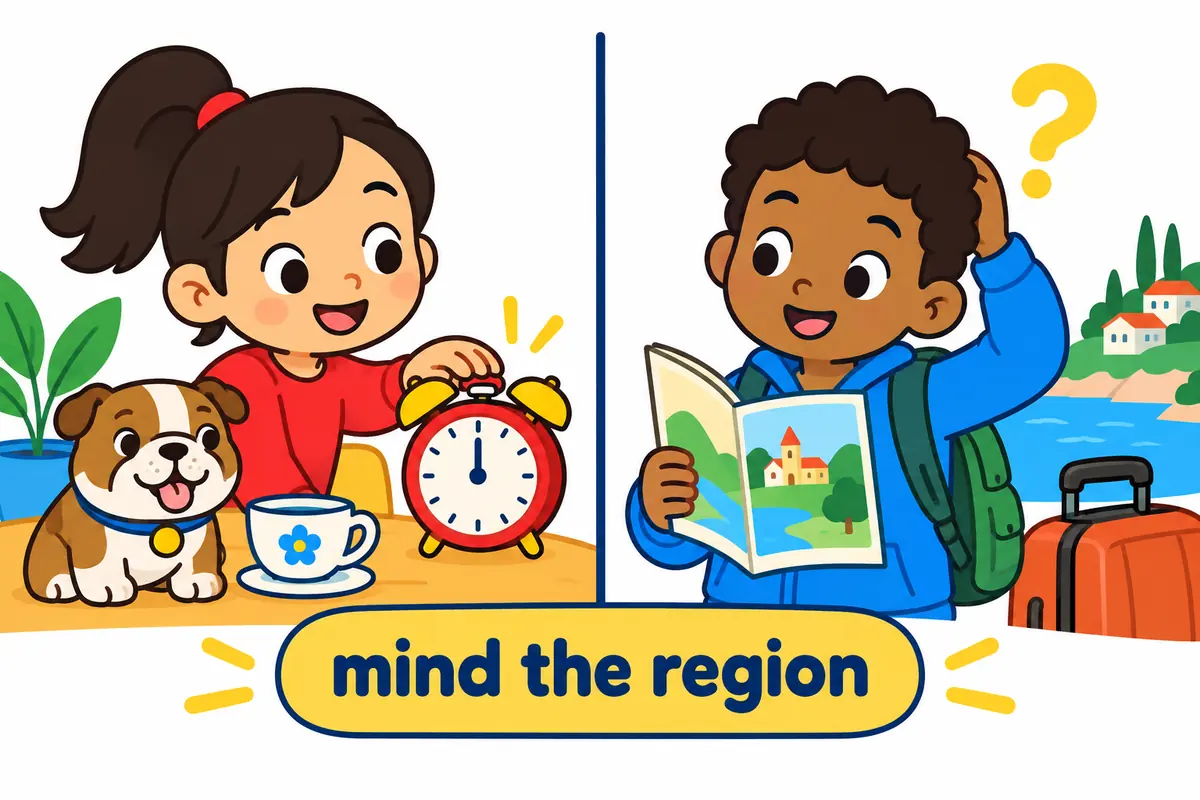
Knock up changes sense with the region and the object. The ten sentences below stay in the safe, standard senses and show what is being woken or built.
| Context | Example sentence | Why this works |
|---|---|---|
| Family morning | Knock me up at seven, before the bus goes. | The British waking sense with a clear time. |
| Hotel note | Could you knock us up at six, please? | Polite request with the pronoun in the middle. |
| Camping | The warden knocked up every tent before sunrise. | Waking a whole group, still British and neutral. |
| Cooking | He knocked up a stew from the leftovers. | The make-quickly sense with a concrete dish. |
| Carpentry | They knocked up three shelves in an afternoon. | Shows a fast, rough build rather than fine work. |
| Photography | We knocked up a backdrop from two sheets. | An improvised solution, the heart of the sense. |
| Tennis report | The pair shared a knock-up before the final. | Uses the hyphenated noun for a warm-up. |
| School play | Parents knocked up a stage in a single evening. | Names a hurried build the whole group shares. |
| Travel diary | In London the landlady knocked us up at eight. | Anchors the waking sense to a British setting. |
| Workshop | A workbench was knocked up from pallets. | Passive voice for an improvised object. |
| Office move | A makeshift desk was knocked up from two crates. | Build sense in a workplace setting. |
| Road trip | We knocked up sandwiches before the drive north. | Make-quickly sense with ordinary food. |
Knock up vs wake up
Knock up and wake up overlap only in British English, and even there they differ in method. Knock up means to wake someone by knocking at their door, while wake up is the general verb for ending sleep and works everywhere.
| Attribute | knock up | wake up |
|---|---|---|
| Region | British for waking; risky in American English | All varieties, always safe |
| Method | Knocking on a door or window | Any means, including an alarm |
| Separability | Separable, pronoun in the middle | Separable in the same way |
| Other senses | Also means make quickly, and a warm-up noun | No unrelated senses |
| Formality | Informal and regional | Neutral everywhere |
Verdict: use wake up when you want to be understood anywhere, and choose knock up for the British waking sense or the quick-build sense in British writing. The regional gap is the real trap: a British guest who asks to be knocked up is making a polite request, while an American who hears the phrase may understand something crude, so the same words need different handling on each side of the Atlantic.
Word forms and grammar of knock up
Only the verb knock changes; up stays fixed. The table also gives the hyphenated noun and the spelling error learners make most often.
| Form | Part of speech | Example |
|---|---|---|
| knock up | phrasal verb, base form | They knock up a shelter every summer. |
| knocks up | third person singular | She knocks up a cake in minutes. |
| knocked up | past and past participle | He knocked up a desk from a door. |
| knocking up | present participle | They were knocking up shelves all day. |
| knock-up | noun, hyphenated | The knock-up lasted ten minutes. |
| knockup | non-standard spelling | Write the noun knock-up with a hyphen. |
Note that the noun is always hyphenated while the verb is always two words. Mixing the two produces knockup, a spelling that no dictionary accepts, so a careful writer keeps the noun and the verb visibly apart.
Common mistakes with knock up
- Incorrect:
Can you knock up me at six?Correct: Can you knock me up at six? Rule: A pronoun object must sit between the verb and its particle. - Incorrect:
She knocked up it in an hour.Correct: She knocked it up in an hour. Rule: The same rule applies to every pronoun, so it, them and us all go in the middle. - Incorrect:
In New York the clerk offered to knock us up at seven.Correct: In New York the clerk offered to wake us at seven. Rule: The waking sense is British; in American English the phrase carries a vulgar slang meaning. - Incorrect:
They played a knock up before the match.Correct: They played a knock-up before the match. Rule: The noun is written with a hyphen. - Incorrect:
They knocked the shed up, then knocked up it again.Correct: They knocked the shed up, then knocked it up again. Rule: A pronoun replaces the noun in the middle position every time.
Practice using knock up
Work through the six items, then read the reason beside each answer.
- Fill the gap: The landlord promised to ______ us ______ before the early train.
- Choose the better word: In Chicago, ask the desk to (knock you up / wake you) at six.
- Correct the error: He knocked up it from spare wood last night.
- Build a sentence: use knock up as a verb about making a quick meal.
- Spot the register: which suits a British hotel note — please knock me up at seven, or please wake me at seven?
- Rewrite with the noun: The players practised briefly before the game. Use knock-up.
- Change the region: rewrite the guest asked to be knocked up at dawn for an American hotel.
Answers
- knock us up — the pronoun us must sit between knock and up.
- wake you — American English avoids the waking sense of knock up, so wake is safer.
- He knocked it up from spare wood — a pronoun replaces the noun in the middle position.
- Model answer: She knocked up a quick pasta before the guests arrived.
- Please knock me up at seven — a British note may use it, though wake me is understood everywhere.
- The players had a short knock-up before the game — the noun takes a hyphen.
- Model answer: The guest asked to be woken at dawn — American English avoids the waking sense of knock up.
The bottom line
Use knock up in a sentence for the British act of waking somebody by knocking, or for making something quickly, and keep the particles together with a pronoun in the middle. The two details that decide most sentences are that the phrase is separable, unlike call for, and that its waking sense is British while American English gives the phrase a vulgar slang meaning. Knock back a quick drink is a different phrasal verb entirely, and build from scratch is the careful version of the quick-build sense. When in doubt, say wake or make, because the phrase is vivid but regional, and clarity beats colour.
Frequently asked questions about knock up
Is knock up rude in English?
It depends on the variety. In British English the phrase is a normal, slightly old-fashioned way to say wake somebody by knocking. In American slang it can carry a vulgar meaning, so the same sentence is risky there. British speakers abroad often switch to wake up to avoid confusion.
What does knock up mean in British English?
In British English knock up mainly means to wake somebody by knocking on their door, as in knock me up at seven. It also means to make something quickly, as in she knocked up a snack. The noun knock-up describes a short practice before a tennis or squash match.
Can you say knock up a meal?
Yes, in British English and in informal writing everywhere, knock up a meal means to prepare it quickly and without fuss. The sense is a rough, speedy job rather than careful cooking, so it suits a snack or a simple supper but not a formal dinner you have planned for weeks.
Is knock up separable or inseparable?
Knock up is separable, so the object may follow the whole phrase or sit between knock and up. A pronoun must take the middle position, giving knock me up rather than knock up me. That separates it from the inseparable call for, where the object always follows the full phrase.