Leaf through means to turn the pages of a book or magazine quickly, looking at it without reading every word. To use leaf through in a sentence, put the reading material straight after the verb: “She leafed through the atlas while the train crossed the bridge.” The verb is inseparable, so the pages cannot be split from through.
Leaf through at a glance
- Leaf through is a transitive phrasal verb: it always takes an object such as a book, album or magazine.
- The verb is inseparable, so the object never comes between leaf and through.
- Its forms are leafs through, leafed through and leafing through.
- It describes light browsing, not careful reading or study.
- The commonest error is splitting the phrase, as in leaf the magazine through.
What does leaf through mean?
Leaf through is a phrasal verb meaning to turn the pages of something quickly and casually, taking in what catches the eye. The Cambridge entry for leaf through keeps the sense to books and printed matter, and the two ideas inside it matter: the motion of the pages, and the absence of close attention. You leaf through a magazine in a waiting room; you do not leaf through a legal contract you must sign.
| Use | Plain meaning | Example sentence |
|---|---|---|
| Browsing pictures | Turning pages to enjoy what you see | He leafed through the photo album with a smile. |
| Scanning for one thing | Flipping pages until something catches your eye | She leafed through the catalogue for winter coats. |
| Passing time | Looking at pages with no fixed purpose | I leafed through an old magazine while I waited. |
One limitation is worth stating plainly. Leaf through is not the same as read through, because it says nothing about understanding or finishing the text. If the reader is meant to study the material, use read through or work through; keep leaf through for the light, unhurried look.
The phrase also carries a faint note of leisure that skim through lacks. Leafing through happens in waiting rooms, on sofas and in bookshops, where nobody expects a result. Once a reader has a deadline, the verb changes to skim, scan or read, because leaf through promises only a pleasant few minutes.
How do you use leaf through in a sentence?
Three grammar facts control every sentence. First, the phrase is transitive, so it needs an object. Second, it is inseparable, so leaf the book through is wrong. Third, the particle never strands at the end: you cannot say the book was leafed through by her with the particle left behind in the same way some phrasal verbs allow. The object simply follows through.
| Pattern | Example | What it signals |
|---|---|---|
| leaf through + object | He leafed through the report. | The object follows the whole phrase. |
| leaf through + object + looking for | She leafed through the album looking for the photo. | Adds a light purpose to the browsing. |
| adverb between verb and particle | He leafed quickly through the stack. | An adverb may sit inside, but the object may not. |
| be leafed through (passive) | The magazine had been leafed through many times. | Passive use is normal and keeps the object as subject. |
| leaf through + pages / book / album | She leafed through the pages of the diary. | The object names the printed thing, not the reading. |
Notice the difference between an adverb and an object. Leaf quickly through the stack is fine, because quickly modifies the verb, but leaf the stack through is impossible, because the stack is the object and must follow through.
Leaf through in a sentence: examples across contexts
Leaf through keeps the same meaning as it moves between registers. The ten sentences below travel from a classroom to a library desk, and each one keeps the verb and its particle together.
| Context | Example sentence | Why this works |
|---|---|---|
| Classroom | Maya leafed through the picture book before choosing it. | A concrete object makes the action easy to picture. |
| Waiting room | He leafed through a magazine while the dentist saw another patient. | The setting explains the casual, undirected reading. |
| Library | She leafed through the atlas and stopped at a map of the coast. | Adds a moment of attention without turning it into study. |
| Newsroom | The editor leafed through the proofs before the first edition. | Shows a quick professional look rather than a full read. |
| Bookshop | He leafed through three novels and bought none. | The browsing is deliberately unhurried and non-committal. |
| Archive | Researchers leafed through the bound volumes of old letters. | Keeps the printed object firmly as the object. |
| Home | Grandad leafed through the album and named every cousin. | Adds a warm, familiar tone without changing the verb. |
| Travel writing | I leafed through a guidebook on the ferry. | Pairs the verb with a light, passing activity. |
| Review | The judge leafed through the photographs without comment. | Shows silence and speed, which suits the verb. |
| Study advice | Do not just leaf through your notes the night before an exam. | Uses the negative to warn against shallow reading. |
| Art class | She leafed through a folder of prints before starting to draw. | Keeps the object a flat, paged collection. |
| Clinic | Patients leafed through health leaflets while they waited. | The plural subject shows a shared, casual action. |
Leaf through vs skim through
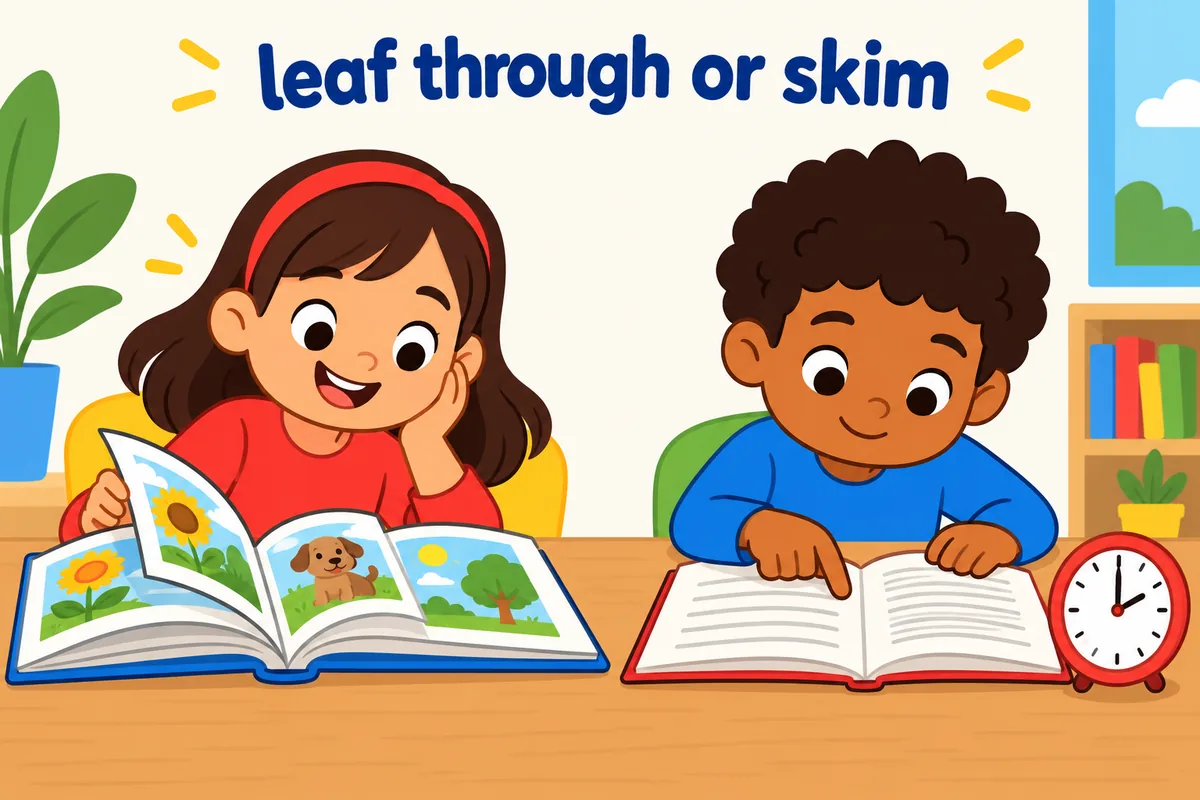
These two partner verbs are close but not identical. To leaf through is to turn pages lightly and look, while to skim through is to read fast on purpose for the main points. A third cousin, to flip through, stresses the quickness of the turning rather than the reading.
| Attribute | leaf through | skim through |
|---|---|---|
| Core action | Turning pages and looking | Reading quickly for the gist |
| Attention | Light and unfocused | Focused but brief |
| Purpose | Browsing, often no fixed goal | Finding the main points in a hurry |
| Typical object | Magazines, albums, catalogues | Reports, articles, chapters |
| Example | He leafed through the holiday brochure. | She skimmed through the summary before the call. |
Verdict: choose leaf through for casual page-turning and skim through when the reader is after information fast, and remember that neither means the careful work of read through.
Word forms and grammar of leaf through
The verb inflects regularly on leaf, while the particle through never changes. The table also lists the form learners build by mistake, and the related through-phrasal-verbs share the same shape.
| Form | Part of speech | Example |
|---|---|---|
| leaf through | phrasal verb, base form | I like to leaf through old maps. |
| leafs through | third person singular | She leafs through the paper every Sunday. |
| leafed through | simple past and past participle | They leafed through the file together. |
| leafing through | present participle | He was leafing through a novel. |
| leaved through | non-standard | Write leafed through; the verb uses the regular -ed. |
Related verbs built on the same particle include go through, which examines something systematically, and run through, which rehearses the main points. To sift through a pile is to search it for something specific, while to leaf through is simply to browse. The single word throughout shares the root but means in every part, so it never takes the same object pattern.
Common mistakes with leaf through
- Incorrect:
She leafed the magazine through.Correct: She leafed through the magazine. Rule: The phrase is inseparable, so the object follows through. - Incorrect:
He leaved through the catalogue.Correct: He leafed through the catalogue. Rule: The past tense is leafed, not leaved. - Incorrect:
I leafed through.Correct: I leafed through the report. Rule: The verb is transitive, so it needs an object. - Incorrect:
They leafed through into the box.Correct: They leafed through the contents of the box. Rule: Through is the particle, not a preposition of direction here, so it takes the object directly. - Incorrect:
She leafed threw the pages.Correct: She leafed through the pages. Rule: Through is the correct spelling; threw is the past tense of throw.
Practice using leaf through
Work through the six items, then check the reasoning rather than only the answer.
- Fill the gap: On the plane he ______ the in-flight magazine.
- Choose the better word: Before the meeting she (leafed through / skimmed through) the summary to catch the three key numbers.
- Correct the error: He leafed the album through slowly.
- Build a sentence: use leaf through + object about a holiday brochure.
- Spot the register: which belongs in a study guide — do not leaf through your notes, or do not leaf your notes through?
- Rewrite in the passive: The children leafed through the picture book. Keep the book as the subject.
Answers
- leafed through — the object follows the whole phrase.
- skimmed through — a focused hurry for key facts suits skim, not leaf.
- He leafed through the album slowly — the object cannot split verb and particle.
- Model answer: She leafed through a holiday brochure by the window.
- Do not leaf through your notes — the phrase stays together.
- The picture book was leafed through by the children — the object becomes the passive subject.
The bottom line
Use leaf through in a sentence when someone turns pages lightly, and keep the object after through because the phrase is inseparable. The two nuances that decide most sentences are these: the verb is transitive, so a book or magazine must follow it, and it never means careful reading, so read through is the better choice for study. For a fast search for information, skim through is the closer partner, and for a thorough pass, go through is the verb to reach for.
Frequently asked questions about leaf through
Is leaf through one word or two?
Leaf through is two words and stays two words in every sentence. It is a phrasal verb, not a compound noun, so it is never written as leafthrough. The verb leaf and the particle through keep their separate spellings, and only the verb changes for tense.
Can you say leaf the book through?
No. Leaf through is inseparable, so the object must follow the whole phrase. Say leaf through the book. Splitting the verb from its particle is the single most common error with this phrase, and it never appears in standard English, however tempting the word order looks.
What is the past tense of leaf through?
The past tense and past participle are both leafed through, because the verb is regular. The form leaved through is wrong; leaved belongs to leaves on trees, not to turning pages. So you write she leafed through the album and she has leafed through the album.
What is the difference between leaf through and skim through?
Leaf through means turning pages lightly and looking at whatever catches your eye. Skim through means reading fast on purpose to take in the main points. Leafing through needs no goal, while skimming through aims at information, so the two verbs rarely fit the same moment.