Line up is a phrasal verb meaning to form a row, to arrange things in order, or to secure something in advance. To use line up in a sentence, decide whether a row is forming or being arranged: “the children lined up,” or “line up the chairs.” When it takes an object, the verb is separable.
Line up at a glance
- Line up is a phrasal verb with a particle, up, that can move around its object.
- It has five common senses: queueing, arranging, securing, matching and supporting.
- The verb is intransitive for queueing and matching, and transitive for arranging and securing.
- The noun is written with a hyphen and no space: a line-up of speakers.
- The commonest error is writing the verb as one word, as in the children will lineup outside.
What does line up mean?
Line up is a phrasal verb whose meaning shifts with its object and its particle. The Cambridge entry for line up groups the senses under forming a row and arranging or obtaining something, and the table below keeps them apart so a sentence cannot drift between them. The one constant is the idea of order: people, objects, times or facts are brought into a single line or matched with one another.
| Sense | Plain meaning | Example sentence |
|---|---|---|
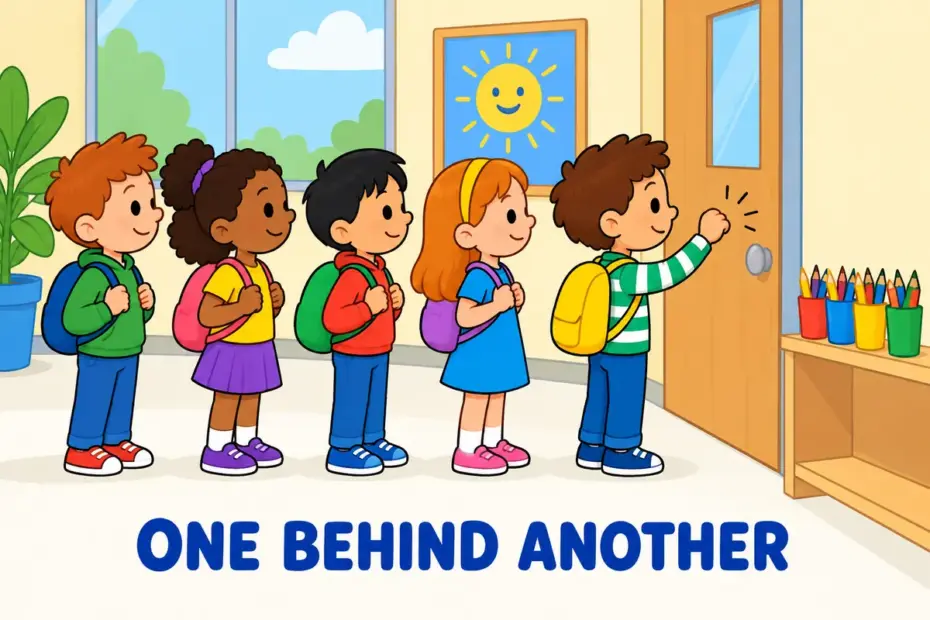
| Queue | Stand in a row, one behind another | The pupils lined up at the classroom door. |
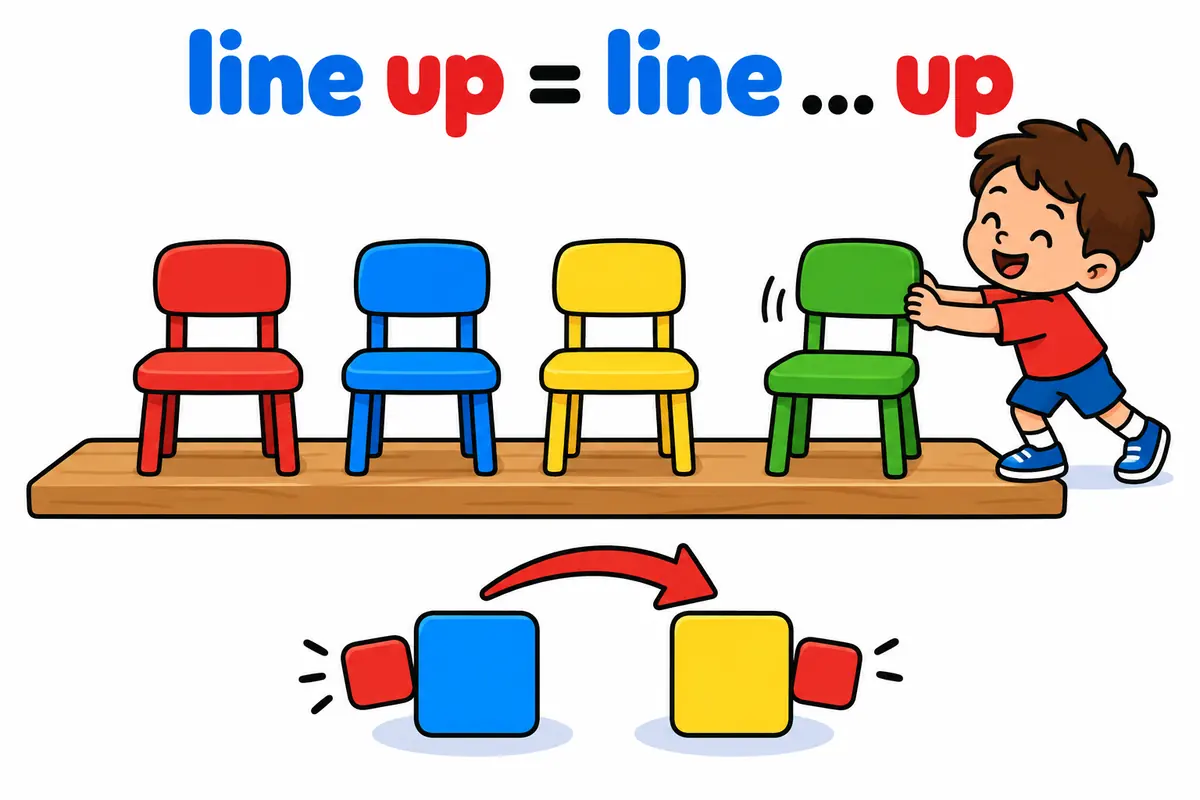
| Arrange | Put objects into a neat row | Line the chairs up along the back wall. |
| Secure | Arrange or obtain something in advance | We lined up a guest speaker for Friday. |
| Match | Fit together or agree exactly | The dates finally lined up with the holiday. |
| Support | Give backing to a person or plan | The whole team lined up behind the captain. |
One honest limit: line up is vague about method. It says that something is arranged or agreed, not how, so a schedule that is line up is not automatically booked. If you mean a firm appointment, say booked or confirmed; if you mean a queue, the single word queue may be plainer, especially in British writing.
How do you use line up in a sentence?
Two grammar facts decide every correct sentence. First, the verb is transitive in the arranging and securing senses and intransitive in the queueing and matching senses. Second, when it is transitive it is separable: the particle up may follow the object, and a pronoun object must sit between the verb and the particle.
| Pattern | Example | What it signals |
|---|---|---|
| line up (no object) | The visitors lined up outside. | Intransitive queueing sense. |
| line up + object | Line up the bottles on the shelf. | Transitive arranging sense, object after up. |
| line + object + up | Line the bottles up on the shelf. | The same sense, particle stranded after the object. |
| line + pronoun + up | Line them up before the photo. | Pronouns must go between verb and particle. |
| be lined up | The interviews were lined up for Monday. | Passive with the particle in place. |
| line up with / behind | The plan lines up with the budget. | Prepositional use for matching and support. |
The order of the words is the whole test. Line up the chairs and line the chairs up mean the same thing, but line up them is impossible; it must be line them up. The intransitive senses never take an object at all, so the queueing line up and the matching line up stand alone.
Line up in a sentence: examples across contexts
The rows below show the verb doing five different jobs in ten registers, from a classroom instruction to a project update.
| Context | Example sentence | Why this works |
|---|---|---|
| Classroom | Everyone line up quietly by the door. | The queueing sense in a direct instruction. |
| Playground | The teams lined up for the final race. | Intransitive, with no object at all. |
| Home | Please line the shoes up in the hall. | Separable arranging sense with the object between verb and particle. |
| Events | The organisers lined up three speakers for the morning. | The securing sense, arranged in advance. |
| Project email | I have lined up a contractor for the repairs. | Securing in business writing. |
| Data | Check that the totals line up with last month. | The matching sense with the preposition with. |
| Planning | Our holidays finally lined up this year. | Intransitive matching of two schedules. |
| Politics | Party members lined up behind the new leader. | The support sense with behind. |
| Sport | The coach lined the substitutes up before kick-off. | Separable arranging with a definite object. |
| Recruitment | They had two candidates lined up for interview. | Passive with the particle stranded. |
The matching sense is close to add up, another phrasal verb with up, and the two often appear together: a set of figures can line up and then add up. When the point is coordination rather than order, the verb synchronize is more precise, and when it is securing time, schedule is the clearer verb.
Line up vs queue
Queue is the nearest confusable, because the queueing sense of line up can usually be replaced by it. The two differ in register and in reach.
| Attribute | Line up | Queue |
|---|---|---|
| Part of speech | Verb (and hyphenated noun line-up) | Verb and noun |
| Senses | Queue, arrange, secure, match, support | Mainly waiting in turn |
| Transitive use | Yes, and separable: line the chairs up | Rarely; you queue or join a queue |
| Register | Neutral; common worldwide | Neutral; especially common in British English |
| Typical subject | People, objects, plans, schedules | People waiting, or data in a computing queue |
| What it implies | Something is brought into order | Someone waits their turn |
Choose queue for waiting in turn, and line up for everything else, including arranging objects and matching plans. Where the matching is exact alignment rather than a queue, align is the stronger verb, since it names the straight line the things share. The verdict: line up is the busier verb, queue the narrower one.
Word forms and grammar of line up
| Form | Part of speech | Example |
|---|---|---|
| line up | phrasal verb, base | Please line up at the gate. |
| lines up | verb, third person singular | She lines up the dominoes carefully. |
| lined up | verb, past and past participle | The band lined up a new tour. |
| lining up | verb, present participle | They are lining up outside already. |
| line-up | noun, hyphenated | The line-up of bands was announced. |
| line-up | noun, identification parade | Police put him in a line-up. |
Keep the verb two words and the noun one. A related particle verb is back up, which also takes up but means to support or to make a copy, not to arrange a row.
Common mistakes with line up
- Incorrect:
The children will lineup at noon.Correct: The children will line up at noon. The verb is two words; lineup is only a noun. - Incorrect:
Line up them by the wall.Correct: Line them up by the wall. A pronoun object must sit between the verb and the particle. - Incorrect:
The events lined up against the plan.Correct: The events lined up with the plan. The matching sense takes with, not against. - Incorrect:
We lined up a meeting, though nothing is confirmed.Correct: We scheduled a meeting, though nothing is confirmed. Line up suggests arrangement, so use a firmer verb when something is fixed. - Incorrect:
I lined up in the queue for an hour.Correct: I queued for an hour. The two verbs duplicate the same idea in one clause. - Incorrect:
The line up of speakers was long.Correct: The line-up of speakers was long. As a noun it takes a hyphen.
Practice using line up
Use the grammar from the earlier tables: decide first whether the verb needs an object, then place the particle.
- Fill in the blank: The runners ______ at the starting line before the whistle.
- Rearrange for natural order: line / the / up / boxes / the / small.
- Correct the error: We lined up them for a photograph.
- Choose the better word: The two reports (line up / align) on every figure.
- Build a sentence: arrange a row of trophies on a shelf, using the separable form.
- Spot the register: Which sentence belongs in a business email, and which on a playground? (a) I have lined up a venue for the launch. (b) Everyone line up behind Sam.
- Fill in the blank: The members ______ behind the chair of the committee.
Answers
- Lined up. The queueing sense is intransitive, so no object follows.
- Line the small boxes up. The particle follows the object in the arranging sense.
- We lined up them is wrong; write We lined them up. A pronoun always goes between the verb and up.
- Align. It claims exact agreement, while line up can suggest a looser match.
- A model answer: She lined the trophies up along the top shelf.
- (a) belongs in a business email, where securing a venue is meant; (b) belongs on a playground, where it means form a queue.
- Lined up. The support sense takes behind, and the past tense matches the sentence.
The bottom line
Line up is a phrasal verb of order, covering queueing, arranging, securing, matching and supporting depending on its object. Keep the exact phrase line up in a sentence aware of two rules: the arranging senses are separable, so a pronoun object goes between the verb and up, and the verb itself is always two words. The noun line-up takes a hyphen, which is the commonest thing writers get wrong. Where the meaning is simply waiting in turn, queue says it in one word.
Frequently asked questions about line up
Is line up one word or two?
As a verb it is always two words: the pupils line up. As a noun it is one word with a hyphen: the line-up of speakers. The single word lineup without a hyphen is common in headlines and American sports writing, but the safe form for the noun keeps the hyphen. The children will lineup is always an error.
Is line up separable?
Yes, in its transitive senses. Line up the chairs and line the chairs up are both correct, and the particle may strand. The rule that catches learners is the pronoun: it must sit between the verb and the particle, so line them up is right and line up them is wrong. The intransitive senses take no object at all.
What does line up behind someone mean?
Line up behind means to give support to a person, group or plan. Members lining up behind a leader are backing that leader rather than queueing behind them. The phrase is common in politics and sport, where it describes public support. Do not confuse it with the matching sense, which uses line up with.
Can line up mean to schedule something?
It can, in the sense of arranging or securing something in advance: we lined up a speaker for Friday. The verb reports that arrangements were made, not that everything is fixed, so a firm appointment still needs booked or confirmed. In informal work talk, lined up a job often means the job has been found but not yet started.