
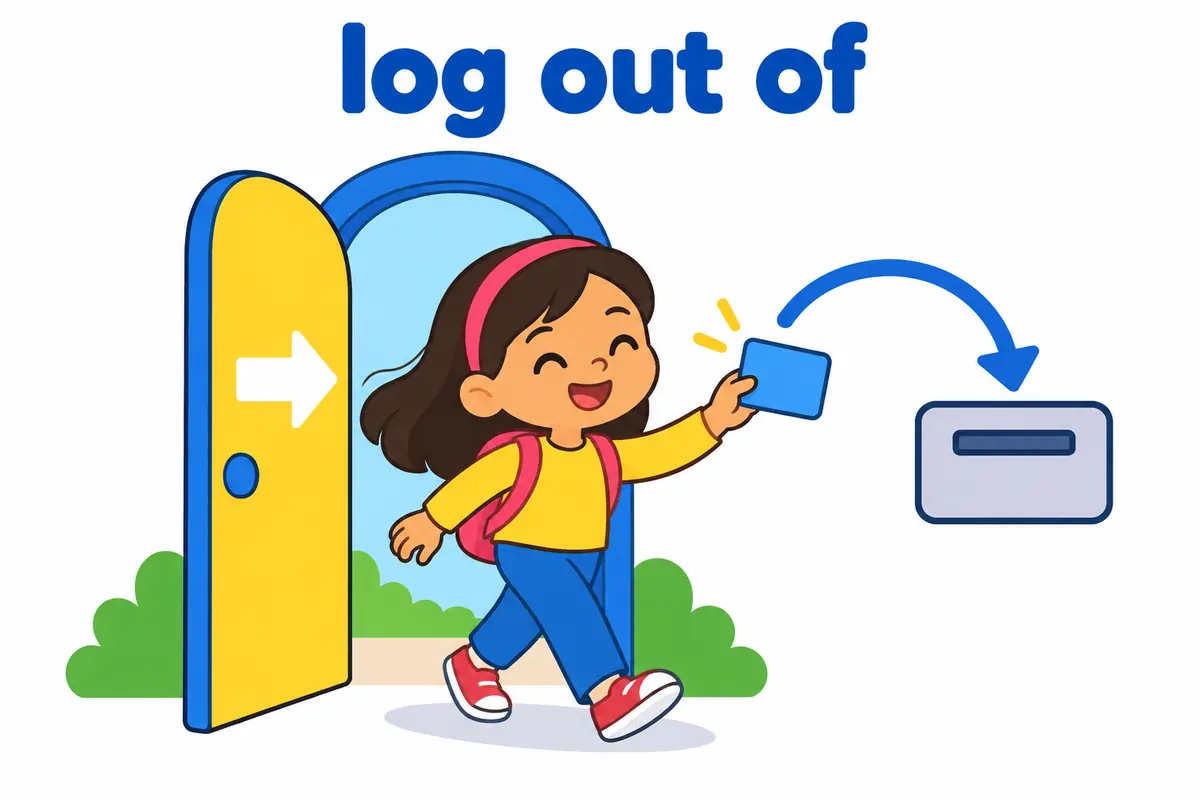
Log out is a phrasal verb meaning to end a session on a device or online account so that nobody else can use it. To use log out in a sentence, add of before the account: “Log out of your email before you leave.” The verb is usually intransitive, so the person is the subject.
Log out at a glance
- Log out is a phrasal verb; its forms are log out, logs out, logged out and logging out.
- The verb is normally intransitive: you log out, and the account follows of.
- The reverse move, log in, starts a session that log out ends.
- The noun logout is one word, while the verb is always two words.
- The commonest error is writing log out your account instead of log out of your account.
What does log out mean?
Log out is a phrasal verb meaning to end a computer or online session. The Cambridge entry for log out pairs the verb with of, as in log out of an app. A second sense is passive: a system logs you out by itself after a set period, usually to protect your data. The distinction matters because the first is a choice and the second is not.
| Sense | Plain meaning | Example sentence |
|---|---|---|
| End your own session | Stop using an account and sign off | I logged out and handed the laptop back. |
| Be disconnected by a system | A device ends a session for you | The bank app logs you out after five idle minutes. |
One limit is worth stating plainly. Log out applies only to accounts that require a session. A shared document that anyone can open has no session to end, so the accurate instruction there is close the file or shut down the computer. Using log out for those cases sounds like a command that a reader cannot actually follow.
The register is worth noting too. Log out appears in help pages, school rules and workplace guidance, so it reads as an instruction rather than a description. In casual conversation people often say they will close the window or shut the laptop instead, which is why log out sounds faintly formal when it is spoken aloud.
How do you use log out in a sentence?
The verb follows five shapes, and the difference between them is whether the user acts or the system acts. Log off shares the base verb and covers almost the same ground, which is why the two are often used in the same instruction.
| Pattern | Example | What it signals |
|---|---|---|
| log out (no object) | Please log out when you finish. | The core intransitive use; the person is the subject. |
| log out of + account | She logged out of her email. | Of introduces the account or app being left. |
| log + object + out | The library logs every visitor out at closing. | Causative: the system ends somebody else’s session. |
| log out from + device | He logged out from the shared computer. | From names the machine rather than the account. |
| be logged out | You are logged out automatically after ten minutes. | Passive, common in help pages and instructions. |
The pattern log out of is the one that sounds native, and the causative log someone out is the one that lets a help page describe automatic behaviour.
Log out in a sentence: examples across contexts
The verb barely changes meaning, but its register shifts from a school computer room to a bank app. The ten sentences below move through those settings, and each one shows who is ending the session. To exit the app is a broader action than to log out of an account, so the two are not interchangeable.
| Context | Example sentence | Why this works |
|---|---|---|
| Classroom | Log out of the shared tablet before you put it away. | Of names the account and the instruction is precise. |
| Office email | Please log out when you leave the desk. | Short intransitive use suits a workplace note. |
| Banking app | The app logs you out after five idle minutes. | Causative form describes automatic security. |
| IT help page | You are logged out of all devices when you change the password. | Passive construction is standard in instructions. |
| News report | Users were logged out across the network after the breach. | Names an event that affected many people at once. |
| Library notice | Every terminal logs out at closing time. | Subject is the system rather than a person. |
| Conversation | Did you log out, or is your account still open? | Everyday question about a simple action. |
| Technical writing | The client should log out cleanly before the token expires. | Precise software vocabulary in a formal register. |
| Travel advice | Always log out of public computers before you walk away. | Pairs an imperative with a clear reason. |
| Privacy guide | Logging out does not delete the browsing history on a shared machine. | Uses the gerund to name the action as a topic. |
| Streaming service | The television box logs out of one profile before another starts. | Shows the causative sense on a household device. |
| Online shop | Log out of your account when a site keeps a payment card on file. | Ties the action to a concrete security reason. |
Only the last sentence uses the gerund logging out, and that form is the natural way to discuss the action rather than perform it. The two automatic sentences are the useful ones to remember, because they show the verb working with no user present at all.
Log out vs log off and log in
Log out has three close neighbours and overlaps heavily with one of them. Log off means almost the same thing and is often interchangeable; log in is the exact opposite. To terminate the session is the formal equivalent, and a server may do it for you after a set time.
| Attribute | log out | log off | log in |
|---|---|---|---|
| Core job | End a session | End a session | Start a session |
| Direction | Closing | Closing | Opening |
| Typical object | An account after of | An account after of | An account after to or into |
| Can be automatic | Yes | Yes | Rarely |
| Register | Neutral, very common | Neutral, slightly broader | Neutral, very common |
Verdict: choose log out for ending an account session, log off when you also mean stepping away from the machine, and log in for the reverse. You quit the program completely, but you log out of just one account.
Word forms and grammar of log out
Log out inflects on the verb, and the space between the two words is the spelling decision that matters most. The table sets out the forms, including the one-word noun that is often confused with the verb.
| Form | Part of speech | Example |
|---|---|---|
| log out | base phrasal verb | Remember to log out at the end of the day. |
| logs out | third person singular | The system logs out idle users. |
| logged out | past and past participle | She logged out and closed the lid. |
| logging out | present participle | Logging out protects the next user. |
| logout | noun, one word | Click the logout button in the corner. |
| logged-out | adjective, hyphenated | A logged-out device asks for a password again. |
The verb is always two words, the noun is always one, and the adjective takes a hyphen. Mixing the three is the clearest sign of a distracted writer. Note also the compound logout page, where the one-word noun sits before another noun; a help page that writes log out page mixes the verb and the noun inside a single label.
Common mistakes with log out
- Incorrect:
Log out your account before you leave.Correct: Log out of your account before you leave. Rule: The verb is intransitive, so the account follows of. - Incorrect:
She logged out the guest profile.Correct: She logged out of the guest profile. Rule: Only a person can be the object of the causative form, not an account. - Incorrect:
Please logout from the system.Correct: Please log out of the system. Rule: The verb is two words; logout is the noun. - Incorrect:
He was log out before the meeting ended.Correct: He was logged out before the meeting ended. Rule: The passive needs the past participle, not the base form. - Incorrect:
I need to log out the computer.Correct: I need to log out of the computer. Rule: The machine is not the object of the verb.
Practice using log out
Work through the seven items, then read the reasons, which explain the pattern rather than only the key.
- Fill the gap: Please ______ of the library account before you leave.
- Choose the better word: On a shared laptop, (log out / log in) when you finish.
- Correct the error: The app logs out you after five minutes.
- Build a sentence: use log out of about a school email account.
- Spot the register: which belongs in an IT guide — you are logged out of all devices, or you get kicked off everything?
- Rewrite with the noun: Press the button to log out. Use logout instead.
- Rewrite in the passive: The server logged out every user. Keep every user as the subject.
Answers
- log out — of introduces the account being left.
- log out — ending the session protects the next user; log in would start one.
- The app logs you out after five minutes — a pronoun object sits inside the phrasal verb.
- Model answer: Remember to log out of your school email on the shared computer.
- You are logged out of all devices — an IT guide stays formal and passive.
- Press the logout button — the noun is one word before another noun.
- Every user was logged out by the server — the passive keeps the users as the subject.
The bottom line
Use log out in a sentence to end a session on an account, and place of before the account because the verb is intransitive. The two points that decide most sentences are the preposition of, which a learner often drops, and the spelling split between the two-word verb and the one-word noun. Closing a tab lets you leave the page without ending the session, so check which action you actually need.
Frequently asked questions about log out
Is log out one word or two?
The verb is always two words, as in log out of your account. The noun is one word, as in click the logout button. The adjective takes a hyphen, as in a logged-out device. Keeping those three forms apart is the only spelling rule that this phrase really needs.
Is log out the same as sign out?
In everyday use the two phrases are interchangeable, and most apps choose one and stay with it. Sign out is slightly more common in interfaces that also use sign in. Log out is the more established term in technical writing, and it is the form that dictionaries list as a headword.
What preposition follows log out?
The standard preposition is of: you log out of an account, an app or a website. Writers also say log out from a device, where from introduces the machine rather than the account. Dropping the preposition altogether, as in log out your account, is the commonest learner error.
Can a system log you out automatically?
Yes, and this is the second sense of the verb. A bank app may log you out after a few idle minutes to protect your money, and a school network may log out every terminal at closing time. In these sentences the system is the subject and you are the object.