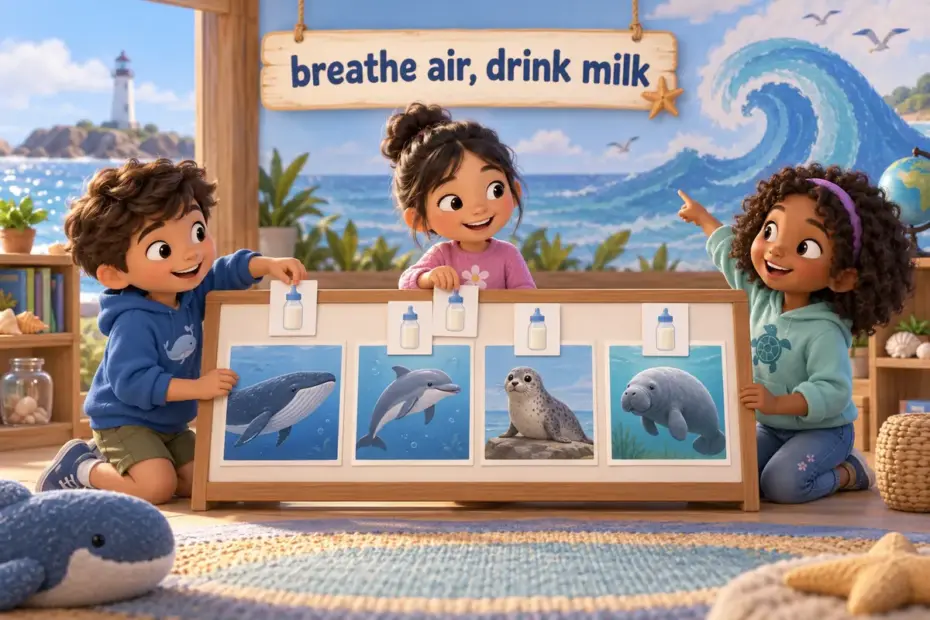
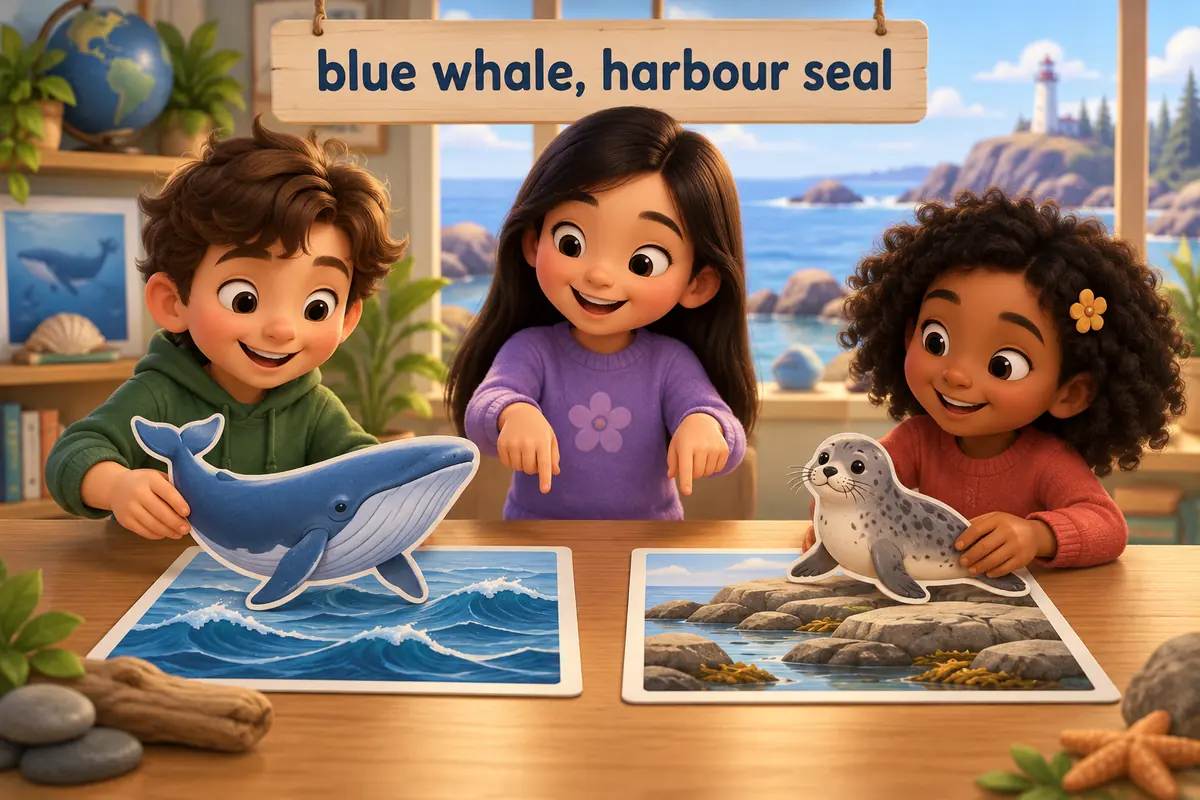
Marine mammal names cover the air-breathing animals that live in the sea and feed their young on milk, from the blue whale to the harbour seal. The names sort into four groups, the cetaceans, the seals, the manatees and the marine hunters, and one example shows the pattern: a dolphin is a small toothed whale.
Marine mammal names at a glance
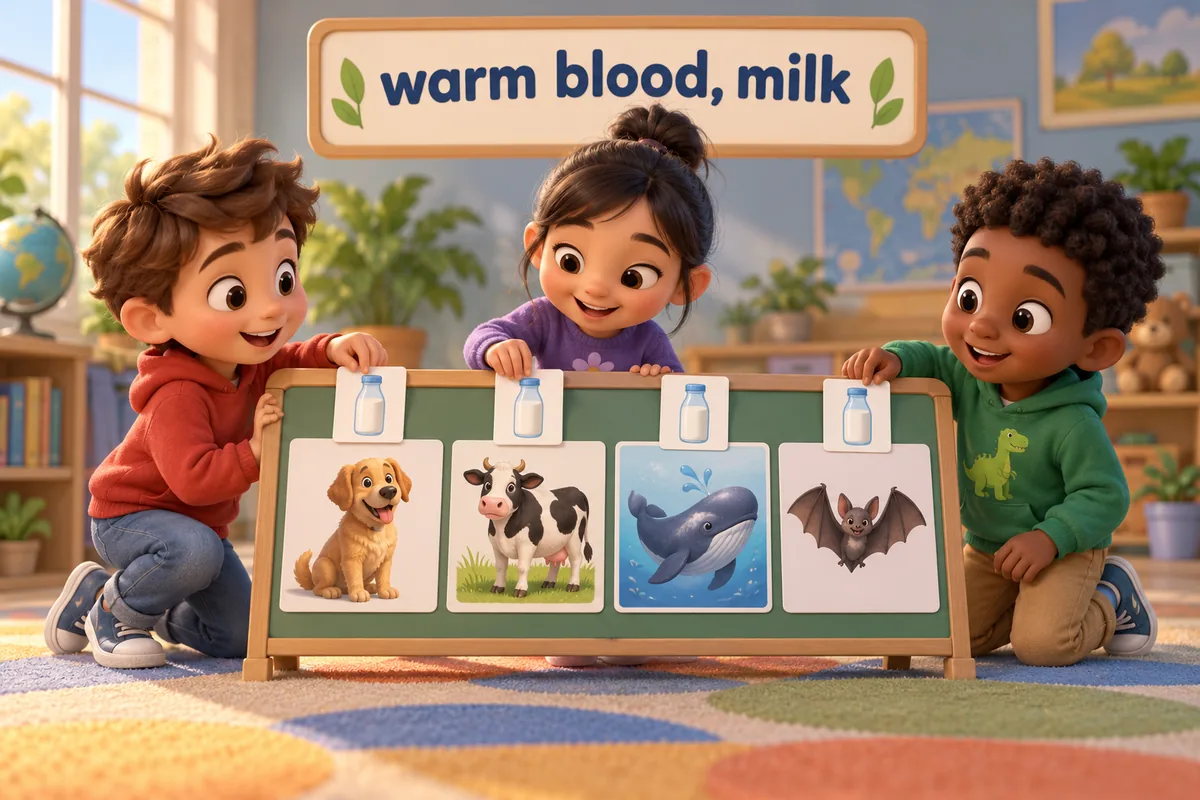
- Marine mammals breathe air, are warm-blooded and feed their young on milk.
- The names divide into cetaceans, seals, manatees and marine hunters.
- Most names are a describing word plus a base noun, as in blue whale or harbour seal.
- The base noun tells the family, so any unfamiliar compound can still be placed.
- The commonest error is calling a whale a fish or a dolphin a porpoise.
What are marine mammals?
A marine mammal is a warm-blooded animal that lives in the sea but breathes air and feeds its young on milk, so the group is defined by the mammal features rather than by the water. The base noun mammal behaves like any other count noun, as shown in mammal in a sentence. A whale, a seal and a manatee are all marine mammals, while a shark, a tuna and a jellyfish are not, because they take oxygen from the water instead of surfacing to breathe.
| Group | Defining feature | Common names |
|---|---|---|
| Whales and dolphins | fully aquatic, with flippers and a tail fluke | blue whale, humpback, orca, bottlenose dolphin, porpoise |
| Seals and their kin | spend time on land and in the sea | harbour seal, elephant seal, sea lion, fur seal, walrus |
| Manatees and dugongs | slow plant-eaters, heavy and round-bodied | manatee, dugong |
| Marine hunters | land mammals that hunt in the sea | sea otter, polar bear |
How are marine mammal names built?
Most names are a describing word plus a base noun, and the base noun is what tells you the family. The adjective sense of the habitat word appears in marine in a sentence.
| Pattern | Example | What it signals |
|---|---|---|
| colour + base noun | blue whale | a striking colour of the species |
| feature + base noun | humpback whale | a shape or habit the animal has |
| place + base noun | harbour seal | where the animal is often found |
| size + base noun | elephant seal | size or another animal’s likeness |
| base noun alone | walrus | the whole animal in one word |
Marine mammal names across contexts
The names appear in science lessons, wildlife writing and ordinary speech, and the register decides how precise each name becomes. The wider class of sea creatures appears in marine animals in a sentence.
| Context | Example sentence | Why this works |
|---|---|---|
| Classroom | A dolphin surfaces to breathe through its blowhole. | ties the name to a defining feature |
| Wildlife writing | Humpback whales sing on their long migrations. | names a group with a habit |
| Science report | The orca is the largest member of the dolphin family. | places a familiar name in its family |
| Everyday speech | We watched a seal haul out onto the rock. | a plain, countable noun |
| Field guide | The harbour porpoise has a small, rounded fin. | a species with a defining feature |
| Zoo or aquarium sign | The manatee grazes on sea grass all day. | names a plant-eater by its diet |
| News report | The walrus population is counted each spring. | a group named with a measure |
| Story | A sea otter floated on its back among the kelp. | a vivid single animal |
| Fact sheet | Marine mammals are warm-blooded and breathe air. | a defining trait in one line |
| Exam answer | Name one marine mammal that eats plants. | asks for a single correct noun |
Which word should you use?
Several names are close relatives that learners mix, and a body feature usually settles the choice. The word for the wider group also carries a false friend, the whale shark, which is a fish despite its name.
| Pair | Usual difference | Example |
|---|---|---|
| dolphin and porpoise | dolphins have a longer snout and a curved fin | The dolphin rode the bow wave. |
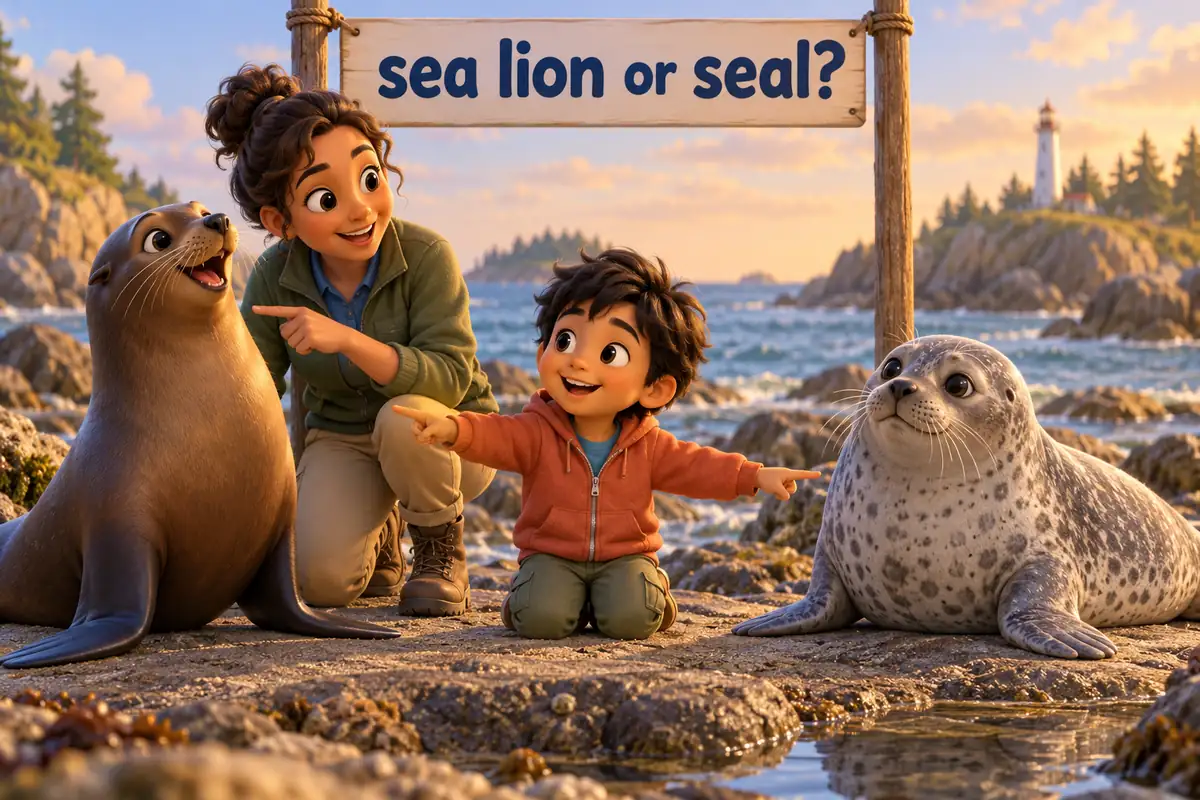
| seal and sea lion | sea lions have visible ear flaps and walk on their flippers | A sea lion barked on the dock. |
| manatee and dugong | the dugong has a fluked tail; the manatee has a rounded one | The manatee drifted through the shallows. |
| whale and whale shark | a whale is a mammal; a whale shark is a fish | The whale shark is harmless to people. |
| orca and whale | the orca is a large dolphin, not a great whale | The orca hunted in a family group. |
Choose the family word when the exact species is unknown, and the species name when a precise example matters. The shared traits, air breathing and milk, place a whale with a cow and a sea otter with a weasel, so a name that sounds like a fish, such as whale shark, can still turn out to be no more than a misleading label.
Word forms and grammar of marine mammal names
These nouns behave like ordinary count nouns, and the adjectives that describe their features are separate words.
| Form | Part of speech | Example |
|---|---|---|
| whale | count noun | One whale swam past the boat. |
| whales | count noun, plural | Whales migrate along the coast. |
| dolphin | count noun | A dolphin is a small toothed whale. |
| cetacean | count noun | The whale is the largest cetacean. |
| pinniped | count noun | Seals and walruses are pinnipeds. |
| aquatic | adjective | Dolphins are highly aquatic mammals. |
| blowhole | noun | Air leaves through the blowhole. |
Use the group words cetacean and pinniped in science writing, where they name the families precisely, and the everyday words whale and seal in ordinary speech. The plural forms are regular, so one dolphin becomes two dolphins, with the plural ending at the end of the whole word.
Common mistakes with marine mammal names
Mistake 1: a whale called a fish. Incorrect: The blue whale is the largest fish in the ocean. Correct: The blue whale is the largest animal, and it is a mammal. Rule: a whale breathes air and feeds milk, so it is not a fish.
Mistake 2: orca treated as a great whale. Incorrect: The orca is a small whale with a tall fin. Correct: The orca is the largest member of the dolphin family. Rule: the orca is a toothed dolphin, not one of the great whales.
Mistake 3: seal and sea lion given as one animal. Incorrect: A sea lion and a seal are exactly the same. Correct: A sea lion has ear flaps and walks on its flippers, while a seal does not. Rule: the ear flaps and the way it moves separate the two names.
Mistake 4: missing plural after a general statement. Incorrect: Marine mammal breathe air. Correct: Marine mammals breathe air. Rule: a general statement about the group takes a plural noun.
Mistake 5: whale shark counted as a mammal. Incorrect: The whale shark is a marine mammal because of its name. Correct: The whale shark is a fish, despite its name. Rule: a name is not proof of a group, so check the features.
Practice using marine mammal names
- Fill in the blank: A dolphin breathes through its ___.
- Choose the better word: The orca is a large (dolphin / fish).
- Correct the error: Marine mammal breathe air.
- Build a sentence: use sea otter to describe an animal floating in kelp.
- Spot the register: which suits an aquarium sign, (a) that big grey thing, or (b) The manatee grazes on sea grass?
- Fill in the blank: A sea lion walks on its flippers, but a ___ slides on its belly.
Answers
- blowhole, because air leaves a dolphin through the blowhole.
- dolphin, because the orca is the largest member of the dolphin family.
- Marine mammals breathe air; a general statement takes a plural noun.
- A sea otter floated on its back among the swaying kelp.
- (b), because an aquarium sign uses a precise name and a habit.
- seal, because a seal moves on its belly while a sea lion uses its flippers.
The bottom line
Marine mammal names gather into four clear groups, and the mammal features of air breathing and milk are the safest test. Whales and dolphins form one family, seals and their kin another, the manatees a third, and the sea otter and polar bear a fourth. Learn the family first, then the species, and a misleading label such as whale shark will not fool you.
Frequently asked questions about marine mammals
Is a dolphin a whale or a fish?
A dolphin is a small toothed whale, so it is a mammal and not a fish. It breathes air through a blowhole, is warm-blooded and feeds its young on milk. The dolphin family also includes the orca, which is its largest member rather than a great whale.
What is the difference between a seal and a sea lion?
A sea lion has small visible ear flaps and can turn its back flippers forward to walk on land. A seal has no ear flaps, only ear openings, and drags itself on its belly. Sea lions also tend to be noisier, barking where seals usually grunt.
Which marine mammals eat plants?
The manatees and the dugong are the plant-eaters, grazing on sea grass and other water plants in shallow coastal waters. They are the sirenians, a separate group from the whales and the seals, and their slow, heavy bodies suit a diet of soft vegetation.
Is a polar bear a marine mammal?
Yes. The polar bear is counted as a marine mammal because it depends on the sea ice for hunting seals and can swim long distances. Like the sea otter, it is a land mammal that adapted to life in and around the sea rather than a fully aquatic animal.