
Quick answer: Use mat for a floor, table, or exercise covering. For a non-shiny finish, matte is widely used in North America and matt is common in Britain; mat also appears as a U.S. finish spelling. Matt is not a standard short form for mattress.
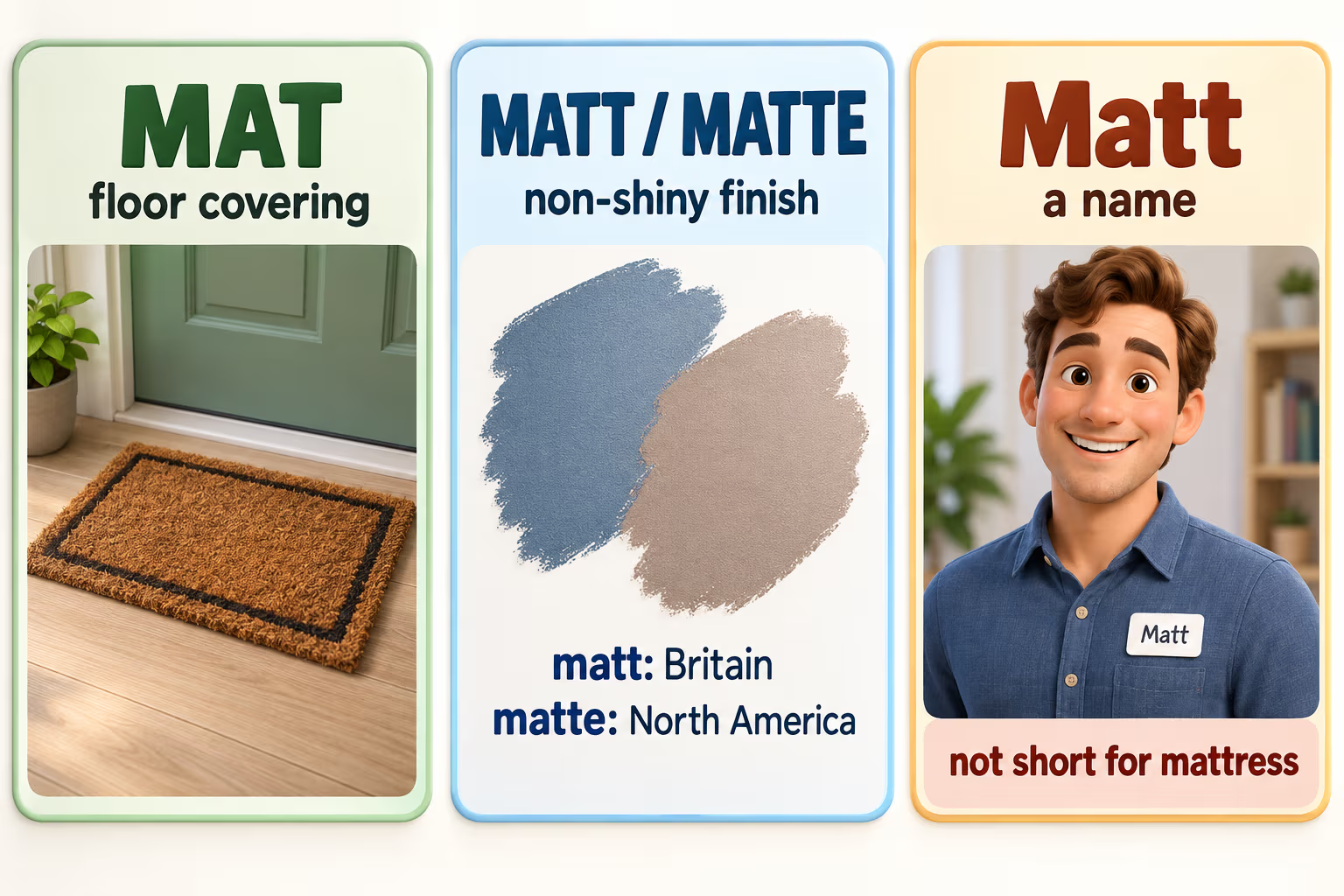
Mat vs. Matt vs. Matte: Quick Reference
Mat, matt, and matte are usually pronounced /mæt/. Their spelling depends on meaning and, for a non-glossy finish, regional convention.
| Form | Meaning and word class | Example |
|---|---|---|
| mat | A noun for a floor, table, or exercise covering | “Leave your shoes on the mat.” |
| mat | Also a U.S. spelling variant for a non-shiny finish | “The paint dries to a mat finish.” |
| matt | An adjective for a non-shiny finish; common in British English | “The cabinet has a matt finish.” |
| matte | An adjective for a non-shiny finish; widely used in North America | “She chose matte paper for the print.” |
| Matt | A capitalized personal name, often a short form of Matthew | “Matt rolled out a yoga mat.” |
| mattress | The full noun for the padded bed surface | “They replaced the old mattress.” |
The finish spellings vary by region. The Government of Canada’s Language Portal says matte describes a dull, non-glossy finish, notes mat as a common U.S. spelling, and identifies matt as primarily British. Oxford Learner’s Dictionaries likewise labels matt British and matte especially North American. Follow your region or publication’s style guide.
When to Use “Mat”
As a noun, mat is a piece of material used as a floor covering, a protective layer on a table, or a soft surface for exercise. Compounds include doormat, placemat, and yoga mat. Cambridge Dictionary lists floor, table, and sport uses for the noun.
Mat can also be a verb meaning to form, cover, or become tangled into a dense mass: “Rain matted the dog’s fur.” In descriptions of paint, paper, or makeup, mat can also appear as an adjective spelling for a non-shiny finish, especially in U.S. usage. The noun and finish adjective are distinguished by the sentence.
When to Use “Matt” or “Matte”
Use matt or matte as an adjective when describing a surface, color, paint, photograph, or cosmetic with little or no gloss. The spelling matt is common in British English; matte is especially common in North America. The words describe the finish, not the material underneath it.
For example, a matte lipstick has a non-shiny finish, and a matt wall paint has low gloss. In North American product descriptions, matte is a clear default; in British writing, matt is usual. If a manufacturer specifies one spelling for a product, keep that spelling when quoting or naming the product.
Is “Matt” Short for “Mattress”?
No standard usage rule makes lowercase matt an abbreviation for mattress. In the spelling comparison, matt is a finish adjective, especially in British English. For a bed, write mattress. Capitalized Matt is a person’s name, as in “Matt bought a new mattress.”
Some product labels or informal notes may use private shorthand, but readers cannot assume that matt means mattress. Spell out mattress in ordinary prose to avoid confusion with the finish adjective or the name Matt.
Examples of “Mat,” “Matt,” and “Matte”
- “Wipe your feet on the mat before coming inside.” — floor covering
- “The yoga instructor placed a mat beside the window.” — exercise surface
- “The designer chose a matte finish for the cabinet.” — North American finish spelling
- “The flat was painted in a soft blue with a matt finish.” — British finish spelling
- “The artist printed the photograph on matte paper.” — non-glossy surface
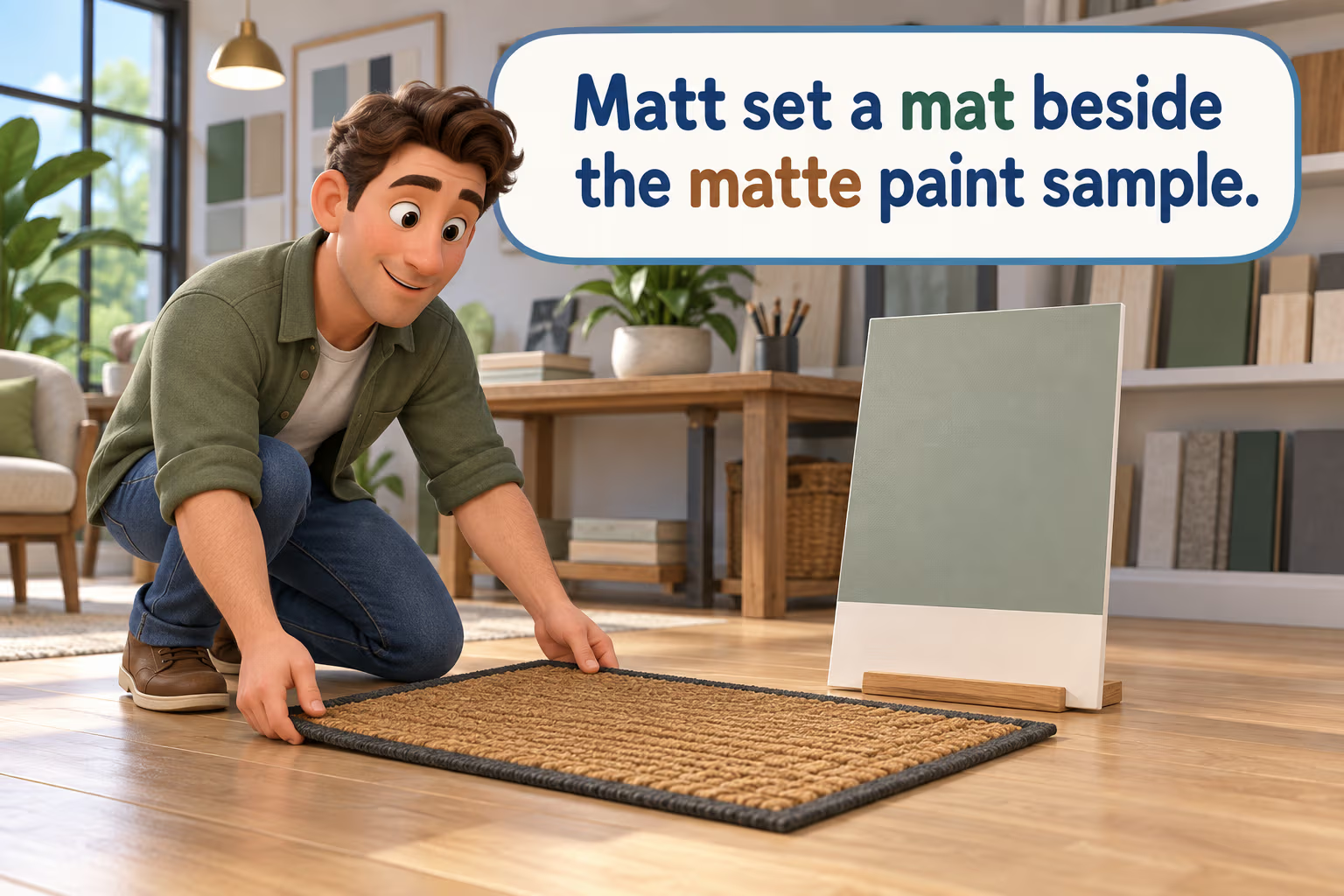
- “Matt set the delivery box on the mat.” — personal name and covering noun
- “They ordered a new mattress for the guest room.” — bed surface
For more sentence examples, see our guides to mat in a sentence and matte in a sentence.
Are you confused about the proper usage of “mat,” “matt,” and “matte”? Well, I’ve got you covered! In this text, I’ll break down the differences between these commonly confused words and provide you with the knowledge you need to use them appropriately. Whether you’re a writer, designer, or just someone who wants to avoid embarrassing mistakes, understanding the nuances of these terms is essential. So, let’s immerse and unravel the mysteries of “mat,” “matt,” and “matte” together. By the end of this article, you’ll be confidently using these words in the right context, leaving no room for confusion.
Key Takeaways
- “Mat,” “matt,” and “matte” are three commonly confused words that have different meanings and applications.
- “Mat” is primarily used as a noun to describe a protective or decorative covering placed on a surface, while “matt” is a less common spelling variant used as an abbreviation for “mattress.”
- “Matte” is an adjective used to describe a surface, finish, or color that is flat, dull, and lacking shine.
- Understanding the correct usage of these words is important for clear and accurate communication in writing, design, and everyday conversations.
Important correction to the earlier examples below: Lowercase matt is not a standard abbreviation for mattress, and it is a standalone adjective for a non-shiny finish. The finish spellings vary by region: matt is common in Britain; matte is especially common in North America; mat also appears as a U.S. variant. Use mattress for the bed and capitalized Matt for a person’s name.
The Difference Between “Mat,” “Matt,” and “Matte”
When it comes to the words “mat,” “matt,” and “matte,” it’s easy to get confused with their usage. These words may sound similar, but they have different meanings and applications. Let’s take a closer look at what sets them apart.
Mat: The word “mat” is primarily used as a noun to describe a protective or decorative covering placed on a surface. It can refer to a variety of objects, such as a doormat, a yoga mat, or a place mat. In each case, the purpose of the mat is to provide cushioning, insulation, or a designated area. For example:
- “I wiped my feet on the welcome mat before entering the house.”
- “She laid out the yoga mat and began her practice.”
Matt: On the other hand, “matt” is a less common spelling variant of “mat,” mainly used as an abbreviation for “mattress.” It’s important to note that “matt” is not a standalone word but rather a shortened form of “mattress.” Example:
Spelling correction: In standard usage, lowercase matt describes a non-shiny finish; it is not an abbreviation for mattress. Write the full word mattress when you mean the bed surface.
- “I’ll be sleeping on the spare room’s matt tonight.”
Matte: Finally, we have the word “matte.” “Matte” is an adjective used to describe a surface, finish, or color that is flat, dull, and lacking shine. It is often used in the context of fine arts, photography, design, and cosmetics. Examples:
- “She preferred a matte finish for her painting to achieve a more subdued look.”
- “I love how her matte lipstick gives a velvety texture to her lips.”
By understanding the differences between “mat,” “matt,” and “matte,” you’ll be able to use them appropriately in your writing, design projects, or everyday conversations. Remember, these words may sound similar, but their meanings and applications are distinct.
Understanding the Correct Usage of “Mat,” “Matt,” and “Matte”
As a writer, it’s important to have a solid understanding of commonly confused words to avoid making mistakes. In this section, I’ll clarify the differences between “mat,” “matt,” and “matte” and provide examples to help you use them correctly in your writing.
Let’s start with the word “mat.” As a noun, “mat” refers to a protective or decorative covering. It is commonly used to describe a flat, coarse piece of material typically made from straw, reeds, or fabric. Mats can be used for various purposes, such as floor coverings, table settings, or even as a backdrop for artwork. Here are a few examples of correct usage:
- “I placed a small mat at the entrance to prevent dirt from getting on the floor.”
- “She bought a colorful mat to enhance the look of her dining table.”
On the other hand, “matt” is a less common spelling variant and is often used as an abbreviation for “mattress.” While it is not as frequently used as “mat,” it is essential to understand its meaning to ensure accurate communication. For example:
Spelling correction: In standard usage, lowercase matt describes a non-shiny finish; it is not an abbreviation for mattress. Write the full word mattress when you mean the bed surface.
- “I need to buy a new matt for my bed as the old one is worn out.”
Finally, let’s clarify the adjective “matte.” Unlike “mat” and “matt,” which are nouns, “matte” is used to describe a surface, finish, or color that is flat and lacking shine. It is commonly used in various fields such as design, photography, and makeup. Here are a few examples:
Grammar clarification: In the finish sense, mat, matt, and matte can all function as adjectives, with regional spelling differences. Mat is also a common noun for a covering, but matt is not limited to being a noun and matte is not the only adjective form.
- “She chose a matte black finish for her car to give it a sleek and classy look.”
- “The makeup artist opted for a matte foundation to create a natural and shine-free complexion.”
Understanding the differences between “mat,” “matt,” and “matte” is crucial for clear and accurate communication. Whether you’re a writer, designer, or simply someone who values proper language usage, knowing these distinctions will help you avoid common errors. Now that we have clarified these words, let’s move on to the next section and explore more commonly confused words.
Commonly Confused Words: “Mat,” “Matt,” and “Matte”
When it comes to the English language, there are often words that sound similar or have similar spellings, leading to confusion among writers and speakers. One such trio of words that causes confusion is “mat,” “matt,” and “matte.” Let’s jump into the definitions and proper usage of these words to clear up any misconceptions.
Mat: The word “mat” is most commonly used as a noun to describe a protective or decorative covering. Think of a welcome mat or a yoga mat. It can also refer to a flat piece of material used to display artwork or to serve as a background for photographs. Here are a few examples of “mat” in sentences:
- Please wipe your feet on the doormat before entering the house.
- The photographer carefully arranged the artwork on a black mat for the exhibition.
- We need to replace the old, worn-out mat in our exercise studio.
Matt: “Matt” is a less common variant spelling of “mat” and is primarily used as an abbreviation for “mattress.” While “mat” can be a noun or a verb, “matt” is typically only used as a noun to refer to the soft, cushioned surface on which we sleep. Here’s an example of “matt” in a sentence:
Spelling correction: In standard usage, lowercase matt describes a non-shiny finish; it is not an abbreviation for mattress. Write the full word mattress when you mean the bed surface.
- I need to buy a new foam matt for my bed because my old one is too lumpy.
Matte: Now let’s move on to “matte.” “Matte” is an adjective used to describe a surface, finish, or color that is flat and lacking shine. It is often used in the context of photography, art, or cosmetics. For example:
- She prefers a matte finish for her foundation because it gives her a natural look.
- The photographer chose a matte paper for printing their black and white photographs.
- The artist used acrylic paints with a matte finish to create a soft, muted effect.
Understanding the distinctions between “mat,” “matt,” and “matte” is important for writers, designers, and anyone who wants to communicate accurately. So, next time you reach for that “matte” lipstick or step on a “mat,” you can confidently use these words correctly.
Tips and Tricks for Using “Mat,” “Matt,” and “Matte” Appropriately
As a writer or designer, it’s crucial to use words correctly to effectively communicate your message. In this section, I’ll share some tips and tricks for using “mat,” “matt,” and “matte” appropriately, so you can avoid confusion and write with confidence.
Understand the Differences
To use these words accurately, let’s start by understanding their definitions and distinctions:
- Mat: This word is primarily used as a noun to describe a protective or decorative covering. For example, a doormat is a mat placed outside a door to keep dirt out. Mats can also be used to display artwork or photographs.
- Matt: This spelling is a less common variant used as an abbreviation for “mattress.” While it’s not as prevalent as the other two words, it may still come up in certain contexts.
- Matte: This word is an adjective used to describe a surface, finish, or color that is flat and lacks shine. It’s commonly used in the context of cosmetics, photography, and artwork. For instance, a matte lipstick has a smooth, non-shiny finish.
Use Examples and Context
Sometimes, the best way to understand how to use words correctly is by seeing them in context. Let’s look at some examples:
- I purchased a mat for my yoga practice to provide cushioning and prevent slipping.
- After a long day, I sank into my cozy matt and instantly felt relaxed.
- The artist chose a matte black frame for the painting to enhance its depth and richness.
Pay Attention to Spelling and Usage
Confusion can arise when it comes to spelling and using these words correctly. Here are a few guidelines:
- Mat is generally used as a noun.
- Matt is less common and used as a shorthand for “mattress.”
- Matte is an adjective describing a flat surface or finish.
Remember to consult a dictionary or style guide if you’re unsure about the correct spelling or usage. It’s always better to double-check and ensure accuracy.
Conclusion
In this text, I have provided valuable tips and tricks for using the words “mat,” “matt,” and “matte” appropriately. By understanding the subtle differences between these terms, you can ensure clear and effective communication in your writing and design work. Remember, it’s crucial to pay attention to spelling and usage to avoid any confusion.
I have emphasized the importance of consulting a dictionary or style guide when you’re unsure about the correct usage of these words. This will help you write with confidence and avoid any potential mistakes. Whether you’re a writer or a designer, mastering the appropriate use of “mat,” “matt,” and “matte” will enhance your ability to convey your message accurately.
By following the tips and examples provided in this text, you’ll be able to use these words in a way that aligns with their specific meanings and contexts. So go ahead and confidently incorporate “mat,” “matt,” and “matte” into your vocabulary, knowing that you’re using them appropriately.
Frequently Asked Questions
Q: What is the difference between “mat,” “matt,” and “matte”?
A: “Mat” refers to a protective covering, “matt” refers to a dull finish, and “matte” refers to a material with a smooth or non-reflective surface.
Correction: The earlier answer reverses the finish spellings. Matt and matte are regional spellings for a non-shiny finish; mat is a covering noun and can also be a finish spelling. Use mattress for the bed surface.
Q: Why is it important to understand the differences between these words?
A: Understanding the differences between these words enables writers and designers to use them appropriately and avoid confusion or inadvertent mistakes in their communication.
Q: How can I ensure I am using these words correctly?
A: To ensure correct usage, consult a dictionary or style guide when in doubt. These resources provide definitions, examples, and guidelines for using words like “mat,” “matt,” and “matte.”
Q: Why should I pay attention to spelling and usage?
A: Paying attention to spelling and usage ensures clarity and professionalism in your writing and design work. Incorrect spelling or usage can confuse readers and negatively impact your message.
Q: How can this article help me write with confidence?
A: This article provides definitions, examples, and tips to help you understand and use “mat,” “matt,” and “matte” correctly. By following the guidance provided, you can write with confidence and effectively convey your ideas and intentions.
Frequently Asked Questions About Mat, Matt, and Matte
What is the difference between mat, matt, and matte?
Mat usually names a floor, table, or exercise covering. For a non-shiny finish, matt is common in British English, while matte is especially common in North America; mat is also used as a finish spelling. Capitalized Matt is a personal name.
Is matt a short form of mattress?
Not in standard general English usage. Lowercase matt is a spelling for a non-shiny finish, especially in British English. If you mean the padded surface of a bed, write mattress. A store or workplace may use private shorthand, but readers will not reliably know what it means.
Should I write matte or matt?
Use the spelling expected by your audience or style guide. Matte is especially common in North America, while matt is common in Britain. Both can describe a surface with little or no gloss. If you are quoting a product name or label, preserve the manufacturer’s spelling.
Can mat describe a finish?
Yes. Although mat is commonly the noun for a covering, the Government of Canada’s Language Portal also identifies it as a spelling used for a dull, non-glossy finish. In context, “a mat finish” describes gloss level, while “a mat by the door” names an object.
How do you remember which spelling to use?
Picture the meaning before you write: a floor or yoga covering is a mat; a low-gloss finish is matte in much of North America or matt in Britain; a person may be named Matt; and a bed has a mattress. The sentence usually makes the choice clear.


