Misconstrue means to interpret something wrongly, usually by reading a word, an action or a silence as something it was never meant to be. To use misconstrue in a sentence, name the message and the wrong meaning that was taken from it: “She misconstrued his silence as agreement.” The wrong reading is always a specific one.
Misconstrue at a glance
- Misconstrue is a transitive verb; its forms are misconstrues, misconstrued and misconstruing.
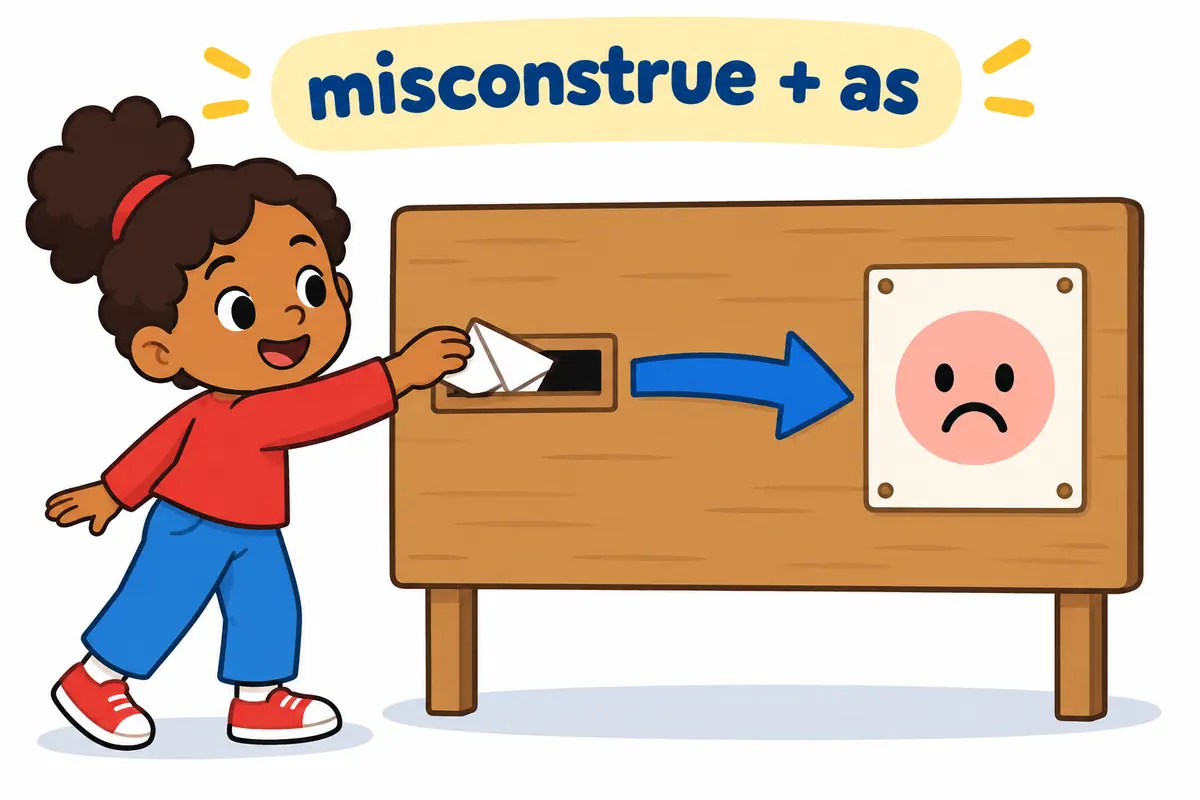
- The signature pattern is misconstrue + something + as + noun, as in misconstrued the note as a threat.
- Misconstrue belongs to formal, legal and journalistic writing more than to conversation.
- Common collocations include easily misconstrued, misconstrue the meaning and be misconstrued as.
- The commonest error is confusing misconstrue with misconceive, which means to plan something badly.
What does misconstrue mean?
Misconstrue is a transitive verb meaning to interpret words, actions or events in the wrong way, so that the meaning taken is not the meaning intended. The Cambridge entry for misconstrue records the single core sense of putting a wrong construction on something. The word is built from mis- and construe, and construe itself already means to interpret, which is why misconstrue always involves an active reading rather than simple ignorance.
| Sense | Plain meaning | Example sentence |
|---|---|---|
| Interpret wrongly | Take a statement or action to mean the wrong thing | She misconstrued his silence as agreement. |
| Put a strained reading on words | Twist the meaning of a clause or remark | The lawyer misconstrued the clause to widen the duty. |
| Misjudge a person | Form a wrong opinion of someone from their words | Readers misconstrued the author as hostile. |
One limitation is worth stating plainly. Misconstrue assumes an honest mistake, not deceit. It describes a reader who took the wrong meaning, not a speaker who lied, so it is milder than misrepresent. When the distortion is deliberate, distort the words or misrepresent is the honest choice, because only those words carry bad faith.
How do you use misconstrue in a sentence?
Name what was said or done, then the wrong meaning it was given, joined by as. Five patterns cover almost every real sentence, and the passive is the one that keeps attention on the message rather than on the reader.
| Pattern | Example | What it signals |
|---|---|---|
| misconstrue + something + as + noun | He misconstrued the short reply as rudeness. | Names the message and the wrong meaning. |
| misconstrue + something + as + -ing | They misconstrued her pause as refusing the offer. | Turns the wrong reading into an action. |
| misconstrue + somebody | The audience misconstrued her and thought her cold. | Applies the verb to a person, not just words. |
| be misconstrued as + noun | A quiet smile can be misconstrued as mockery. | Passive voice, common in warnings and style guides. |
| misconstrue + something (no as) | Do not misconstrue my meaning. | Direct object, when the wrong reading is left unnamed. |
When the reader simply fails to grasp the message at all, misunderstand a message is the broader verb; when the failure is smaller and about tone, to misread a tone is closer. Misconstrue sits between them, because it says the reader did arrive at a meaning, only the wrong one.
Misconstrue in a sentence: examples across contexts
Misconstrue changes register but keeps one job: it reports that a wrong meaning was taken. The ten sentences below move from a classroom to a legal judgment, and each one names both the message and the reading that went wrong.
| Context | Example sentence | Why this works |
|---|---|---|
| Classroom | The teacher misconstrued the whisper as cheating, though the boy was only asking for a pen. | Names the innocent act and the wrong accusation together. |
| Workplace email | Our client misconstrued the short reply as a refusal to help. | Email tone is the classic ground for this verb. |
| News report | The minister said her remark had been misconstrued as a threat. | The passive suits a public figure defending herself. |
| Legal writing | The court held that the clause had been misconstrued by both parties. | A formal, impersonal use in legal reasoning. |
| Literary criticism | Early readers misconstrued the narrator as the author himself. | Separates the created voice from the writer. |
| Science writing | A cautious result is easily misconstrued as a proven one. | The adverb easily warns other researchers. |
| Conversation | I misconstrued her joke and thought she was serious. | The first person works in speech with the as-pattern. |
| Diplomacy | A single word in the statement was misconstrued as a concession. | Shows how much weight one reading can carry. |
| History essay | Later historians argued that the treaty had been misconstrued for a century. | Time span stresses a costly, lasting error. |
| Online comment | Her post was misconstrued as an attack, and the thread turned hostile. | Captures how quickly a public reading spreads. |
Notice that only one sentence uses the first person and only one uses the passive with a public figure. That split is the clearest signal of where the word lives in writing.
Misconstrue vs misunderstand
Misconstrue and misunderstand both describe a failure to get the right meaning, and learners treat them as twins. The difference is what kind of failure it is: misconstruing assigns a wrong meaning, while misunderstanding may assign none. The table keeps the two apart.
| Attribute | misconstrue | misunderstand |
|---|---|---|
| Core idea | Read the wrong meaning into something | Fail to grasp the meaning at all |
| Typical object | Words, actions, silence | A person, a topic, instructions |
| Implies a wrong reading | Usually yes, named with as | Not necessarily |
| Register | Formal and literary | Neutral and everyday |
| Common pattern | misconstrue something as something | misunderstand someone or something |
| Frequency | Fairly rare | Very common |
Verdict: use misunderstand for the everyday failure to follow a message, and save misconstrue for the sharper case where a specific wrong meaning was taken from what somebody said or did.
Why does misconstrue sound formal?
Misconstrue sounds formal for three reasons a careful reader can point to. First, mis- prefixes a base verb, construe, that is itself rare outside law and criticism, so the word inherits that weight. Second, the as-pattern forces the writer to state an interpretation, which suits analysis rather than chat, and a court can say the parties misapprehend the rule when the error is about meaning rather than fact. Third, the word keeps a faint note of blame, so it appears where accusations are weighed, as in journalism, judgment and negotiation.
The result is a word that fits a committee or a court far better than a text message. A student who writes she misconstrued me will sound stilted, while the same verb in a lawyer arguing that the clause was misconstrued sounds exact. Learners who notice this register can avoid the commonest misuse, which is not a grammatical error at all but a mismatch of setting.
Word forms and grammar of misconstrue
Misconstrue inflects regularly and has no common adjective, so writers who want a related description reach for the noun a common misconception or the adjective misconstrued itself. The table also lists the near relative learners confuse with it.
| Form | Part of speech | Example |
|---|---|---|
| misconstrue | verb, base form | Please do not misconstrue my question. |
| misconstrues | verb, third person | He misconstrues every polite refusal. |
| misconstrued | verb, past and past participle | She misconstrued the brief. |
| misconstruing | verb, present participle | You are misconstruing what I said. |
| misconstrued | adjective, participial | The misconstrued remark caused weeks of trouble. |
| misconstrual | noun, rare | A misconstrual of the rule brought the appeal. |
Common mistakes with misconstrue
- Incorrect:
The team misconstrued about the instructions.Correct: The team misconstrued the instructions. Rule: Misconstrue is transitive and takes a direct object, never about. - Incorrect:
He misconstrued that the meeting was cancelled.Correct: He misconstrued the message as a cancellation. Rule: The verb takes a noun phrase or an as-phrase, not a that-clause. - Incorrect:
Please do not misconstrue of my remark.Correct: Please do not misconstrue my remark. Rule: There is no preposition between the verb and its object. - Incorrect:
They misconceived the plan and thought it was a trick.Correct: They misconstrued the plan as a trick. Rule: Learners often confuse two words here: to misconceive is to form a plan badly, while to misconstrue is to read a meaning wrongly. - Incorrect:
The clause is easy to be misconstrued.Correct: The clause is easy to misconstrue. Rule: After easy to, English prefers the active infinitive, so the passive does not fit.
Practice using misconstrue
Complete the seven items, then read the reason beside each answer rather than only the key. Two items ask you to judge register, because setting is where this verb is most often misused.
- Fill the gap: The judge ruled that the contract had been ______ by the earlier court.
- Choose the better word: I simply (misunderstood / misconstrued) the bus timetable and missed the stop.
- Correct the error: The manager misconstrued that the report was a complaint.
- Build a sentence: use misconstrue something as about a friend taking a short text message the wrong way.
- Spot the register: which belongs in a legal judgment — the words were misconstrued as a guarantee, or she totally got the wrong end of the stick?
- Rewrite with the passive: The public misconstrued the diagram as a map. Begin with The diagram.
- Change the word class: use the rare noun misconstrual in a sentence about an appeal.
Answers
- misconstrued — the passive with had been fits the formal report of a wrong reading.
- misunderstood — there was no wrong meaning, only a failure to follow the timetable.
- The manager misconstrued the report as a complaint — the verb needs an as-phrase, not a that-clause.
- Model answer: Sam misconstrued her one-word reply as a snub and stopped texting.
- The words were misconstrued as a guarantee — the passive suits the impersonal judgment.
- The diagram was misconstrued as a map by the public — the message moves to the subject and the reader follows by.
- Model answer: A misconstrual of the tax rule led directly to the appeal.
The bottom line
Use misconstrue in a sentence when a specific wrong meaning has been read into what someone said or did, and name that wrong meaning with as. The two nuances that decide most sentences are these: the verb is transitive, so the message is always its object, and it assumes honest error rather than deceit, which keeps it milder than misrepresent. Where there is no wrong reading, only a gap in understanding, misjudge a person and misunderstand are the plainer verbs.
Frequently asked questions about misconstrue
Is misconstrue a formal word?
Yes, misconstrue sits in formal, legal and journalistic writing rather than in casual speech. Its base verb, construe, is itself rare outside law, and the as-pattern makes the writer state an interpretation. In everyday talk, misunderstand or get the wrong idea does the same work with less ceremony.
Does misconstrue imply bad faith?
No. Misconstrue assumes an honest mistake, because it describes a reader who took the wrong meaning rather than a speaker who lied. When deliberate distortion is meant, misrepresent or distort is the accurate verb. Choosing misconstrue keeps the sentence neutral about motives, which is why it is common in careful reporting.
What does it mean if a message is misconstrued?
It means the message was given a wrong meaning by those who read or heard it, not that the words were unclear. A polite question can be misconstrued as an accusation, and a brief reply as coldness. The fault lies in the reading, which is exactly why the passive is so common with this verb.
Can you misconstrue a person?
You can, though it is less common than misconstrue a message. The audience misconstrued her means they formed a wrong idea of her character from what she said or did. The meaning stays close to misunderstanding a person, but it keeps the sense that a positive reading was actively misread as a negative one.