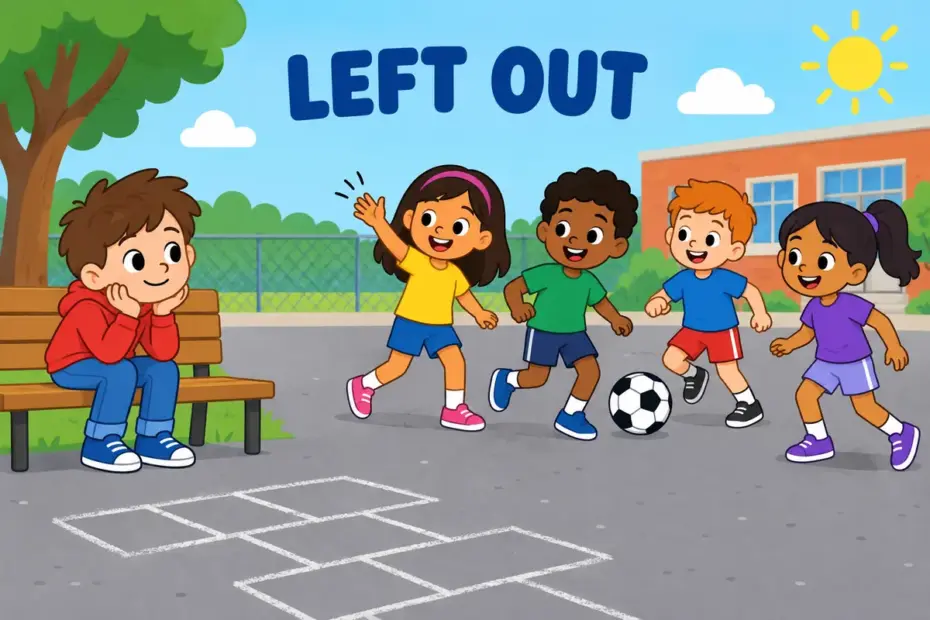
Miss out means to leave someone or something out, or to lose a chance by failing to act. To use miss out in a sentence, decide which sense applies: the list missed out my name, or we missed out on the tickets. The particle can move, so the position of out changes with the sense.
Miss out at a glance
- Miss out is a phrasal verb with two common senses: omit and lose an opportunity.
- The omission sense is chiefly British and keeps out close to miss.
- The opportunity sense almost always uses on: miss out on a deal.
- The particle can follow the object in the omission sense: miss my name out.
- The commonest error is dropping on before the thing that was missed.
What does miss out mean?
Miss out is a phrasal verb meaning either to fail to include someone or something, or to lose an opportunity by not taking it. The Cambridge entry for miss out records the chiefly British omission sense, and to omit a name from a list is the formal single-word equivalent, while to exclude a member is stronger because it suggests a deliberate decision.
| Sense | Plain meaning | Example sentence |
|---|---|---|
| Omit | Fail to include someone or something | The secretary missed out two names. |
| Lose an opportunity | Fail to take an advantage in time | We missed out on the early discount. |
| Be excluded | Not share what others enjoyed | The youngest child missed out on the trip. |
| Not get a share | Receive nothing while others do | Cut the cake so nobody misses out. |
One limitation is worth stating plainly. Miss out is informal and, in the omission sense, much more common in British than American English. A formal report would write that the list omitted a name rather than that it missed it out, so register decides the choice as much as meaning does.
How do you use miss out in a sentence?
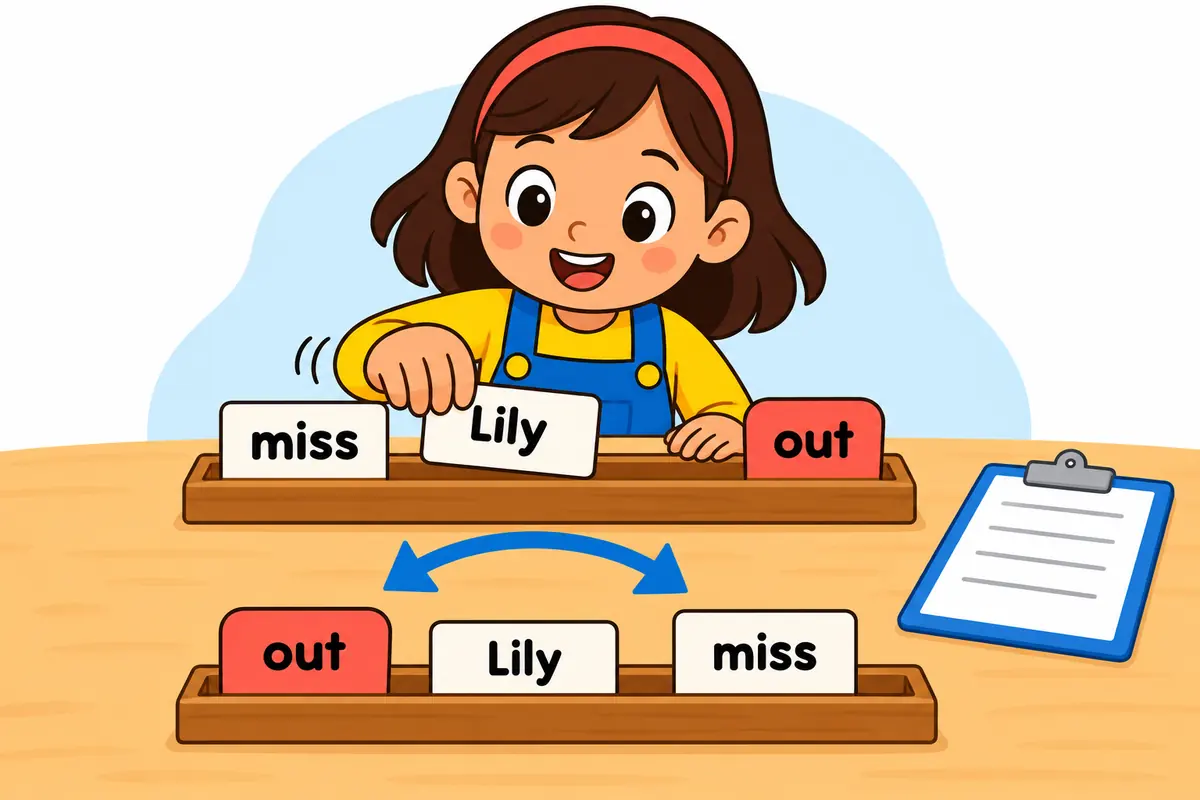
Miss out is separable in its omission sense, so out may follow the object or stay beside miss: the list missed out my name and the list missed my name out are both correct. In the opportunity sense the verb is intransitive and takes on, and that on cannot move to the end: you miss out on a chance, never miss a chance out on. In speech the particle carries the main stress, so miss OUT on sounds more natural than MISS out.
| Pattern | Example | What it signals |
|---|---|---|
| miss + object + out | She missed my name out. | Omission; the particle follows the object. |
| miss out + object | She missed out my name. | Omission; the particle stays with the verb. |
| miss out on + noun | They missed out on the grant. | Lost opportunity; on is required. |
| miss out, no object | Share the pizza so nobody misses out. | Intransitive; nobody is excluded. |
| miss out on + -ing | He missed out on seeing the comet. | Names a past experience that was lost. |
Where the sentence means deliberately not doing something, to skip a class is the active choice, while miss out usually describes a loss the speaker regrets. Choosing between them tells the reader whether the outcome was decided or merely suffered.
Miss out in a sentence: examples across contexts
The ten sentences below keep the same phrasal verb while moving from a party invitation to a formal notice, and each one makes clear which sense is at work.
| Context | Example sentence | Why this works |
|---|---|---|
| Classroom | The teacher missed out the last name on the register. | Omission sense, British style. |
| Party | Invite the whole class so nobody misses out. | Intransitive, no object after out. |
| Workplace email | Apologies if I missed anyone out of the loop. | The circular phrase uses out after the object. |
| News report | Thousands of families missed out on the emergency payment. | Opportunity sense with on. |
| Fiction | She had missed out on a normal childhood. | Names a whole lost experience. |
| Sales copy | Do not miss out on the final reductions. | The fixed warning phrase uses on. |
| Travel | We missed out on the last ferry by minutes. | On plus the thing that was lost. |
| Recruitment | Strong candidates can miss out if the advert is vague. | Intransitive, describing exclusion. |
| Conversation | I missed out on the joke and laughed late. | Everyday spoken use with on. |
| Formal notice | Two items were missed out of the printed agenda. | Passive omission sense with out of. |
The particle out behaves in the same movable way in other phrasal verbs, which is why learners meet it so often. You can ask a classmate out or back out of a promise, and in each case the little word carries the meaning while the verb stays in place.
Miss out vs skip and pass up
Miss out overlaps with skip and pass up, and the three divide the work by intention. To pass up an offer is a deliberate refusal, while to forgo a bonus is a formal way of giving something up on purpose.
| Attribute | miss out | skip | pass up |
|---|---|---|---|
| Core job | Fail to include, or lose a chance | Deliberately not do or attend | Deliberately refuse a chance |
| Intention | Usually accidental, sometimes regretted | Always chosen | Always chosen |
| Typical object | A name, a person, a chance, a trip | A class, a meal, a step | An offer, a deal, a bargain |
| Requires on | For the opportunity sense only | No | No |
| Register | Informal, chiefly British | Neutral | Informal to neutral |
Verdict: choose miss out when something is left out or a chance is lost, skip when someone deliberately does not attend, and pass up when a known offer is turned down. To lose a match is a plain defeat, and to forgo a bonus is a formal choice, so neither carries the accidental sense of exclusion that miss out does.
Word forms and grammar of miss out
Miss out takes the regular inflections of the base verb miss, and the table also shows how the base verb differs in meaning. The full form to overlook a detail is the formal substitute in business writing.
| Form | Part of speech | Example |
|---|---|---|
| miss out | phrasal verb, base form | Do not miss out on the trip. |
| misses out | third person singular | He always misses out my name. |
| missed out | past and past participle | They missed out on the tickets. |
| missing out | present participle | You are missing out on a good film. |
| miss | base verb, different meaning | I miss my old school. |
| overlook | verb, formal substitute | The report overlooked one clause. |
The base verb miss means to fail to hit or to feel the absence of someone, so I missed the bus and I miss my friends are unrelated to the phrasal verb. Adding out is what creates the senses of omission and lost opportunity.
Common mistakes with miss out
- Incorrect:
Do not miss out the sale.Correct: Do not miss out on the sale. Rule: The opportunity sense needs on before the thing that could be lost. - Incorrect:
The list missed out on my name.Correct: The list missed out my name. Rule: The omission sense takes a direct object and never on. - Incorrect:
We missed on the last train.Correct: We missed out on the last train. Rule: Out is part of the phrasal verb and cannot be dropped. - Incorrect:
He missed out of the party.Correct: He missed out on the party. Rule: The preposition is on, not of, before the lost event. - Incorrect:
She missed out to include me.Correct: She missed me out. Rule: The omission sense needs no infinitive and no on; the name is the object.
Practice using miss out
Work through the seven items, then read the reasoning rather than only the key.
- Fill the gap: Check the list so that nobody is missed ______ .
- Choose the better word: We decided to ______ the meeting and stay home. (miss out / skip)
- Correct the error: She missed out on my name when she read the register.
- Build a sentence: use miss out on about a concert that sold out before you bought tickets.
- Spot the register: which belongs in a formal notice — two items were missed out of the agenda, or we totally missed two things?
- Move the particle: rewrite She missed out my name with out after the object.
- Rewrite with a formal verb: The report missed out a key clause. Use omit.
Answers
- out — nobody is missed out uses the intransitive form with the particle after the verb.
- skip — the sentence describes a deliberate choice, which is skip, not the accidental miss out.
- She missed out my name when she read the register — the omission sense takes a direct object without on.
- Model answer: We missed out on the concert because the tickets sold out first.
- Two items were missed out of the agenda — a formal notice avoids the vague we and totally.
- She missed my name out — out may follow the object in the separable omission sense.
- The report omitted a key clause — omit is the formal single-word equivalent of miss out.
The bottom line
Use miss out in a sentence when someone or something is left out, or when a chance is lost, and let the preposition signal which sense you mean. Two facts decide most sentences: the opportunity sense needs on, as in miss out on an offer, and the omission sense takes a direct object with out free to move after it. For a deliberate refusal, pass up is the more precise phrasal verb.

Frequently asked questions about miss out
Is miss out British or American?
The omission sense, meaning to leave something out, is chiefly British, so a British office might say you missed a name out from the list. American writers usually say left out or omitted. The opportunity sense, as in miss out on a deal, is common in both varieties and appears in advertising everywhere.
What does miss out on mean?
Miss out on means to lose an opportunity or fail to share in something good. The on introduces the thing that was not obtained, as in miss out on a scholarship. Because the phrase describes a loss the speaker regrets, it often appears in warnings such as do not miss out on this offer.
Can you separate miss and out?
Yes, but only in the omission sense, where out may follow the object: miss my name out and miss out my name are both correct. In the opportunity sense the two words stay together and on follows them, so you miss out on a chance and never miss a chance out on.
Is miss out formal or informal?
Miss out sits in informal and neutral writing, and the omission sense sounds conversational. Formal reports prefer omit or exclude, and formal notices prefer leave out. The opportunity sense is acceptable in advertising and everyday journalism, where its energy suits persuasive sentences.