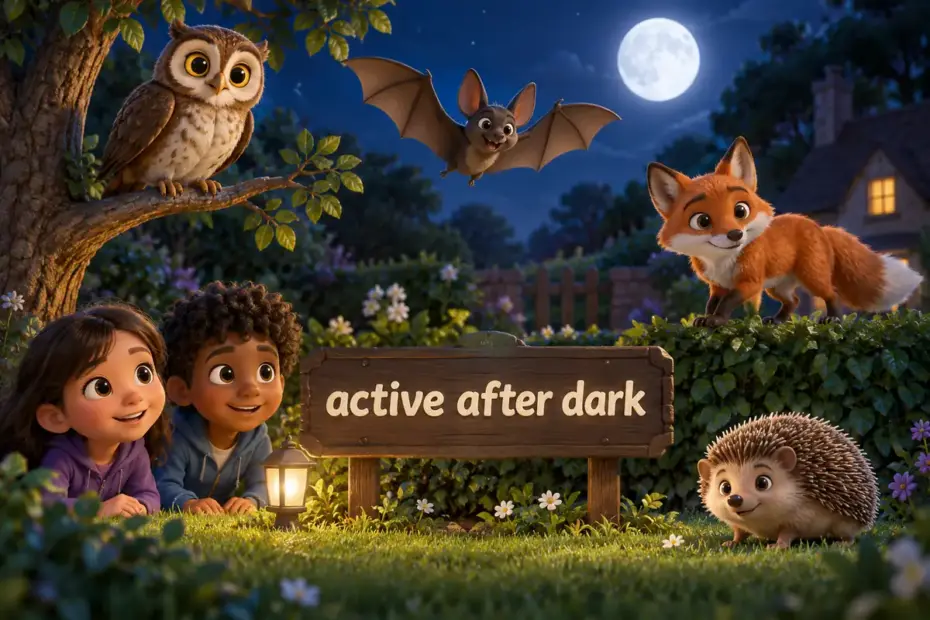
Nocturnal animal names describe the creatures that are active at night and rest by day, such as the owl, the bat, the fox and the hedgehog. Their bodies suit the dark, with large eyes, sharp hearing or a keen sense of smell.
Nocturnal animal names at a glance
- A nocturnal animal is active at night and rests during the day.
- The group includes mammals, birds, insects and reptiles.
- Common names are short: owl, bat, fox, moth, gecko.
- The plural is regular for most names: owls, bats, foxes, moths.
- The commonest error is calling every night animal nocturnal when some are active at dusk instead.
What are nocturnal animal names?
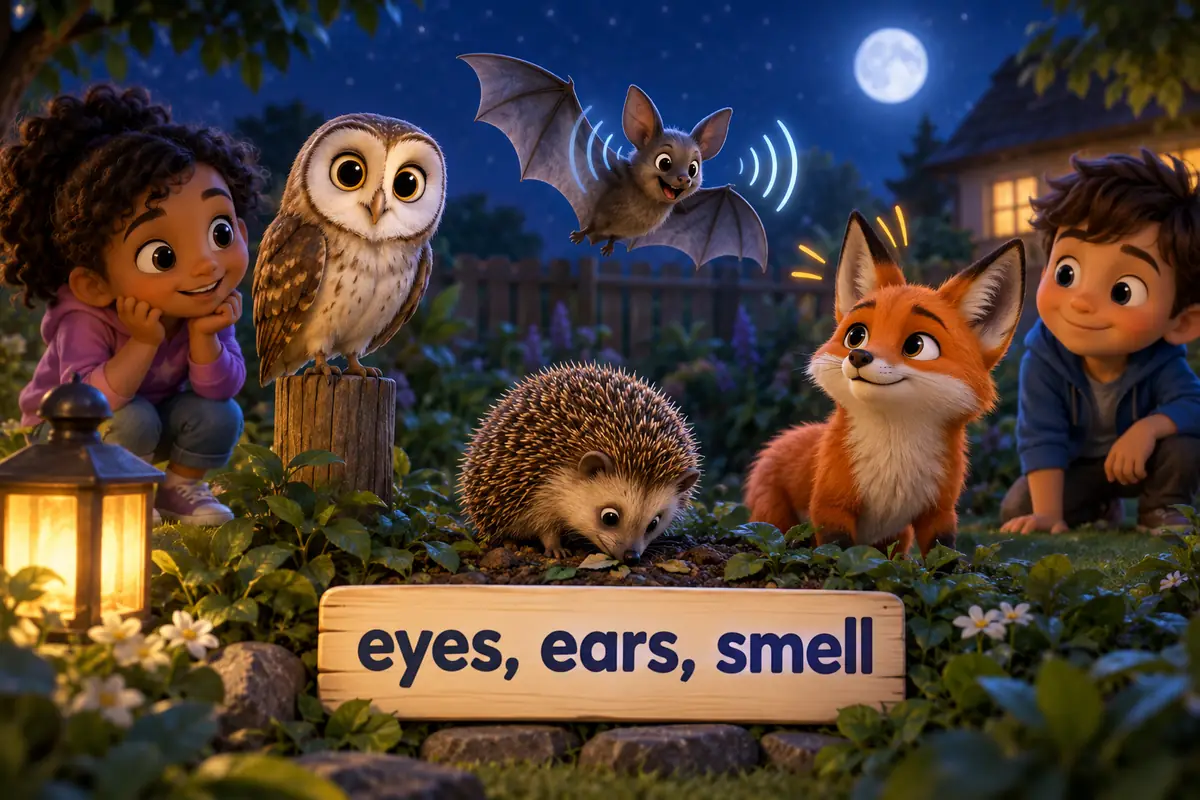
Nocturnal animal names are the common words for wildlife that comes out after dark. The animals sort by how they find their way at night, and the eye or the ear gives the clue. A general word for the group appears in animal in a sentence.
| Animal | Active time | One fact |
|---|---|---|
| Owl | night | Flies almost silently when it hunts. |
| Bat | night | Uses echoes to find its way in the dark. |
| Fox | dusk and night | Often forages at dusk and before dawn. |
| Badger | night | Lives in an underground home called a sett. |
| Hedgehog | night | Snuffles through leaves for insects. |
| Raccoon | night | Uses nimble front paws to open things. |
| Opossum | night | Lies still when it feels threatened. |
| Mouse | night | Small and quick in the dark. |
| Rat | night | A strong climber and a clever forager. |
| Coyote | dusk and night | Known for its howl after dark. |
| Skunk | night | Sprays a strong scent when alarmed. |
| Leopard | night | Hunts alone under cover of dark. |
| Kiwi | night | A flightless bird that probes the ground for food. |
| Aye-aye | night | Taps wood to find grubs inside. |
| Tarsier | night | Has very large eyes for the dark. |
| Gecko | night | Climbs smooth surfaces with its toes. |
| Firefly | night | Glows to signal to other fireflies. |
| Moth | night | Often drawn towards a light. |
| Cricket | night | Chirps to call for a mate. |
| Cockroach | night | Avoids light and hides by day. |
One honest limit belongs here. Not every animal in a group is active at night, and some, such as the fox and the coyote, are busiest at dusk and dawn rather than in the deepest dark, so a single label rarely fits a whole species at every hour.
How do you use nocturnal animal names in a sentence?
Each name is a countable noun, and the small words around it stay the same. The adjective itself is used in ordinary sentences in nocturnal in a sentence.
| Pattern | Example | What it signals |
|---|---|---|
| a nocturnal + name | A nocturnal owl called from the barn. | one night animal |
| name + plural + verb | Bats streamed out at dusk. | a group in motion |
| the + name + is + adjective | The hedgehog is shy and slow. | a description |
| name + that + clause | The moth that circles the lamp is drawn to light. | a defining clause |
| a group of + plural | A group of badgers dug near the hedge. | a cluster |
Nocturnal animal names: examples across contexts
The same names move from a night walk to a news report, and each setting frames them a little differently. The contrast with animals that live in water appears in marine animal in a sentence.
| Context | Example sentence | Why this works |
|---|---|---|
| Night walk | A bat flickered over the pond just after sunset. | a field sighting |
| Classroom | Sort the owl, the moth and the gecko as night animals. | a sorting task |
| Nature blog | The fox slipped along the hedge without a sound. | a vivid description |
| News report | Hedgehog numbers are checked by counting road crossings. | a factual report |
| Conversation | Did you hear the owls last night? | an everyday question |
| Garden diary | A hedgehog visited the lawn at about eleven. | a dated record |
| Museum label | The tarsier has eyes suited to very low light. | a display caption |
| Exam answer | A nocturnal animal is active at night and sleeps by day. | a formal claim |
| Science piece | Fireflies glow to attract a mate in the dark. | a fact about behaviour |
| Puzzle | An animal that taps wood to find grubs at night is the aye-aye. | a definition in use |
| Photographer note | Swifts and owls need a very low light setting after sunset. | a technical tip |
| Ranger log | A leopard was heard coughing in the dark near the waterhole. | a survey record |
| School poster | Some animals sleep all day and wake at night. | a simple summary |
Which night-animal words cause confusion?
A few labels for activity overlap, and learners often stretch one word too far. A word for kept animals appears in domestic animal in a sentence.
| Word | Meaning | Example |
|---|---|---|
| nocturnal | active at night | Owls are nocturnal. |
| diurnal | active by day | Robins are diurnal. |
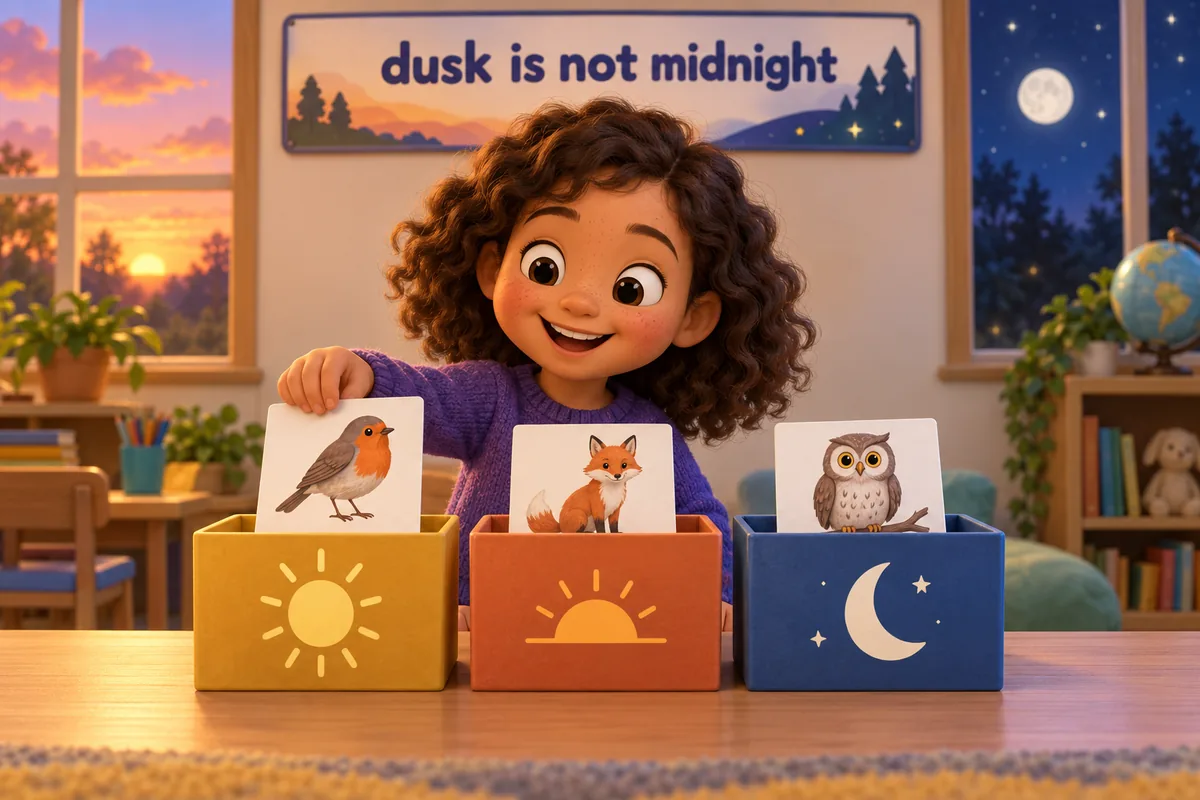
| crepuscular | active at dusk and dawn | Foxes are often crepuscular. |
| bat / bird | a flying mammal / a feathered animal | A bat is not a bird. |
| nocturnal / nightly | active at night / happening each night | A nightly walk, not a nocturnal walk. |
Word forms and grammar of nocturnal animal names
The describing word builds a small family, from the adjective to the adverb. A related word for animals kept on a farm appears in farm animal in a sentence.
| Form | Part of speech | Example |
|---|---|---|
| nocturnal | adjective | A nocturnal animal rests by day. |
| nocturnally | adverb | Many moths fly nocturnally. |
| diurnal | adjective | A diurnal bird is active by day. |
| crepuscular | adjective | A crepuscular animal is busy at dusk. |
| night | noun | The owl hunts at night. |
| dark | noun | Its eyes suit the dark. |
Common mistakes with nocturnal animal names
Mistake 1: the wrong activity word. Incorrect: A fox is fully nocturnal, never seen at dusk. Correct: A fox is often crepuscular, active at dusk and dawn. Rule: crepuscular suits dusk-and-dawn animals better than nocturnal does.
Mistake 2: a bat called a bird. Incorrect: A bat is a bird that flies at night. Correct: A bat is a flying mammal. Rule: a bat has fur and feeds its young on milk, so it is a mammal.
Mistake 3: a plural after the article a. Incorrect: We saw a owls in the barn. Correct: We saw an owl in the barn. Rule: a and an come before a singular noun.
Mistake 4: a singular verb with a plural subject. Incorrect: The bats is out early. Correct: The bats are out early. Rule: a plural subject takes a plural verb.
Mistake 5: a plural modifier. Incorrect: Nocturnals animals need cover by day. Correct: Nocturnal animals need cover by day. Rule: an adjective never takes a plural s.
Practice using nocturnal animal names
Each item below asks for one name, one activity word or one correction, and every answer gives the reason rather than the key alone.
- Fill in the blank: A ___ uses echoes to find its way in the dark.
- Choose the better word: An animal most active at dusk and dawn is (diurnal / crepuscular).
- Correct the error: A bat is a bird that flies at night.
- Build a sentence: use a group of about badgers near a hedge.
- Spot the register: which line suits a garden diary, (a) A hedgehog visited the lawn at about eleven, or (b) Saw a hedgehog, it was well late, like.
- Fill in the blank: An animal that is active by day is ___ .
Answers
- bat, because a bat uses echoes, or echolocation, to find its way in the dark.
- crepuscular, because crepuscular means active at dusk and dawn, while diurnal means active by day.
- A bat is a flying mammal; it has fur and feeds its young on milk.
- A group of badgers dug near the hedge at night.
- (a), because a garden diary uses plain, clear language.
- diurnal, because diurnal is the adjective for an animal active during the day.
The bottom line
Nocturnal animal names are best learned by how each animal finds its way in the dark, starting with the owls and bats that echo or listen, then the foxes and badgers that rely on smell, then the moths and crickets that signal at night. Match the word to the hour, since crepuscular suits a dusk animal and diurnal suits a day animal. Learn the group this way and the long list stays easy to picture.
Frequently asked questions about nocturnal animal names
What are some common nocturnal animal names?
Common nocturnal animal names include the owl, bat, fox, badger, hedgehog, raccoon, opossum, mouse, rat, coyote, skunk, leopard, kiwi, aye-aye, tarsier, gecko, firefly, moth, cricket and cockroach. These are active at night and rest by day, often using sharp hearing or smell to move in the dark.
What is the opposite of nocturnal?
The opposite of nocturnal is diurnal, which means active during the day. A robin or a squirrel is diurnal. A third label, crepuscular, describes animals active at dusk and dawn, such as the fox. In practice, many animals fall between these labels and change their habits with the season.
Is a bat a bird or a mammal?
A bat is a mammal, not a bird. It has fur rather than feathers, and it feeds its young on milk. Bats are the only mammals that can truly fly. Many bats use echolocation, sending out sounds and reading the echoes, to find insects and to move safely in the dark.
Why are so many animals active at night?
Many animals are active at night for two main reasons. The dark offers cover from predators and can make it easier to avoid the heat of the day. Night also brings out insects and other prey for hunting animals. Since fewer rivals are about, night can be a quieter time to feed.