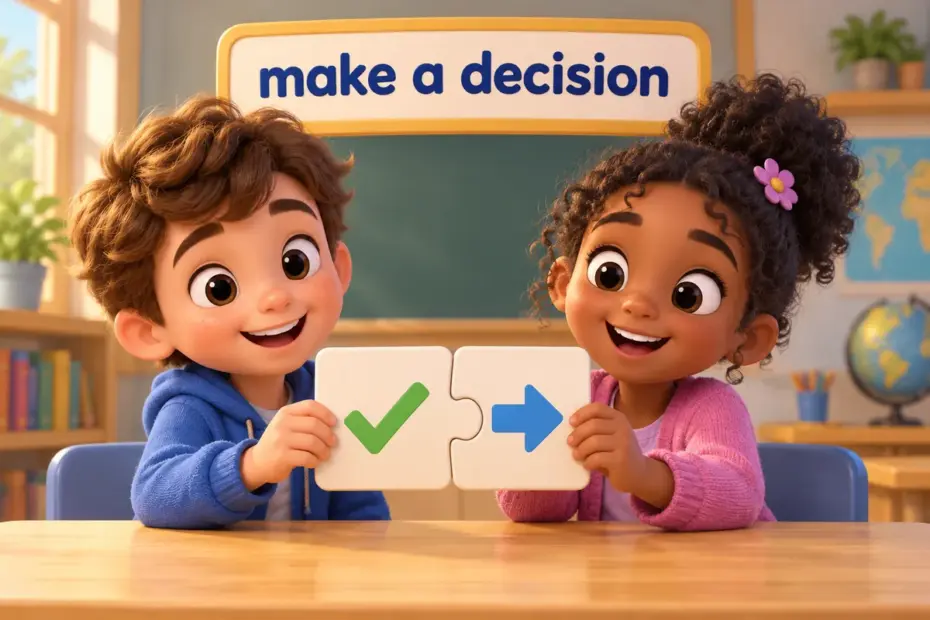
Noun collocations in English are the word partners a noun habitually keeps, so a speaker says make a decision and heavy rain rather than take a decision or strong rain. Both versions are understandable, yet only one sounds native. Learning the pair, not just the noun, is what makes a sentence sound right.
Noun collocations in English at a glance
- A noun collocation is a noun plus its usual partner word.
- The main types are verb plus noun, adjective plus noun, and noun plus noun.
- The partner is fixed by habit, not by logic.
- Collocations differ from idioms, which change meaning as a whole.
- The commonest error is choosing a synonym of the partner word.
What are noun collocations in English?
Noun collocations in English are the fixed partnerships between a noun and the words that naturally go with it. The partner might be a verb, an adjective or another noun, and the choice is set by usage rather than by meaning. An ordinary noun used in a sentence can be paired in many ways, yet only some pairs sound at home.
| Type | Example | What it shows |
|---|---|---|
| verb + noun | make a decision | One verb fixes the action. |
| adjective + noun | heavy rain | The adjective is the natural one. |
| noun + noun | traffic jam | Two nouns make one idea. |
| noun + verb | the rain falls | The noun takes one verb. |
| noun + preposition | a reason for | The preposition is fixed too. |
The reason learners notice collocations is that a wrong partner reads as foreign even when the grammar is perfect. Strong rain breaks no rule, yet every English speaker expects heavy rain, and that expectation is the whole point of a collocation. A page of abstract nouns used in sentences shows the same pull toward fixed partners with ideas such as attention and progress.
How do you use noun collocations in a sentence?
The verb is the partner that causes the most trouble, because English splits the work between make, do and take in a way that few languages share. The table pairs each verb with nouns that habitually follow it, so the choice becomes a memory task rather than a translation task.
| Verb | Common partner noun | When it fits |
|---|---|---|
| make | make a mistake | For creating or producing. |
| do | do the homework | For tasks and duties. |
| take | take a photo | For actions you perform. |
| have | have a rest | For experiences and states. |
| give | give advice | For offering something to others. |
Adjective partners work the same way. A native speaker reaches for strong coffee but heavy rain, and for a deep sleep rather than a big sleep, because the adjective is stored with the noun. Learning a noun together with one strong adjective is a small habit that pays off in every piece of writing.
Noun collocations across contexts
Collocations appear in every register, and the table gives one natural sentence for each setting. Every row names the fixed pair and explains why that partner is the natural one.
| Context | Sentence | Why this works |
|---|---|---|
| Classroom | Please take notes during the lesson. | take is the fixed partner of notes. |
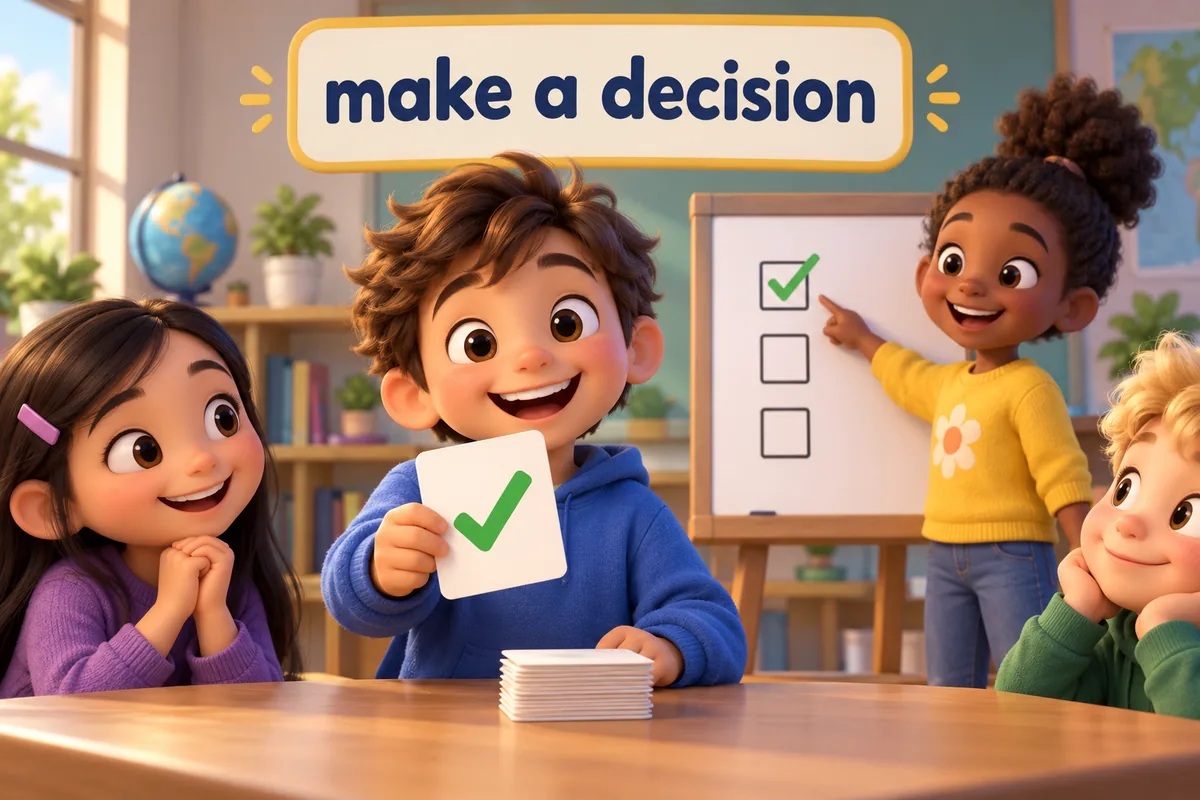
| Work email | We need to make a decision by Friday. | make pairs with decision. |
| News report | Heavy rain closed the coast road. | heavy is the natural partner of rain. |
| Conversation | Let us have a quick chat. | have pairs with chat. |
| Academic writing | The study found a strong correlation. | strong pairs with correlation. |
| Story | A sharp wind cut across the field. | sharp is the collocate of wind here. |
| Recipe | Beat the egg and add a pinch of salt. | pinch pairs with salt. |
| Business | They reached an agreement after hours. | reach pairs with agreement. |
| Sport | The team kept a clean sheet. | clean pairs with sheet in this sense. |
| Health note | He caught a bad cold. | catch pairs with cold. |
Reading is the fastest way to collect these pairs, because a piece of real text repeats the same partnerships many times. A word list such as nouns that begin with a becomes a collocation list once each noun is learned with its usual verb and adjective.
Register adds a second layer of choice. A formal report prefers to reach an agreement and to conduct a review, while casual speech says to come to an agreement and to have a look. The noun stays the same and the partner shifts, which is why the pair, not the noun alone, is the unit worth storing.
Which verb should you use?
Make, do and take divide the common actions between them, and the difference is habit rather than logic, so the table is worth learning as a set. When two verbs seem possible, the one that appears in a dictionary example is the safe choice.
| Verb | Partner nouns | The idea behind it |
|---|---|---|
| make | a mistake, a decision, progress | You create or produce the thing. |
| do | homework, the dishes, a favour | You perform a task. |
| take | a photo, a break, a seat | You perform a brief action. |
| have | a rest, a look, a chat | You enjoy an experience. |
| give | advice, an answer, a hand | You offer something. |
A useful habit is to record the noun with one strong verb, one adjective and one preposition, so three partners are learned at once. The same approach works for a letter-based set from nouns that begin with b, where nouns such as break, bath and benefit each bring their own partners.
Word forms and grammar of collocations
A collocation usually keeps the same shape when the noun changes form, so the verb make stays with the noun family around decision. The table shows a noun beside a related form and a natural example of each.
| Noun | Related form | Example |
|---|---|---|
| decision | decision-making | Good decision-making saves time. |
| rain | rainy | The rainy season starts soon. |
| mistake | mistaken | She was mistaken about the date. |
| advice | adviser | The adviser gave clear advice. |
| agreement | agree | They agree on the plan. |
| correlation | correlated | The two values are correlated. |
One trap is mixing the parts of two set phrases, as when a writer blends to make a decision and to take a decision into to make a take. Each collocation is a whole unit, and pulling one word out of one and pushing it into another breaks the partnership that made the phrase natural.
Prepositions are the quiet partner that learners drop most often. A rise in prices, an interest in music and a solution to a problem each keep a fixed preposition that cannot be swapped for another. Because the wrong preposition rarely changes the meaning, it slips past a reader as a small fault, yet it is one of the clearest marks of a sentence written by a learner rather than a native speaker, and a dictionary example is the quickest way to check it.
Common mistakes with collocations
- Incorrect:
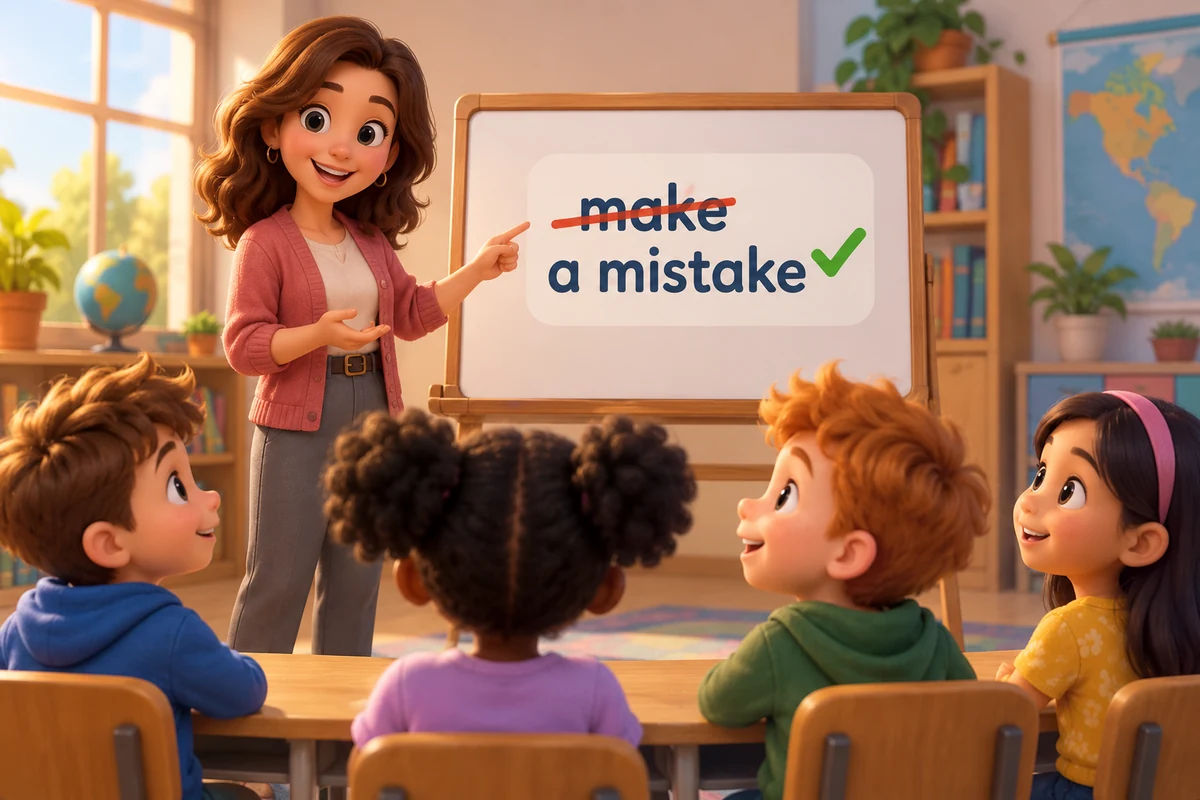
I did a mistake in the report.Correct: I made a mistake in the report. Rule: make, not do, partners with mistake. - Incorrect:
Strong rain fell all day.Correct: Heavy rain fell all day. Rule: heavy is the fixed partner of rain. - Incorrect:
She made a photo with her phone.Correct: She took a photo with her phone. Rule: take, not make, partners with a photo. - Incorrect:
We discussed about the plan.Correct: We discussed the plan. Rule: discuss takes a direct object and needs no about. - Incorrect:
He told a mistake.Correct: He made a mistake. Rule: tell partners with a lie or a story, not with mistake.
Practice using collocations
- Fill the gap: We need to ______ a decision before noon. (make / do)
- Choose the natural partner: ______ rain is expected tonight. (Strong / Heavy)
- Correct the error: She did a lot of mistakes in the test.
- Fill the gap: Please ______ a photo of the group. (take / make)
- Build a sentence using the collocation reach an agreement.
- Spot the register: which fits a formal report, (a) We reached an agreement, or (b) We came to some deal?
Answers
- make, because make is the fixed partner of decision.
- Heavy, because heavy is the natural adjective for rain.
- She made a lot of mistakes in the test, because make partners with mistake.
- take, because take is the fixed partner of a photo.
- The two sides reached an agreement after a long meeting, because reach pairs with agreement.
- (a) We reached an agreement, because reach is the formal partner of agreement.
The bottom line
Noun collocations in English are the partnerships that make a noun sound at home, from make a decision to heavy rain. The partner is fixed by habit, so a correct synonym can still sound wrong. Learn each noun with its usual verb, adjective and preposition, and store the pair rather than the single word.
Frequently asked questions about collocations
What is a noun collocation?
A noun collocation is a noun together with a word that habitually goes with it, such as make a decision or heavy rain. The two words form a natural partnership, and the pairing is learned as a unit because the partner is fixed by usage rather than by logic.
Why are collocations important?
Collocations make a sentence sound native. A phrase such as take a decision is grammatically fine and easy to understand, yet an English speaker expects make a decision. Using the natural partner is one of the clearest signs of fluent and accurate writing.
What is the difference between a collocation and an idiom?
A collocation keeps its literal meaning, so make a decision simply means deciding. An idiom carries a figurative meaning that the single words do not show, as in break the ice. Collocations stay transparent, while idioms must be learned whole.
How can I learn collocations quickly?
Record each new noun with one strong verb, one adjective and one preposition, and read plenty of natural text so the pairs repeat. A dictionary that shows example sentences is more useful than a plain definition, because the examples reveal the partners the noun prefers.