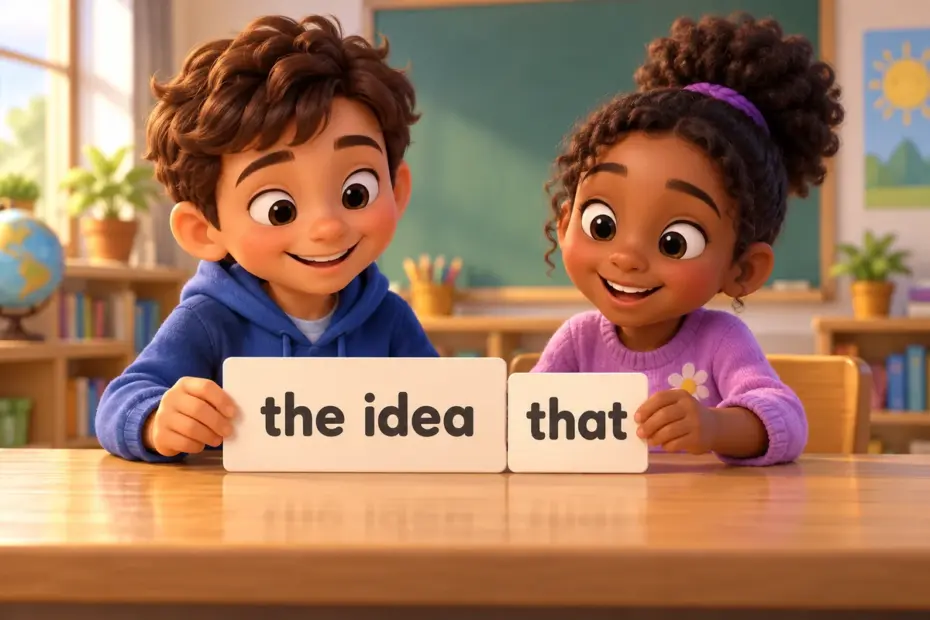
Noun complements in English are the clauses and phrases that complete the meaning of a noun, so the idea that we should wait and a rise in prices both finish a noun that would otherwise stand half empty. They follow abstract nouns such as fact, hope, decision and need. The news that we had won is one clear example.
Noun complements in English at a glance
- A noun complement completes the meaning of a noun.
- The three main types are the that-clause, the to-infinitive and the prepositional phrase.
- Abstract nouns such as idea, hope and decision usually take a complement.
- A noun complement differs from a relative clause, which describes a noun.
- The commonest error is the wrong preposition after the head noun.
What are noun complements in English?
Noun complements in English are the words that a head noun needs to make sense. An abstract noun such as idea, hope or decision points to something that must be spelled out, and the complement spells it out. An ordinary noun used in a sentence often needs nothing more, while an abstract noun usually asks for its complement.
| Complement type | Example | What it adds |
|---|---|---|
| that-clause | the idea that we should wait | States the content of the idea. |
| to-infinitive | the decision to leave early | Names the action the noun points to. |
| prepositional phrase | a rise in prices | Adds the thing the noun concerns. |
| wh-clause | the question of whether to stay | Raises the choice the noun holds. |
The test is a question. If the noun leaves a reader asking what, which or whether, a complement is due. The belief that we can improve and the decision to try again both answer such a question, and a page of abstract nouns used in sentences shows how often those nouns arrive with their own completing phrase.
How do you use noun complements in a sentence?
The head noun decides which kind of complement is allowed, and the table groups the common nouns with the type each one takes. A that-clause states content, a to-infinitive names an action, and a prepositional phrase names what the noun concerns.
| Head noun | Complement type | Example |
|---|---|---|
| fact, idea, belief | that-clause | The fact that she agreed surprised us. |
| hope, fear, news, doubt | that-clause | The hope that he returns keeps us going. |
| decision, attempt, plan | to-infinitive | Their plan to expand failed. |
| refusal, desire, wish | to-infinitive | Her wish to travel grew stronger. |
| increase, drop, effect | preposition plus noun | A drop in demand hurt sales. |
Once the type is chosen, the structure fills in naturally. A that-clause keeps its own subject and verb, as in the claim that the road was closed, while a to-infinitive drops the subject and leaves the action bare, as in the attempt to close the road. Choosing between them depends on the head noun rather than on the writer.

Noun complements across contexts
The complement appears wherever an abstract noun carries the main idea, and the table gives one sentence from each setting. Every row names the complement type and explains why the noun needs it.
| Context | Sentence | Why this works |
|---|---|---|
| Classroom | The fact that water boils at 100 degrees is easy to test. | The clause completes the noun fact. |
| Work email | Our aim to finish by Friday still stands. | The infinitive completes the noun aim. |
| News report | A rise in fuel costs worried drivers. | The phrase completes the noun rise. |
| Academic writing | The belief that language shapes thought is debated. | The clause fills out the noun belief. |
| Conversation | I share your hope that things will improve. | The clause completes the noun hope. |
| Legal writing | The claim that the contract was broken must be proved. | The clause completes the noun claim. |
| Story | Her decision to leave surprised everyone. | The infinitive completes the noun decision. |
| Business | There is a growing need for skilled staff. | The phrase completes the noun need. |
| Debate | The question of whether to act divided the room. | The wh-clause completes the noun question. |
| Health note | A drop in energy can signal illness. | The phrase completes the noun drop. |
A related pattern is the clause that describes a noun rather than completing it, and the two are easy to confuse because both can begin with that. A word list such as nouns that begin with a gives practice nouns to test, since only an abstract noun such as aim or assumption takes a true complement.
Register shapes the choice as well. Formal writing keeps the that-clause, as in the finding that costs had risen, while a brisk note often drops it, as in our finding costs had risen. The clause itself stays whole either way, so the noun is never left unfinished in meaning even when a small connector disappears.
Which complement should you use?
The frequent confusion is between a noun complement and a relative clause, and the difference is the job rather than the word that introduces each one. The table sets the two apart so the test becomes quick.
| Feature | Noun complement | Relative clause |
|---|---|---|
| What it does | Completes the noun | Describes the noun |
| Head noun | Usually abstract | Any noun |
| Typical marker | that, to, of, for, in | who, which, that |
| Removable? | No, the noun feels incomplete | Often yes |
| Example | the hope that we win | the team that won |
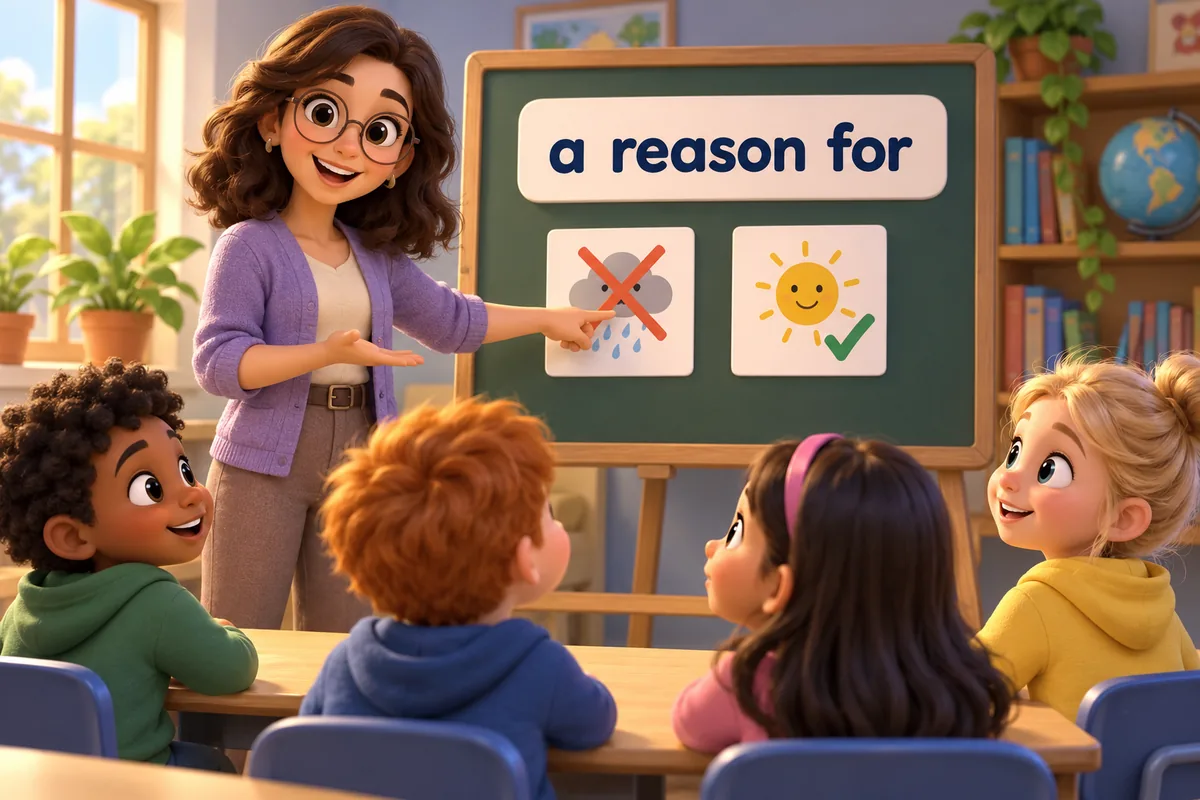
The second choice is the preposition that follows the head noun, because English fixes it by habit. A reason for a delay, a need for help and an interest in art each keep their own preposition, and a list such as nouns that begin with b shows nouns such as belief and benefit taking their own fixed partners.
Word forms and grammar of noun complements
Many head nouns are built from a verb, so the family around a word shows which complement fits. The table pairs a verb with its noun and a natural example of the complement in use.
| Verb | Noun | Example |
|---|---|---|
| decide | decision | The decision to wait was wise. |
| believe | belief | The belief that hard work pays off is common. |
| increase | increase | An increase in sales pleased the board. |
| need | need | The need for care is urgent. |
| intend | intention | Her intention to help was clear. |
| fail | failure | The failure to act cost time. |
Countability interacts with the complement too. A noun such as need can be uncountable in the need for care or countable in a need for care, and the complement stays the same while the article changes. Learning the head noun with its preposition, rather than learning the preposition alone, is the habit that prevents the errors readers notice most.
Common mistakes with noun complements
- Incorrect:
There is a reason of the delay.Correct: There is a reason for the delay. Rule: reason takes the preposition for. - Incorrect:
An increase of prices worried shoppers.Correct: An increase in prices worried shoppers. Rule: increase takes in for the thing affected. - Incorrect:
The fact of that she agreed surprised us.Correct: The fact that she agreed surprised us. Rule: a that-clause follows the head noun directly. - Incorrect:
Her decision of leaving early was wise.Correct: Her decision to leave early was wise. Rule: decision takes a to-infinitive. - Incorrect:
The need of help was urgent.Correct: The need for help was urgent. Rule: need takes the preposition for.
Practice using noun complements
- Fill the gap: the hope ______ the weather improves. (that / which)
- Choose the preposition: a rise ______ demand puzzled the analysts. (in / of)
- Correct the error: Their plan of moving abroad fell through.
- Fill the gap with a to-infinitive: the attempt ______ the record. (break)
- Build a sentence using the head noun belief with a that-clause.
- Spot the register: which fits a formal report, (a) The finding that costs rose is clear, or (b) Costs rose, that is clear?
Answers
- that, because an abstract noun such as hope takes a that-clause for its content.
- in, because a rise in demand is the fixed phrase.
- Their plan to move abroad fell through, because plan takes a to-infinitive.
- the attempt to break the record, because attempt takes a to-infinitive.
- The belief that effort brings results is common, because the that-clause completes the noun belief.
- (a) The finding that costs rose is clear, because the that-clause completes the abstract noun finding.
The bottom line
Noun complements in English complete an abstract noun with the content it points to, whether that content arrives as a that-clause, a to-infinitive or a prepositional phrase. The head noun decides which type fits and which preposition follows. Learn each noun with its complement, and the sentence holds together without a reader wondering what is missing.
Frequently asked questions about noun complements
What is a noun complement?
A noun complement is a clause or phrase that completes the meaning of a noun. In the hope that you can come, the clause that you can come completes the abstract noun hope. Without the complement, the noun would point to something the reader cannot yet identify.
How is a noun complement different from a relative clause?
A noun complement supplies content the noun needs, as in the idea that we should wait. A relative clause describes the noun in front of it, as in the man who called. Both can begin with that, so the test is whether removing the clause leaves the noun incomplete.
Which nouns usually take a that-clause?
Abstract nouns that name a thought, a report or a feeling take a that-clause. Common ones include fact, idea, belief, hope, fear, claim, doubt, news and possibility. Concrete nouns such as table or window do not take this kind of complement at all.
Which nouns take a to-infinitive?
Nouns that name a plan, a choice or a wish take a to-infinitive, such as decision, attempt, plan, refusal, desire, wish and intention. The infinitive names the action the noun points to, so the decision to leave names the leaving itself.