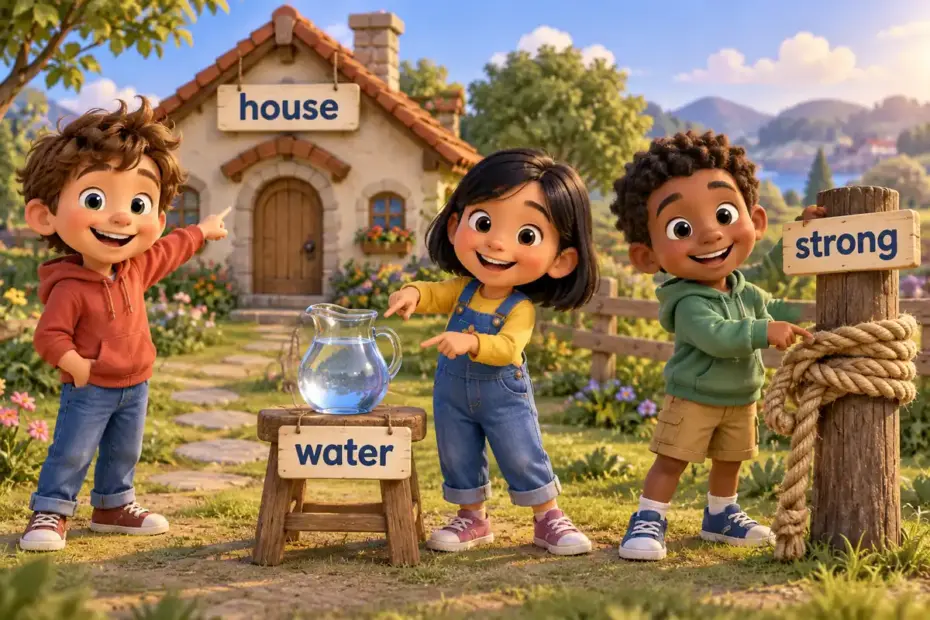
Old English vocabulary words are the words of the English spoken in England before about 1150, and many still sit inside modern English. Words such as house, water, strong, and friend come from that period. In “the house stands strong,” every word is Old English in origin.
Old English vocabulary words at a glance
- Old English vocabulary words are the core Germanic words of English before about 1150.
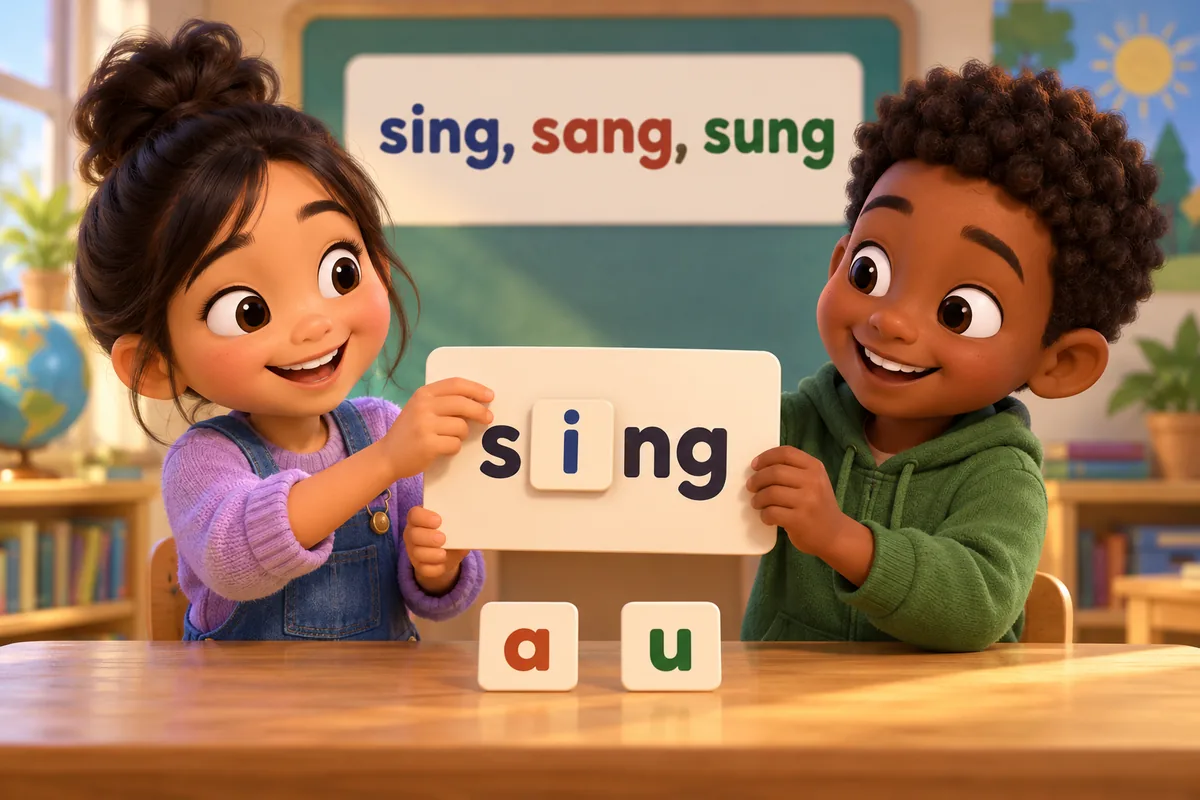
- They are short and concrete: house, bread, water, tree, run, sing.
- Most survivors are everyday nouns, verbs, and adjectives, not technical terms.
- Some changed meaning over centuries, so the modern sense can surprise you.
- The commonest error is calling any old-fashioned word an Old English word.
What does Old English vocabulary mean?
Old English vocabulary is the word stock of the earliest recorded stage of English, the Germanic language spoken in England before the Norman Conquest and for a century after it. A word belongs to that stock when its ancestry is Germanic rather than French, Latin, or a later borrowing.
| Layer | What it holds | Examples |
|---|---|---|
| Everyday things | basic nouns for home and nature | house, water, tree, bread |
| Body and family | words for people and kin | mother, father, hand, heart |
| Basic actions | common verbs | run, sing, sleep, build |
| Simple qualities | short adjectives | strong, cold, green, dear |
| Function words | pronouns and prepositions | I, you, the, with |
Calling a word Old English does not mean it is odd or remote. It means the word was already in the language more than nine centuries ago, and the everyday words above are the ones that never left. A word such as telephone or government, by contrast, entered English far later and from other sources, so it belongs to a completely different layer.
The same habit of naming a plain quality appears in the everyday list of adjectives for old, where describing age is the whole job.
How do you recognise an Old English word?
Three quick tests separate the oldest layer from later borrowings, and each test can be run on a single word without a dictionary.
| Test | What it asks | Example |
|---|---|---|
| Length | Is it one short syllable or two? | tree, water, cold |
| Sensory core | Does it name a body part, tool, or basic action? | hand, bread, sleep |
| Irregular plural | Does it keep an old plural such as -en or a vowel change? | oxen, feet, mice |
| Free-standing stress | Is the stress on the first syllable of a compound? | sunrise, doorway, farmland |
| Silent pair | Does a plainer twin exist beside a fancier word? | cow beside beef, pig beside pork |
None of the tests is proof on its own, but together they point the right way. A word that is short, concrete, and irregular is almost always old, while a long word that stays regular is usually a later arrival.
Old English vocabulary words across contexts
The surviving words show up in almost every register, which is why they feel invisible rather than historical.
| Context | Example sentence | Why this works |
|---|---|---|
| Classroom | The class listed the Old English words bread, water, and tree. | concrete nouns are easy to check |
| History essay | After the conquest, Old English kept the words for home and farm. | the core layer stayed in daily use |
| Poetry | The green wood sleeps under a cold moon. | short words carry a plain music |
| Everyday speech | Bring the bread and water to the table. | the oldest words fill ordinary needs |
| Language lesson | Strong and long both come from Old English. | adjectives show the layer clearly |
| Place names | The village name ends in -ton, an old element for a farm. | settlement names preserve old forms |
| Children’s book | The little children ran to the deep well. | basic verbs suit simple stories |
| Dictionary entry | The entry marks the word as Old English in origin. | origin notes join word to layer |
| Translation task | Every hand and heart in the hall was glad. | body words travel between languages |
| Word game | Name five Old English words for things in a kitchen. | the game tests the everyday layer |
| Academic writing | Core vocabulary survived despite heavy French borrowing. | the claim states a known pattern |
| Museum label | The tool kept its Old English name through the centuries. | objects and names age together |
A phrase built on this idea turns up in daily speech, as in the sentence examples for old fashioned in a sentence.
Which Old English words should you use today?
Most need no decision because they are already ordinary, but a few survive only inside fixed phrases, and those are where writers hesitate.
| Situation | Use freely | Keep to set phrases |
|---|---|---|
| Describing a home | house, door, roof | dwelling (a later borrowing) |
| Talking about food | bread, milk, apple | victuals (formal and rare) |
| Describing weather | cold, wind, rain | inclement (a Latin borrowing) |
| Everyday actions | run, eat, sleep | partake (formal and rare) |
| Fixed idioms | keep to “with might and main” | it rarely appears outside the phrase |
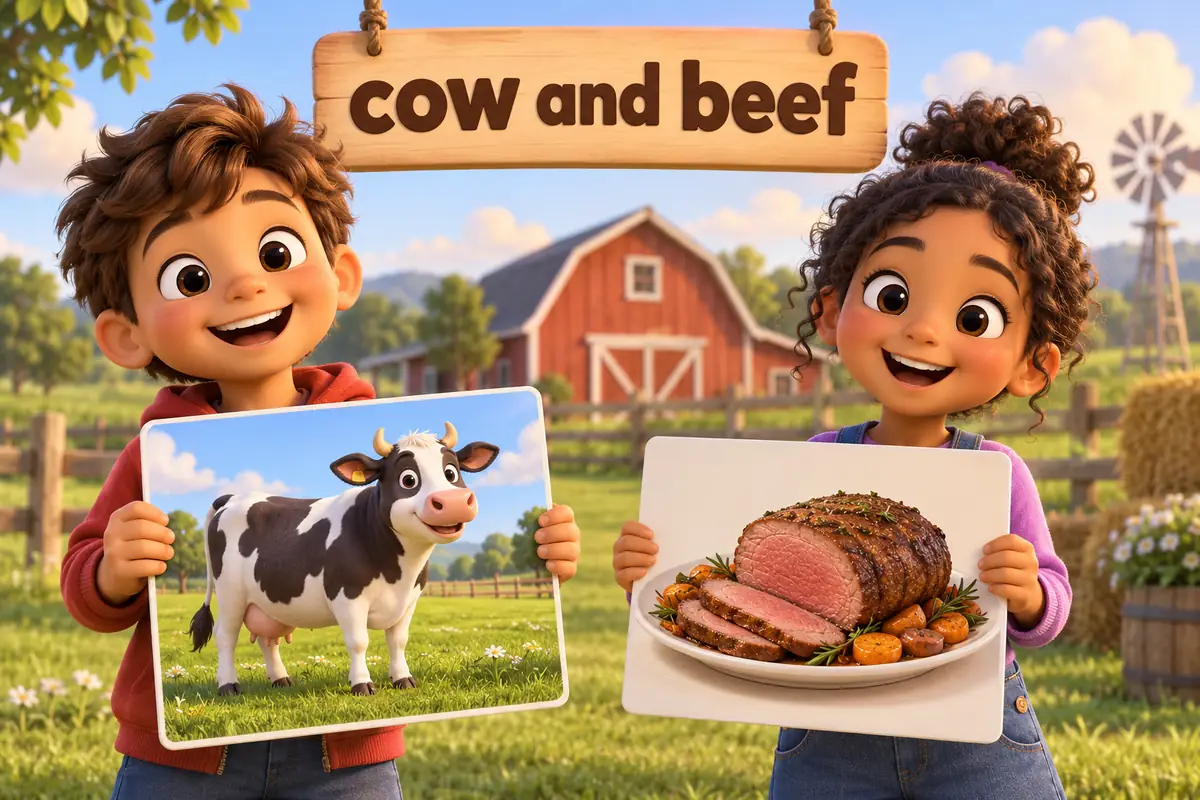
English also carries two labels for the same animal because of its history: the living animal kept its Old English name, and the cooked meat took a French one after the conquest. That single contrast is the easiest way to feel the layers. A learner who says the word cow and the word beef has already met both halves of the story.
Nostalgia rests on the same old words, and the examples for the good old days in a sentence show the mood in use.
For age that reaches back further still, the examples for as old as the hills in a sentence carry the idiom.
Word forms and grammar of Old English vocabulary
| Old English word | Modern form | Modern example |
|---|---|---|
| hus | house | They sold the house last spring. |
| wæter | water | The water boiled in the pot. |
| strang | strong | The rope was strong enough. |
| singan | sing | The choir will sing at dawn. |
| freond | friend | An old friend called today. |
| cu | cow | The cow stood in the field. |
| bréad | bread | She baked bread on Sunday. |
| feoh | fee, and the root of money words | The fee was small but fair. |
Old English used a fuller set of endings than modern English, so the same root could carry several shapes. The modern forms above are the descendants, not direct spellings, and the endings mostly disappeared as the language moved toward Middle English.
Common mistakes with Old English vocabulary words
Mistake 1: calling any ancient word Old English. Incorrect: Thou art is an Old English phrase. Correct: Thou art is Early Modern English. Rule: Old English ends around the twelfth century, long before Shakespeare.
Mistake 2: expecting Old English to read like modern English. Incorrect: Old English is easy once you know modern English. Correct: Old English needs study because its grammar and spelling differ greatly. Rule: it is a different stage of the language, not a style.
Mistake 3: assuming a meaning never changed. Incorrect: In Old English, silly meant foolish. Correct: In Old English, silly meant happy or blessed. Rule: meanings drift across centuries.
Mistake 4: crediting every core word to Old English. Incorrect: The pronoun they is Old English. Correct: They came into English from Old Norse. Rule: some very common words arrived from other Germanic sources.
Mistake 5: blending the three periods. Incorrect: Chaucer wrote in Old English. Correct: Chaucer wrote in Middle English. Rule: Old English comes first, then Middle English, then Modern English.
Practice using Old English vocabulary words
- Fill in the blank: The word water comes from ___ English.
- Choose the better word: Which pair shows an Old English animal name beside its French meat name, (cow / beef) or (tree / wood)?
- Correct the error: Chaucer wrote his poems in Old English.
- Build a sentence: use three Old English words to describe a plain meal.
- Spot the layer: which word is the later borrowing, (house) or (mansion)?
- Fill in the blank: The plural oxen keeps an old English ending, unlike the regular plural ___ .
Answers
- Old, because water belongs to the earliest Germanic layer.
- cow and beef, because the animal kept its Old English name and the meat took a French one.
- Chaucer wrote in Middle English; Old English had ended before his time.
- The bread and milk made a plain meal on the old table.
- mansion, because it came through French rather than Old English.
- cows, because the regular -s plural replaced the older -en in most words.
The bottom line
Old English vocabulary words are the short, concrete Germanic words that English has carried since before about 1150, and they still name the everyday world of home, body, food, and weather. Later French and Latin borrowings sit on top, which is why cow and beef, or house and mansion, describe the same thing at different depths. Recognise the old layer by its brevity, its irregular plurals, and its concrete sense, and use those words freely.
Frequently asked questions about Old English vocabulary words
Is Old English the same as Shakespeare’s English?
No. Shakespeare wrote in Early Modern English, the stage that followed Middle English. Old English is much older, ending around the twelfth century, and its grammar, endings, and spelling are far harder for a modern reader. The two are separated by about five hundred years.
How many modern words come from Old English?
The surviving core runs to thousands of items, and most of them are the commonest words in the language: the function words, the body parts, the family names, and the basic verbs. Frequency matters more than raw count, because these words appear in almost every sentence.
Why did Old English words survive while others vanished?
The words that survived were tied to daily life, so speakers kept using them whatever the ruling language was. After the Norman Conquest, French supplied many words for law, food, and fashion, while English kept its names for home and farm. Everyday need protected the oldest layer.
What are a few easy Old English words to learn first?
Start with house, water, bread, tree, mother, father, hand, and heart, then add verbs such as run, sing, sleep, and build. Each is short, concrete, and already common, so the learner can use them at once while noticing how old the layer is.