Old English words are the vocabulary of the language spoken before about 1150, and many of them still sit close to the modern forms, as hus stands near house and modor near mother. A large everyday group survived with a small change, while others were later replaced. The tables below list the common words and their modern relatives.
Old English words at a glance
- Many common words survive almost unchanged, such as hus for house.
- Some keep the same root but shift a vowel, as stan sits near stone.
- Old English nouns carried gender and case endings that modern English dropped.
- Several words were later replaced by borrowings from French and Latin.
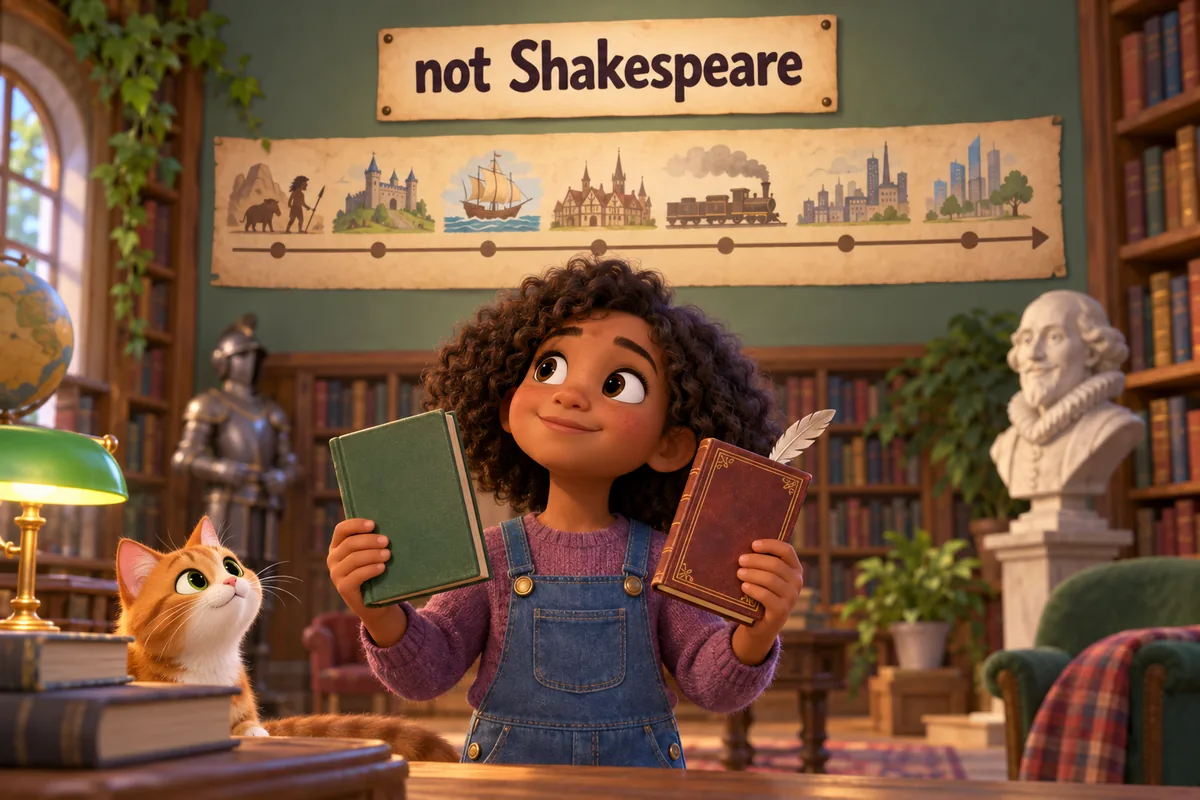
- The commonest error is calling the English of Shakespeare Old English.
What are Old English words?
Old English words are the nouns, verbs and adjectives of the earliest recorded English, and the everyday core of that vocabulary is still recognisable today. The describing words for anything distant appear in adjectives for old, and the table pairs common words with their modern relatives.
| Word | Meaning | Modern relative |
|---|---|---|
| hus | house | house |
| modor | mother | mother |
| faeder | father | father |
| braed | bread | bread |
| waeter | water | water |
| sunne | sun | sun |
| mona | moon | moon |
| freond | friend | friend |
| lufu | love | love |
| heorte | heart | heart |
| nama | name | name |
| god | good | good |
The list is short on purpose, because the point is the pattern rather than a full dictionary. A reader who learns ten of these words can often recognise twenty more by sound and shape.
Most of these words belong to the oldest layer of the language, and a reader can often hear the modern form behind the older spelling. The small shifts, such as the vowel in stan, are regular enough to make the whole group easier to read than a first glance suggests.
How did the words change over time?
The changes follow a few clear routes: a small vowel shift, a dropped ending, or a later borrowing that pushed an older word aside. A form that has fallen out of everyday speech is often called old-fashioned in a sentence.
| Pattern | Example | What it signals |
|---|---|---|
| nearly unchanged | hus and house | the word survived with a small shift |
| shared root | modor and mother | the same core across the stages |
| changed vowel | stan and stone | a vowel shifted over time |
| dropped ending | nama and name | a final ending was lost |
| compound of two nouns | hlaford, meaning lord | two ideas joined into one word |
| later borrowing | a French word after 1066 | contact added new vocabulary |
A borrowing often replaced an older word for the same idea, which is why some common modern nouns have no direct Old English ancestor. The words that survived tend to be the ones used by everyone every day.
Old English words across contexts
The vocabulary appears in history lessons, translation tasks and language study, and each setting asks for a different level of detail. A later idiom that leans on the same word appears in good old days in a sentence.
| Context | Example sentence | Why this works |
|---|---|---|
| History lesson | The word hus means house in the oldest texts. | states a plain meaning |
| Translation task | Turn braed into its modern form. | asks for the match |
| Language blog | Modor and mother share the same root. | shows a close pair |
| Glossary | Heorte means heart and keeps its shape. | defines the word and its form |
| Story | The freond greeted the traveller at the gate. | uses the word in a scene |
| Classroom | Old English nouns carried case endings. | marks a grammar point |
| Exam question | Give the Old English word for water. | asks for one form |
| Word study | Sunne and sun differ by a single ending. | pairs old and new |
| Poetry | He named the mona over the still water. | uses the word in verse |
| Conversation | Lufu sounds close to the modern word love. | notes the pair by ear |
Which word should you use?
The choice turns on the period of the sentence. A history text uses the older form, while a modern paragraph uses the present word. A phrase about great age appears in as old as the hills in a sentence.
| Situation | Better choice | Why |
|---|---|---|
| A modern sentence | the present word, such as house | the modern form fits the period |
| A history text | the older form, such as hus | the older form matches the topic |
| A translation task | the exact older form | the exercise wants the historical word |
| A word study | both forms together | the pair shows the change |
| A creative passage | the older form in moderation | too many old words become hard to read |
| A formal report | the modern form | the older word would sound out of place |
A writer who wants the flavour of the older stage can borrow one or two words, but a page of them slows the reader. The safer habit is to keep the modern word as the base and add an older form only where the subject calls for it.
Word forms and grammar of the old words
The words behave differently from their modern relatives, because the earlier stage marked gender and case. A related modern idiom sits in old boy network in a sentence.
| Form | Part of speech | Example |
|---|---|---|
| hus | neuter noun | hus means house |
| modor | feminine noun | modor means mother |
| nama | weak noun | nama means name |
| god | adjective | god means good |
| lufu | abstract noun | lufu means love |
| -e ending | inflection | sunne keeps a final e |
| case ending | inflection | a noun changes with its job in the sentence |
Common mistakes with the old words
Mistake 1: calling the English of Shakespeare Old English. Incorrect: Shakespeare wrote in Old English. Correct: Shakespeare wrote in early modern English. Rule: Old English is the earlier stage, before about 1150.
Mistake 2: using an old spelling in a modern sentence. Incorrect: He stepped into his hus. Correct: He stepped into his house. Rule: the older spelling belongs to the older stage.
Mistake 3: assuming every modern word is Old English. Incorrect: The word television is Old English. Correct: Television is a modern coinage. Rule: many everyday words are modern or later borrowings.
Mistake 4: reading an old word with a modern vowel. Incorrect: stan read to rhyme with modern can. Correct: stan with the a of father. Rule: the older vowels keep their Latin values.
Mistake 5: dropping the final ending. Incorrect: writing sunn for sunne. Correct: sunne with its final e. Rule: the ending is part of the recorded form.
Practice using the old words
- Fill in the blank: The Old English word for water is ___.
- Choose the better word: In a modern sentence, use (hus / house).
- Correct the error: Shakespeare wrote in Old English.
- Build a sentence: use freond about a welcome.
- Spot the register: which suits a history text, (a) the house, or (b) the hus?
- Fill in the blank: The Old English word lufu means ___.
Answers
- waeter, because it is the recorded form for water.
- house, because a modern sentence uses the present word.
- Shakespeare wrote in early modern English; Old English is much earlier.
- The freond welcomed the traveller with a warm greeting.
- (b), because a history text matches the older form.
- love, because lufu is the Old English word for love.
The bottom line
Old English words are the everyday core of the earliest English, and many survive with only a small change, as hus sits near house and modor near mother. The nouns once carried gender and case endings, and some old words were later replaced by borrowings from French and Latin. Use the older form in history and study, and the modern word everywhere else.
Frequently asked questions about the old words
Which Old English words are still in use?
Everyday words for family, nature and the body survived well, so mother, father, water, sun, moon, heart and friend all have close Old English ancestors. Many basic verbs and the commonest nouns of daily life belong to this group, which is why the older stage often feels familiar.
Is Old English the same as the English of Shakespeare?
No. Old English is the earliest stage, spoken before about 1150, with a heavy system of endings. The English of Shakespeare belongs to a much later period and is close to modern speech. The two stages share many roots but read very differently.
Do most modern English words come from Old English?
No. The everyday core is largely Old English, but a very large share of the modern vocabulary was borrowed later, especially from French and Latin. That is why a plain sentence often uses old roots while a technical or formal text leans on later borrowings.
How do you spell Old English words today?
Modern editions use a few special letters, such as ash and the two letters for the th sound, and they often add a small mark for a long vowel. A simplified spelling such as hus or modor is fine for study, as long as the reader knows it is a modern convention.