How to Use Omission in a Sentence
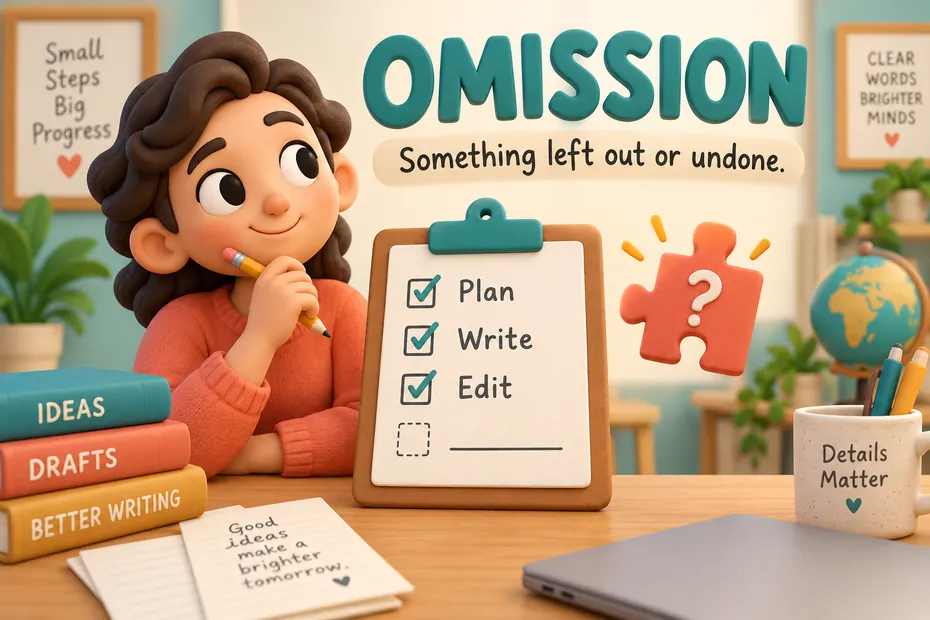
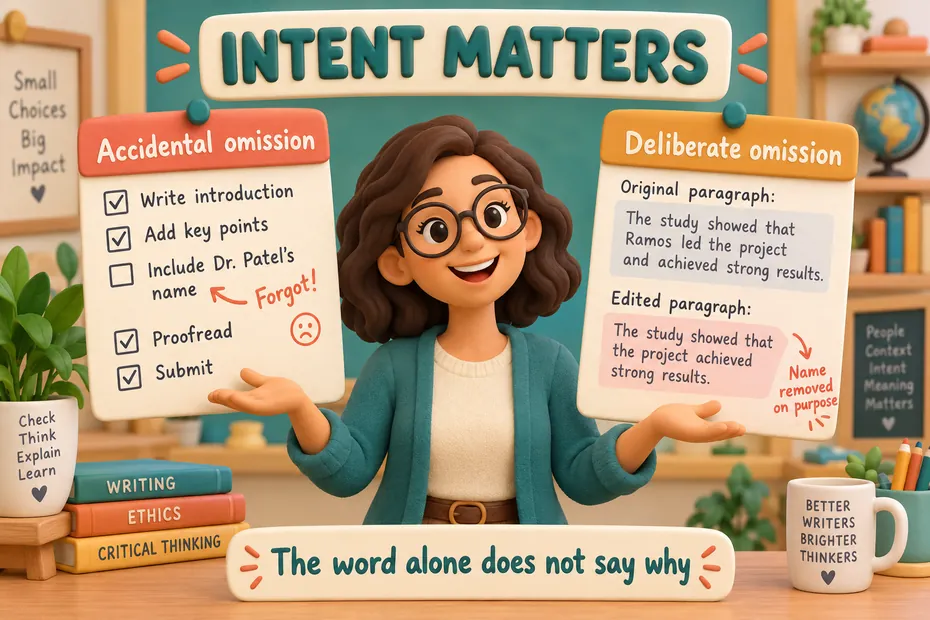
Omission is a noun meaning something left out or left undone, or the act of leaving it out. For example, “The omission of the date made the invitation confusing.” An omission can be accidental or deliberate; the word alone does not tell you why the information is missing.
Omission Is Not Always Intentional
Clarification for the introduction below: Omission is broader than intentional editing. A writer may deliberately leave out an unnecessary detail, but someone may also forget a name or fail to include a required date. Merriam-Webster’s entry covers something neglected or left undone as well as the act of omitting. Add an adjective when intention matters.
| Phrase | Original example | Meaning |
|---|---|---|
| Accidental omission | An accidental omission left Priya’s name off the invitation. | The missing item was not intentionally excluded. |
| Deliberate omission | The editor explained the deliberate omission of a repeated paragraph. | The item was intentionally left out. |
| Significant omission | The missing deadline was a significant omission. | The missing information mattered. |
| Omission from | His omission from the guest list surprised us. | The person was not included in that list. |
Clear Omission Sentences for Children
Clarification for the original children’s section: Its sentences about cats, fruit, and homework do not actually use omission. They also do not establish that any information has been omitted. For practice using the vocabulary word itself, use the new examples here instead. Each sentence names a missing item or the act of leaving something out.
- The omission of my name meant I did not get a badge.
- We fixed an omission in the class list.
- The omission of the time confused the guests.
- A quick check helped Mia find the omission.
- The missing picture was an omission in the booklet.
- Our teacher asked us to correct two omissions.
- The omission was accidental, so we added the name.
To check understanding, ask “What was left out?” after each example. In the first sentence, the missing item is a name. In the third, it is a time. If a sentence merely contains a shortened expression, it may illustrate a different kind of grammatical omission, but it does not necessarily teach how to use the noun omission.
Omission Of, Omission From, and Omission In
Use omission of to name the item left out: “The omission of the address caused confusion.” Use omission from to identify the source that lacks an item: “The address’s omission from the invitation caused confusion.” Both sentences describe the same missing information but arrange the details differently.
Use an omission in when locating a gap in a document: “We found an omission in the instructions.” You can then explain the missing detail in the next sentence. This pattern is useful when you want to discuss the problem before identifying its cause. Avoid leaving the reader with “There was an omission” when the missing item is important.
Omit, Omitted, and Omission
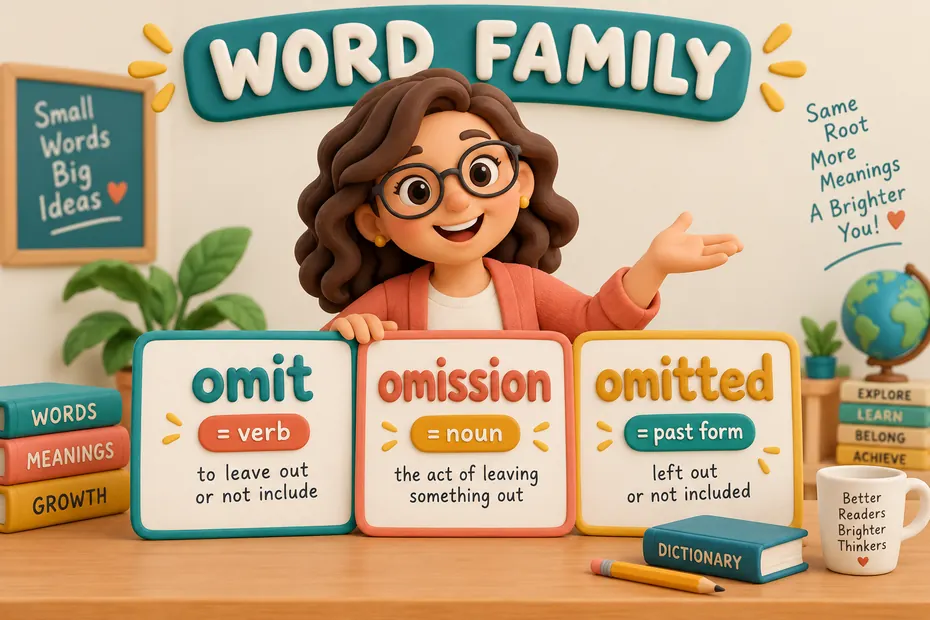
Omit is the verb: “Please do not omit the date.” Omitted is its past-tense and past-participle form: “I omitted the date,” or “The date was omitted.” Omission is the noun: “The omission of the date was a mistake.” Choose the form according to the sentence’s grammar.
The spelling changes deserve attention: omit has one t, while omitted and omitting have two. The noun is omission, with two s letters. “Ommision” and “omision” are misspellings. A word-family comparison is more useful than memorizing a sentence that happens to contain an unrelated form.
Omission Compared with an Error of Commission
In the expression errors of omission and commission, omission concerns something not done, while commission concerns something done. An incomplete list may contain an error of omission because a required item is missing. An incorrect addition may be an error of commission because someone inserted something that should not be there.
Keep this contrast within its context. Commission has other ordinary meanings, including a fee or a group appointed to perform a task. It is not simply the everyday opposite of omission in every sentence. For a school explanation, “leaving something out” and “adding something incorrectly” are often clearer than the formal pair.
How to Write a More Useful Omission Example
Name the missing detail, identify where it should have appeared, and explain the consequence if that consequence matters. Compare “The report had an omission” with “The omission of the survey date made the report difficult to interpret.” The second sentence lets readers understand the actual problem without assuming bad intentions.
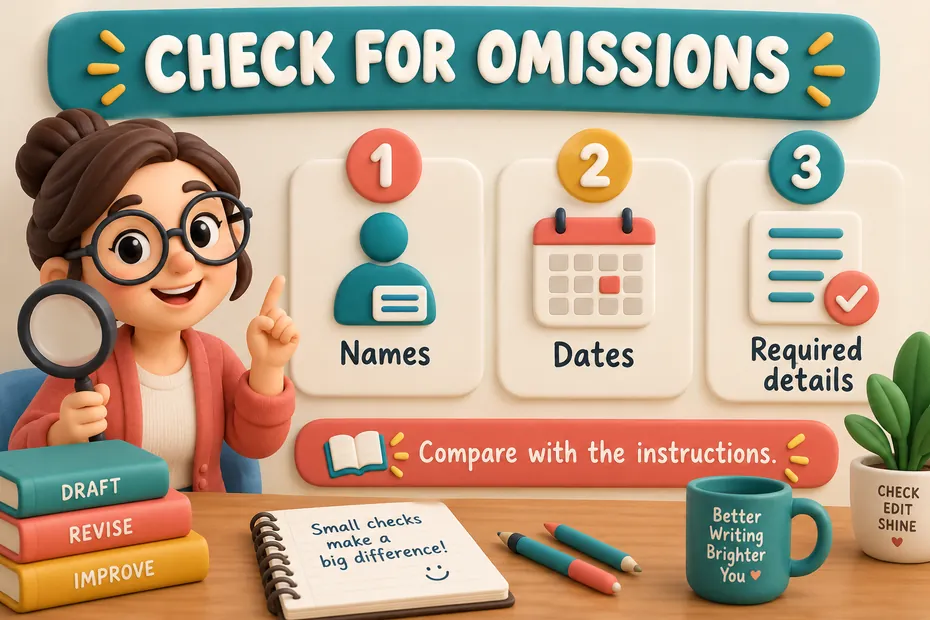
For proofreading practice, compare a document against its instructions or a checklist. Look for required names, dates, sources, and steps. A sentence can be grammatically correct yet still omit necessary information. Do not call every short sentence an omission; brevity is only a problem when the missing material is needed.
Frequently Asked Questions
What is a simple sentence with omission?
“The omission of the date confused the guests” is a clear example. Omission names the missing information, and “of the date” identifies it. For a shorter example, write “We corrected an omission.” Add context afterward if the reader needs to know what was left out.
Does omission mean someone forgot something?
Sometimes, but not always. An accidental omission may result from forgetting; a deliberate omission results from a choice to leave something out. The noun itself does not establish intention. Words such as accidental, deliberate, unexplained, and significant help readers understand what you mean without guessing.
What is the plural of omission?
The plural is omissions: “The checklist helped us find three omissions.” Use a plural when counting separate missing items or failures to include them. If you describe the act as a whole, singular omission may fit: “The omission of several names delayed the event.”
Is omission the same as deletion?
They can overlap, but they emphasize different things. Omission concerns what is absent or left out. Deletion commonly describes removing something that was included. A forgotten name can be an omission without being a deletion, because it may never have appeared in the document in the first place.
Dictionary Sources
Have you ever wondered what the term “omission” means in writing? In simple terms, omission refers to the action of leaving something out or not including it.
When we talk about omission in writing, we are referring to the intentional exclusion of certain elements or details from a piece of text. This can be done for various reasons such as brevity, clarity, or emphasis on other important information.
7 Examples Of Omission Used In a Sentence For Kids
- The cat caught the mouse and ate it.
- I like to eat apples, bananas, and grapes.
- The sun is hot on a sunny day.
- The dog wants to go walk in the park.
- I like to play games with my friends.
- The bird sings a sweet song in the morning.
- The teacher gives us homework to do.
14 Sentences with Omission Examples
- Omission of key points in an essay can result in a lower grade.
- It is important to check your work for any omissions before submitting it.
- Make sure to avoid omitting important information in your presentations.
- The professor noted an omission of references in the research paper.
- Omissions in your bibliography can lead to accusations of plagiarism.
- Always double-check your assignments to catch any omitted details.
- The student received feedback about the omission of a conclusion in their report.
- A common mistake when taking notes is omitting essential details.
- The group project suffered due to the omission of one member’s contributions.
- PowerPoint slides should be concise to prevent omissions of critical information.
- The student’s grade was affected by their omission of important dates in their timeline.
- Revising your notes regularly can help prevent omissions during exams.
- Avoid omitting necessary evidence to support your arguments in essays.
- The panel discussion highlighted the omission of a particular perspective in the debate.
How To Use Omission in Sentences?
To use Omission effectively in a sentence, start by identifying the unnecessary or repetitive words in your sentence. Omission is the act of leaving out or excluding certain words to make the sentence more concise and clear without changing its original meaning.
Remember to pay attention to articles (a, an, the), pronouns (he, she, it), and auxiliary verbs (is, am, are) as these are often good candidates for omission. For example, instead of saying “I am going to the store,” you could simply say “Going to the store.”
Another key aspect of using Omission is maintaining the coherence and clarity of your sentence. Make sure that after removing certain words, the sentence still conveys the intended message and does not become confusing.
Practice using Omission by writing sentences and then trying to condense them by removing unnecessary words. This will help you get a feel for which words are essential for the sentence’s meaning and which ones can be omitted.
In summary, using Omission in a sentence requires identifying and removing unnecessary words while ensuring that the sentence remains coherent and clear. With practice, you will become more comfortable with this technique and be able to create more concise and effective sentences.
Conclusion
In conclusion, sentences with omission are common in language and can be found in various forms, such as ellipses, acronyms, and shortened phrases. Omission allows for brevity and clarity in communication by eliminating unnecessary words or information. It is a useful tool in writing to convey information efficiently while maintaining readability.
By understanding and using sentences with omission effectively, writers can enhance the flow of their writing and make their communication more concise and impactful. Whether it’s omitting words for stylistic purposes or to streamline information, mastering the art of omission in sentences can improve the overall quality of written work.