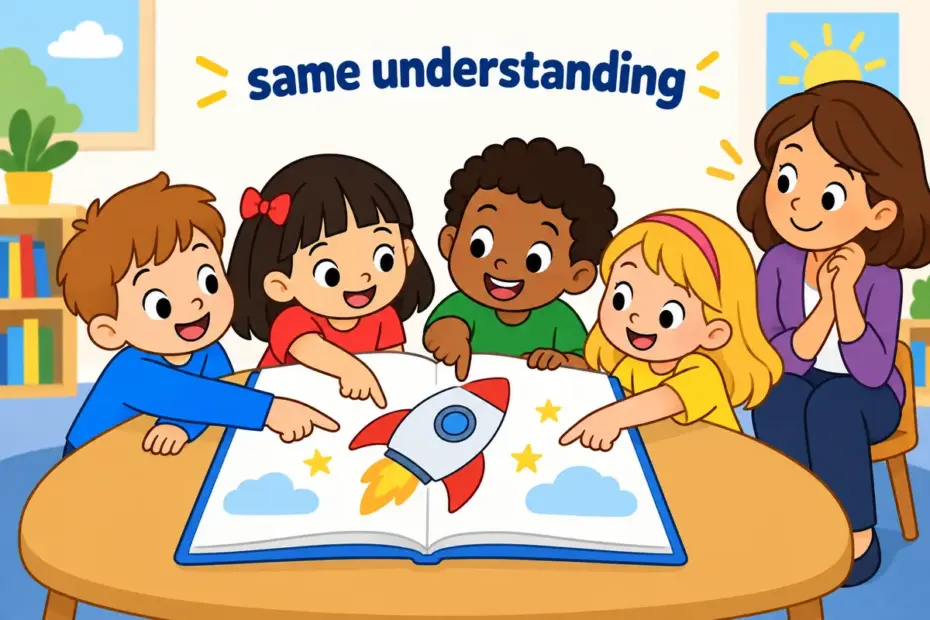
On the same page is an idiom meaning in agreement, or sharing the same understanding of a plan or problem. In a sentence it follows be, get or keep and a plural subject: “we are on the same page about the budget”. It describes shared understanding between people, not personal friendship or liking.
On the same page at a glance
- On the same page is a fixed idiom; the noun page is never plural and never changes.
- The verb in front of it varies: be on the same page, get someone on the same page, keep someone on the same page.
- It usually needs at least two parties, so the subject is we, they, the team or two named people.
- The topic follows about or on, and the other party follows as: on the same page as the chair.
- The negation not on the same page is a polite way to name a disagreement.
- The commonest error is swapping on for in, as in we are in the same page.
What does on the same page mean?
On the same page is an idiom meaning that two or more people share the same understanding or plan. The Cambridge entry for on the same page records the sense of agreeing about something, and the phrase always concerns information rather than affection. A sentence such as “the two leads are on the same page about the schedule” reports shared knowledge, not warmth. Where the agreement is fully settled and formal, agreement or in agreement is the plainer choice, because the idiom sounds casual.
| Sense | Plain meaning | Example sentence |
|---|---|---|
| Shared understanding | Everyone holds the same picture of a plan | We are on the same page about the brief. |
| Mutual agreement | People formally accept the same position | The two sides are on the same page at last. |
| Ongoing alignment | People are kept informed and aligned | A weekly note keeps us on the same page. |
One honest limitation is worth stating. On the same page is heavily used in business writing, and in a report or an essay it can sound like a cliche. The noun also cannot be extended: you cannot be on the same pages, and you cannot be on the same page of a document in this sense. Where the tone must stay formal, write in agreement instead.
How do you use on the same page in a sentence?
The idiom is fixed, so the variation sits in the verb and the prepositions around it. Be states the shared understanding, get creates it, and keep maintains it. About or on introduces the topic, and as introduces the other party. The six patterns below cover almost every real sentence.
| Pattern | Example | What it signals |
|---|---|---|
| be on the same page about + topic | We are on the same page about the schedule. | Shared understanding of a plan. |
| get + people + on the same page | The briefing got the whole team on the same page. | The act of aligning people. |
| keep + people + on the same page | Weekly notes keep the editors on the same page. | Ongoing alignment over time. |
| on the same page as + person | I am on the same page as the finance lead. | Names who shares the view. |
| not on the same page | We are not on the same page on pricing. | A polite way to name a gap. |
| be on the same page that + clause | The group was on the same page that the launch should wait. | A shared conclusion, stated fully. |
Where the subject agrees only partly, the idiom can be softened: the editors are on the same page about the method but not the sample. That partial use is one of the phrase’s real strengths, because plain agree sounds more total.
On the same page in a sentence: examples across contexts
On the same page changes register more than it changes meaning. The twelve sentences below keep the same idiom while moving from a classroom to a negotiation, and each one shows who shares the understanding and what it concerns.
| Context | Example sentence | Why this works |
|---|---|---|
| Classroom | The group got on the same page about the poster design before lunch. | Everyday shared planning among pupils. |
| Workplace email | Let us make sure we are on the same page about the deadline. | A polite check before the work begins. |
| Meeting | The chair spent ten minutes getting everyone on the same page. | The phrase names the purpose of the meeting. |
| News report | Negotiators said they were not yet on the same page. | A diplomatic way to report a gap. |
| Sports | The coach and captain are on the same page about tactics. | A shared plan inside a team. |
| Parent and teacher | The teacher and the family were on the same page about reading. | Agreement on a shared goal. |
| Project update | A short note keeps both offices on the same page. | Ongoing alignment across sites. |
| Conversation | Are we on the same page, or did I miss something? | A gentle check for understanding. |
| Academic prose | The authors are on the same page about the method but not the sample. | Partial agreement, stated precisely. |
| Political writing | The two parties are finally on the same page over the bill. | Public agreement after open conflict. |
| Customer service | The agent made sure the customer and the depot were on the same page. | Confirms a shared understanding was reached. |
| Editorial | The style guide keeps contributors on the same page. | Agreement on shared standards. |
Only two of the sentences name the topic with about; the rest rely on context, which is normal for an idiom this familiar.
On the same page vs aligned, unanimous and in agreement
On the same page overlaps with three more formal phrases and is interchangeable with none. aligned stresses shared direction, unanimous means every vote agrees, and in agreement is the neutral equivalent that suits formal prose.
| Attribute | on the same page | aligned | unanimous |
|---|---|---|---|
| Core meaning | Sharing one understanding | Moving in the same direction | Every person agrees |
| Strength | Informally shared view | Strategic agreement | Complete agreement |
| Typical subject | Teams, families, negotiators | Plans, teams and systems | Juries, committees and votes |
| Focus | Understanding | Direction | Count and completeness |
| Register | Conversational and business | Business and formal | Formal |
Verdict: choose on the same page for everyday shared understanding, aligned for strategy, and unanimous when every member agrees. For formal prose, in agreement does the same work without the corporate flavour. Where the two sides openly clash, disagree and conflict name the opposite.
Word forms and grammar of on the same page
The idiom is fixed, so what varies is the verb and the prepositions, never the noun. The table shows the forms that occur in real writing and the one that never does, so a learner can see exactly what may change.
| Form | Part of speech | Example |
|---|---|---|
| be on the same page | core idiom | We are on the same page. |
| get someone on the same page | verb variation | Get the interns on the same page. |
| keep someone on the same page | verb variation | Keep the team on the same page. |
| on the same page as | comparison | She is on the same page as the chair. |
| on the same page about | topic marker | They are on the same page about costs. |
| on the same pages | not standard | The idiom is never pluralised. |
Keep page singular in every version; the plural changes the idiom back into a literal statement about paper.
Common mistakes with on the same page
- Incorrect:
We are in the same page.Correct: We are on the same page. Rule: the idiom uses on, never in. - Incorrect:
We are on the same page of the plan.Correct: We are on the same page about the plan. Rule: the idiom is fixed, so page is not followed by of. - Incorrect:
I am on the same paper as you.Correct: I am on the same page as you. Rule: the noun in the idiom is page. - Incorrect:
The team is on the same pages.Correct: The team is on the same page. Rule: the phrase is never pluralised. - Incorrect:
He is on the same page for me.Correct: He is on the same page as me. Rule: use as to name the other person, not for.
Practice using on the same page
Work through the six items, then read the reasoning beside each answer rather than only the key.
- Fill the gap: A five-minute call got the two branches ______ before the launch.
- Choose the better phrase: Before we start, (are we on the same page / are we in the same page) about who calls the client?
- Correct the error: The designers are on the same page of the new logo.
- Build a sentence: use not on the same page about a delivery date.
- Spot the register: which belongs in a formal report — The departments are in agreement on the target, or the departments are on the same page, big time?
- Rewrite without the cliche: We are on the same page about the budget. Replace the idiom with a formal phrase.
Answers
- on the same page — the idiom uses on and keeps page singular.
- are we on the same page — the idiom takes on, not in.
- The designers are on the same page about the new logo — the idiom is fixed and takes about, not of.
- Model answer: We are not on the same page about the delivery date.
- The departments are in agreement on the target — a report avoids the casual idiom.
- We agree on the budget — agree states the same thing in formal, neutral English.
The bottom line
Use on the same page in a sentence when you mean that people share the same understanding of a plan or problem, and let the verb show whether that understanding is stated, created or kept. The two nuances worth keeping are these: the noun page never changes, and the idiom is casual enough that formal writing should prefer in agreement. Its opposite is being at odds, which disagree states plainly.
Frequently asked questions about on the same page
Is on the same page formal?
It is informal to neutral and very common in business writing, which is exactly why it can sound like a cliche in a report. In academic, legal or formal prose, in agreement or aligned is usually safer. The idiom is fine in an email, a meeting or a blog post, and it rarely causes confusion.
Do you say on the same page or in the same page?
On is correct: we are on the same page. In is a common learner error and suggests a literal sheet of paper rather than shared understanding. The preposition is part of the fixed idiom, so it never changes. Think of two people looking at the same page of one book.
Can on the same page be used about one person?
The idiom needs at least two parties to share the understanding, so the subject is usually we, they or two named people. It can name one person when a second is supplied with as: I am on the same page as my manager. A singular subject alone, as in I am on the same page, has no clear second party.
Why is on the same page considered a cliche?
Because it spread through office writing until it appeared in almost every planning email, where a plain word such as agree or aligned would say the same thing. The idiom is still useful in speech, but in a report it can look like filler. Reserve it for casual contexts and use in agreement in formal ones.