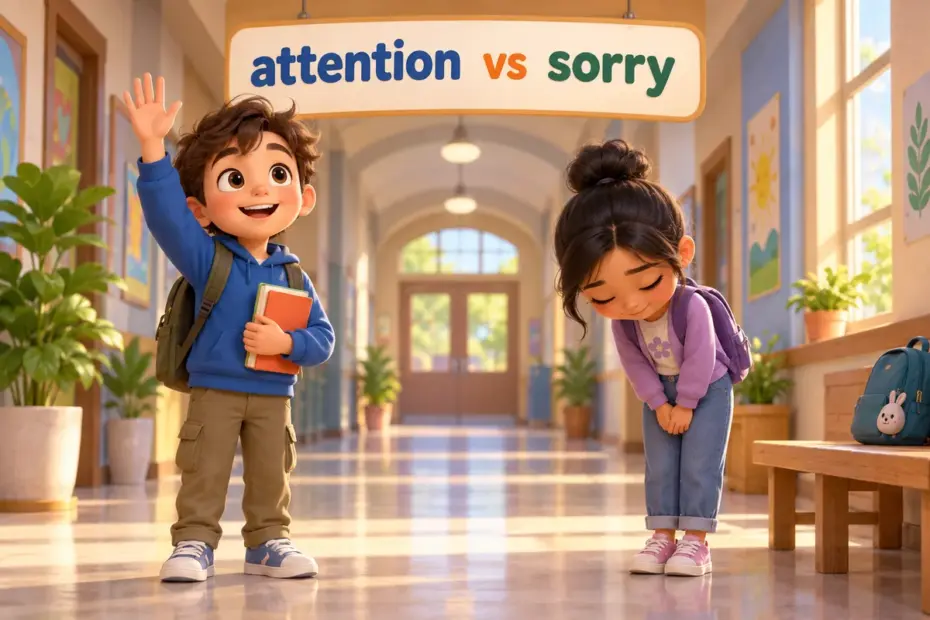
Pardon me vs excuse me are both polite openers, but they do different work. Excuse me gets attention, asks someone to move, or covers a small interruption, while pardon me apologises for a blunder or asks someone to repeat a remark. Choose excuse me for everyday contact and pardon me for formality and repetition.
Pardon Me vs Excuse Me at a glance
- Both are fixed politeness phrases rather than ordinary questions.
- Excuse me gets attention or asks someone to step aside.
- Excuse me also covers leaving, interrupting, or a small mistake.
- Pardon me apologises for a minor blunder such as a cough or a slip.
- Pardon, spoken alone, asks a speaker to repeat something and sounds slightly formal.
What does excuse me mean and what does pardon me mean?
Excuse me is a fixed phrase used to get attention, to ask someone to move, or to cover a small interruption. Pardon me is a fixed phrase used to apologise for a small fault or to ask for a repetition. The Cambridge entry for excuse and the Cambridge entry for pardon show the two words behind the phrases, and one line shows the split: excuse me, is this seat taken, but pardon me for the noise.
| Phrase | Function | Plain meaning | Example |
|---|---|---|---|
| excuse me | Attention | Get someone’s attention politely | Excuse me, is this seat taken? |
| excuse me | Small apology | Cover a minor fault | Excuse me for interrupting your call. |
| excuse me | Request to pass | Ask someone to move | Excuse me, may I get past? |
| pardon me | Small apology | Cover a blunder | Pardon me for the late reply. |
| pardon me | Repetition | Ask someone to repeat | Pardon me, could you say that again? |
| pardon (alone) | Repetition, brief | Ask again, more briefly | Pardon? I missed that. |
The two phrases overlap only at the edges. Excuse me handles most everyday contact, while pardon me leans formal and turns up in apologies and requests to repeat. The single word pardon drops the pronoun and acts as a quick request for repetition.
What is the difference between excuse me and pardon me?
The difference is the job the phrase does and the register it carries. Excuse me is the everyday all-purpose opener for attention, movement and small interruptions, while pardon me is a slightly formal apology or a request to repeat. A near-miss pair such as addition vs edition fails in a similar way, and a one-letter trap such as abel vs able shows how small marks change meaning.
| Test | Excuse me | Pardon me |
|---|---|---|
| Main job | attention and passing | apology and repetition |
| Register | everyday and neutral | slightly formal |
| Sentence position | opens a request | opens an apology |
| Common partner | Excuse me, could you … | Pardon me for … |
| Poorest fit | a serious fault | a crowded train aisle |
| Frequency in speech | very common | less common |
Choose excuse me to open a request or to move through a crowd, and choose pardon me to apologise roundly or to ask someone to repeat a remark.
How do you use excuse me and pardon me in a sentence?
Both phrases follow fixed patterns, and the words that follow them are a faster test than the meaning. To watch the base word behave, read excuse in a sentence.
| Pattern | Example | What it signals |
|---|---|---|
| Excuse me, + question | Excuse me, where is the station? | getting attention |
| Excuse me, + request | Excuse me, could you move? | a polite request |
| Excuse me for + noun or -ing | Excuse me for asking. | a small apology |
| Excuse me, + a moment | Excuse me a moment. | a brief departure |
| Pardon me for + noun or -ing | Pardon me for the noise. | a formal apology |
| Pardon me, + question | Pardon me, what did you say? | a request to repeat |
| Pardon? (alone) | Pardon? | asking again, briefly |

Excuse me and pardon me in a sentence: examples across contexts
Reading the pair in different registers makes the choice automatic, and more polite openers sit in excuse me in everyday sentences.
| Context | Example sentence | Why this works |
|---|---|---|
| Classroom | Excuse me, may I borrow a ruler? | attention from a teacher |
| Crowded bus | Excuse me, may I get past, please? | a request to move |
| Restaurant | Excuse me, could we have the bill? | calling a server politely |
| Office | Pardon me for the late reply to your message. | a slightly formal apology |
| Telephone | Pardon me, I did not catch the last part. | a request to repeat |
| Formal dinner | Pardon me for a moment; I will be right back. | a courteous departure |
| Meeting | Excuse me for interrupting, but the time is up. | a small, in-the-moment apology |
| Shop | Excuse me, do you sell envelopes? | attracting staff attention |
| Corridor | Pardon me for the bump; the bag was heavier than I thought. | a covered small blunder |
| Family table | Pardon me for reaching across the plate. | a minor breach of manners |
| Conference | Pardon me, would you mind repeating the question? | a formal request to repeat |
| Lift | Excuse me, this is my floor; may I step out? | a polite movement request |
Which should you use?
Match the phrase to the moment: everyday contact and movement take excuse me, and a rounded apology or a request to repeat takes pardon me.
| Situation | Use | Example |
|---|---|---|
| Getting a stranger’s attention | excuse me | Excuse me, you dropped your scarf. |
| Apologising for a small slip | pardon me | Pardon me for the mistake. |
| Asking someone to step aside | excuse me | Excuse me, may I pass? |
| Asking a speaker to repeat | pardon me | Pardon me, could you repeat that? |
Register is the second test. Excuse me belongs to every setting from a market stall to a boardroom, and it never sounds out of place. Pardon me sounds a touch more formal and slightly older, so it suits apologies at a distance, in letters, or in careful speech. When a fault is serious rather than small, reach for a full apology such as I am sorry, because neither short phrase carries enough weight.
Word forms and grammar of excuse and pardon
| Form | Part of speech | Example |
|---|---|---|
| excuse me | fixed phrase | Excuse me, please. |
| pardon me | fixed phrase | Pardon me for the mistake. |
| pardon | verb | The governor may pardon a prisoner. |
| pardon | noun | She asked the court for a pardon. |
| excusable | adjective | The delay was excusable. |
| inexcusable | adjective | The rudeness was inexcusable. |
| pardon? (alone) | one word | Pardon? |
Common mistakes with excuse me and pardon me
Mistake 1: splitting the phrase. Incorrect: Excuse I, may I pass? Correct: Excuse me, may I pass? Rule: the politeness phrase is the fixed pair excuse me, so do not break it apart.
Mistake 2: pardon alone for attention. Incorrect: Pardon, could you help me find the lift? Correct: Excuse me, could you help me find the lift? Rule: to get attention, use excuse me; pardon alone asks for a repetition.
Mistake 3: a missing pronoun. Incorrect: Pardon for the interruption. Correct: Pardon me for the interruption. Rule: the apology phrase needs me to form pardon me.
Mistake 4: a short phrase for a serious fault. Incorrect: Excuse me for the delay; the project is a month late. Correct: I am sorry for the delay; the project is a month late. Rule: excuse me covers small, in-the-moment slips, not serious ones.
Mistake 5: the verb pardon without agreement. Incorrect: She pardon the prisoner. Correct: She pardoned the prisoner. Rule: as a verb, pardon means to forgive officially and must agree with its subject.
Practice using excuse me and pardon me
- Fill in the blank: ___, is this the queue for tickets?
- Choose the better phrase: ___ for the noise from the road outside.
- Correct the error: Pardon, could you tell me where the bank is?
- Build a sentence: use pardon me for to apologise for a late answer.
- Spot the register: which line suits a formal letter, (a) Hey, say that again, or (b) Pardon me, would you repeat the figure?
- Fill in the blank: ___, I did not hear the last word.
Answers
- Excuse me, because the phrase is asking for attention.
- Pardon me, because it covers a small fault with a formal tone.
- Excuse me, could you tell me where the bank is? Pardon alone asks for repetition, not directions.
- Pardon me for the late answer to your letter.
- (b), because pardon me and its formal phrasing suit a letter.
- Pardon? or Pardon me; both ask the speaker to repeat.

The bottom line
The pardon me vs excuse me choice turns on the moment and the register. Excuse me opens everyday requests, gets attention and asks people to move, while pardon me apologises for a small slip or asks for a repetition. Reach for the fuller apology when a fault is serious, because neither short phrase carries that weight.
Frequently asked questions about pardon me and excuse me
Is pardon me old-fashioned?
Pardon me sounds a little older and more formal than excuse me, but it is still current in careful speech and in writing. It survives best in apologies and in requests to repeat, as in pardon me, could you say that again. In casual talk, excuse me is the more common opener.
Can I say excuse me to ask someone to repeat?
Yes. Excuse me with a rising tone can ask for a repetition, as in excuse me? or excuse me, what was that. It works in everyday settings. Pardon me and the brief pardon do the same job with a more formal or polite feel, so the choice depends on the setting.
What is the difference between pardon and pardon me?
Pardon alone is a short request for repetition, as in pardon? Pardon me is the fuller apology or repetition phrase and always keeps the pronoun. There is also the verb pardon, meaning to forgive officially, as in the court may pardon a prisoner, where the sense is legal rather than polite.
Is excuse me impolite when asking someone to move?
No. Excuse me is the standard polite way to ask someone to step aside, especially with please or could you, as in excuse me, may I get past. The politeness rests on the phrase and the tone, so a firm voice without a smile can still sound abrupt.