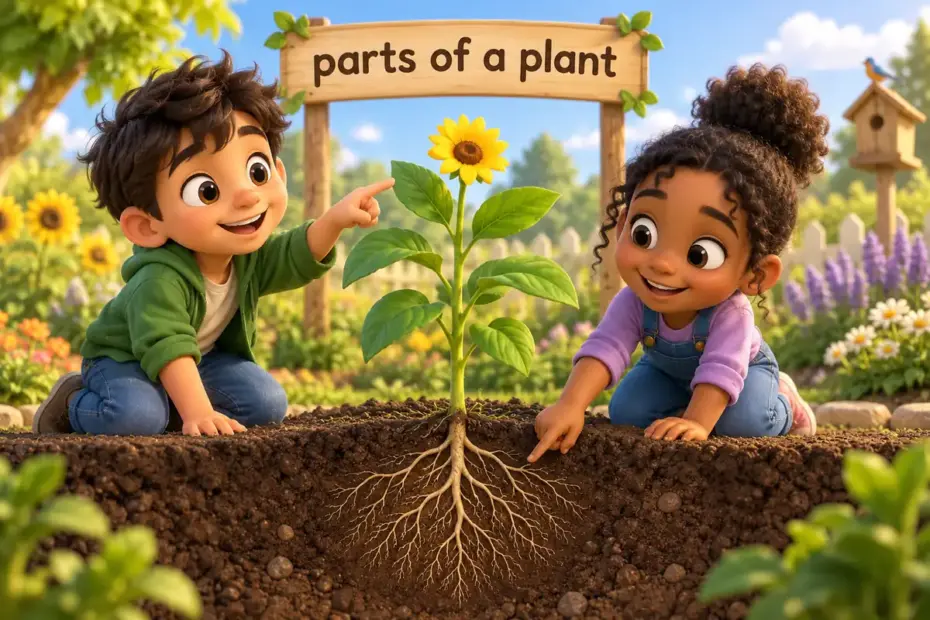
A plant is a living machine with a small set of named parts, and learning the parts of a plant helps children explain how a seed becomes a flower. The roots, stem, leaves, flower and seeds each do one job, and together they keep the plant alive and make new plants.
Parts of a Plant at a Glance
- A flowering plant usually has roots, a stem, leaves, flowers, fruit and seeds.
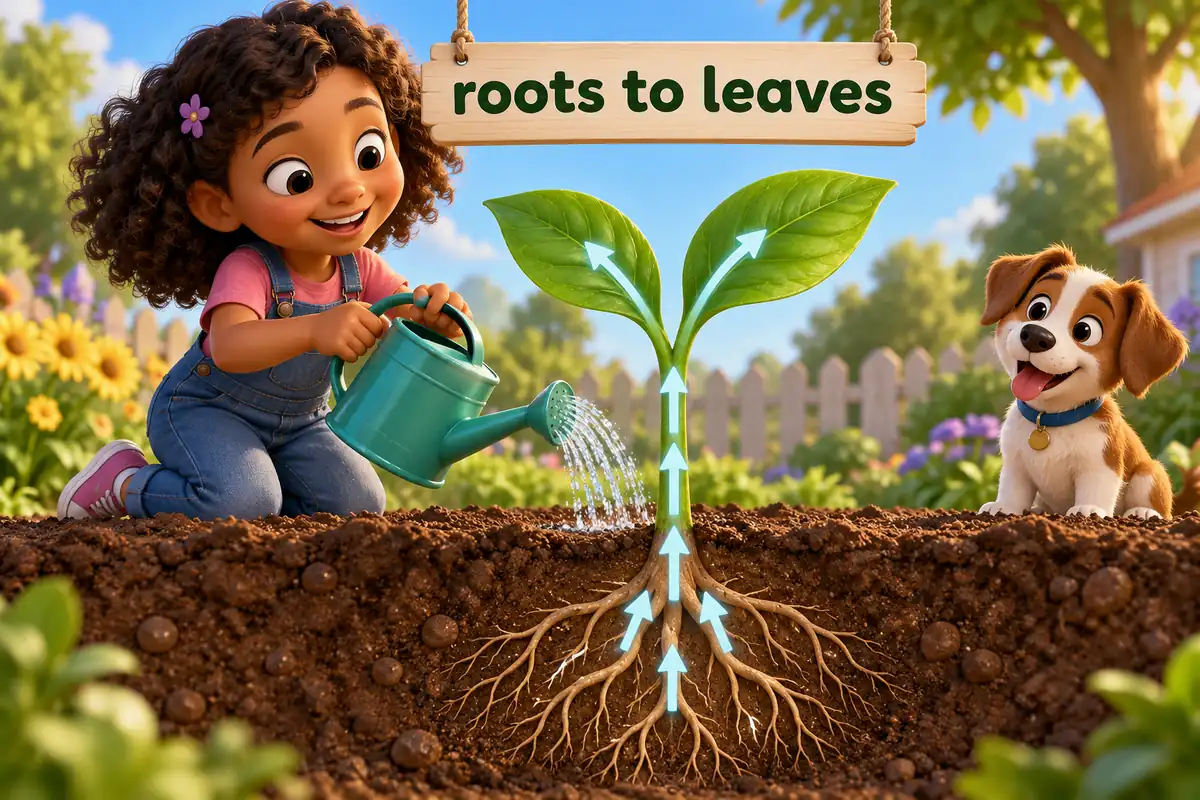
- The roots take up water and minerals and anchor the plant.
- The stem supports the leaves and carries water and food.
- The leaves make food from light, water and air.
- The flower holds the parts that make seeds.
- The fruit protects the seeds and helps them travel.
What Are the Parts of a Plant?
The parts of a plant are the roots, the stem, the leaves, the flower, the fruit and the seed, and each grows in a fixed place. Naming them correctly matters in science lessons and garden notes, because a plant is not one shape but an assembly of structures with separate jobs. The table below gives every part its position and its plain-language job.
| Part | Also called | Its main job | Where it sits |
|---|---|---|---|
| root | root system | takes up water and holds the plant firm | below the soil |
| stem | shoot | supports the leaves and carries food and water | above the soil |
| leaf | foliage | makes food by photosynthesis | on the stem |
| flower | bloom | holds the parts that make seeds | at the shoot tip |
| fruit | seed case | protects the seeds and helps them travel | around the seeds |
| seed | embryo | grows into a new plant | inside the fruit |
| bud | shoot tip | holds a young shoot or flower | at tips and joints |
| root hair | absorber | soaks up water and minerals | on young roots |
What Does Each Part of a Plant Do?
Every structure of a plant performs one task, and the list is easier to remember when each task is tied to something a child can see. This table pairs a part with its function and with the quick test that identifies it in the garden.
| Part | Function | How to spot it |
|---|---|---|
| root hairs | absorb water and minerals | fine fuzz on young roots |
| node | the point where a leaf joins the stem | the bump where leaf meets stem |
| internode | the gap between two nodes | the stalk space between leaves |
| petiole | attaches a leaf to the stem | the small leaf stalk |
| sepal | protects the flower while it is a bud | the green flaps under the petals |
| petal | attracts bees and other pollinators | the coloured flower parts |
| stamen | the male part that makes pollen | a stalk with a dusty tip |
| pistil | the female part that receives pollen | the central flask in the flower |
How the Parts of a Plant Work Together
A plant stays alive because its parts pass water, food and seeds along in one order. Follow a seed from the soil to a new seed and the diagram stops looking like a list of labels and starts looking like a life cycle.
| Step | Parts involved | What happens |
|---|---|---|
| seed germinates | seed, root | a root pushes down and a shoot pushes up |
| root grows | roots, root hairs | the plant anchors and begins to drink |
| shoot grows | stem, nodes, leaves | new leaves open toward the light |
| food made | leaf | photosynthesis turns light and water into sugar |
| flower opens | flower, petals, stamens | pollen moves from flower to flower |
| seeds form | pistil, fruit, seed | seeds ripen safely inside the fruit |
Parts of a Plant in Sentences Across Contexts
A term is learned once a child can drop it into a real sentence. The eight frames below show the same vocabulary working in a classroom, a garden diary and a shop label. The same habit of naming every mechanism appears in car parts from A to Z.
| Context | Example sentence | Why it works |
|---|---|---|
| classroom | Colour the roots brown and the leaves green. | names two parts with a clear task |
| garden diary | The stem bent toward the window, so I turned the pot. | links a part to a change |
| shop label | Water at the roots, not on the leaves, keeps this fern happy. | gives care advice with real terms |
| exam answer | The leaf makes food using light, water and air. | states a function in one line |
| home talk | The flower dropped its petals, and little seeds appeared. | uses the parts in order |
| nature walk | This fruit is really a seed case with a hard coat. | connects two parts |
| poster | A bud at the tip will open into a new shoot. | links a part to what comes next |
| news article | Weak roots left the crop unable to reach deep water. | reports a cause and an effect |
Root and Stem: Which Part Does What?
A root normally grows down and a stem normally grows up, and the two parts split the work between them. Telling them apart is easy once a learner checks the direction and looks for nodes.
| Attribute | Root | Stem |
|---|---|---|
| usual direction | downward, into the soil | upward, toward the light |
| main job | takes up water and minerals | supports leaves and moves water |
| structure | no nodes, leaves or buds | has nodes and buds |
| colour | often pale or brown | often green when young |
| example | a carrot and grass roots | a sunflower stalk and a tree trunk |
The verdict is simple: if it grows downward and has no buds, it is a root; if it grows upward and carries nodes, it is a stem. One honest limit is worth stating for young learners. Not every plant has every part on this page, because ferns and mosses have no flowers, and neither group makes seeds.
Key Terms and Word Forms for Plant Parts
Most plant vocabulary is noun-based, though a few verbs and adjectives appear in lessons and care guides. Compare the naming of plant parts with human body parts that start with a.
| Term | Part of speech | Example sentence |
|---|---|---|
| plant | noun | The plant leaned toward the window. |
| plant | verb | We planted beans in a row. |
| root | noun | A long root reached the water. |
| leaves | plural noun | The leaves turned gold in autumn. |
| flower | verb | These shrubs flower in early spring. |
| pollinate | verb | Bees pollinate the apple trees. |
| rooted | adjective | The rooted cutting stood firm. |
A parallel list of anatomical names sits in human body parts that start with b, and the pattern continues in human body parts that start with c.
Common Mistakes When Naming Plant Parts
The root makes food for the plant. The leaf makes food, and the root takes up water. Rule: photosynthesis happens in the leaf, not underground.
The stem only holds the plant up. The stem supports the plant and carries water and food. Rule: a stem does two jobs, support and transport.
The flower becomes the fruit after a bee visits. The flower makes seeds, and the fruit grows around those seeds. Rule: the flower is the parent structure, not the fruit itself.
Two leafs opened on the branch. Two leaves opened on the branch. Rule: the plural of leaf is leaves.
The bud is a small flower. The bud is a young shoot that may hold leaves or flowers. Rule: a bud can open into either, so it is not always a flower.
Practice Using the Parts of a Plant
- The ____ take up water and minerals from the soil.
- The ____ makes food for the plant using light, water and air.
- Choose the better part: the (stem / root) supports the leaves and carries water upward.
- Correct the error: Two leafs opened on the branch.
- Build one sentence that names the flower and the seed and explains the link between them.
- Spot the register: which sentence belongs in a science lesson, A or B? A: The leaf makes food by photosynthesis. B: The leaf makes food from sunshine stuff.
Answers
- roots – they absorb water and minerals from the soil.
- leaf – it carries out photosynthesis using light, water and air.
- stem – the stem supports the leaves, while the root drinks from the soil.
- Two leaves opened on the branch – the plural of leaf is leaves.
- A model answer is: The flower makes the seeds, and the fruit grows around those seeds to keep them safe. – it names both parts and shows the link.
- A – it uses the correct scientific term, photosynthesis.
The Bottom Line
The parts of a plant are the roots, stem, leaves, flower, fruit and seeds, and each one carries out a single clear job. The roots drink, the leaves make food, and the flower and fruit together produce and protect new seeds. Learn the direction test for roots and stems and the plural word leaves, and both the diagram and the writing fall into place.
Frequently asked questions about parts of a plant
Do all plants have flowers?
No. Flowering plants, which make up most garden and food plants, do have flowers, fruit and seeds. Ferns and mosses do not, and they multiply by spores instead, so they show roots and leaves but no petals at any time of year.
What is the difference between a node and an internode?
A node is the point on the stem where a leaf or bud is attached, while an internode is the stretch of stem between two nodes. Leaves and buds always grow at nodes, and the internodes are the clear gaps you see between them.
Which part of the plant makes food?
The leaf makes food by photosynthesis, using sunlight, water and carbon dioxide from the air. The green colour comes from chlorophyll, which captures the light. Roots and stems support the plant but do not make food, because only green parts carry chlorophyll.
How do seeds travel to new places?
Seeds travel inside fruit, which protects them and helps them move away from the parent plant. Some fruits are eaten by animals and the seeds pass out later, while others are light enough to blow in the wind or float on water.