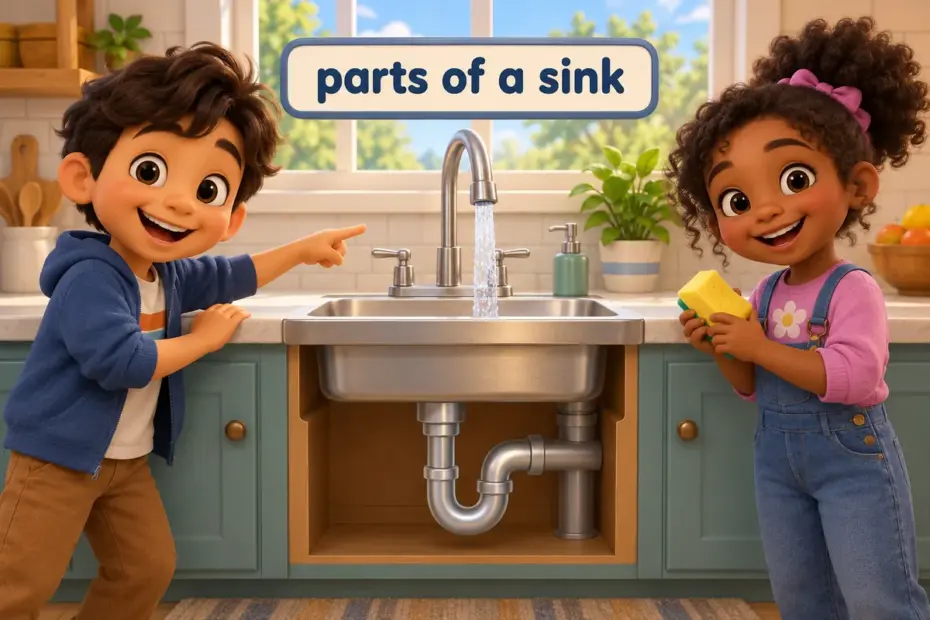
The parts of a sink are the basin, faucet, handles, drain, stopper, and the pipes underneath that carry water in and away. Water arrives through the supply lines and leaves through the drain and trap, so each piece has one clear job to do.
Parts of a sink at a glance
- A sink has six visible parts: the basin, faucet, handles, drain, stopper, and rim.
- The faucet brings water in, and the drain and trap carry it away.
- Hot and cold supply lines feed the faucet from behind the wall.
- The stopper holds water in the basin, and the overflow hole lets extra water escape.
- The commonest error is writing sync, which means to match, in place of sink.
What are the parts of a sink?
A sink is the basin and the fittings that deliver and remove water in a kitchen or bathroom. The basin holds the water, the faucet releases it, the drain and P-trap carry waste away, and two supply lines feed hot and cold water into the faucet behind the wall. The rim frames the whole bowl, and the stopper sits inside the drain so the basin can be filled.
| Part | Where it is | What it does | Example sentence |
|---|---|---|---|
| Basin | The main bowl | Holds the water | The basin of a sink was full of soapy water. |
| Rim | The top edge | Frames the bowl | She rested the sponge on the rim of a sink. |
| Faucet | Above the drain | Releases hot and cold water | The faucet of a sink dripped all night. |
| Spout | Mouth of the faucet | Directs the water stream | Water poured from the spout of a sink. |
| Handle | Left and right of the faucet | Turns the flow on and off | Turn the handle of a sink to start the water. |
| Aerator | Screwed onto the spout | Mixes air into the stream | The aerator of a sink softens the flow. |
| Drain | Centre of the basin | Lets used water out | The drain of a sink was blocked with rice. |
| Stopper | Sits inside the drain | Holds water in the bowl | Push the stopper of a sink down to fill it. |
| Overflow hole | High on the basin wall | Lets excess water escape | The overflow hole of a sink stops flooding. |
| P-trap | Under the basin | Traps waste and smells | The P-trap of a sink keeps gases out. |
| Supply line | Behind the wall | Brings hot and cold water | A supply line of a sink leaked under the cabinet. |
| Shutoff valve | On each supply line | Stops water for repairs | Close the shutoff valve of a sink before fixing it. |
How do you use the parts of a sink in a sentence?
The phrase names one piece and gives it a job. Put the part before of a sink, or let the sink own it with an apostrophe, and match the verb to the number of parts you name. The fitter fails first, so the rarer words come last.
| Pattern | Example | What it signals |
|---|---|---|
| the + part + of a sink | The faucet of a sink dripped. | names one fitting |
| a sink’s + part | A sink’s drain was blocked. | shows possession |
| plural part + of a sink | The handles of a sink turn easily. | talks about a pair |
| part + verb | The stopper holds the water. | describes a job |
| label + part | The plumber replaced the trap. | trade and repair use |
| part + helps + verb | The aerator helps water flow softly. | explains a function |
Parts of a sink in context: examples across contexts
The same names appear in a classroom, a plumbing guide, and a repair bill, and the wording around them changes with the setting. Readers who enjoy labelled lists can browse car parts that starts with a to z for a parallel set of names.
| Context | Example sentence | Why this works |
|---|---|---|
| Classroom | The teacher asked us to name each part of a sink on the worksheet. | a school labelling task |
| Plumbing guide | Clean the aerator of a sink when the flow slows. | a practical instruction |
| Repair bill | Replaced the P-trap of a sink and checked the seal. | a short trade record |
| Kitchen conversation | The sink in the staff room is blocked again. | everyday complaint |
| Landlord letter | Please do not pour grease down the sink of a flat. | a formal request |
| Science lesson | Water leaves a sink through the drain and the trap. | a plain factual statement |
| DIY video | Turn off the shutoff valve of a sink before you work. | a safety step |
| Hotel notice | Report any leak under the sink to the front desk. | a public instruction |
| Story for children | The little duck splashed in the sink and giggled. | simple narrative wording |
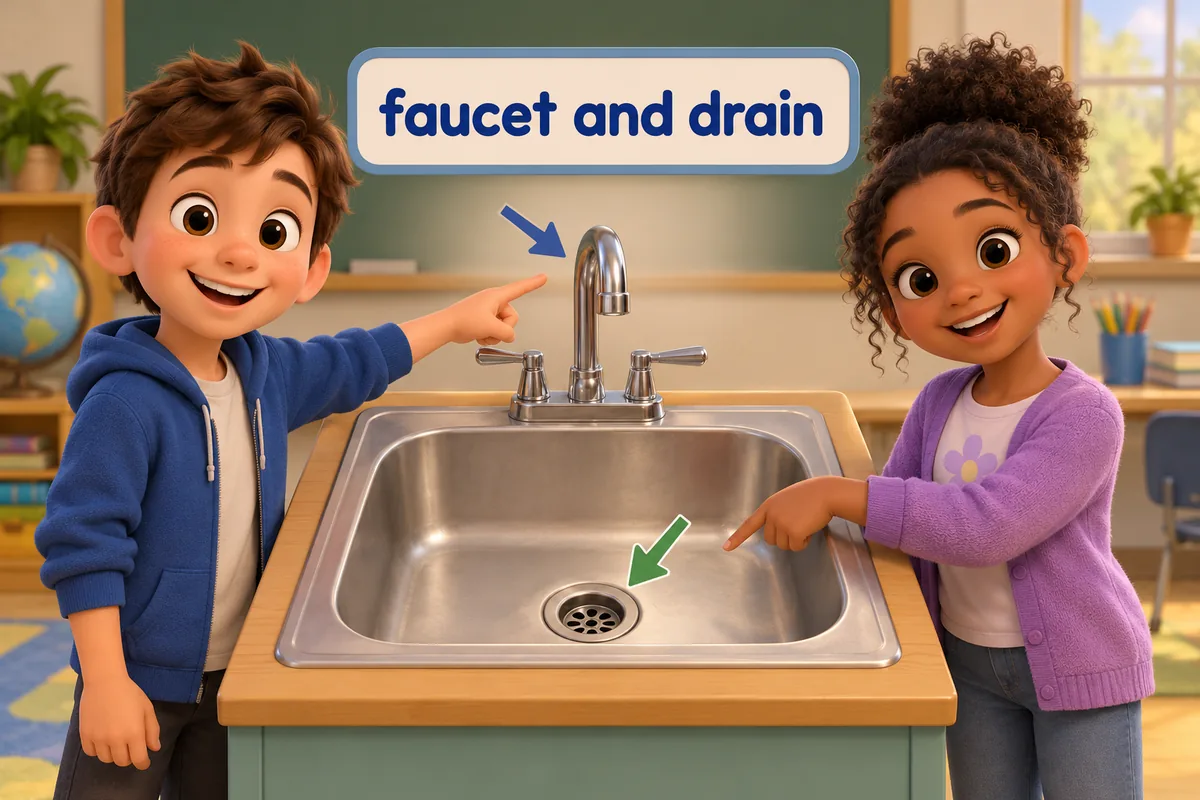
| Exam question | Label the faucet and the drain of a sink in the diagram. | a clear instruction |
Faucet, drain, and trap: how the parts differ
Grouping the parts by water direction makes the diagram easy to read, because supply, use, and waste are three separate stages. A similar labelled approach works for human body parts that start with a, where each name also maps to one job.
| Feature | Faucet | Drain | Trap |
|---|---|---|---|
| Main job | brings water in | lets water out | seals off waste gases |
| Water direction | into the basin | out of the basin | away to the sewer |
| Where it sits | above the rim | centre of the bowl | under the basin |
| Typical material | metal with a finish | stainless steel | plastic or metal |
| Diagram label | faucet | drain | P-trap |
Word forms and grammar of the parts of a sink
Most part names are nouns, and only a few change spelling in the plural. The adjective leaky describes a faulty fitting, and the verb drain describes what the water does. The same word even names an engineering device, as in a heat sink that draws warmth away from a chip.
| Form | Part of speech | Example |
|---|---|---|
| sink | noun | The sink is in the corner. |
| sinks | noun, plural | Both sinks need new taps. |
| faucet | noun | The faucet has two handles. |
| faucets | noun, plural | Modern faucets mix the water. |
| stopper | noun | The stopper was stuck. |
| stoppers | noun, plural | The stoppers come in two sizes. |
| drain | noun and verb | Water drains slowly here. |
| leaky | adjective | A leaky pipe wastes water. |
| plumbing | noun | The plumbing was replaced. |
| rinse | verb | Rinse the basin after use. |
Common mistakes with the parts of a sink
Two words that sound alike cause most of the trouble, and a homophone mix-up such as cinque vs sink vs sync fails in the same way.
Mistake 1: sync for sink. Incorrect: Please put the plates in the sync. Correct: Please put the plates in the sink. Rule: a sink is a basin, while to sync means to match two things.
Mistake 2: a singular verb with two handles. Incorrect: The handles of a sink turns stiffly. Correct: The handles of a sink turn stiffly. Rule: a plural subject takes a plural verb.
Mistake 3: broke for broken. Incorrect: The faucet is broke. Correct: The faucet is broken. Rule: use the adjective broken after is, not the verb broke.
Mistake 4: of for off. Incorrect: Turn of the tap. Correct: Turn off the tap. Rule: off shows stopping a flow, while of shows a relationship.
Mistake 5: a sink of water. Incorrect: He washed a sink of dishes. Correct: He washed a sinkful of dishes. Rule: sink is the bowl itself, so the amount is a sinkful.
Practice using the parts of a sink
- Fill in the blank: The ___ releases hot and cold water into the basin.
- Choose the better word: Water leaves through the (drain / faucet).
- Correct the error: Please put the plates in the sync.
- Build a sentence: use P-trap to say where waste waits before leaving.
- Spot the register: which line suits a repair bill, (a) The kitchen sink is broken, or (b) That basin thing is kaput?
- Fill in the blank: Close the ___ before you replace the faucet.
Answers
- faucet, because the faucet is the part that supplies water.
- drain, because the drain is the outlet at the base of the bowl.
- Please put the plates in the sink; sync means to match, not a basin.
- Waste waits in the P-trap under the basin before it flows to the sewer.
- (a), because a repair record uses neutral, precise wording.
- shutoff valve, because it stops the water before the repair.

The bottom line
The parts of a sink split into three clear stages: the faucet and supply lines bring water in, the basin holds it, and the drain and trap carry it away. Learn the positions, because the faucet sits above the bowl, the drain sits at the base, and the trap curls below. Once direction and job are linked, the diagram stops being a memory test.
Frequently asked questions about the parts of a sink
What are the main parts of a sink?
A sink has six visible parts and several hidden ones. Above the counter sit the basin, rim, faucet, spout, handles, drain, and stopper. Below, the aerator, overflow hole, P-trap, supply lines, and shutoff valves do the rest. Each part handles either supply, use, or waste water.
What is the difference between a sink and a basin?
A basin is just the bowl that holds the water, while a sink is the whole unit made of the basin plus the faucet, drain, and pipework. In British bathrooms the word basin often names the whole fixture, and the kitchen one is called a sink. The terms overlap, but basin stays narrower.
Why does a sink have a P-trap?
The P-trap is the curved pipe under the basin that keeps a small amount of water after each use. That water seal blocks sewer gases and smells from rising back into the room. It also catches small objects that fall down the drain, which is why rings often turn up there.
How do you stop a sink from dripping?
A dripping sink usually means a worn washer or cartridge inside the faucet. Turn off the shutoff valves under the basin first, then open the handle to drain the pipe. Replacing the washer or cartridge stops the drip, and a plumber does it quickly if the fitting is old.