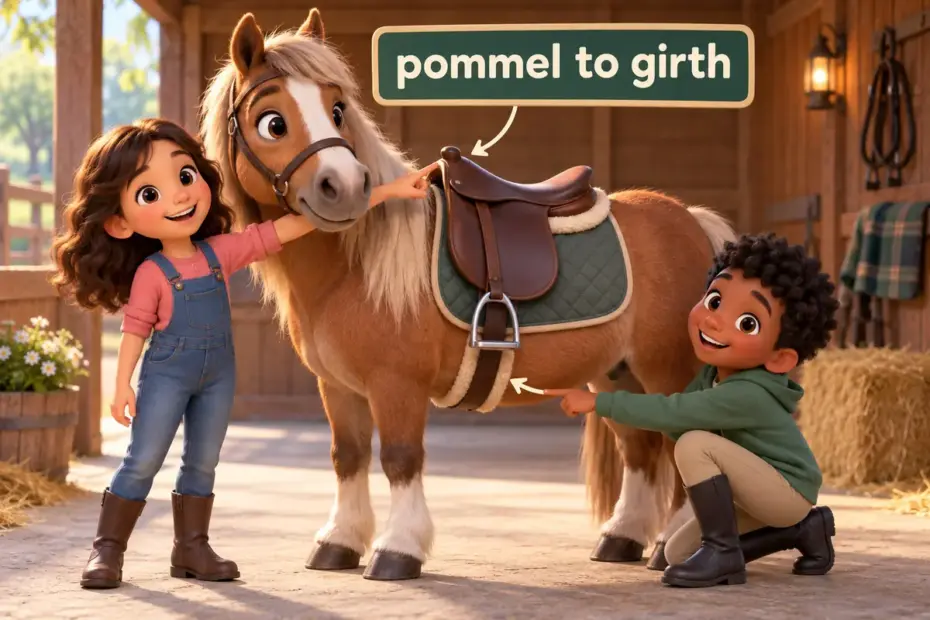
A clear guide to the parts of a saddle functions and diagram must name the pommel, seat, cantle, girth and stirrups that hold a rider in place. Each part has one job, and together they spread the rider’s weight and keep the saddle steady on the horse.
Parts of a Saddle Functions and Diagram at a Glance
- The tree is the frame that gives the saddle its shape.
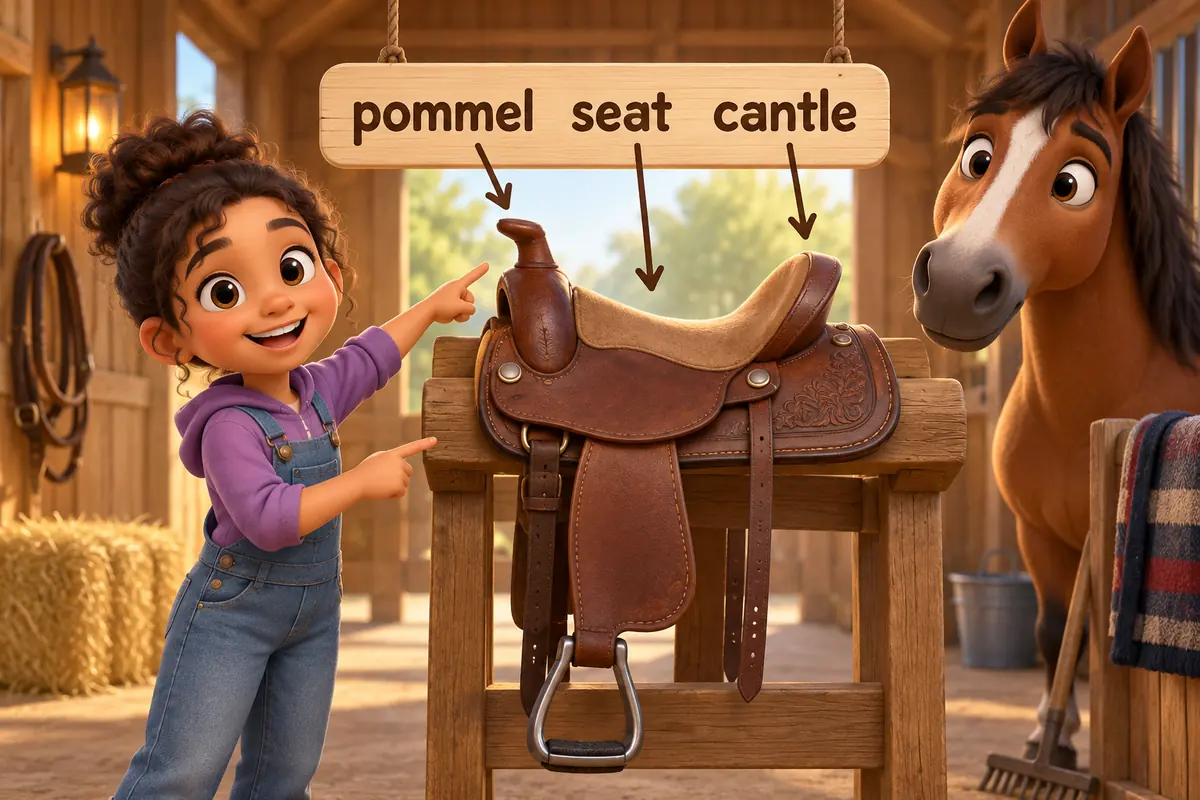
- The pommel is the raised front, and the cantle is the raised back.
- The seat is the part the rider actually sits on.
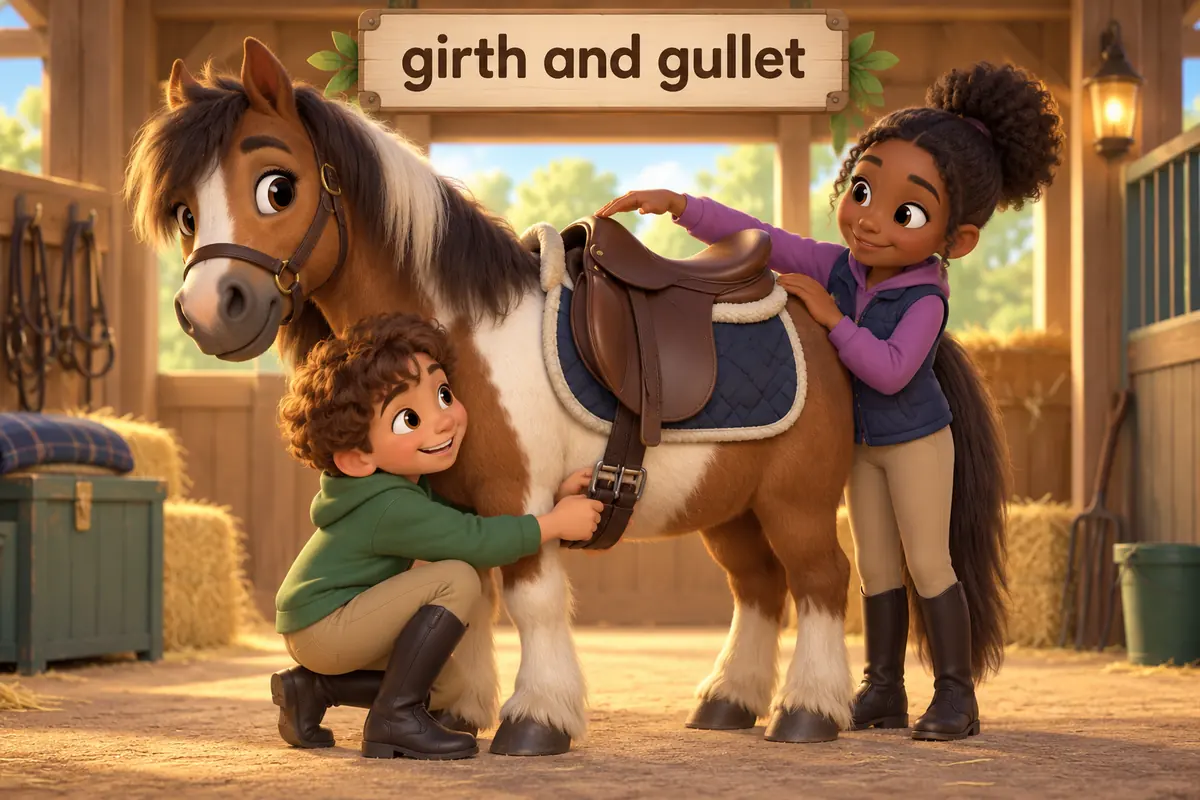
- The girth circles the horse and holds the saddle on.
- The stirrups rest the rider’s feet on adjustable leathers.
- The panels cushion the horse’s back and spread the load.
What Are the Parts of a Saddle?
The parts of a saddle are the tree, the pommel, the seat, the cantle, the stirrups and the girth that fixes it in place. Each part sits in a fixed spot, so a learner can point to it on a labelled diagram and name it without hesitating. The table below gives every part its position and its plain-language job.
| Part | Also called | Its main job | Where it sits |
|---|---|---|---|
| tree | frame | gives the saddle shape and spreads weight | the base under everything |
| pommel | front arch | forms the raised front of the seat | front of the saddle |
| horn | rope grip | holds a rope on a western saddle | on top of the pommel |
| seat | rider seat | is where the rider sits | the top middle |
| cantle | back arch | supports the rider from behind | back of the saddle |
| skirt | side panel | covers the rigging and holds rings | the side of a western saddle |
| fender | stirrup hanger | hangs the stirrup leather | drops from the side |
| stirrup | foot rest | supports the rider’s foot | at the base of the fender |
What Does Each Part of a Saddle Do?
Every part of a saddle performs one task, and the list is easier to remember when each task is tied to something you can check by hand. This table pairs a part with its function and with the quick test that identifies it before a ride.
| Part | Function | How to spot it |
|---|---|---|
| girth | holds the saddle on by circling the horse | the strap under the belly |
| billet straps | attach the girth to the saddle | short straps under the flap |
| panel | cushions the horse’s back | the padded underside |
| flap | protects the rider’s leg from the leathers | the large side panel |
| knee roll | supports the rider’s knee | a padded block on the flap |
| gullet | keeps pressure off the withers | the gap at the front underside |
| saddle pad | protects and cushions the back | cloth between saddle and back |
| stirrup leather | adjusts stirrup height | the strap from saddle to stirrup |
How the Parts of a Saddle Work Together
A saddle stays secure because its parts pass the rider’s weight along one path from seat to horse. Follow the tack from the pad to the stirrups and the diagram stops looking like a list of labels and starts looking like a system. The same habit of naming every mechanism appears in car parts from A to Z.
| Step | Parts involved | What happens |
|---|---|---|
| pad placed | saddle pad | the cloth sits on the horse’s back |
| saddle set | tree, gullet | the gullet clears the withers |
| girth fastened | girth, billet straps | the saddle is held in place |
| stirrups set | stirrup leather, stirrup | the rider adjusts the length |
| rider mounts | seat, stirrups | the rider sits balanced and centred |
| weight spread | tree, panel | the load spreads along the back |
Parts of a Saddle in Sentences Across Contexts
A term is learned once a writer can drop it into a real sentence. The eight frames below show the same vocabulary working in a riding lesson, a tack-shop note and a vet’s advice. Compare the naming of tack parts with human body parts that start with a.
| Context | Example sentence | Why it works |
|---|---|---|
| riding lesson | Check the gullet clears the withers before you tighten the girth. | gives a clear order |
| tack-shop note | These billet straps fit most English saddles. | names a part in a product note |
| vet advice | Dry sweat under the panel, not just on the pad. | ties care to a part |
| exam answer | The tree spreads the rider’s weight along the horse’s back. | states a function in one line |
| trail chat | The horn is handy when you open a gate from the saddle. | links a part to a use |
| repair note | A cracked tree makes the seat feel uneven. | ties a fault to a part |
| poster | Set the stirrups so your knee stays slightly bent. | connects a part to posture |
| news article | A lighter tree cut the weight of the saddle for young riders. | reports a change and its effect |
English and Western Saddles: Which Fits the Ride?
An English saddle keeps the rider close to the horse with a flat flap and no horn, while a western saddle adds a deep seat, a horn and a skirt for long days of work. The right choice follows the job the rider has in mind.
| Attribute | English saddle | Western saddle |
|---|---|---|
| seat | small and close contact | larger and deeper |
| horn | none | a horn at the front |
| sides | a large flat flap | a skirt with fenders |
| usual use | jumping, dressage and racing | trail riding, roping and ranch work |
| rider position | forward and light | upright and secure |
The verdict is that an English saddle suits fast, athletic riding and a western saddle suits long, practical work, so the ride decides the tack. One honest limit is worth stating, because the parts differ between designs. A treeless saddle has no rigid tree at all, and many western parts such as the skirt and horn have no equivalent on an English model, so a learner should read the diagram for the type in front of them.
Key Terms and Word Forms for Saddle Parts
Most saddle vocabulary is noun-based, though a few verbs and adjectives appear in tack care and riding lessons. A parallel list sits in human body parts that start with b.
| Term | Part of speech | Example sentence |
|---|---|---|
| saddle | noun | The saddle sat on its rack. |
| saddles | plural noun | Two saddles hung in the tack room. |
| saddle | verb | She saddled the pony before dawn. |
| stirrup | noun | His boot rested in the stirrup. |
| girth | noun | The girth was checked twice. |
| pommel | noun | Her hand brushed the pommel. |
| saddled | adjective | The saddled horse waited quietly. |
The pattern continues in human body parts that start with c.
Common Mistakes When Naming Saddle Parts
The pommel is the back of the saddle. The pommel is the front arch, and the cantle is the back. Rule: the pommel rises at the front, the cantle at the rear.
The girth is part of the saddle seat. The girth is the strap that circles the horse, not the seat. Rule: the girth fastens the saddle on from underneath.
The stirrup is the leather strap. The stirrup is the metal foot rest, and the leather is the strap that hangs it. Rule: leather holds, stirrup supports the foot.
Every saddle has a horn. Only a western saddle usually has a horn. Rule: the horn is a feature of western tack, not of all saddles.
The tree is a wooden part of the horse. The tree is the frame inside the saddle. Rule: the tree is part of the tack, not the animal.
Practice Using the Parts of a Saddle
- The ____ is the frame that gives the saddle its shape and spreads weight.
- The ____ circles the horse and holds the saddle in place.
- Choose the better part: the (cantle / pommel) is the raised front of the saddle.
- Correct the error: The pommel is the back of the saddle.
- Build one sentence that names the tree and the panel and explains what each does.
- Spot the register: which sentence belongs in a riding lesson, A or B? A: Check that the gullet clears the withers. B: Make sure the gap at the front is not squashing the pony.
Answers
- tree – it is the internal frame that spreads the rider’s weight.
- girth – it fastens under the belly and holds the saddle on.
- pommel – the pommel is the front arch, while the cantle is the back.
- The cantle is the back of the saddle – the pommel is the front arch.
- A model answer is: The tree shapes the saddle while the panel cushions the horse’s back and spreads the load. – it names both parts and gives each a job.
- A – it uses the correct terms, gullet and withers, and gives a clear check.
The Bottom Line
The parts of a saddle functions and diagram set covers the tree, pommel, seat, cantle, girth and stirrups, and each part carries the rider’s weight along one path. The tree shapes and spreads, the panel cushions, and the girth fastens the whole saddle to the horse. Learn which part is at the front and which is underneath, and both the diagram and the tack check make sense.
Frequently asked questions about saddle parts
What is the tree of a saddle?
The tree is the internal frame that gives the saddle its shape and spreads the rider’s weight across the horse’s back. It is usually made from wood, fibreglass or a strong synthetic material, and a cracked tree makes the seat feel uneven.
What is the gullet and why does it matter?
The gullet is the channel at the front underside of the saddle that arches over the horse’s withers. It must be wide and high enough to keep pressure off that bony area. A gullet that is too narrow can rub and cause soreness.
Why does a western saddle have a horn?
The horn is a sturdy knob on top of the pommel that gives a place to wrap a rope, so a rider can hold a roped animal without tying it to the saddle. It also gives a steadying hand when a rider mounts or opens a gate.
How tight should the girth be?
The girth should be snug enough to keep the saddle from sliding but loose enough for the horse to breathe and move freely. You should fit about two fingers under it. Tighten it in stages before mounting rather than all at once.