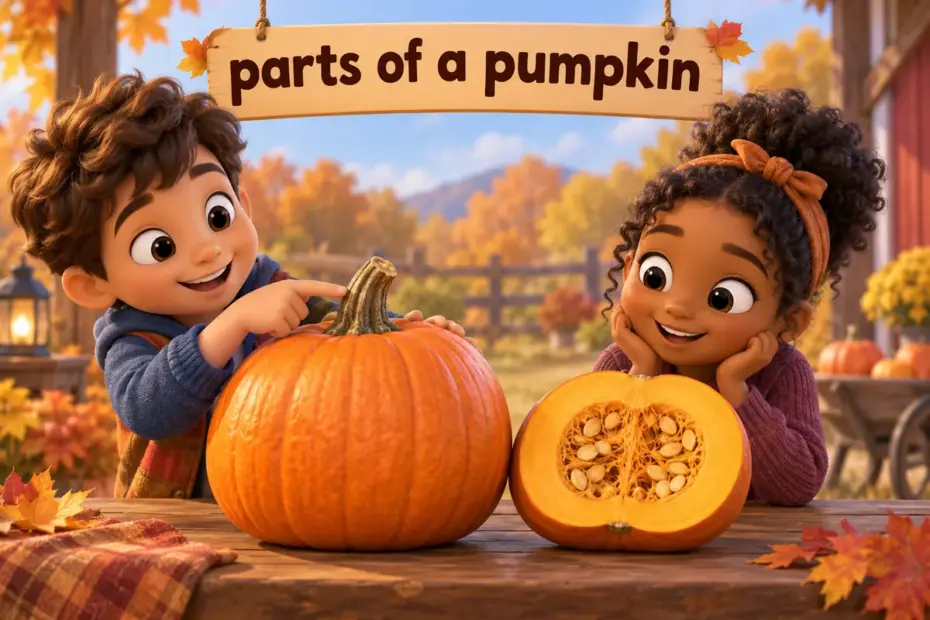
A pumpkin is a fruit with a simple set of named parts, and learning the parts of a pumpkin helps children understand what sits inside before they carve one. The skin, flesh, pulp, seeds and stem each do one job, and together they protect the seeds and help the plant make new pumpkins.
Parts of a Pumpkin at a Glance
- A pumpkin has a hard skin, called the rind, that protects the flesh.
- The flesh and pulp store food and water for the seeds.
- The seeds sit in the central cavity and grow into new plants.
- The stem, or peduncle, once carried water to the fruit.
- Ribs, or lobes, give the pumpkin its ribbed shape.
- The blossom end is the scar left by the flower.
What Are the Parts of a Pumpkin?
The parts of a pumpkin are the skin, the flesh, the pulp, the cavity, the seeds and the stem. Each one sits in a fixed place, so a child can point to it on a cut-away diagram and name it without hesitating. The table below gives every part its position and its plain-language job.
| Part | Also called | Its main job | Where it sits |
|---|---|---|---|
| skin | rind | protects the flesh and holds in moisture | the outer surface |
| flesh | pulp wall | stores food and water for the seeds | inside the skin |
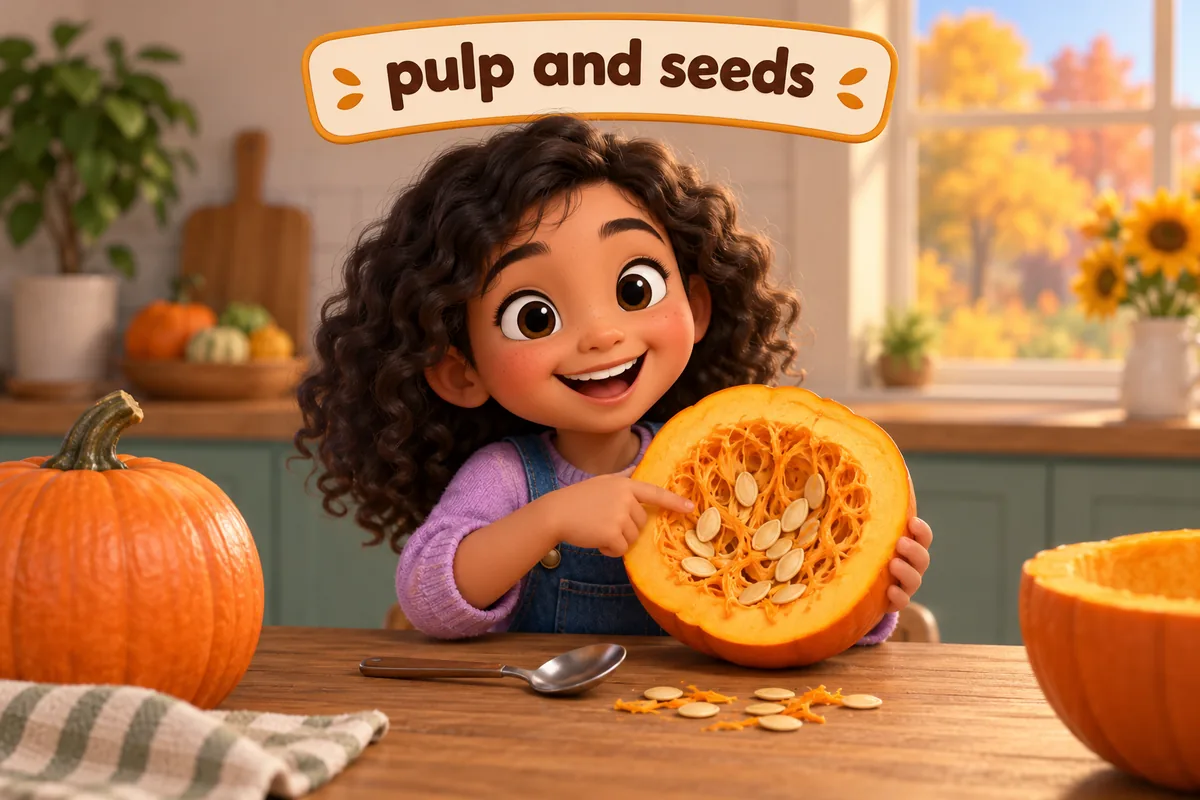
| pulp | fibrous strands | holds the seeds in place | around the seeds |
| cavity | seed hollow | holds the seeds and pulp | the centre |
| seeds | pepitas | grow into new pumpkin plants | inside the cavity |
| stem | peduncle | carried water while the fruit was on the vine | the top of the fruit |
| ribs | lobes | give the fruit its shape and strength | vertical grooves on the skin |
| blossom end | flower scar | marks where the flower once sat | the base opposite the stem |
What Does Each Part of a Pumpkin Do?
Every structure of the fruit performs one task, and the list is easier to remember when each task is tied to something a child can see. This table pairs a part with its function and with the quick test that identifies it when the pumpkin is cut open.
| Part | Function | How to spot it |
|---|---|---|
| rind | protects against pests and drying | the hard outer skin |
| flesh | stores food for the growing seeds | the firm orange wall |
| pulp | surrounds and feeds the seeds | the stringy material inside |
| seeds | carry the plant into the next generation | flat oval seeds in the centre |
| stem | connects the fruit to the vine | the woody handle on top |
| ribs | stiffen the fruit wall | the ridges running down the side |
| tendril | helps the vine climb | a spring-like curl on the vine |
| vine | carries water and food to the fruit | the long trailing stem on the ground |
How the Parts of a Pumpkin Work Together
A pumpkin forms because its parts pass water, food and pollen along in one order. Follow a seed from the soil to a ripe fruit and the diagram stops looking like a list of labels and starts looking like a life cycle. The same habit of naming every mechanism appears in car parts from A to Z.
| Step | Parts involved | What happens |
|---|---|---|
| seed planted | seed, soil | a shoot pushes up through the ground |
| vine grows | vine, tendril | the plant trails or climbs across the ground |
| leaves feed | leaves | photosynthesis makes sugar for growth |
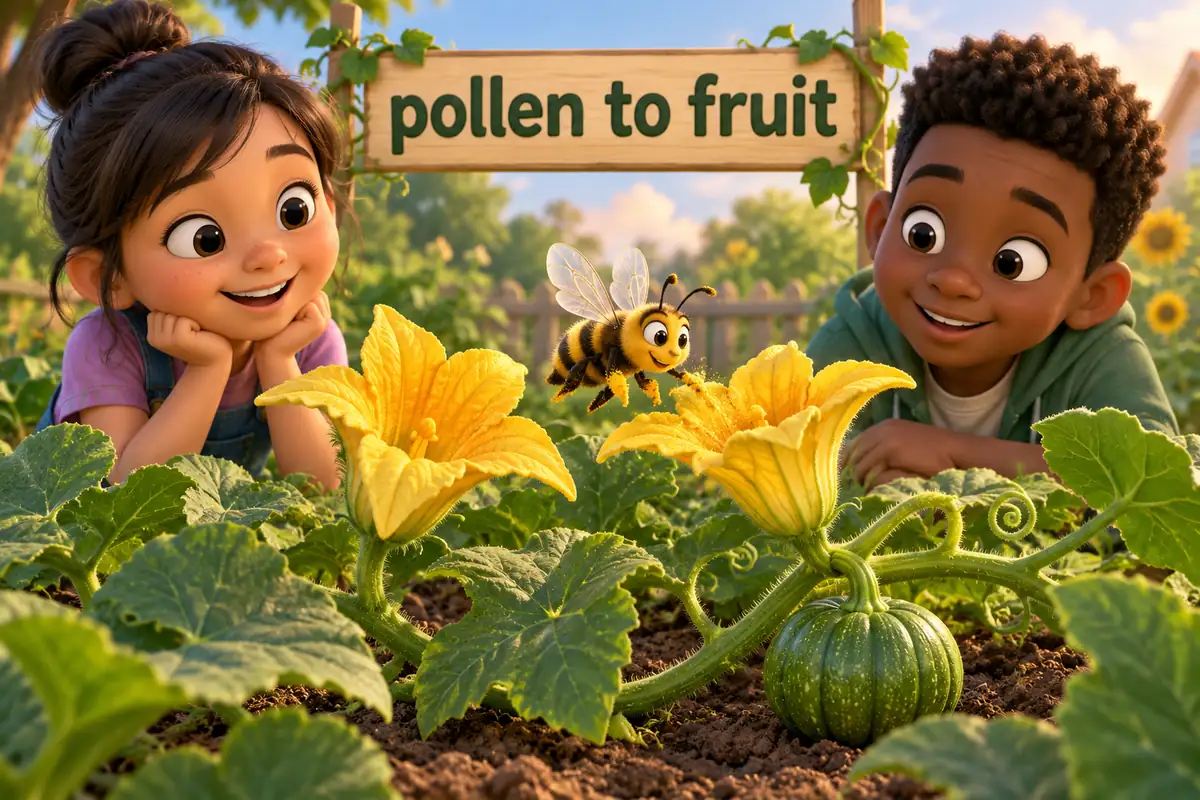
| flower opens | flower | bees carry pollen from flower to flower |
| fruit forms | ovary, blossom end | a small green pumpkin appears |
| fruit ripens | skin, flesh, seeds | the rind hardens and the seeds fill out |
Parts of a Pumpkin in Sentences Across Contexts
A term is learned once a child can drop it into a real sentence. The eight frames below show the same vocabulary working in a classroom, a kitchen and a farm shop. Writers who need a colour or shape word can borrow the list under adjectives for pumpkin.
| Context | Example sentence | Why it works |
|---|---|---|
| classroom | We scooped the pulp and counted the seeds. | names two parts in one action |
| kitchen | Roast the seeds after you rinse off the pulp. | gives a cooking step with real terms |
| farm shop | A green stem means the pumpkin was cut recently. | links a part to freshness |
| exam answer | The rind protects the flesh and the seeds inside. | states a function in one line |
| home talk | Cut around the stem so the lid keeps its handle. | uses the part name in advice |
| nature walk | A curling tendril helped the vine climb the fence. | connects a part to a habit |
| poster | The ribs make the pumpkin easy to slice into even wedges. | links a part to a use |
| news article | Wet weather left the rind too soft to store. | reports a cause and an effect |
Pumpkin and Squash: Which Word Is Right?
A pumpkin is one kind of squash, while squash is the wider family name that covers many gourds. The two words overlap, so the right choice depends on whether the speaker means one familiar orange fruit or the whole group.
| Attribute | Pumpkin | Squash |
|---|---|---|
| botanical group | one kind of squash | a larger group of gourds |
| usual use | carving and pie filling | cooking and roasting |
| shape | round and strongly ribbed | varied, from long to round |
| rind | usually hard and orange | can be thin or hard |
| naming habit | a common name in shops | a general name in cooking |
The verdict is straightforward: call the round orange fruit a pumpkin when you carve it or bake it, and use squash when you mean the whole family or a different member such as butternut. One honest limit is worth stating, because naming varies. Not every pumpkin is orange, and some green or white squashes are sold as pumpkins in shops, so colour alone is not a reliable test.
Key Terms and Word Forms for Pumpkin Parts
Most pumpkin vocabulary is noun-based, though a few adjectives and verbs appear in recipes and lessons. Compare the naming of fruit parts with human body parts that start with a.
| Term | Part of speech | Example sentence |
|---|---|---|
| pumpkin | noun | The pumpkin sat on the porch. |
| pumpkins | plural noun | Three pumpkins lined the path. |
| rind | noun | The rind was too hard to cut. |
| pulp | noun | Pulp clung to the seeds. |
| pepita | noun | Each pepita is a green pumpkin seed. |
| squash | verb | She squashed the soft gourd flat. |
| ribbed | adjective | The ribbed skin made even slices. |
A parallel list sits in human body parts that start with b.
Common Mistakes When Naming Pumpkin Parts
The pumpkin is a vegetable. The pumpkin is a fruit, because it grows from a flower and holds seeds. Rule: a fruit holds seeds, while a vegetable is another plant part.
The stem feeds the pumpkin after it is picked. The stem carried water only while the fruit was on the vine. Rule: a cut stem no longer supplies anything.
The pulp is the same as the flesh. The flesh is the firm wall, and the pulp is the stringy material around the seeds. Rule: flesh is solid, pulp is fibrous.
The ribs are cuts in the skin. The ribs are natural ridges, not cuts. Rule: they grow with the fruit and are part of its shape.
Two pumpkin are on the step. Two pumpkins are on the step. Rule: the plural of pumpkin adds s.
Practice Using the Parts of a Pumpkin
- The hard outer skin of a pumpkin is called the ____.
- The ____ holds the seeds in place inside the central cavity.
- Choose the better word: the (stem / rind) once carried water to the fruit on the vine.
- Correct the error: The pumpkin is a vegetable.
- Build one sentence that names the rind and the seeds and explains what each does.
- Spot the register: which sentence belongs in a kitchen recipe, A or B? A: Rinse the seeds and discard the pulp. B: Get rid of the gooey bits and keep the pips.
Answers
- rind – it is the hard outer skin that protects the fruit.
- pulp – it surrounds and holds the seeds in the cavity.
- stem – the stem, or peduncle, carried water while the fruit was attached.
- The pumpkin is a fruit – it grows from a flower and holds seeds.
- A model answer is: The rind protects the seeds while the seeds inside grow into new pumpkin plants. – it names both parts and gives each a job.
- A – it uses the correct terms, seeds and pulp, and gives a clear instruction.
The Bottom Line
The parts of a pumpkin are the rind, flesh, pulp, cavity, seeds and stem, and each one protects or feeds the seeds at the centre. The rind guards the fruit, the pulp holds the seeds in place, and the stem carried water while the pumpkin grew on the vine. Learn that a pumpkin is a fruit and that pepitas are its seeds, and both the diagram and the cooking make sense.
Frequently asked questions about parts of a pumpkin
Is a pumpkin a fruit or a vegetable?
A pumpkin is a fruit. Botanically, a fruit is the part of a plant that grows from a flower and contains the seeds, and a pumpkin does both. In cooking and shops it is often grouped with vegetables because people use it in savoury dishes.
What are pumpkin seeds called?
Pumpkin seeds are also called pepitas. A pepita is the green seed found inside the cavity, surrounded by fibrous pulp. When the seeds are hulled and roasted, pepitas are the flat green kernels that often appear in salads and snacks.
Why is the stem important on a pumpkin?
The stem, or peduncle, joined the fruit to the vine and carried water and food while the pumpkin grew. After harvest it becomes the handle people hold. A green, firm stem usually means the fruit was cut recently and will store well.
What are the ribs on a pumpkin?
The ribs, or lobes, are the natural ridges that run down the side of the fruit. They are part of the shape rather than cuts in the skin, and they stiffen the fruit wall. The grooves also make it easy to slice a pumpkin into even wedges.