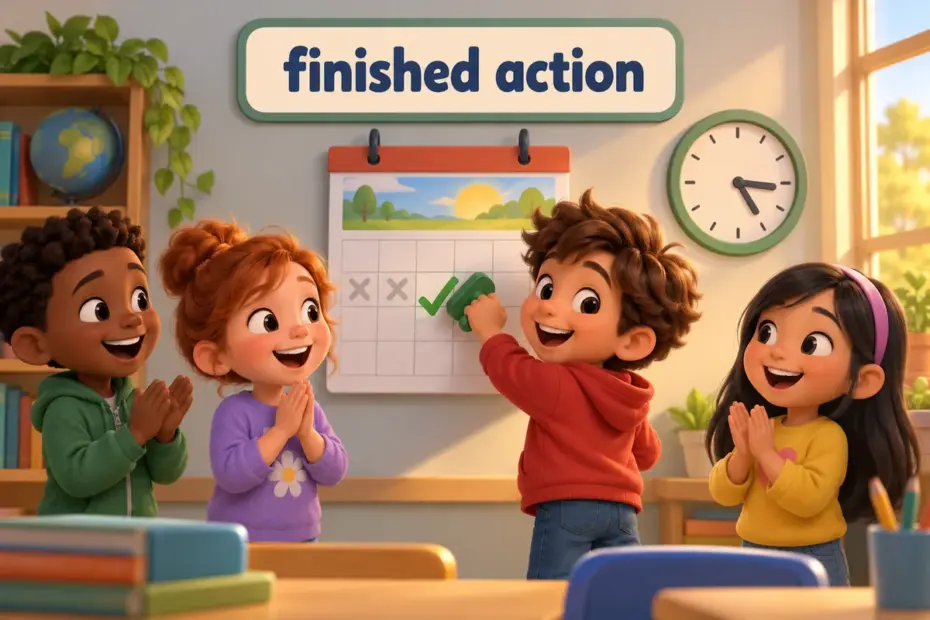
Past simple tense structure and examples follow one idea: the action is finished at a known past time. Regular verbs add -ed, and irregular verbs take their own past form. In “we visited Rome in 2019,” the trip is complete and the year fixes when it happened.
Past simple tense structure and examples at a glance
- The past simple is a verb tense that reports a completed past action.
- Regular verbs add -ed; irregular verbs take a separate past form.
- Negatives and questions use did, and then the main verb stays in its base form.
- Typical time words include yesterday, last week, in 1999, and two days ago.
- The commonest error is adding a second past ending after did.
What does the past simple tense mean?
The past simple is a verb tense that presents an action as a single, finished event at a definite past time. It contrasts with the past continuous, which leaves the action open, and with the present perfect, which ties the past to now.
| Use | Plain meaning | Example |
|---|---|---|
| Completed action | finished at a known time | We visited Rome in 2019. |
| A sequence of events | events told in order | She opened the door and walked in. |
| Past habits | repeated actions no longer true | I played tennis every summer. |
| A past state | a condition that held then | He liked the quiet street. |
| A finished period | a completed span of time | I lived there for three years. |
An honest limit matters here: a definite past time needs the past simple, not the present perfect. “I saw him yesterday” is right, while “I have seen him yesterday” is not, because the present perfect refuses to name a single finished time. The tense also carries the backbone of narrative, because a story told in order needs one finished verb after another, each landing before the next begins.
The tense reports a finished moment, and the examples for past in a sentence show how a time phrase makes that moment exact.
How do you form the past simple tense?
Regular verbs take -ed, irregular verbs take their own form, and every negative or question hands the past to did.
| Pattern | Example | What it signals |
|---|---|---|
| Regular: base + -ed | We walked home. | a finished action |
| Irregular: a separate past form | They went home. | a finished action |
| subject + did not + base | I did not see it. | a negative past |
| Did + subject + base? | Did you call? | a yes or no question |
| Wh-word + did + subject + base? | Where did she go? | a wh-question |
| Yes or No + subject + did or did not | Yes, I did. | a short answer |
Every regular verb follows the same ending, and the page on tense in a sentence sets this tense beside the others that share the past idea.

Past simple tense examples across contexts
The tense reports the same finished event in every register, but the time phrase changes with the setting. In a list of actions the verbs march forward together, while in a report a single dated verb often does the whole job.
| Context | Example sentence | Why this works |
|---|---|---|
| Classroom | The class finished the test before lunch. | a completed event with a point |
| Workplace email | I sent the figures on Monday. | records when the work was done |
| News report | The council approved the plan last night. | a finished decision |
| Storytelling | She knocked, waited, and then left. | events told in order |
| Everyday speech | We watched the match at six. | a single finished activity |
| Diary entry | I woke early and walked to the river. | a sequence of actions |
| Police statement | The driver stopped at the light. | one past fact fixed in time |
| Biography | He moved to the coast in 1990. | a dated life event |
| Academic writing | The team collected the data over three months. | a completed study step |
| Travel writing | We climbed the hill before dawn. | a finished action in sequence |
| Customer service | Our team shipped the order on Friday. | a dated, finished task |
| Recount | They laughed, cheered, and clapped as one. | a run of completed actions |
Reading a sequence aloud is the fastest test of the tense. Verbs placed one after another in the order they happened sound natural in the past simple, and the reader never has to stop and work out which event came first.
Spelling the ending catches many learners, and the guide to word structure in a sentence shows how the -ed joins a base.
Past simple vs past continuous
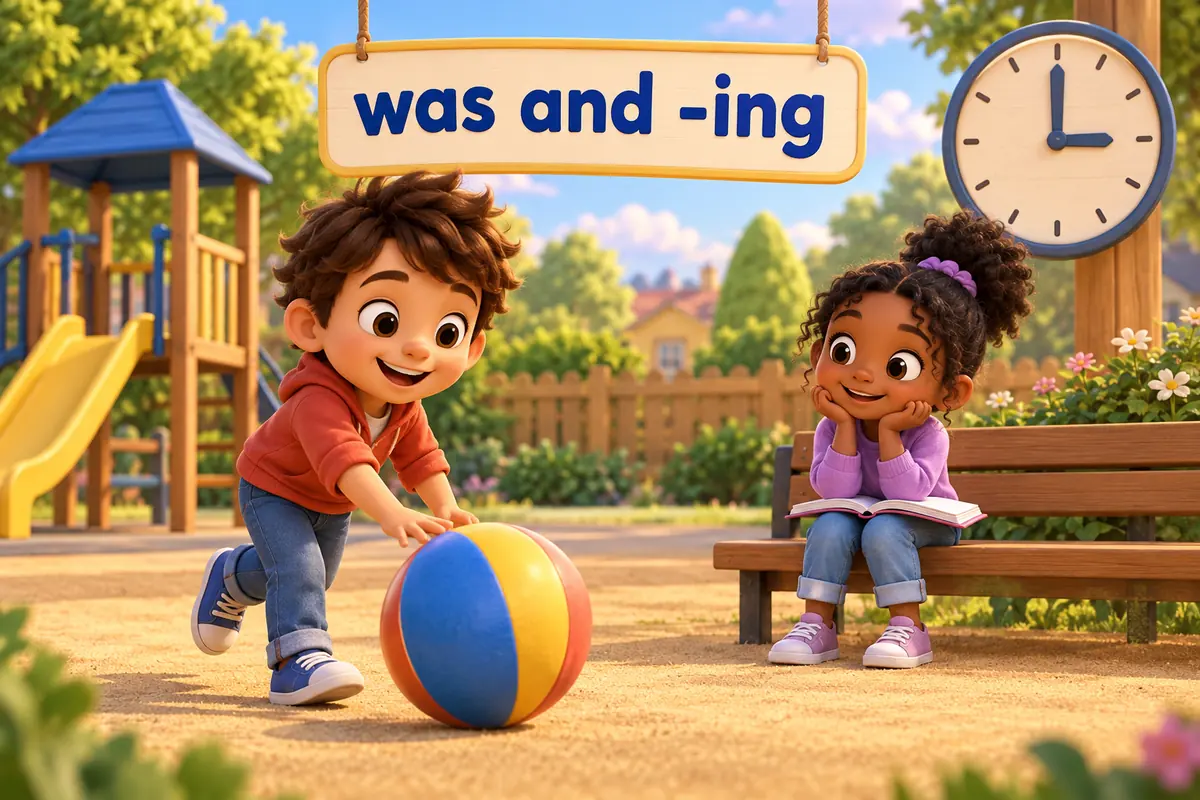
The two tenses often share a sentence, and the choice depends on whether an action is finished or was still running at the moment described.
| Feature | Past simple | Past continuous |
|---|---|---|
| Focus | action completed | action in progress |
| Shape | the past form of the verb | was/were + -ing |
| Time taken | a finished point | a moment unfolding |
| Typical frame | yesterday, in 1999, last week | while, at eight, as |
| In an interrupted sentence | the shorter interruption | the longer action |
| Example | I read the letter at eight. | I was reading at eight. |
Choose the past simple for a finished event and the past continuous for an action that was still going; when both appear, the interruption usually takes the past simple. A sentence such as I was cooking when the phone rang shows the two tenses working together, with the background in the continuous and the event that broke it in the simple.
Word forms and grammar of the past simple tense
| Form | Rule | Example |
|---|---|---|
| Regular verb | add -ed | walk becomes walked |
| Verb ending in e | add -d | like becomes liked |
| Consonant + y | change y to -ied | carry becomes carried |
| Short stressed vowel | double the final consonant | plan becomes planned |
| Irregular verb | its own past form | go becomes went |
| Negative | did not + base | did not go |
| Question | did + subject + base | did you go |
| Emphatic | did + base in a positive claim | I did call you |
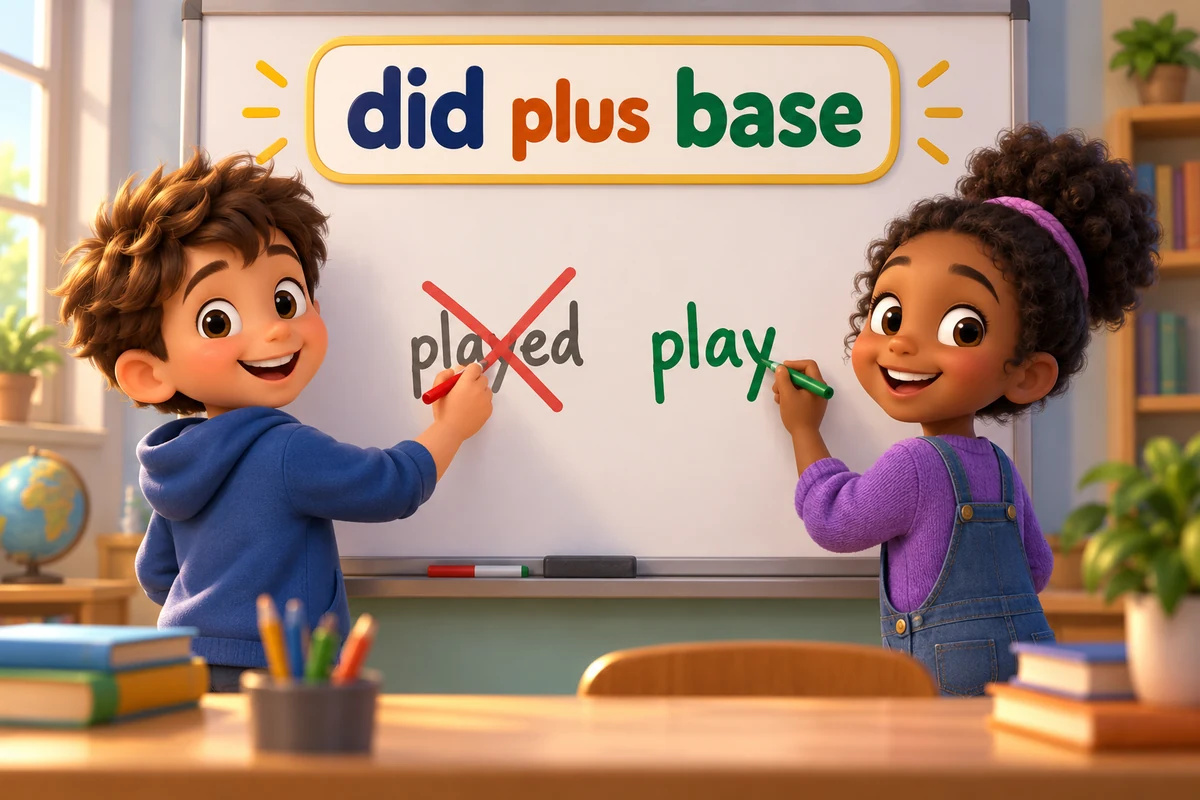
The base form appears twice in the same pattern for a reason: did already marks the past, so the main verb cannot mark it again. Apart from that one rule, the tense is the same after every subject, so I, you, she, and they all take an identical past form.
Common mistakes with the past simple tense
Mistake 1: a double past in the negative. Incorrect: I did not went. Correct: I did not go. Rule: after did, the main verb stays in its base form.
Mistake 2: a double past in a question. Incorrect: Did you saw him? Correct: Did you see him? Rule: the question word did carries the past on its own.
Mistake 3: over-regularising an irregular verb. Incorrect: She goed home. Correct: She went home. Rule: irregular verbs keep their own past form.
Mistake 4: the present perfect with a definite past time. Incorrect: I have seen him yesterday. Correct: I saw him yesterday. Rule: a named past time takes the past simple.
Mistake 5: the continuous for a finished action. Incorrect: I was reading the whole book last summer. Correct: I read the whole book last summer. Rule: a completed action takes the past simple.
Practice using the past simple tense
- Fill in the blank: Last night we ___ (watch) a film.
- Choose the better tense: She (read / was reading) the letter yesterday.
- Correct the error: They didn’t finished their homework.
- Build a sentence: use three past simple verbs to report a morning routine.
- Spot the register: which line suits a news report, (a) The council approved the plan, or (b) The council was approving the plan?
- Fill in the blank: ___ you see the teacher after class?
Answers
- watched, because last night names a finished past time.
- read, because yesterday fixes a finished action.
- They didn’t finish their homework; did not is followed by the base form.
- I woke at six, ate breakfast, and walked to school.
- (a), because a news report states completed events.
- Did, because a past simple question opens with did plus the base form.
The bottom line
Past simple tense structure and examples are built on one finished action at a known past time, formed with -ed for regular verbs and a separate form for irregular ones. Negatives and questions pass the past to did, leaving the main verb plain. Keep the past continuous for actions still running, and reserve the present perfect for a past that reaches into the present.
Frequently asked questions about the past simple tense
When do you use the past simple instead of the present perfect?
Use the past simple when the time is finished and named, as in I saw him yesterday, and the present perfect when the time is open or unstated, as in I have seen him. Naming a finished time such as yesterday forces the past simple.
How do you make a past simple question?
Start with did, then the subject, then the base form of the main verb, as in did she call. The past lives in did, so the main verb never takes -ed, which is why did she called is wrong. Add a question word in front for a wh-question.
Which time words pair with the past simple?
The commonest markers are yesterday, last week, last year, in 1999, two days ago, and then. Each names a finished period, so each excludes the present perfect. When no time is named, the speaker must decide whether the period is open or closed.
Do all past simple verbs end in -ed?
No. Regular verbs do, but irregular verbs take their own forms, such as went, saw, bought, and wrote. There is no shortcut beyond learning the common irregulars in sets of three: go, went, gone, and see, saw, seen. Saying the three forms together as a small chant fixes them faster than any written rule.