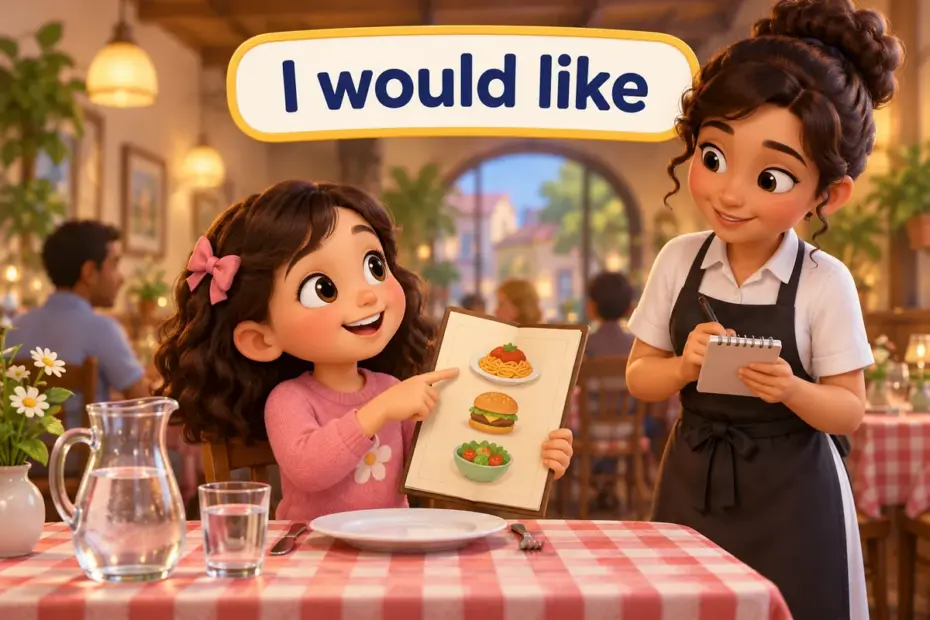
Phrases for ordering food carry a diner through a whole meal, from getting a table to asking for the bill. English usually softens the request with I would like, could I have, or can I get. In “I would like the soup, please,” the frame is polite and complete.
Phrases for ordering food at a glance
- The key frames are I would like, could I have, can I get, and I will have.
- A polite order names the dish and adds please, without the blunt word want.
- Questions about the menu use what do you recommend or is this dish spicy.
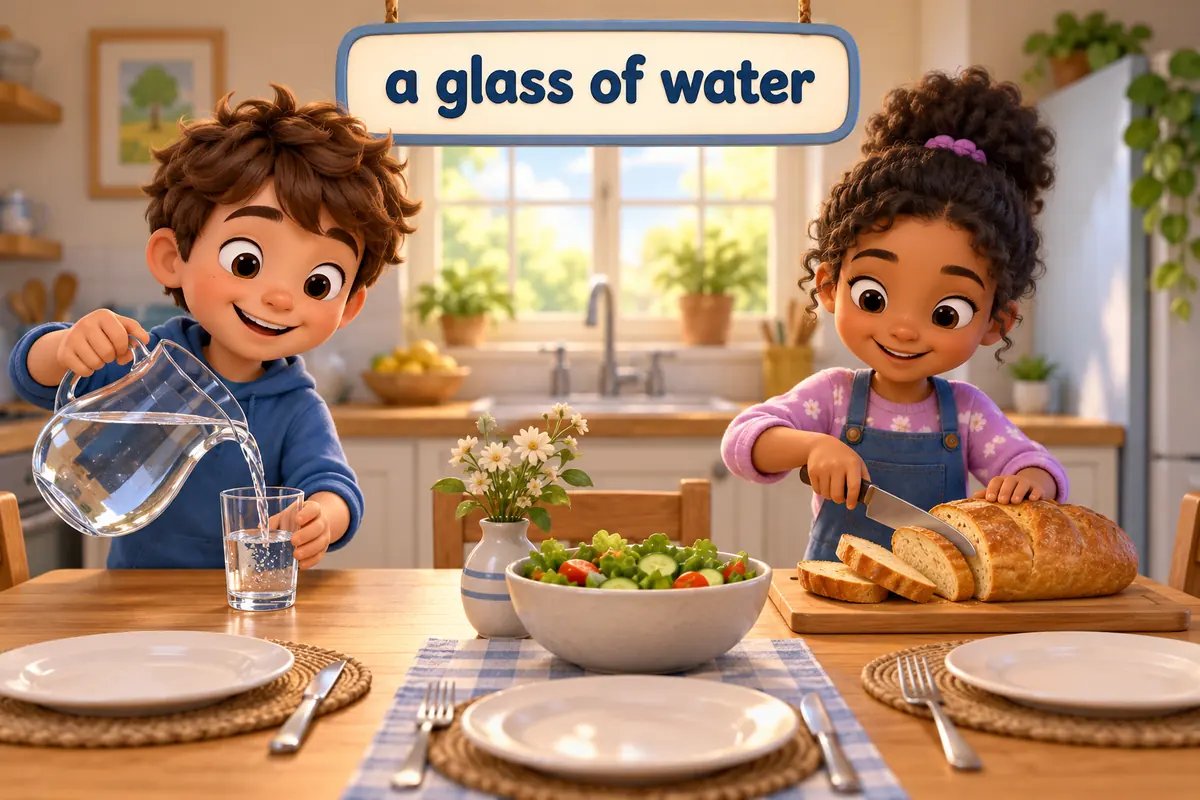
- Uncountable items take a measure word, as in a glass of water.
- The commonest error is ordering with want, which sounds demanding.
What are phrases for ordering food?
Phrases for ordering food are the fixed requests a customer uses at each stage of a meal. They range from a simple I will have, through questions about the menu, to the final request for the bill, and each stage has its own customary wording.
| Stage | Useful phrase | Example |
|---|---|---|
| Getting a table | a table for two, please | A table for two, please. |
| Ordering a dish | I would like, or I will have | I will have the pasta. |
| Asking about a dish | what do you recommend | What do you recommend today? |
| Special requests | could I have it without | Could I have it without cheese? |
| Paying | could we have the bill | Could we have the bill, please? |
An honest limit matters here: the polite frames are standard rather than required, since a busy cafe accepts a plain I will have the soup without hurt feelings. The softer wording matters most in a formal restaurant or with a server the diner has not met before.
Describing a dish clearly helps, and the list of adjectives for food supplies words such as spicy, fresh, and mild.
How do you make a polite order?
Most polite orders use one frame, name a dish, and finish with please, which turns a bare demand into a courteous request.
| Pattern | Example | What it signals |
|---|---|---|
| I would like + noun | I would like a coffee. | a standard polite order |
| Could I have + noun | Could I have the salad? | a gentle request |
| I will have + noun | I will have the soup. | a firm but neutral choice |
| Can I get + noun | Can I get a glass of water? | a casual, common request |
| Could I have + it + without + noun | Could I have it without onion? | a special request |
| Could we have + the bill | Could we have the bill, please? | a polite way to pay |
The frame also decides how a change is made mid-order, since it is easy to add to a polite request without starting the sentence again. Keeping the frame first and the dish name last lets a diner swap one choice for another at the final moment.
One order can be quick and simple, and the examples for fast food in a sentence show the shortest form of the request.
Phrases for ordering food across contexts
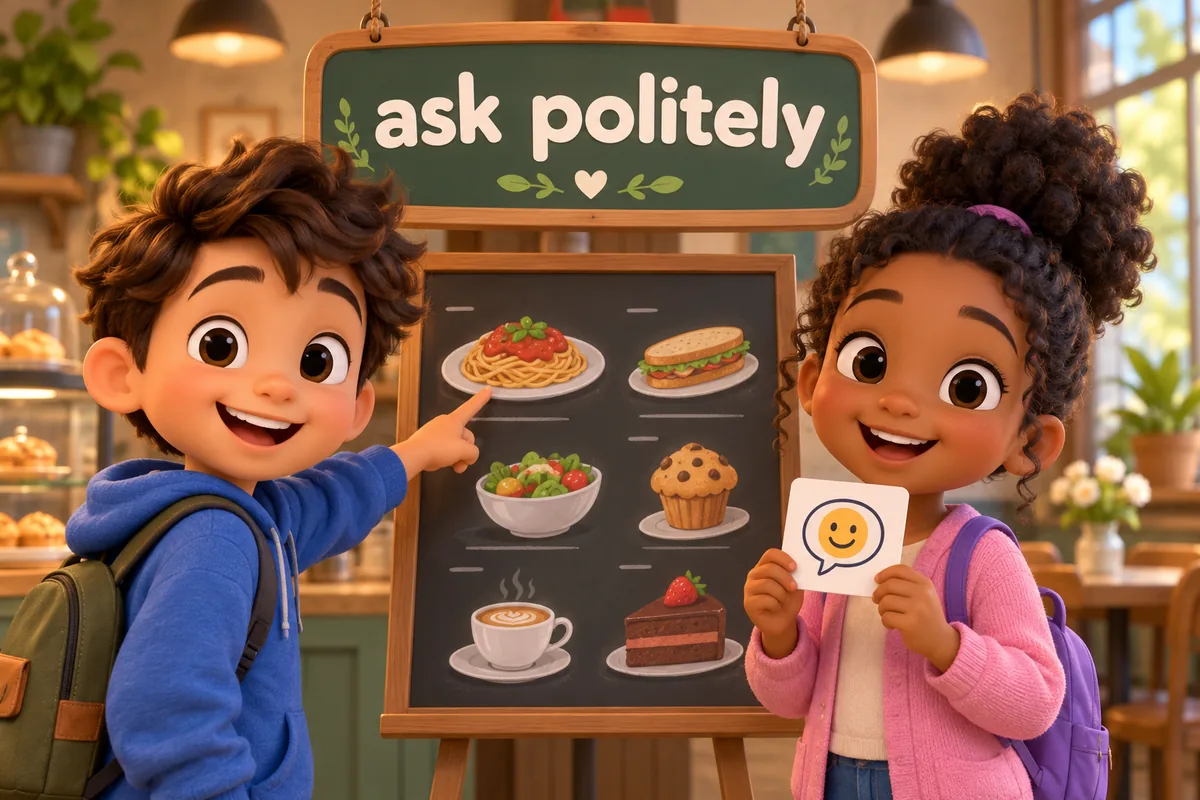
The wording shifts with the setting, from a quick counter order to a formal table with several courses. A diner who can move between the two registers handles almost any meal with ease, because the dish stays the same while only the frame changes.
| Context | Example sentence | Why this works |
|---|---|---|
| Cafe counter | Can I get a flat white, please? | a short, casual request |
| Formal restaurant | I would like the fish, please. | a polite, complete order |
| Family meal | Could we have one more plate? | a gentle request for a group |
| Food truck | I will have the large one. | a quick, definite choice |
| Coffee shop | Could I have it with oat milk? | a substitution request |
| Business lunch | What do you recommend for a light meal? | a polite question about the menu |
| Paying | Could we have the bill, please? | a standard closing request |
| Allergy concern | Does this dish contain nuts? | a clear safety question |
| Takeaway | Is that to take away? | a stock clarifying question |
| Dessert | What is on the dessert menu? | an open menu question |
| Drinks | Just water for me, please. | a brief, clear choice |
| Paying by card | Can I pay by card? | a simple yes or no check |
Some settings skip the table altogether, and the examples for convenience food in a sentence match that quicker register.
Shared platters need their own wording, and the examples for finger food in a sentence show how to order for a group.
Polite orders vs blunt orders
The same dish can be requested in a warm or a harsh tone, and the difference sits in one or two words.
| Feature | Polite order | Blunt order |
|---|---|---|
| Verb | would like, could have | want, give me |
| Tone | warm and courteous | demanding |
| Closing word | please | none |
| Length | a full frame | a bare demand |
| Typical setting | restaurants and strangers | close friends only |
| Example | I would like the soup, please. | Give me the soup. |
Choose the polite frame in any service setting, and save the blunt form for close friends, because the softer wording costs nothing and keeps the exchange pleasant. The same logic explains why a short please alone can rescue an otherwise bare request when a full frame feels too formal for the moment.
Word forms and grammar of ordering phrases
| Form | Structure | Example |
|---|---|---|
| Countable item | a or an plus noun | I would like an orange. |
| Uncountable item | a measure word plus of | a glass of water |
| Plural item | a number plus pair of | two pairs of chopsticks |
| Negative request | without plus noun | without sugar |
| Polite question | could or can plus I plus base verb | Could I have the menu? |
| Short reply | just plus noun, please | Just a tea, please. |
The measure word is the detail learners miss most: water, bread, and rice are uncountable, so they take a glass, a slice, or a bowl rather than the number directly. The same pattern covers drinks and soups, which is why a bowl of soup and a cup of tea sound right while a soup and a tea do not.
Common mistakes with ordering phrases
Mistake 1: ordering with want. Incorrect: I want a coffee. Correct: I would like a coffee. Rule: would like is the polite frame in a service setting.
Mistake 2: a bare demand with no please. Incorrect: Give me the bill. Correct: Could we have the bill, please? Rule: a request needs a soft frame and a closing please.
Mistake 3: counting an uncountable item. Incorrect: I will have a water and two breads. Correct: I will have some water and two slices of bread. Rule: uncountable nouns need a measure word.
Mistake 4: an incomplete would like structure. Incorrect: I would like eat. Correct: I would like to eat, or I would like some food. Rule: would like takes a noun or to plus a verb.
Mistake 5: a vague menu question. Incorrect: What do you have? Correct: Could you tell me what is on the specials board? Rule: a precise question gets a precise answer.
Practice using phrases for ordering food
- Fill in the blank: I ___ like the chicken salad, please.
- Choose the better phrase: (I want / Could I have) a glass of water?
- Correct the error: Give me two breads, please.
- Build a sentence: order a soup and ask for it without onion.
- Spot the register: which line suits a formal restaurant, (a) Give me the fish, or (b) I would like the fish, please?
- Fill in the blank: Could we have the ___, please?
Answers
- would, because I would like is the standard polite order.
- Could I have, because it is a gentle request rather than a demand.
- Could I have two slices of bread, please; uncountable items take a measure word.
- I would like the soup, and could I have it without onion?
- (b), because the polite frame suits a formal restaurant.
- bill, because could we have the bill is the standard way to pay.
The bottom line
Phrases for ordering food run from getting a table to paying the bill, and the frame I would like keeps almost every stage polite. Name the dish, add a measure word for anything uncountable, and finish with please. The blunt forms belong with close friends, while the soft ones carry a diner through any service setting.
Frequently asked questions about phrases for ordering food
Is it polite to say I want when ordering?
Want is not rude in every setting, but it sounds bare beside the standard would like. In a restaurant or cafe, I would like or could I have reads as more considerate and is what most native speakers use. Keep want for family and close friends.
How do I order an uncountable item like water or rice?
Use a measure word between the number and the noun, as in a glass of water, two bowls of rice, or a slice of bread. The noun itself stays singular because it is uncountable. Saying a water or two rices sounds wrong to most listeners.
What should I say if I have a food allergy?
Ask a direct safety question such as does this dish contain nuts, and add could you check with the kitchen for anything uncertain. Name the ingredient plainly rather than describing a preference, because an allergy needs a clear answer before the food is prepared.
How do I ask for the bill politely?
Use could we have the bill, please, or may we have the check if you are in North America. Adding the word please and the frame could we keeps it courteous. In a shared meal, could we split the bill asks for separate payments in one line.